03-09-2026
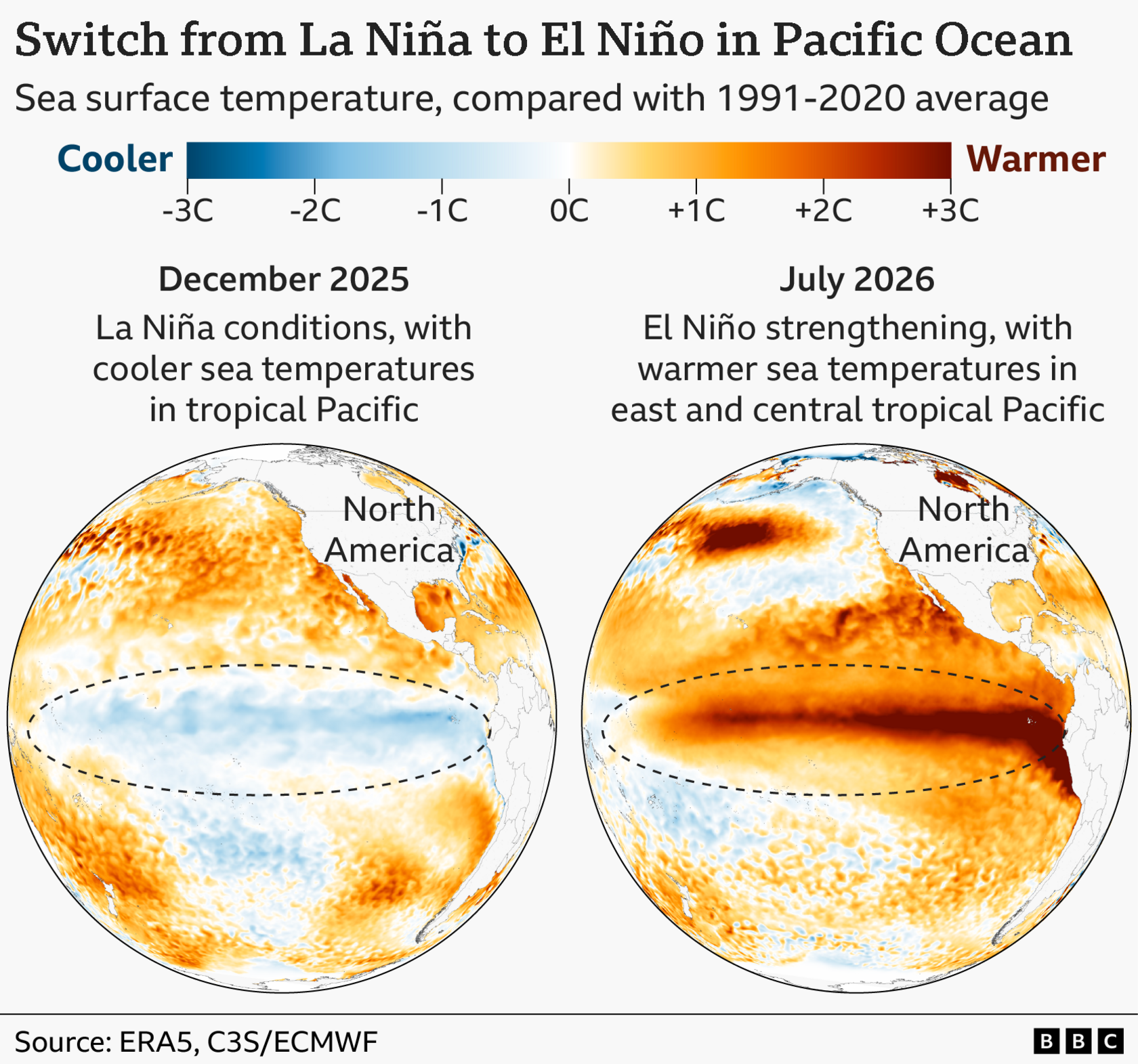
The World Meteorological Organization (WMO) has warned that the current El Niño event could become the strongest recorded since monitoring began about four decades ago. The naturally occurring climate phenomenon, which warms surface waters in the central and eastern equatorial Pacific Ocean, is expected to intensify to “very strong” levels in the coming months and is almost certain to continue through February. Its peak is forecast for the end of 2026, but its effects could continue into 2027.
WMO chief Celeste Saulo said the event could become “off the charts” if its current trajectory continues. The agency warned that stronger El Niño conditions will increase the likelihood of floods, droughts, extreme heat and disruptive rainfall patterns around the world. UN Secretary-General Antonio Guterres said the phenomenon was being “supersized” as the planet enters a “danger zone of extreme weather.”
El Niño is not caused by climate change, but scientists expect it to intensify the effects of a planet already warming because of fossil-fuel emissions. Ocean heat can remain in the atmosphere and contribute to higher global temperatures the following year. The powerful 2023–24 El Niño helped make 2024 the warmest year on record, and the WMO said another temperature record could be broken.
Authorities and climate-sensitive sectors, including agriculture, health, energy and water, have been urged to prepare immediately. El Niño commonly produces drought in parts of Australia, Indonesia and the Amazon, disrupts monsoon patterns in India, and alters rainfall across tropical regions. WMO forecasts for September to November indicate above-normal temperatures across almost all land areas. Sea-surface temperature anomalies have already risen from 1.5 degrees Celsius above average to weekly values of 2.2–2.6 degrees, while some subsurface Pacific waters were more than 8 degrees above average.
Entities: El Niño, World Meteorological Organization (WMO), Celeste Saulo, Antonio Guterres, United Nations • Tone: urgent • Sentiment: negative • Intent: warn
03-09-2026
The World Meteorological Organization (WMO) warns that the current El Niño event could intensify to an exceptional, potentially record-setting level in the coming months and persist through February 2027. The agency estimates there is a nearly 100 percent probability that the phenomenon will continue through February, its highest level of certainty in an El Niño/La Niña update.
El Niño is a naturally occurring climate pattern caused by unusually warm surface waters in the central and eastern equatorial Pacific Ocean. It alters global wind, pressure and rainfall patterns, increasing the risks of drought, flooding and extreme heat in distant regions. WMO Secretary-General Celeste Saulo said that, if current trends continue, the event could be stronger than any recorded since monitoring began four decades ago, describing it as “off the charts.”
The phenomenon is expected to peak near the end of 2026, while its climatic effects may continue into 2027 because ocean heat is released gradually into the atmosphere. The strong 2023–24 El Niño helped make 2024 the warmest year on record, and Saulo warned that this record could be broken again.
The WMO says El Niño is not caused by human-driven climate change, but it is likely to intensify the effects of a planet already warming because of fossil-fuel use. Forecasts for September through November indicate above-normal temperatures across almost all land areas and major shifts in rainfall. Regions such as the Amazon, Indonesia and Australia could experience drought, while India may face disrupted monsoons.
Ocean measurements show continued strengthening: temperatures in the central-eastern equatorial Pacific were up to 2.6°C above average in mid-August, while some subsurface waters were more than 8°C above normal. UN officials urged governments and climate-sensitive sectors, including agriculture, health, energy and water, to prepare immediately for worsening impacts.
Entities: El Niño, World Meteorological Organization (WMO), Celeste Saulo, Antonio Guterres, Wilfran Moufouma-Okia • Tone: urgent • Sentiment: negative • Intent: warn
03-09-2026
The world has entered what UN Secretary-General António Guterres calls a “danger zone of extreme weather” as a potentially unprecedented El Niño develops in the Pacific Ocean. The World Meteorological Organization says the event could last until at least February 2027 and may become the strongest since records began in 1950. Sea-surface temperatures in the central and eastern tropical Pacific are already more than 2°C above average, with some forecasts suggesting they could approach 4°C above average. Subsurface temperatures are more than 8°C above normal in places.
El Niño shifts global weather patterns, bringing drought and wildfire risks to parts of Southeast Asia, Central America and northern South America, while increasing rainfall, flooding and landslides in eastern Africa, southern Brazil, the southern United States, Peru and Ecuador. Lower rainfall is also expected to disrupt trade through the Panama Canal, while Indonesia is battling wildfires across more than 107,000 hectares and using cloud-seeding aircraft to encourage rainfall.
The event is also linked to stronger typhoons in East Asia. China expects seven typhoons to make landfall this year, following several deadly storms and a mass evacuation caused by Typhoon Dolphin. Australia is concerned about marine heatwaves, coral bleaching and ecological damage, although the Great Barrier Reef may avoid the worst conditions. Southern Australia and Tasmania remain at high risk of algal blooms, fish deaths and other marine impacts.
Governments and aid organizations are expanding early-warning systems, pre-emptive medical support, financial assistance for affected industries and monitoring programs. The US has deployed the USNS Comfort to Peru, while Practical Action is helping communities access river, flood and weather information. However, the strength of the event, combined with human-caused climate change and underlying vulnerabilities such as exposed housing and fragile infrastructure, has raised fears of severe effects on vulnerable communities worldwide.
Entities: El Niño, World Meteorological Organization (WMO), António Guterres, Celeste Saulo, Pacific Ocean • Tone: urgent • Sentiment: negative • Intent: warn
03-09-2026
The United Nations warns that the current El Niño event is likely to intensify significantly and become “very strong” by the end of 2026, producing severe weather impacts around the world. The World Meteorological Organization (WMO) says the event is expected to continue through early 2027, with nearly 100% certainty—an unusually high level of confidence for an El Niño forecast.
El Niño is part of the El Niño-Southern Oscillation climate pattern, which is driven by ocean and atmospheric conditions in the tropical Pacific but affects weather globally. It is associated with unusually warm Pacific Ocean temperatures and can bring extreme heat, drought and flooding to distant regions. The WMO expects above-normal temperatures across nearly the entire planet, while rainfall patterns will vary by location: some areas may face excessive rain and flooding, while others experience worsening drought.
The potential effects are especially concerning because global oceans were already unusually warm before the El Niño developed. Tropical Pacific temperatures rose from approximately 1.5 to 2.6 degrees Celsius above average during the summer, meaning the event is unfolding from an exceptionally hot baseline. U.N. officials say this could amplify the disruption and devastation caused by related extreme weather.
To help communities prepare, the World Health Organization has begun working with national weather agencies to improve forecasts and early-warning systems. The effort is intended to reduce risks as heat, drought, floods and other weather threats intensify in the coming months.
Entities: El Niño, El Niño-Southern Oscillation (ENSO), United Nations, World Meteorological Organization (WMO), World Health Organization (WHO) • Tone: urgent • Sentiment: negative • Intent: warn
03-09-2026
The United Nations is warning that an intensifying El Niño climate pattern could cause widespread disruption to communities, economies and global commodity markets through February 2027. UN officials describe the event as unusually powerful, with tropical eastern Pacific sea-surface temperatures more than 2 degrees Celsius above normal in July and early August, while subsurface temperatures were more than 8 degrees above average.
The World Meteorological Organization expects heightened risks of floods, droughts and extreme heat. Asia-Pacific and Latin American countries are expected to experience the most immediate effects. Guatemala, Honduras and El Salvador are already facing erratic weather, drought and severe crop losses, while Indonesia is dealing with destructive wildfires. El Salvador has declared a state of emergency over drought conditions linked to El Niño.
The climate pattern is also threatening food supplies and commodity prices worldwide. A weaker monsoon in India could reduce production of rice, sugar, cotton and soybeans. In Peru, officials say anchovy fishing has suffered a devastating decline; anchovies are widely used in livestock feed. Markets for corn, cocoa and coffee could also be affected, creating consequences well beyond the regions experiencing the weather directly.
Energy systems and extractive industries face risks as well. Extreme and unpredictable weather could disrupt hydropower, wind and solar generation, energy demand, oil and gas production and refining, and mining operations. UN Secretary-General António Guterres said the world is entering a danger zone of extreme weather and must act quickly to protect people and pursue climate action. El Niño is a naturally occurring pattern that alternates with La Niña every two to seven years, but the current event’s scale and intensity have prompted heightened concern.
Entities: El Niño, United Nations, World Meteorological Organization (WMO), António Guterres, Celeste Saulo • Tone: urgent • Sentiment: negative • Intent: warn
03-09-2026
The World Meteorological Organization (WMO) says the current El Niño weather phenomenon is expected to intensify into a “very strong” event and persist until at least February 2027. The agency warns that the event could become stronger than any El Niño recorded since systematic monitoring began four decades ago, potentially exceeding the limits of existing classification charts.
El Niño is a naturally recurring climate pattern that develops when surface waters in the central and eastern equatorial Pacific Ocean become unusually warm. It occurs every two to seven years and is not directly caused by climate change, although scientists say global heating can amplify its effects. The phenomenon disrupts winds, pressure systems and rainfall patterns worldwide. Australia, Indonesia and parts of the Amazon often experience drought, while East Africa and the southern United States can face unusually heavy rainfall.
WMO Secretary-General Celeste Saulo said there is an exceptionally high likelihood—nearly 100%—that El Niño will continue through February 2027. Tropical Pacific sea-surface temperatures are already well above average, while subsurface temperatures in some areas were more than 8 degrees Celsius above normal in July and early August. Although the event is expected to peak toward the end of the year, its effects could continue into 2027. The WMO also noted that global temperatures are often especially high after an El Niño; the 2023–2024 event contributed to 2024 becoming the warmest year on record, and another record may soon be broken.
UN Secretary-General António Guterres described the phenomenon as being “supersized” and said the planet was entering “uncharted waters.” Saulo warned that intensifying drought, flooding and extreme heat could multiply and cascade, damaging communities, economies and global supply chains. She urged governments to prepare climate-sensitive sectors, emphasizing that there is no time to lose.
Entities: El Niño, World Meteorological Organization (WMO), United Nations, António Guterres, Celeste Saulo • Tone: urgent • Sentiment: negative • Intent: warn
03-09-2026
The World Meteorological Organization (WMO), the United Nations’ climate agency, has warned that an El Niño event developing in the coming months could become the strongest seen since records began roughly four decades ago. The organization said the naturally occurring climate phenomenon is expected to intensify to “very strong” levels and is almost certain to continue through February.
The warning indicates that the current El Niño could be unusually powerful compared with previous events, although the report does not provide specific regional forecasts or detail its likely effects on temperatures, rainfall, drought, storms, or other weather patterns. El Niño is a recurring natural climate phenomenon that can influence weather conditions across large parts of the world.
The WMO’s warning was accompanied by an alarmed assessment from the United Nations chief, who said the world is entering the “danger zone of extreme weather.” This links the expected El Niño development to broader concerns about increasingly severe or disruptive weather conditions, although the article does not state that El Niño alone is responsible for those trends.
The report was published by France 24 on September 3, 2026, and is presented as a video report by journalist Carys Garland. The article’s central message is that the anticipated strength and persistence of El Niño represent a significant global climate and weather concern. It focuses on the WMO’s forecast and the UN’s warning rather than describing specific impacts already occurring or outlining government responses.
Entities: El Niño, World Meteorological Organization (WMO), United Nations, Carys Garland, France 24 • Tone: urgent • Sentiment: negative • Intent: warn
03-09-2026
The article reports a warning from the United Nations that an unusually powerful, or “supersized,” El Niño is very likely to continue into 2027. The World Meteorological Organization (WMO) says the climate pattern is being driven by exceptionally warm ocean conditions across the tropical Pacific. Based on its latest forecasts, the organization expects El Niño to strengthen over the coming months and reach its peak toward the end of the year.
The warning places the developing event in a broader global context. The United Nations says the world has entered “a danger zone of extreme weather,” signaling concern that the continued presence and projected intensity of El Niño could contribute to hazardous weather conditions. The article does not provide specific regional forecasts or describe particular disasters, but it emphasizes the potential significance of the event because of its expected strength and duration.
El Niño is a recurring climate pattern associated with changes in ocean temperatures and atmospheric circulation. Although the excerpt does not detail its effects, the U.N. warning indicates that governments and communities may need to prepare for an extended period of disruptive or extreme weather. The forecast is notable both because the event is expected to intensify before peaking later in the year and because its influence may persist well beyond that peak, potentially being felt into 2027.
The article’s focus is therefore on the WMO’s latest assessment and its warning that the combination of unusually warm tropical Pacific waters, a strengthening El Niño, and an already extreme-weather-prone global environment represents a serious concern.
Entities: El Niño, United Nations, World Meteorological Organization (WMO), tropical Pacific, extreme weather • Tone: urgent • Sentiment: negative • Intent: warn
03-09-2026
The France 24 Business segment, issued on 3 September 2026, focuses on the anticipated economic consequences of a particularly severe El Niño weather phenomenon. Its headline describes the event as capable of delivering a “massive blow” to the global economy, while the programme summary says the United Nations has characterized it as a “supersized” phenomenon. The available material does not provide the full report, scientific projections, regional forecasts, or an estimate of the expected financial damage, so the precise scale and timing of the impact cannot be determined from the supplied text alone.
The segment also examines how drought associated with severe weather is affecting UK cider producers. This suggests that the programme connects the wider climate event to specific pressures on agricultural production, although it does not identify the producers involved, quantify losses, or explain how shortages may affect prices and supply.
A separate business story in the same programme concerns Nvidia’s reported purchase of Hugging Face for $12.9 billion. The teaser offers no information about the terms of the transaction, the strategic rationale, or its implications for the artificial-intelligence industry. The item is presented by France 24 journalists Camille Knight and Daniel Quinlan and has a listed duration of eight minutes. Because the supplied page extract contains a programme description rather than a full transcript or conventional written article, the summary is limited to the topics explicitly identified: the economic risks of El Niño, drought-related effects on UK cider production, and Nvidia’s acquisition of Hugging Face.
Entities: El Niño, United Nations (UN), Global economy, Severe weather, Drought • Tone: urgent • Sentiment: negative • Intent: inform