03-09-2026
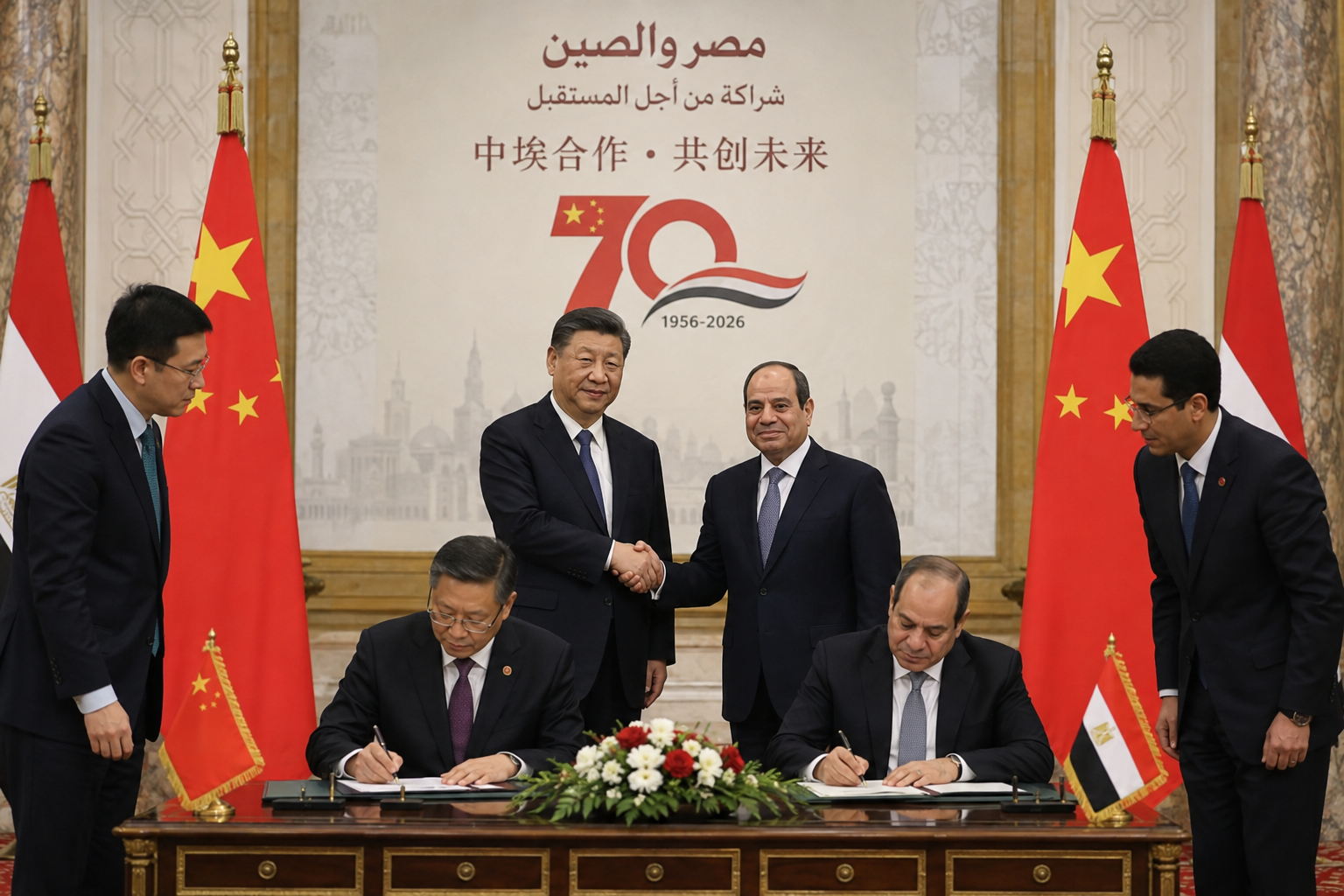
Egyptian officials have described Chinese President Xi Jinping’s two-day state visit to Cairo as a significant opportunity to strengthen relations between China and Egypt and to promote greater international stability. The visit coincided with the 70th anniversary of diplomatic relations between the two countries, which share longstanding cultural and civilizational links. Xi and Egyptian President Abdel Fattah El-Sisi also attended the signing of several cooperation agreements.
Egyptian former Foreign Ministry assistant Mohamed Hegazy portrayed the relationship as grounded in dialogue between two civilizations and in principles such as coexistence, non-interference, respect for international law, and support for the international order. He also argued that China is increasingly contributing ideas and initiatives aimed at bringing countries together during a period marked by war, conflict, and global disorder.
Beyond the bilateral relationship, analysts interpreted Xi’s visit as part of a broader Chinese effort to present Beijing as a stabilizing force in the Middle East and the wider international system. This positioning contrasts with the role of the United States, traditionally one of Egypt’s most important regional partners. The article suggests that Washington risks losing influence as China expands its soft power and deepens economic and diplomatic ties across the region.
Economic relations underscore China’s growing importance to Egypt. Annual trade between Egypt and China is estimated at approximately $20 billion, compared with $15.7 billion in trade between Egypt and the United States in 2025. The visit therefore represented both a commemoration of bilateral ties and an opportunity for China to strengthen its strategic, political, and economic influence in a key regional country.
Entities: Xi Jinping, Abdel Fattah El-Sisi, Mohamed Hegazy, Egypt, Cairo • Tone: analytical • Sentiment: positive • Intent: analyze
03-09-2026
Chinese President Xi Jinping visited Egypt and toured the Grand Egyptian Museum with Egyptian President Abdel Fattah al-Sisi as Beijing and Cairo moved to deepen their strategic relationship. Xi’s visit, his first to Egypt in ten years, began with an official welcome at Cairo’s Ittihadiya presidential palace, including a 21-gun salute, followed by talks between the two leaders.
The meeting took place amid China’s efforts to expand its influence in the Middle East and heightened regional concerns linked to the ongoing U.S.-Iran war, security risks, and the safety of international shipping routes. Xi called on Middle Eastern countries to manage their own affairs and oppose outside intervention. He said China supported regional dialogue focused on peace and security and was prepared to cooperate with regional governments to safeguard shipping lanes.
China’s position reflects both diplomatic and economic interests. It is a major purchaser of Iranian oil and has resisted attempts to economically isolate Tehran, while also seeking to protect its commercial activity throughout the region. These issues formed part of the broader strategic context of Xi’s discussions with Sisi.
Economic cooperation was another central focus. Egypt’s presidency announced that the two countries had signed an agreement to begin the third phase of an Egyptian-Chinese industrial zone. The zone currently contains approximately 200 companies and has attracted an estimated $4 billion in investment, underscoring the scale of bilateral economic ties.
Following the talks, Xi and Sisi, accompanied by their wives, visited the Grand Egyptian Museum in Giza. The museum is one of Egypt’s most significant cultural and tourism developments. Xi’s visit demonstrated that the expanding Beijing-Cairo partnership combines investment and trade with increasing coordination on regional diplomacy, security, and infrastructure.
Entities: Xi Jinping, Abdel Fattah al-Sisi, China, Egypt, Grand Egyptian Museum • Tone: analytical • Sentiment: neutral • Intent: inform
03-09-2026
Chinese President Xi Jinping visited Egypt for the first time in a decade, making it his only stop in the Middle East. The visit came as the region remains deeply affected by the six-month U.S.-Israeli war with Iran and as traditional American partners explore broader security relationships. Egyptian President Abdel Fattah el-Sisi and First Lady Entissar el-Sisi welcomed Xi and his wife with a formal ceremony in Cairo, underscoring the importance both governments attach to the relationship.
The article explains that China views Egypt as a gateway to Africa, a site for local manufacturing and an important partner because of the Suez Canal. Bilateral cooperation has expanded beyond trade and infrastructure into artificial intelligence, technology sharing and defense. Chinese J-16 fighter jets recently conducted exercises with Egypt’s French-made Rafale aircraft, signaling increased military cooperation.
Egypt continues to receive more than $1 billion annually in U.S. military assistance, but it is diversifying its security partnerships. Bilal Saab, a former Pentagon adviser, describes this as a “portfolio approach” in which countries seek multiple layers of deterrence rather than relying exclusively on Washington. He emphasizes that regional states are attempting to complement, rather than replace, the U.S. security umbrella, even as they view the United States as increasingly unpredictable.
Egypt faces security challenges along its borders with Israel, Gaza, Sudan and Libya. Its most pressing strategic concern may be Ethiopia’s construction of dams on the Nile, which Cairo says threatens its vital water supply. In a joint statement after the meeting, China supported Egypt’s Nile water rights and its stated right to protect water and food security. Egypt, in turn, reaffirmed Beijing’s position that Taiwan is an inalienable part of Chinese territory. The visit thus combined economic, military and diplomatic interests while highlighting China’s growing influence in Egypt and the broader Middle East.
Entities: Xi Jinping, Egypt, Abdel Fattah el-Sisi, China, United States • Tone: analytical • Sentiment: neutral • Intent: inform
03-09-2026
Chinese President Xi Jinping’s visit to Egypt is presented as more than a routine effort to deepen bilateral economic and diplomatic relations. The Associated Press argues that the trip reflects China’s broader ambition to expand its influence across the Middle East, particularly as U.S. influence has been weakened by its military involvement in a six-month war with Iran. Xi is seeking to portray China as a stabilizing power and to contrast Beijing’s approach with what Chinese officials describe as U.S. unilateralism and bullying.
Egypt is an important partner for both countries. Cairo has strengthened ties with Beijing to diversify its strategic relationships, joining the BRICS group in 2023 and signing agreements related to China’s Belt and Road Initiative in 2024. China has invested more than $10 billion in Egypt, including a business hub near Cairo and an electric rail line in the Nile Delta. Bilateral trade is estimated at $20 billion annually, exceeding U.S.-Egypt trade in 2025.
The article places the visit within China’s wider diplomatic strategy. Beijing brokered the 2023 restoration of diplomatic relations between Iran and Saudi Arabia, advocates a two-state solution to the Israeli-Palestinian conflict, and has cultivated ties with the Palestinian Authority. However, relations between Tehran and Riyadh have since deteriorated amid the Iran war.
Egypt’s control of the Suez Canal also gives it heightened strategic importance because disruptions in the Strait of Hormuz have made the canal a vital alternative route for energy shipments. China and Egypt have additionally expanded military cooperation, including their first joint combat exercise involving Chinese J-16 and Egyptian Rafale fighter jets. Xi’s visit follows a Shanghai Cooperation Organization meeting and coincides with U.S. efforts to economically isolate Iran, a country whose oil China continues to purchase in large quantities.
Entities: Xi Jinping, Abdel Fattah el-Sissi, China, Egypt, United States • Tone: analytical • Sentiment: neutral • Intent: analyze