02-09-2026
The article argues that the US-led international order is weakening, largely because the rules-based system has been applied inconsistently and major institutions such as the United Nations have failed to respond effectively to recent conflicts. It cites Israel’s destruction of Gaza, criticism from Jordan’s King Abdullah, the alleged abduction of Venezuela’s Nicolas Maduro by the Trump administration, and a record number of state-based conflicts as evidence of the system’s decline.
Against this backdrop, the author examines whether the Shanghai Co-operation Organisation (SCO) and Brics could help shape a new global order. The SCO, which includes China, Russia, India, Pakistan, four Central Asian states, Belarus and Iran, represents approximately 42 per cent of the world’s population. It has expanded beyond its original focus on terrorism, separatism and extremism and is increasingly presented as a major demographic, economic and geopolitical platform.
Brics has also grown beyond its original members—Brazil, Russia, India, China and South Africa—to include the UAE, Saudi Arabia, Egypt, Iran, Indonesia and Ethiopia. The enlarged group claims nearly half of the world’s population and about 40 per cent of global GDP at purchasing power parity. The article highlights practical initiatives, including the Brics New Development Bank, which has approved almost $43 billion for more than 120 infrastructure projects.
However, the author notes that both organisations face scepticism. Critics question whether the SCO produces meaningful cooperation, while Donald Trump has accused Brics of seeking to replace the US dollar. The groups say they are pursuing reduced dependence on the dollar rather than its total displacement. Their consensus-based decision-making may also limit their speed and effectiveness. Overall, the article presents Brics and the SCO as important, but still imperfect and developing, alternatives to the fading old order.
Entities: Shanghai Co-operation Organisation (SCO), Brics, United States-led rules-based international order, Donald Trump, Joe Biden • Tone: analytical • Sentiment: negative • Intent: analyze
02-09-2026
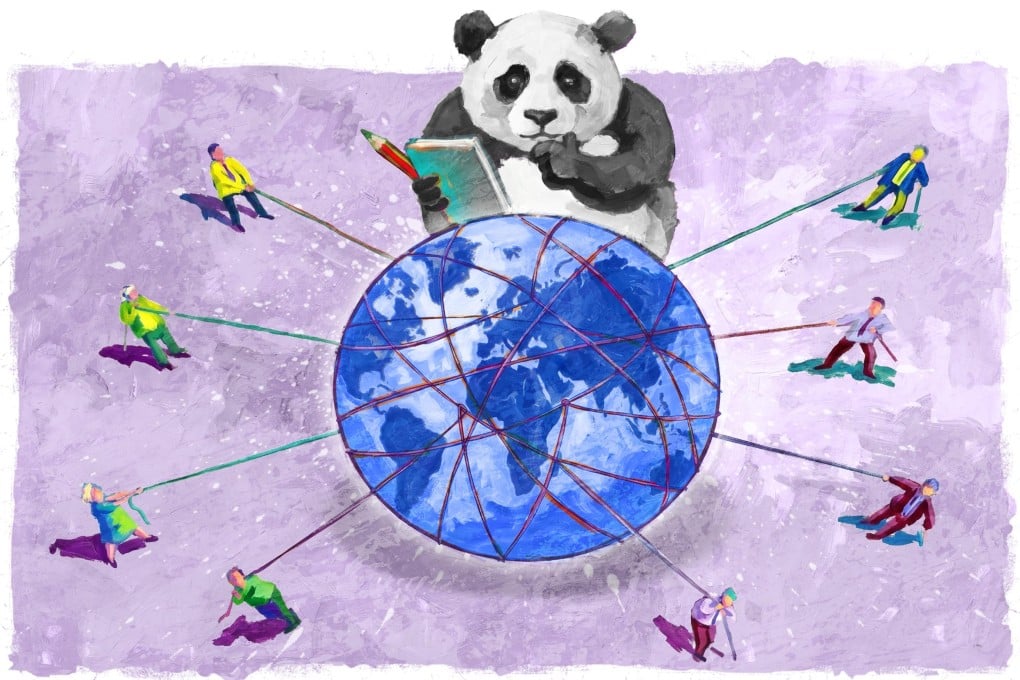
Tony Zhao argues that China’s vision of an “equal and orderly multipolar world” must move beyond principles and demonstrate how a multipolar system can function peacefully. China has spent years presenting its preferred principles for global governance and, in June, consolidated many of them in a white paper outlining how the Global Governance Initiative could translate those principles into practice. The initiative is paired with a second ambition: creating a universally beneficial and inclusive form of economic globalisation.
The article places China’s proposals in the context of the upcoming 81st United Nations General Assembly in New York, whose theme is “Restoring Trust, Managing Transformation.” Zhao contends that the central challenge in China’s formulation is not multipolarity itself, which is becoming increasingly plausible, but the idea that such a system can remain “orderly.” Middle powers are increasingly avoiding firm alignment with any single major power and instead balancing among several centres of influence. While this diffusion of power gives states greater room to negotiate, it does not automatically produce stability or cooperation.
Zhao contrasts this emerging environment with the post-Cold War expectation that economic integration would gradually reduce political differences. That belief, associated most famously with Francis Fukuyama, assumed history was moving toward a common political destination. The author suggests that this confidence has now weakened. The defining issue for the developing international system is therefore not political convergence, but the need for sustained coexistence among different powers and models.
The article’s broader implication is that Beijing must provide concrete institutional mechanisms, beginning with institutional design, if it wants its vision of multipolarity to be viewed as credible and peaceful.
Entities: China, Tony Zhao, Beijing, London, Global Governance Initiative • Tone: analytical • Sentiment: neutral • Intent: analyze
02-09-2026
The article argues that the Shanghai Cooperation Organisation (SCO) is becoming more strategically significant, even though it is not a formal alliance comparable to NATO or an institution like the European Union. Founded 25 years ago to manage borders among China, Russia and four Central Asian states, the SCO now includes China, Russia, India, Iran, Pakistan, most Central Asian republics and Belarus, with Turkey and several Gulf states participating as partners. Its members represent more than 3.4 billion people and approximately one-quarter of global GDP.
The organization’s growing relevance is linked to heightened geopolitical instability, including the unresolved war in Ukraine, conflict involving Iran and the United States, and the vulnerability of energy markets around the Strait of Hormuz. Chinese President Xi Jinping wants the SCO to play a larger role in technology and security while promoting cooperation without formal alliances, confrontation or explicit targeting of third parties.
The author cautions against describing the SCO as an anti-American alliance. Its members have competing interests: India and China are strategic rivals, India and Pakistan remain tense, Central Asian states seek flexibility among several outside powers, and Turkey is both a NATO member and an advocate of a stronger Eurasian role. The SCO lacks NATO’s military command structure and the EU’s supranational institutions. Nevertheless, it provides governments that do not want their foreign policies defined in Washington with a forum to coordinate, negotiate and hedge. Its influence therefore comes less from military unity than from creating an alternative platform for cooperation and strategic autonomy.
Entities: Shanghai Cooperation Organisation (SCO), Adriel Kasonta, China, Russia, United States • Tone: analytical • Sentiment: neutral • Intent: analyze