02-09-2026
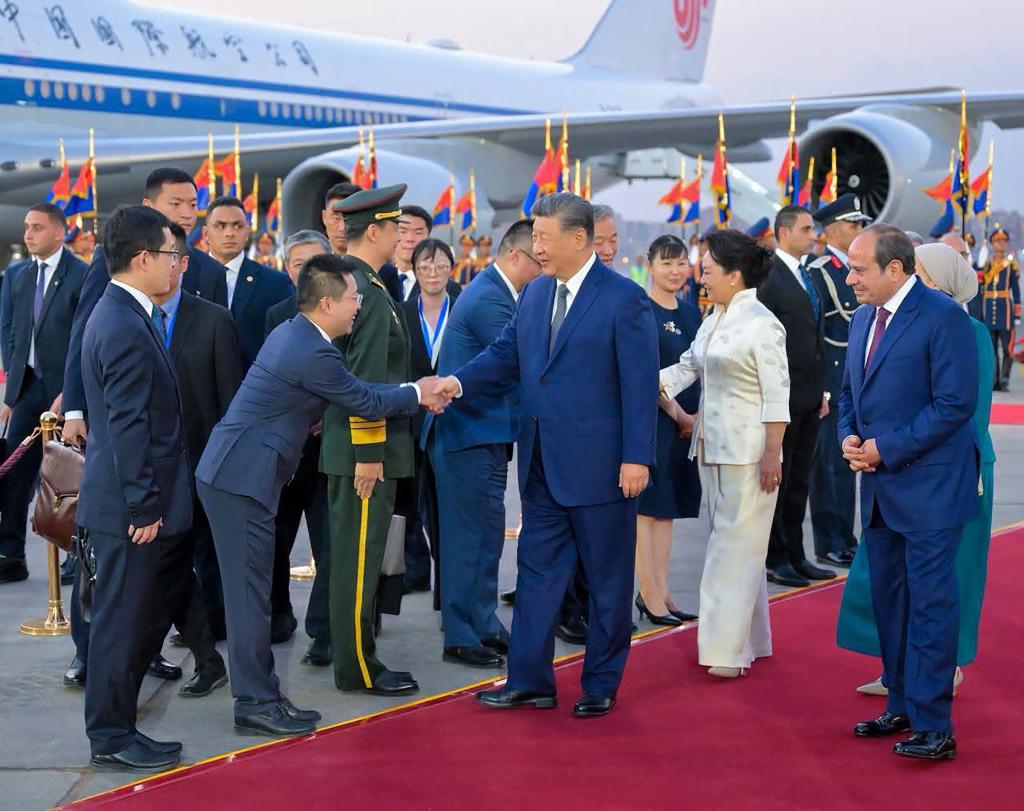
Chinese President Xi Jinping began a two-day state visit to Egypt, his first trip there in a decade, as both countries face potential US sanctions because of their financial and economic relationships with Iran. Xi and his wife were welcomed in Cairo by Egyptian President Abdel Fattah al-Sisi and Egypt’s first lady. The visit is taking place amid a broader Middle East crisis that followed US and Israeli strikes against Iran on February 28 and the resulting disruption to regional trade and security.
Washington has threatened to expand sanctions against Iran’s supporters and partners, potentially affecting Egyptian and Chinese banks. China, a major purchaser of Iranian oil, has sought to portray itself as a neutral actor and has repeatedly called for a lasting ceasefire. Egypt, which receives substantial US military aid, has also warned against further escalation after a drone strike hit one of its ports in July.
The two leaders are expected to discuss the Gaza war, Iran, and shipping security in the Red Sea and Strait of Hormuz. Analysts cited in the article say Beijing views Cairo as a strategic partner and power broker because of Egypt’s relationships with Washington, Israel, Palestinian groups, and other regional actors. Both countries support an independent Palestinian state under a two-state solution.
The visit also has a significant economic dimension. China and Egypt are marking 70 years of diplomatic relations, while China’s trade surplus with Egypt reached $12 billion during the first seven months of 2026. The countries are expected to sign agreements involving artificial intelligence, transport, energy, and investment in the Suez Canal Economic Zone. Egyptian officials and analysts hope the talks will attract Chinese investment into Egypt’s AI and electronics industries and deepen the broader China-Egypt strategic partnership.
Entities: Xi Jinping, Abdel Fattah al-Sisi, Egypt, China, United States • Tone: analytical • Sentiment: neutral • Intent: inform
02-09-2026
Treasury Secretary Scott Bessent said China was the only G20 member to dissent from a joint statement criticizing non-market economies for generating persistent trade imbalances through large volumes of inexpensive exports. The statement, issued after finance ministers and central bankers met in Asheville, North Carolina, said countries should eliminate non-market policies that worsen imbalances, particularly policies that suppress domestic consumption and encourage excessive reliance on exports. It also called on countries with persistent external surpluses to address those distortions.
Bessent identified China as the country with the world’s largest and “unsustainable” current-account surplus. He said the other 19 G20 members could take action in the coming days, weeks or months to address what he described as an unsustainable global economic equilibrium. The Treasury Department’s statement included a footnote documenting China’s objections. Beijing also opposed language concerning shipping disruptions in the Strait of Hormuz, which Iran has effectively blocked amid its war with the United States, as well as paragraphs supporting International Monetary Fund monitoring of global imbalances and identifying countries whose external debt is significantly owed to G20 members.
The disagreement comes as the Trump administration pressures Iran economically through secondary sanctions under “Operation Economic Outcast.” The policy has raised questions about whether Washington could target China, Iran’s largest trading partner and oil buyer. Bessent said the United States and China share important positions on Iran, including opposition to an Iranian nuclear weapon and support for free maritime trade in the Strait of Hormuz. He also noted that China obtains half of its energy from the Gulf and argued that Beijing should help find a solution. The dispute occurs ahead of long-term U.S.-China trade talks and Chinese President Xi Jinping’s planned visit to the United States in late September.
Entities: China, Scott Bessent, Group of 20 (G20), U.S. Treasury Department, Asheville, North Carolina • Tone: analytical • Sentiment: negative • Intent: inform
02-09-2026
G20 finance leaders concluded two days of meetings in Asheville, North Carolina, with broad support for a final statement despite disagreements over Russia’s participation and China’s objections to parts of the text. US Treasury Secretary Scott Bessent said the attendance of Russian Finance Minister Anton Siluanov had not disrupted discussions and argued that engagement remained important because Siluanov was not under sanctions. European officials, however, criticized Russia’s inclusion while Moscow continues its war in Ukraine. Siluanov was excluded from the G20’s traditional group photograph, and EU officials said they had received little warning that he would attend. EU economy chief Valdis Dombrovskis said it was inappropriate to normalize Russia’s presence while it is conducting an aggressive war and killing civilians. The dispute occurred as Germany accused Russia of an attempted hybrid attack involving a drone at a strategic airport. The statement also addressed the war involving Iran and Israel, calling for free and predictable navigation through the Strait of Hormuz, although China opposed that section. Washington sought support for sanctions on Iran and for reducing global trade imbalances. China also objected to language warning that excessive and persistent economic imbalances could cause distortions, a reference to criticism of its industrial overcapacity and export competition. The meeting included discussions of continued support for Ukraine, including separate talks among G7 finance ministers. German Finance Minister Lars Klingbeil condemned intensified Russian attacks on Kyiv’s civilian population and said European ministers had clearly stated their position. The Asheville meeting will help prepare for a G20 leaders’ summit that President Donald Trump is scheduled to host in Miami in December.
Entities: G20, Scott Bessent, Anton Siluanov, Donald Trump, Valdis Dombrovskis • Tone: analytical • Sentiment: negative • Intent: inform
02-09-2026
Chinese President Xi Jinping used a rare visit to Egypt to call on Middle Eastern countries to oppose “external interference” and take greater responsibility for their own regional security. During talks with Egyptian President Abdel Fattah al-Sisi in Cairo, Xi said China was prepared to cooperate with regional governments to protect international shipping and promote development, as the six-month US-Iran war disrupts maritime routes and challenges the traditional US security role in the region.
Xi and Sisi urged diplomatic efforts to reach a comprehensive agreement ending the conflict. They also signed an agreement launching the third phase of an Egyptian-Chinese industrial zone near the Suez Canal. The zone reportedly already contains about 200 companies and approximately $4 billion in investment. Although Egypt did not disclose the value of the new commitments, the deal is expected to deepen China’s presence around the canal, a crucial global trade route affected by regional instability.
The visit reflects Beijing’s effort to expand its Middle Eastern influence through investment, trade, and diplomatic engagement. China views Egypt as an important regional partner and an entry point for broader influence, while Cairo is seeking to diversify its international relationships rather than depend on a single major power. Egypt maintains close ties with the United States, including substantial military aid, but has also strengthened defense and economic cooperation with China.
The article notes that Egypt recently held joint air exercises with China, while Chinese exports to Egypt produced a $12 billion trade surplus during the first seven months of 2026. Xi’s visit also comes before an anticipated meeting with US President Donald Trump and amid tensions over possible sanctions affecting Chinese banks and Iran-related trade.
Entities: Xi Jinping, Abdel Fattah al-Sisi, China, Egypt, Middle East • Tone: analytical • Sentiment: neutral • Intent: inform
02-09-2026
Chinese President Xi Jinping’s three-day visit to Egypt is presented as part of Beijing’s broader effort to expand its economic, diplomatic and strategic influence across the Middle East. Although the visit formally marks an opportunity to strengthen bilateral ties, the article emphasizes its geopolitical significance: China is cultivating a relationship with Egypt, a major US partner, while portraying itself as a stabilizing alternative to the United States’ long-standing military involvement in the region.
Egypt is seeking to diversify its strategic partnerships. The two countries are celebrating 70 years of diplomatic relations, and Egypt has supported China’s position on Taiwan. Egypt joined the BRICS grouping in 2023 and signed agreements with China in 2024 to cooperate on the Belt and Road Initiative. China has invested more than $10 billion in Egypt, including in a business hub near Cairo and an electric rail line in the Nile Delta. Bilateral trade is estimated at $20 billion annually, exceeding US-Egypt trade in 2025.
The article places the visit within China’s wider regional diplomacy. Beijing brokered the 2023 restoration of diplomatic ties between Iran and Saudi Arabia and has advocated a two-state solution to the Israeli-Palestinian conflict. However, the Iran war has strained the Saudi-Iranian rapprochement and disrupted energy shipments through the Strait of Hormuz. This has increased the importance of Egypt’s Suez Canal, an alternative route for transporting oil and other supplies.
Xi’s trip also follows a joint Chinese-Egyptian air exercise and a Shanghai Cooperation Organization summit attended by several major regional and global powers. The visit comes as the Trump administration increases sanctions pressure on Iran, a major Chinese oil supplier. Overall, the article portrays Egypt as a gateway for China to the Arab and African worlds and as an increasingly important component of Beijing’s competition with Washington.
Entities: Xi Jinping, Abdel Fattah el-Sissi, China, Egypt, United States • Tone: analytical • Sentiment: neutral • Intent: analyze
02-09-2026
US Treasury Secretary Scott Bessent said China prevented the Group of 20 from issuing a joint communique after finance ministers and central bank governors met in Asheville, North Carolina. The dispute centered on China’s large current-account and trade surplus, which Bessent described as “unsustainable” and damaging to global, regional and domestic markets. Instead of a consensus communique, the United States released a statement in the chair’s voice, saying that countries with persistent external surpluses should reduce policies that suppress domestic consumption and encourage excessive reliance on exports. Bessent said 19 G-20 members supported the statement, while China objected to sections concerning the Strait of Hormuz, a proposed task force on trade imbalances, International Monetary Fund monitoring powers and debt restructuring.
The article reports that China recorded a US$1.2 trillion trade surplus in 2025, while the United States ran an approximately US$200 billion trade deficit with China. Bessent made the issue a central priority during the summit. He also said he had limited discussions with Chinese officials about artificial intelligence because Vice-Premier He Lifeng was absent. Bessent expects AI investment to increase productivity and lower inflation, with benefits potentially becoming visible within six months. He said AI-related capital spending could become “extremely disinflationary.”
The article also covers US efforts to increase economic pressure on Iran. Bessent said he discussed possible sanctions and other measures with US allies, Russia and China, noting that China buys about 90 per cent of Iran’s oil. He said Washington and Beijing agree that the Strait of Hormuz should remain open. His comments came after the United States and Iran exchanged strikes on August 31 and September 1. Bessent warned that Iran could respond with further military action but suggested that Tehran might still be prepared to negotiate.
Entities: Scott Bessent, Donald Trump, Xi Jinping, He Lifeng, Group of 20 (G-20) • Tone: analytical • Sentiment: negative • Intent: inform