02-09-2026
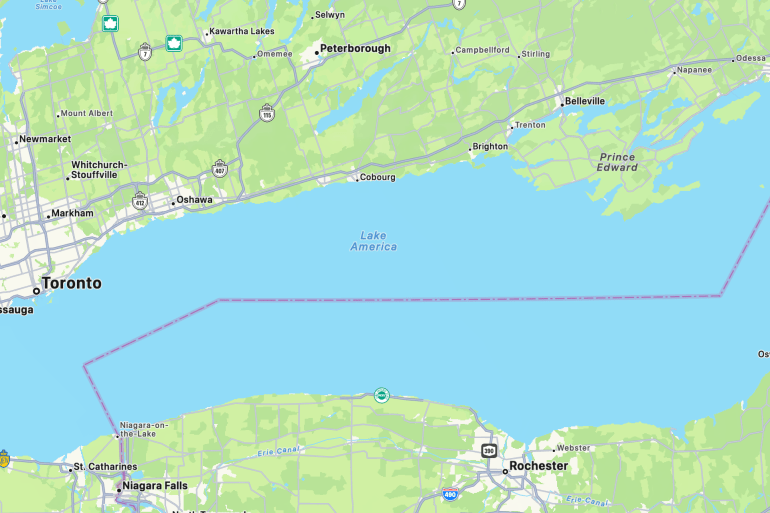
Apple has changed the name of Lake Ontario to “Lake America” for users of Apple Maps in the United States, following reported direct lobbying by President Donald Trump. The change occurred on the same day John Ternus became Apple’s chief executive. Apple is the second major US technology company to adopt the new label after Google made a similar change on Google Maps. Google displays “Lake America” to US users, “Lake Ontario” to Canadian users, and both names to users elsewhere.
Trump’s executive order changed the lake’s name in the US Geographic Names Information System, the federal reference used for official government geographic terminology. Although the order does not legally require private companies to alter their own maps, statements by administration officials indicate that Trump has pressed companies directly. Interior Secretary Doug Burgum said Trump contacted Apple to request the change. Private firms that depend on federal approvals and contracts may also face pressure to comply.
Apple has previously followed Trump-backed geographic renamings, including changing the Gulf of Mexico to the “Gulf of America” and renaming Alaska’s Denali as “Mount McKinley.” Apple did not immediately comment on whether its policy matches Google’s approach of showing different labels by location. MapQuest, another digital mapping service, has rejected the change, saying users can “name it whatever you want at your leisure.”
The renaming effort comes amid worsening relations between the United States and Canada during Trump’s second term. Failed trade negotiations led the US to impose 50 percent tariffs on nearly $20bn of Canadian goods, with Canada promising equivalent retaliation. Lake Ontario lies between the two countries and derives its name from the Indigenous Wendat language. The article places the renaming within Trump’s broader campaign to expand US influence and promote English as the official US language.
Entities: Apple, Apple Maps, Lake Ontario / “Lake America”, Donald Trump, John Ternus • Tone: analytical • Sentiment: negative • Intent: inform
02-09-2026
Apple has changed the name of Lake Ontario to “Lake America” for users of the U.S. version of Apple Maps, following an executive order from U.S. President Donald Trump. The change came shortly after Alphabet made the same adjustment on Google Maps for U.S. users. Apple said the new label reflects a change to the body of water’s name in the U.S. Geographic Names Information System.
U.S. Interior Secretary Doug Burgum said Trump had contacted Apple directly about the renaming. Apple will continue to display “Lake Ontario” for users in Canada, while people elsewhere will see both names. The company used a similar regional approach after Trump ordered the Gulf of Mexico to be called the Gulf of America.
Google’s earlier update caused confusion in Canada because some federal and provincial government websites use Google’s mapping API and temporarily displayed “Lake America.” The article emphasizes that Trump’s executive order applies only to U.S. federal usage and does not control what Canada, international organizations or other institutions call the lake.
Canadian Prime Minister Mark Carney and New York Governor Kathy Hochul have rejected the renaming. Lake Ontario is more than 400 years old, and approximately 52 percent of its surface area is in Canada, with the rest in New York. A Reuters/Ipsos poll found that a majority of Americans opposed both the renaming order and Trump’s proposed tariff increases on Canadian goods.
The naming dispute is presented as another example of technology companies being drawn into geopolitical conflicts. Historian Tim Naftali said the decision was intended to encourage U.S. nationalist sentiment and provoke Canada. The article also links the move to Trump’s repeated comments about Canada becoming the 51st U.S. state and to his earlier renaming of the Gulf of Mexico.
Entities: Apple Maps, Google Maps, Apple, Alphabet, Lake Ontario • Tone: analytical • Sentiment: negative • Intent: inform
02-09-2026
Apple has changed the name of Lake Ontario to “Lake America” for users of its Maps app in the United States, following an executive order signed by Donald Trump. Users outside the US will continue to see “Lake Ontario.” The move follows Google Maps’ adoption of the same name and comes amid an escalating trade dispute between Washington and Ottawa.
Trump celebrated the change on Truth Social, claiming that the adoption of “Lake America” by the two major mapping services made the renaming “complete, ratified, and binding.” However, the United States cannot force Canada or other countries to recognize the new name. Canadian Prime Minister Mark Carney rejected the renaming, noting that “Ontario” derives from the language of the Indigenous Wendat people and predates both Canadian Confederation and the US Declaration of Independence.
The order officially announced the name change the previous week. Although it did not explicitly link the decision to the trade dispute, it followed criticism from Canadian officials of Trump’s sweeping tariffs and threats of further duties on Canadian steel, vehicles and auto parts. Canada responded with tariffs of its own on hundreds of US products.
Apple had reportedly been considering whether to comply after Trump personally requested the change. Interior Secretary Doug Burgum later said the president had contacted Apple directly and predicted that the change would soon appear for US users. Google justified its decision by citing Trump’s order and the naming practices of the US Geographic Names Information System. It displays “Lake America” in the US, “Lake Ontario” in Canada, and both names elsewhere.
MapQuest has taken the opposite position, publicly refusing to rename the lake. Its rejection reportedly helped propel the mapping app to the top of Apple’s US App Store rankings, turning the naming dispute into a broader example of corporate compliance and public resistance.
Entities: Apple Maps, Apple, Google Maps, MapQuest, Lake Ontario / “Lake America” • Tone: analytical • Sentiment: negative • Intent: inform
02-09-2026
US President Donald Trump has suggested renaming the Strait of Hormuz “Trump Strait,” arguing that the strategic waterway is now under US control. The proposal follows his administration’s earlier efforts to rename the Gulf of Mexico as the Gulf of America and Lake Ontario as Lake America. Google and Apple have reportedly updated their maps for US users to reflect some of the new designations, although other countries and international institutions are not required to accept them.
The Strait of Hormuz remains central to the unresolved conflict with Iran. Before the current crisis, roughly one-fifth of the world’s petroleum liquids passed through the waterway, but shipping levels have fallen to a fraction of their prewar levels. The disruption has contributed to higher energy prices and growing concern among American voters about living costs ahead of the November midterm elections. The article also notes that the Trump administration has struggled to end the conflict and fully reopen the strait.
Treasury Secretary Scott Bessent has argued that the waterway could eventually become “worthless” if Gulf states successfully develop alternative routes for exporting energy. However, the article references analysis challenging that assessment, noting that new pipelines are unlikely to eliminate the strait’s strategic importance.
The article explains that Trump can direct US federal agencies to use particular geographical names, but he cannot compel foreign governments or international bodies to adopt them. A possible US designation would involve the US Geological Survey and its Foreign Names Committee, which oversees the standardization of foreign place names for federal use. The process includes formal submissions and committee review. The proposal has attracted online ridicule while also raising questions about whether a US president should be able to unilaterally alter internationally recognized geographical names.
Entities: Donald Trump, Strait of Hormuz, Iran conflict and war, United States federal government, Gulf of Mexico • Tone: analytical • Sentiment: negative • Intent: inform
02-09-2026
The article reports that MapQuest has experienced a renewed surge in app downloads after announcing that it will continue to use the name “Lake Ontario.” The announcement came in response to an executive order issued by President Donald Trump the previous week, which reportedly called for Lake Ontario to be renamed “Lake America.” The proposed renaming is presented as part of an ongoing trade conflict between the United States and Canada.
The article’s headline frames MapQuest’s renewed popularity as an unexpected consequence of the controversy. Although the supplied content does not provide download figures, comments from MapQuest, reactions from Canadian or U.S. officials, or details about how the executive order would be implemented, it suggests that public interest in the naming dispute has driven people back to the mapping application. The reference to the company’s decision not to adopt the proposed name indicates that MapQuest’s position has become notable amid the broader political dispute.
The excerpt is brief and primarily informative, linking a political action involving geographic nomenclature to a commercial effect on a navigation platform. Its wording also carries a lightly ironic quality: a dispute over the name of a major lake has apparently increased attention to a service that had become less prominent. Because only a short excerpt is provided, the article’s broader reporting, sourcing, historical context, and any verification of the executive order or download surge are unavailable.
Entities: MapQuest, Lake Ontario, Lake America, Aoife Walsh, Donald Trump • Tone: analytical • Sentiment: neutral • Intent: inform
02-09-2026
The article describes Laura Beveridge’s visit to Ontario, New York, a small town named after Lake Ontario, which borders the town to the north. The visit was prompted by President Donald Trump’s reported decision to rename the body of water “Lake America.” Beveridge set out to learn how residents of a community that overwhelmingly supported Trump viewed the change.
According to the article, local reactions were mixed. Some Trump supporters welcomed the new name enthusiastically, suggesting that political loyalty or support for the president influenced their response to the renaming. However, the strongest defenders of the traditional name, “Lake Ontario,” were particularly willing to speak publicly and appear on camera to explain their objections to “Lake America.”
The article presents the dispute as a local expression of a broader political and cultural divide. Although the town’s voting patterns might suggest widespread support for Trump’s action, residents’ views on the lake’s name are not uniform. The contrast between enthusiastic supporters of the change and residents who want to preserve the original name forms the central focus of the piece.
The provided excerpt ends by introducing the residents’ explanations without including their individual comments. It therefore functions partly as a preview of the reactions and interviews that appear to follow in the full article. The story’s framing emphasizes the tension between presidential authority, regional identity, attachment to a longstanding geographic name, and the political loyalties of the local community.
Entities: Laura Beveridge, The Washington Post, Ontario, New York, Lake Ontario, Lake America • Tone: analytical • Sentiment: neutral • Intent: inform
02-09-2026
US President Donald Trump has suggested renaming the Strait of Hormuz as “Trump Strait,” claiming that the strategically important waterway is now under US control. His proposal came as fighting between the United States, Israel and Iran continued and as Iran was described as having effectively shut the strait for six months. Trump presented the idea on social media, writing that the waterway should be renamed because it would have a “nice ring to it” and be “hotter” than ever, echoing his broader pattern of proposing geographic name changes.
The White House subsequently reinforced the proposal by posting a map of the Gulf on social media with the waterway labeled “Trump Strait.” The article characterizes the suggested unilateral renaming as an assertion of US authority over an international body of water. It also places the idea in the context of other recent naming controversies, including US efforts to rename Lake Ontario as “Lake America.” Ontario Premier Doug Ford reportedly responded by unveiling a sign calling the lake “Lake Ontario, Now and Always.”
Trump’s proposal comes despite the conflict’s apparent lack of resolution. The article notes that the six-month-old war with Iran shows no sign of ending, while Trump separately indicated that renewed US strikes against Iran would not last “too long.” Overall, the report presents the renaming suggestion as a symbolic and provocative political gesture made during an ongoing international conflict, contrasting Trump’s self-referential rhetoric with the seriousness of the war and the strategic importance of the Strait of Hormuz.
Entities: Donald Trump, Strait of Hormuz, Trump Strait, Iran, United States • Tone: analytical • Sentiment: negative • Intent: inform