02-09-2026
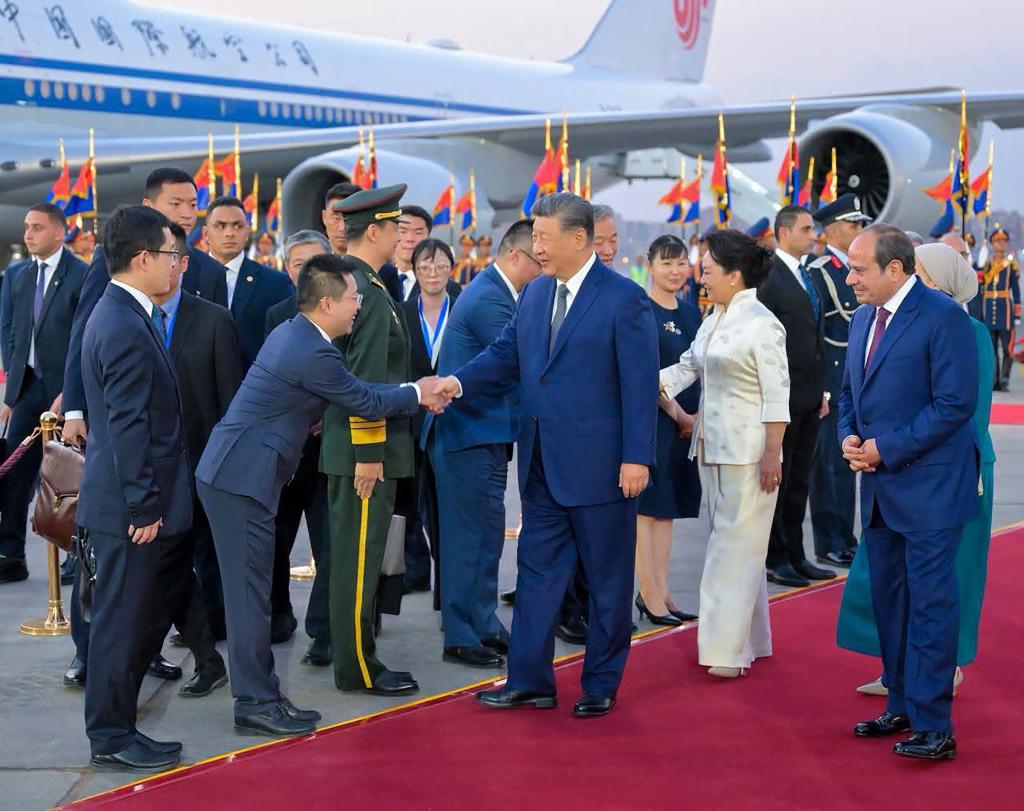
Chinese President Xi Jinping began a two-day state visit to Egypt, his first trip there in a decade, as both countries face potential US sanctions because of their financial and economic relationships with Iran. Xi and his wife were welcomed in Cairo by Egyptian President Abdel Fattah al-Sisi and Egypt’s first lady. The visit is taking place amid a broader Middle East crisis that followed US and Israeli strikes against Iran on February 28 and the resulting disruption to regional trade and security.
Washington has threatened to expand sanctions against Iran’s supporters and partners, potentially affecting Egyptian and Chinese banks. China, a major purchaser of Iranian oil, has sought to portray itself as a neutral actor and has repeatedly called for a lasting ceasefire. Egypt, which receives substantial US military aid, has also warned against further escalation after a drone strike hit one of its ports in July.
The two leaders are expected to discuss the Gaza war, Iran, and shipping security in the Red Sea and Strait of Hormuz. Analysts cited in the article say Beijing views Cairo as a strategic partner and power broker because of Egypt’s relationships with Washington, Israel, Palestinian groups, and other regional actors. Both countries support an independent Palestinian state under a two-state solution.
The visit also has a significant economic dimension. China and Egypt are marking 70 years of diplomatic relations, while China’s trade surplus with Egypt reached $12 billion during the first seven months of 2026. The countries are expected to sign agreements involving artificial intelligence, transport, energy, and investment in the Suez Canal Economic Zone. Egyptian officials and analysts hope the talks will attract Chinese investment into Egypt’s AI and electronics industries and deepen the broader China-Egypt strategic partnership.
Entities: Xi Jinping, Abdel Fattah al-Sisi, Egypt, China, United States • Tone: analytical • Sentiment: neutral • Intent: inform
02-09-2026
Egyptian President Abdel Fatah el-Sissi and Chinese President Xi Jinping oversaw the signing of several agreements aimed at expanding cooperation between Egypt and China. The deals cover technology, economic cooperation, and the digital economy, indicating an effort to deepen bilateral ties across both traditional economic sectors and newer technology-related fields.
The agreements were signed during Xi’s visit to Cairo, where the Chinese leader arrived on Tuesday evening. He was welcomed by el-Sissi and military guards in a formal red-carpet ceremony at the airport. The visit centers on strengthening relations between the two countries and advancing cooperation on shared economic and political priorities.
According to Chinese state media, Xi also used discussions with el-Sissi to call for Egypt and China to reject what he characterized as “unilateral acts of bullying.” He further encouraged the two countries to work together toward what he described as a more just and equitable global governance system. These remarks place the bilateral agreements within a broader diplomatic message about international cooperation and opposition to unilateral behavior.
The article presents the visit as both an economic and political engagement. While the specific terms of the signed deals are not detailed, their focus on technology, economic cooperation, and the digital economy suggests that Cairo and Beijing are seeking to broaden their partnership beyond formal political relations. The meeting also underscores the leaders’ interest in coordinating their positions on global governance and international affairs.
Entities: Xi Jinping, Abdel Fatah el-Sissi, Egypt, China, Cairo • Tone: neutral • Sentiment: neutral • Intent: inform
02-09-2026
Treasury Secretary Scott Bessent said China was the only G20 member to dissent from a joint statement criticizing non-market economies for generating persistent trade imbalances through large volumes of inexpensive exports. The statement, issued after finance ministers and central bankers met in Asheville, North Carolina, said countries should eliminate non-market policies that worsen imbalances, particularly policies that suppress domestic consumption and encourage excessive reliance on exports. It also called on countries with persistent external surpluses to address those distortions.
Bessent identified China as the country with the world’s largest and “unsustainable” current-account surplus. He said the other 19 G20 members could take action in the coming days, weeks or months to address what he described as an unsustainable global economic equilibrium. The Treasury Department’s statement included a footnote documenting China’s objections. Beijing also opposed language concerning shipping disruptions in the Strait of Hormuz, which Iran has effectively blocked amid its war with the United States, as well as paragraphs supporting International Monetary Fund monitoring of global imbalances and identifying countries whose external debt is significantly owed to G20 members.
The disagreement comes as the Trump administration pressures Iran economically through secondary sanctions under “Operation Economic Outcast.” The policy has raised questions about whether Washington could target China, Iran’s largest trading partner and oil buyer. Bessent said the United States and China share important positions on Iran, including opposition to an Iranian nuclear weapon and support for free maritime trade in the Strait of Hormuz. He also noted that China obtains half of its energy from the Gulf and argued that Beijing should help find a solution. The dispute occurs ahead of long-term U.S.-China trade talks and Chinese President Xi Jinping’s planned visit to the United States in late September.
Entities: China, Scott Bessent, Group of 20 (G20), U.S. Treasury Department, Asheville, North Carolina • Tone: analytical • Sentiment: negative • Intent: inform
02-09-2026
China is signaling public caution toward Iran as President Xi Jinping prepares for a high-stakes meeting with U.S. President Donald Trump in Washington later this month. Xi held a brief, informal meeting with Iranian President Masoud Pezeshkian on the sidelines of the Shanghai Cooperation Organization summit in Kyrgyzstan, according to Iranian state media. However, Chinese state media did not report the encounter, even while extensively covering Xi’s meetings with other leaders. Analysts interpret the limited publicity as an effort to preserve China’s relationship with Tehran without making Beijing appear aligned with Iran ahead of the Trump summit.
SCO leaders jointly condemned military strikes on Iran and affirmed member states’ right to civilian nuclear development under the Nuclear Non-Proliferation Treaty. However, the statement did not promise military or economic assistance. China has remained Iran’s largest buyer of sanctioned oil, but imports have declined sharply since the war began as Beijing drew on domestic reserves and reduced shipments through the Strait of Hormuz.
Analysts offered differing explanations for Xi’s restrained public posture. Some described it as careful management of diplomatic optics, while Alfredo Montufar-Helu said it could reflect Beijing’s frustration with Tehran. China has called for an end to the conflict and the reopening of the Strait of Hormuz, whereas Iran’s actions have generally moved in the opposite direction. Nevertheless, the meeting itself suggests Beijing is keeping diplomatic channels open.
The article places the Iran issue within broader U.S.-China tensions. At a Group of 20 finance ministers’ meeting, Treasury Secretary Scott Bessent pressed countries to address China’s manufacturing overcapacity and record trade surplus. Analysts believe Washington and Beijing are maximizing leverage before the Trump-Xi summit, where the Iran war and possible secondary sanctions on Chinese entities could become major points of contention.
Entities: Xi Jinping, Masoud Pezeshkian, Donald Trump, Shanghai Cooperation Organization, Kyrgyzstan • Tone: analytical • Sentiment: neutral • Intent: analyze
02-09-2026
Chinese President Xi Jinping used a rare visit to Egypt to call on Middle Eastern countries to oppose “external interference” and take greater responsibility for their own regional security. During talks with Egyptian President Abdel Fattah al-Sisi in Cairo, Xi said China was prepared to cooperate with regional governments to protect international shipping and promote development, as the six-month US-Iran war disrupts maritime routes and challenges the traditional US security role in the region.
Xi and Sisi urged diplomatic efforts to reach a comprehensive agreement ending the conflict. They also signed an agreement launching the third phase of an Egyptian-Chinese industrial zone near the Suez Canal. The zone reportedly already contains about 200 companies and approximately $4 billion in investment. Although Egypt did not disclose the value of the new commitments, the deal is expected to deepen China’s presence around the canal, a crucial global trade route affected by regional instability.
The visit reflects Beijing’s effort to expand its Middle Eastern influence through investment, trade, and diplomatic engagement. China views Egypt as an important regional partner and an entry point for broader influence, while Cairo is seeking to diversify its international relationships rather than depend on a single major power. Egypt maintains close ties with the United States, including substantial military aid, but has also strengthened defense and economic cooperation with China.
The article notes that Egypt recently held joint air exercises with China, while Chinese exports to Egypt produced a $12 billion trade surplus during the first seven months of 2026. Xi’s visit also comes before an anticipated meeting with US President Donald Trump and amid tensions over possible sanctions affecting Chinese banks and Iran-related trade.
Entities: Xi Jinping, Abdel Fattah al-Sisi, China, Egypt, Middle East • Tone: analytical • Sentiment: neutral • Intent: inform
02-09-2026
Chinese President Xi Jinping’s three-day visit to Egypt is presented as part of Beijing’s broader effort to expand its economic, diplomatic and strategic influence across the Middle East. Although the visit formally marks an opportunity to strengthen bilateral ties, the article emphasizes its geopolitical significance: China is cultivating a relationship with Egypt, a major US partner, while portraying itself as a stabilizing alternative to the United States’ long-standing military involvement in the region.
Egypt is seeking to diversify its strategic partnerships. The two countries are celebrating 70 years of diplomatic relations, and Egypt has supported China’s position on Taiwan. Egypt joined the BRICS grouping in 2023 and signed agreements with China in 2024 to cooperate on the Belt and Road Initiative. China has invested more than $10 billion in Egypt, including in a business hub near Cairo and an electric rail line in the Nile Delta. Bilateral trade is estimated at $20 billion annually, exceeding US-Egypt trade in 2025.
The article places the visit within China’s wider regional diplomacy. Beijing brokered the 2023 restoration of diplomatic ties between Iran and Saudi Arabia and has advocated a two-state solution to the Israeli-Palestinian conflict. However, the Iran war has strained the Saudi-Iranian rapprochement and disrupted energy shipments through the Strait of Hormuz. This has increased the importance of Egypt’s Suez Canal, an alternative route for transporting oil and other supplies.
Xi’s trip also follows a joint Chinese-Egyptian air exercise and a Shanghai Cooperation Organization summit attended by several major regional and global powers. The visit comes as the Trump administration increases sanctions pressure on Iran, a major Chinese oil supplier. Overall, the article portrays Egypt as a gateway for China to the Arab and African worlds and as an increasingly important component of Beijing’s competition with Washington.
Entities: Xi Jinping, Abdel Fattah el-Sissi, China, Egypt, United States • Tone: analytical • Sentiment: neutral • Intent: analyze
02-09-2026
The article argues that China is beginning to develop the military capabilities needed to protect and support its expanding economic interests overseas. It presents China’s recent participation in Egypt’s “Eagles of Civilisation” air exercise as evidence of this shift. Chinese J-16 fighter jets flew to Egypt with support from YU-20 aerial refuelling tankers, marking the first time China has deployed these combat aircraft to Africa. The exercise also enabled China to operate alongside Egyptian Rafale and MiG-29 fighters, providing practical experience in moving and sustaining a combat force across continents and cooperating with a major Arab military.
The drills are placed within the broader development of China-Egypt relations. According to the article, ties that began with diplomacy and trade have expanded into infrastructure, technology and military cooperation. China’s economic presence is especially significant around the Suez Canal, where Chinese companies operate manufacturing and logistics facilities that connect supply chains with European, African and Middle Eastern markets.
The article highlights the continued growth of this relationship. Egyptian companies recently signed 17 export contracts with Chinese buyers valued at US$168 million, while Chinese investment in Egypt during the first half of 2026 was estimated at as much as US$2 billion. Beijing has also granted Egyptian goods zero-tariff access, removing duties that had reached 30 per cent. However, the economic relationship remains uneven, with Egypt recording a trade deficit of more than US$18 billion with China the previous year.
Overall, the article portrays the joint drills as both a military milestone and an extension of China’s economic strategy. As Beijing’s overseas commercial footprint grows, it is developing the operational reach to support those interests militarily, particularly in strategically important regions such as the Suez Canal and Africa.
Entities: China, Egypt, Beijing, Xi Jinping, Chinese J-16 fighter jets • Tone: analytical • Sentiment: neutral • Intent: analyze
02-09-2026
US Treasury Secretary Scott Bessent said China prevented the Group of 20 from issuing a joint communique after finance ministers and central bank governors met in Asheville, North Carolina. The dispute centered on China’s large current-account and trade surplus, which Bessent described as “unsustainable” and damaging to global, regional and domestic markets. Instead of a consensus communique, the United States released a statement in the chair’s voice, saying that countries with persistent external surpluses should reduce policies that suppress domestic consumption and encourage excessive reliance on exports. Bessent said 19 G-20 members supported the statement, while China objected to sections concerning the Strait of Hormuz, a proposed task force on trade imbalances, International Monetary Fund monitoring powers and debt restructuring.
The article reports that China recorded a US$1.2 trillion trade surplus in 2025, while the United States ran an approximately US$200 billion trade deficit with China. Bessent made the issue a central priority during the summit. He also said he had limited discussions with Chinese officials about artificial intelligence because Vice-Premier He Lifeng was absent. Bessent expects AI investment to increase productivity and lower inflation, with benefits potentially becoming visible within six months. He said AI-related capital spending could become “extremely disinflationary.”
The article also covers US efforts to increase economic pressure on Iran. Bessent said he discussed possible sanctions and other measures with US allies, Russia and China, noting that China buys about 90 per cent of Iran’s oil. He said Washington and Beijing agree that the Strait of Hormuz should remain open. His comments came after the United States and Iran exchanged strikes on August 31 and September 1. Bessent warned that Iran could respond with further military action but suggested that Tehran might still be prepared to negotiate.
Entities: Scott Bessent, Donald Trump, Xi Jinping, He Lifeng, Group of 20 (G-20) • Tone: analytical • Sentiment: negative • Intent: inform
02-09-2026
Egypt and China presented a unified position on several major regional and international issues after Egyptian President Abdel Fattah El Sisi held talks with Chinese President Xi Jinping in Cairo. Their joint statement identified the Palestinian cause as the central issue in the Middle East and called for the Gaza ceasefire to be consolidated, humanitarian aid to enter without restriction and the Palestinian Authority to return to Gaza. The leaders rejected any forced displacement of Palestinians and criticized Israeli settlement activity, land confiscation and settler violence in the occupied West Bank and East Jerusalem. They also defended the role of the UN agency for Palestinian refugees, UNRWA.
A key outcome for Egypt was China’s recognition of the Nile’s vital importance to the country and its legitimate right to protect its water and food security. Both governments called on Nile Basin states to comply with international law and avoid causing harm, language that supports Egypt’s position in its dispute with Ethiopia over the Grand Ethiopian Renaissance Dam. Cairo and Beijing also backed Sudan’s sovereignty and territorial integrity and pledged to support efforts to end the war through a Sudanese-led political process. Regarding the Red Sea, they said responsibility for governance and security rests primarily with states bordering the waterway.
Egypt reaffirmed its support for China’s one-China principle, recognizing Taiwan as part of the People’s Republic of China and endorsing China’s position on sovereignty and territorial integrity. The visit, held during the 70th anniversary year of diplomatic relations, produced five formal agreements and more than 20 additional cooperation documents. These cover alignment between Egypt’s Vision 2030 and China’s Belt and Road Initiative, industrial development, supply chains, information technology, the Suez Canal Economic Zone, digital infrastructure, electric vehicles, shipbuilding, renewable energy, semiconductors, desalination, artificial intelligence, tourism, education and Egyptian exports to China.
Entities: Egypt, China, Egyptian President Abdel Fattah El Sisi, Chinese President Xi Jinping, Nile water security • Tone: analytical • Sentiment: neutral • Intent: inform
02-09-2026
The article examines the Chinese military aircraft and air-defence equipment displayed or deployed in Egypt during President Xi Jinping’s September 2026 visit. The equipment is participating in Eagles of Civilisation 2026, the second joint military exercise between the Egyptian and Chinese air forces. China sent a larger and more varied contingent than in 2025, including fighter jets, an aerial tanker, an airborne early-warning aircraft, an electronic-warfare platform and helicopters. The exercise is portrayed as a practical showcase for Chinese defence exports to Egypt and other Middle Eastern customers.
Analyst Justin Bronk of the Royal United Services Institute says China is seeking to replace Russia as Egypt’s preferred non-Western supplier of combat aircraft. Egypt previously received Russian MiG-29M fighters but abandoned a planned purchase of Su-35S aircraft. The article suggests that Egypt’s dissatisfaction with the Su-35S, combined with the effects of the war in Ukraine on Russia’s defence industry, has created an opening for Beijing.
The Shenyang J-16 is present for demonstration but is unlikely to be exported because of licensing restrictions linked to its Russian Su-30 origins and its importance to China’s own air force. The J-10C is the principal fighter being promoted for Egypt, while the newer stealth-capable J-35 could give Egypt access to the Arab world’s first fifth-generation fighter fleet if a sale occurs. China also demonstrated the YU-20 tanker, which refuelled an Egyptian Rafale using a NATO-standard probe, highlighting interoperability between Chinese and Western aircraft. The KJ-500 airborne early-warning aircraft and Y-9LG electronic-warfare aircraft further demonstrate China’s expanding capabilities. Egypt has reportedly already acquired and deployed the HQ-9B long-range surface-to-air missile system.
Entities: Xi Jinping, Egypt, China, Eagles of Civilisation 2026, Justin Bronk • Tone: analytical • Sentiment: neutral • Intent: analyze