02-09-2026
Spanish prosecutors report that 23 sexual assault cases, including nine involving children, have been recorded in Ceuta since approximately 72,000 migrants crossed from Morocco into the Spanish territory on 30 and 31 July. Most of those who entered have returned to Morocco, but about 5,000 remain, including an estimated 1,400 to 1,600 children. Ceuta's chief prosecutor, Silvia Rojas, said the reported cases represented nearly one incident per day and warned that the real number could be higher because some victims had not come forward. She said migrant girls were especially vulnerable because of their irregular legal status and difficult living conditions.
According to Spanish news agency Efe, suspects include four Moroccans, three Spaniards and one Belgian. Doctors at Ceuta University Hospital have treated several suspected victims, including, according to emergency doctor Susana Ascaso, a 10-year-old child. The migrant influx has placed considerable pressure on Ceuta and contributed to clashes and other violence involving migrants and local residents. At least 100 people reportedly died while trying to reach Ceuta by sea.
The Spanish government has approved a multimillion-euro aid package for essential services and unaccompanied children. Prime Minister Pedro Sánchez has also called the national security council together twice in one week. His government faces criticism from opposition parties, while Ceuta's regional president, Juan Jesús Vivas, has urged demonstrations in support of the territory.
The events have further strained relations between Spain and Morocco, which claims Ceuta and neighbouring Melilla despite Spain administering both territories. Sánchez has rejected claims that Morocco organised the crossing, saying there is no intelligence showing government involvement. He instead blamed online disinformation allegedly amplified by networks linked to Russia, Israel and the international far right; Russia and Israel deny those allegations, while Morocco also denies involvement. Spanish fact-checker Maldita said crossing-related messages had circulated on Moroccan social media before the influx.
Entities: Ceuta, Morocco, Spain, Silvia Rojas, Ceuta chief prosecutor, Pedro Sánchez, Spanish prime minister • Tone: urgent • Sentiment: negative • Intent: inform
02-09-2026
Hundreds of migrants, most of them Moroccan, are living in a makeshift camp on Ceuta’s El Trampolín beach after arriving through the border with Morocco in July. The migrants have reportedly avoided official reception centres following Madrid’s announcement that it intends to deport those who entered during the mass arrival. Many of the people in the camp are young and say they are uncertain about their future, with no clear solution offered after weeks of waiting.
Nebil Tazi, a 32-year-old migrant from Tangier, describes harsh conditions in the camp, where people sleep in tents on the beach and face health risks. He says some migrants need medical care but cannot access a doctor, while diseases are a growing concern. Tazi explains that the migrants want either to reach Europe or find an immediate alternative to their current situation.
Another migrant, 21-year-old Hamza Mohammed, says he hopes to join family members in Spain and obtain a better quality of life. He says migrants need employment and money to support their families, arguing that these opportunities are unavailable in Morocco but possible in Spain.
The situation is contributing to heightened tensions in Ceuta several weeks after approximately 80,000 migrants arrived in the territory. Local residents have demonstrated against what they describe as the Spanish government’s lack of a clear policy for managing the migration situation. The article highlights the migrants’ precarious living conditions, their fear of deportation, and the broader political and social pressure surrounding the arrivals.
Entities: Ceuta, El Trampolín beach, Moroccan migrants, Nebil Tazi, Tangier • Tone: emotional • Sentiment: negative • Intent: inform
02-09-2026
Thousands of people have protested across Spain over the government’s response to the mass arrival of migrants in Ceuta, a Spanish autonomous city on Morocco’s north African border. Demonstrators and opposition parties accuse Prime Minister Pedro Sánchez of abandoning Ceuta’s residents and failing to protect the border. The governing side argues that right-wing parties are exploiting the crisis for political purposes.
At least 72,000 migrants crossed from Morocco into Ceuta on 30 and 31 July. Although most have since returned, up to 5,000 reportedly remain in makeshift camps, on the streets or on beaches. The influx has triggered unrest in Ceuta and intensified political pressure on Sánchez. Local protests have called for migrants to be returned to their countries of origin or redistributed elsewhere in Spain, while many demonstrators have demanded the prime minister’s resignation.
The conservative Partido Popular and far-right Vox, which govern or have substantial support in several Spanish municipalities, organized or supported Wednesday’s demonstrations. More than 50,000 people attended the Madrid rally, according to government figures. PP leader Alberto Núñez Feijóo accused the government of allowing Ceuta to be “invaded” and “occupied”, while Vox leader Santiago Abascal accused Sánchez of serving Morocco. A large demonstration also took place in Ceuta.
Pressure increased after a National Police report reportedly described “total permissiveness” by Moroccan security forces during the crossings. The report said Morocco’s deployment near the border was smaller than usual and cited migrants who described a passive police presence, but it did not categorically accuse Morocco of organizing the influx. Sánchez has instead blamed trafficking gangs and online misinformation, while Morocco denies involvement.
Ceuta and Melilla have long been disputed by Morocco and remain a source of diplomatic tension. Spanish authorities also say misleading social-media posts portrayed the crossing route as safe and easy, although at least 100 people reportedly died attempting to swim around the border fence.
Entities: Ceuta, Spain, Morocco, Pedro Sánchez, Alberto Núñez Feijóo • Tone: analytical • Sentiment: negative • Intent: inform
02-09-2026
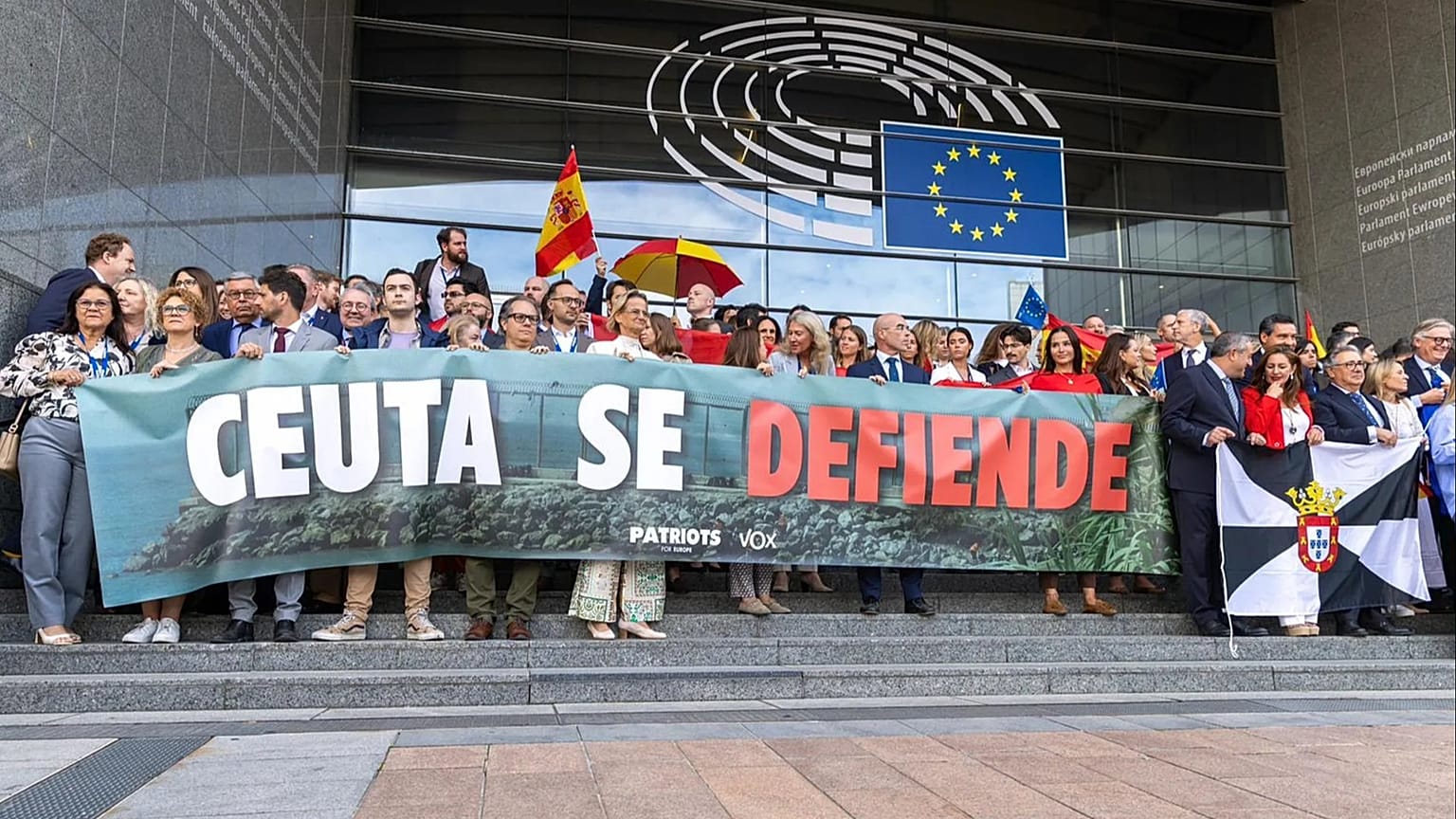
Around 500 people gathered outside the European Parliament in Brussels to protest the Spanish government’s handling of the migration crisis in Ceuta. The demonstrations were organised separately by Spain’s centre-right Popular Party and the far-right Vox party, but took place simultaneously on Ceuta Day and brought together lawmakers from the European People’s Party (EPP) and Patriots for Europe (PfE).
The protesters and MEPs accused Prime Minister Pedro Sánchez of failing to defend Spain’s territorial integrity and of allowing Morocco to assume responsibility for Ceuta’s security. EPP vice-president Dolors Montserrat said Sánchez had effectively “handed over” security responsibility to a third country and was yielding to Rabat. The criticism follows a report by El Español claiming that Spain’s National Centre for Immigration and Borders (CENIF) concluded that the mass entry of migrants into Ceuta on 30 July had been guided by Moroccan security forces. More than 70,000 people reportedly arrived during the incident, with several thousand still in the exclave.
The Sánchez government has not publicly blamed Morocco and has maintained that there is no proof of direct involvement by Moroccan authorities. Interior Minister Fernando Grande-Marlaska asked police chief Francisco Pardo to verify the reported CENIF information, which was allegedly sent to a judge investigating the incident. The European Commission declined to comment on leaked information, saying that the investigation into Morocco’s possible involvement remains the responsibility of Spanish authorities.
Vox accused Sánchez of betraying Spain and called for Article 102 of the Spanish Constitution to be activated, potentially triggering criminal proceedings against the prime minister and his cabinet. The party also urged the EU to condemn and sanction Morocco, classify the migration surge as an act of hybrid warfare, suspend EU-Morocco agreements, and halt visas for Moroccan citizens.
Entities: Ceuta, Pedro Sánchez, European People’s Party (EPP), Patriots for Europe (PfE), European Parliament • Tone: analytical • Sentiment: negative • Intent: inform
02-09-2026
Spain’s government is facing its most serious political and security crisis in years after leaked reports suggested Moroccan forces helped push migrants toward Ceuta during an unprecedented border breach. Media outlets cited a police document alleging that Moroccan authorities encouraged the sea crossing, acted passively, and that the influx of roughly 80,000 people was not accidental. The report directly contradicted Madrid’s position, which has blamed social-media misinformation and human traffickers while continuing to describe Morocco as a trusted partner on migration.
Interior Minister Fernando Grande-Marlaska ordered police to clarify the allegations, but a senior police official denied that any report explicitly blamed Morocco. The conflicting accounts have intensified accusations that parts of the police or Interior Ministry may be leaking information to damage the government or expose failures. Opposition leader Alberto Núñez Feijóo accused Prime Minister Pedro Sánchez’s government of knowing about the threat and covering it up. If authorities ignored intelligence warnings, the government could face calls for a no-confidence vote ahead of the 2027 election.
The crisis is also placing severe pressure on Ceuta. Thousands of migrants remain in the enclave, including many minors who cannot easily be returned under Spanish law. Local president Juan Jesús Vivas accused Morocco of deliberately harassing Ceuta and Melilla and called the events a violation of Spain’s territorial integrity rather than a conventional migration crisis. Administrative delays, limits linked to the Schengen area, and the lack of suitable facilities have complicated the response. Spain has requested assistance from Frontex, while Morocco has argued that Spain’s regularisation plan encouraged the crossings. The European Commission declined to comment on the leaked report, calling it a national matter.
Entities: Ceuta, Spain’s Sánchez government, Morocco, Spanish Interior Ministry, Fernando Grande-Marlaska • Tone: urgent • Sentiment: negative • Intent: analyze
02-09-2026
A Spanish police report reviewed by AFP says Moroccan security forces showed “total permissiveness” during the unprecedented migrant rush into Ceuta in July. The report alleges that Morocco deployed fewer officers than usual around the border and that migrants described Moroccan police as passive while tens of thousands crossed into the Spanish territory in North Africa.
Approximately 72,000 people entered Ceuta during the episode, and at least 90 reportedly died trying to reach Europe. Most migrants were quickly returned to Morocco or escorted back across the border, but about 5,000 people—including 1,200 minors—remained in Ceuta weeks later. The influx placed severe pressure on the territory, whose population is around 84,000, and intensified concerns about its humanitarian capacity.
The causes of the mass crossing remain contested. Spain’s central government has attributed the movement partly to an online social-media campaign, while local authorities say Madrid ignored warnings that the border could be breached. Ceuta’s regional leader, Juan Jesús Vivas, rejected the description of the event as simply a migration crisis, calling it a violation of Spain’s territorial integrity.
Thousands of people demonstrated in Ceuta and in Madrid and more than 200 other Spanish towns, calling for a response to the humanitarian situation and criticizing Prime Minister Pedro Sánchez’s government. Some protesters carried Spanish flags and used anti-migrant slogans. The protests were organized by the officially nonpartisan Spanish Federation of Municipalities and Provinces but were promoted by the conservative Popular Party and the far-right Vox party, which have made the crisis central to their campaign against Spain’s left-wing government.
Entities: Ceuta, Morocco, Spain, Moroccan security forces, Spanish police report • Tone: analytical • Sentiment: negative • Intent: inform
02-09-2026
Residents of Ceuta are calling for calm as protests and counter-protests spread across Spain over an unprecedented migration crisis in the North African enclave. The crisis began nearly five weeks earlier, when at least 72,000 people crossed into Ceuta from Morocco during a deadly border surge. Local authorities estimate that more than 10,000 migrants, including unaccompanied minors, remain in makeshift camps or on the streets and beaches.
The continued presence of migrants has prompted near-daily demonstrations by residents who accuse Spain’s central government of failing to respond adequately. Protesters are demanding that migrants without the right to remain be returned to their countries of origin or redistributed to other parts of Spain. Local organizers say they want peaceful demonstrations and are attempting to exclude far-right activists to prevent violence. Nevertheless, previous protests have included attacks on a migrant camp at El Trampolin beach, while Moroccan migrants have been arrested after throwing stones and bottles at army patrols.
Nationwide demonstrations were organized by the Federation of Municipalities and Provinces, which is dominated by the opposition conservative People’s Party. Spain’s left-wing government has accused the opposition of exploiting the crisis politically. Left-wing groups and unions have organized counter-demonstrations denouncing racist and Islamophobic attacks against migrants.
Negotiations between the central and local governments remain deadlocked. The People’s Party, which governs many Spanish regions, including some in coalition with Vox, supports deporting all remaining migrants, including minors. The national government has expanded temporary accommodation from about 500 to more than 3,400 places and deployed over 1,600 police officers, but local officials and charities say the response remains insufficient. They argue that the central government must provide funding while local authorities provide space, warning that continued inaction could increase tensions and endanger both residents and migrants.
Entities: Ceuta, Spain, Morocco, Spanish central government, 72,000-person border surge • Tone: analytical • Sentiment: negative • Intent: inform