04-11-2026
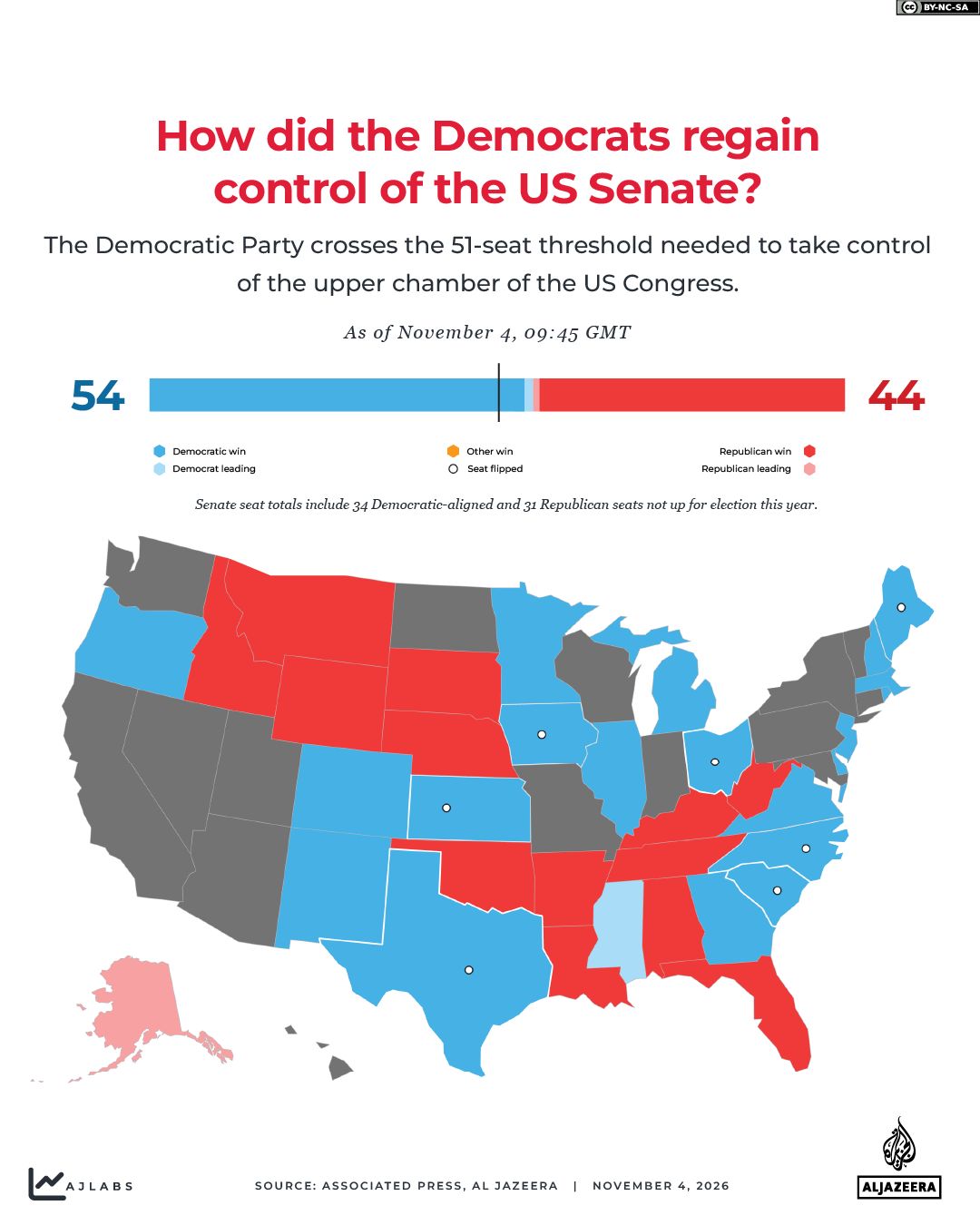
Democrats have won control of the US Senate and are projected by multiple media outlets to take the House of Representatives, ending the Republican Party’s control of Congress after the 2026 midterm elections. The party flipped six Republican Senate seats and about two dozen House seats, including in traditionally Republican states. The results exceed the Democrats’ required net gains of four Senate seats and three House seats. Notable Senate victories included Roy Cooper in North Carolina, Annie Andrews in South Carolina, James Talarico in Texas, Sherrod Brown in Ohio and Adam Hamilton in Kansas. Jon Ossoff also won re-election in Georgia. Several of the states where Democrats prevailed had backed Donald Trump by substantial margins in 2024, making the results a major setback for the president and his party.
With Democrats controlling both chambers, Trump is likely to face obstacles advancing his legislative agenda and will need bipartisan support to pass legislation. The article also expects a Democrat-controlled House to increase oversight of his administration through investigations, subpoenas and hearings. Trump said he would accept the results and work with Democrats, but also argued they would not truly be in control because he could veto legislation. He claimed he would have won by a landslide had he been on the ballot. Trump acknowledged that the war with Iran had affected Republican candidates, while also defending his actions in the conflict. The article describes the election as a significant reversal for Republicans, who entered the midterms with narrow majorities in both chambers.
Entities: Democratic Party, Republican Party (GOP), Donald Trump, Annabel Bowles, United States Congress • Tone: analytical • Sentiment: neutral • Intent: inform
04-11-2026
After Democrats won control of both the House of Representatives and the Senate in the 2026 midterm elections, President Donald Trump’s Republican Party will have less ability to pass legislation and confirm nominees. The article explains what the change could mean once the new Congress takes office on January 3. Democrats plan to use their House majority to block Republican bills and introduce an early legislative package addressing tariffs, the Iran war and health insurance costs. However, their ability to enact those proposals will be constrained: most Senate bills require 60 votes to advance, and Trump can veto legislation unless it has two-thirds support in both chambers.
The House majority will give Democrats stronger investigative powers, including the ability to subpoena records and witnesses. Party leaders and members have signalled interest in investigating Trump, his family’s business interests and government agencies such as the Justice Department and FBI. Some Democrats also want to impeach Trump for a third time, but the party is divided, and removing him would require a two-thirds Senate vote. Defense Secretary Pete Hegseth may be a more plausible impeachment target: a resolution has already been introduced by outgoing Republican Thomas Massie, and Jeffries has said Democrats may address the matter if Trump does not remove Hegseth.
Before the new Congress is sworn in, the current Congress must return on November 9 and address government funding. Funding expires on December 11, and failure to pass new bills could trigger another shutdown. The Democratic Senate majority will also make it harder for Trump to confirm nominees, including potential Supreme Court justices. The article notes that Justices Clarence Thomas and Samuel Alito are older, but both reportedly intend to remain on the court for now. Trump, however, retains the power to fire cabinet members and could replace them without Senate confirmation.
Entities: Donald Trump, Hakeem Jeffries, Alexandria Ocasio-Cortez, Pete Hegseth, Thomas Massie • Tone: analytical • Sentiment: neutral • Intent: inform
04-11-2026
ABC Americas editor John Lyons argues that Donald Trump’s Republicans suffered a sweeping defeat in the 2026 midterm elections, but that the result does not make Trump a powerless “lame duck.” The losses—including Democratic Senate victories in traditionally Republican states such as North and South Carolina, Texas and Kansas—suggest that Trump has lost his once-reliable ability to read the public mood. Lyons points to Trump’s final pre-election speech, in which he praised renovations to a Washington reflecting pool and the White House lawn while many Americans faced sharply rising petrol costs. The article presents the speech as politically tone-deaf and asks whether it reflected a decline in Trump’s judgment.
The defeat of Ken Paxton in Texas is offered as evidence that Trump’s influence and campaign spending have limits. Trump backed Paxton over incumbent Republican John Cornyn, and Republicans and Elon Musk reportedly spent as much as US$350 million trying to win the race. They nevertheless lost to James Talarico, a 37-year-old former teacher and Presbyterian seminarian. The spending may also have diverted resources from more winnable contests.
Despite the electoral setback, Trump retains substantial authority as president and commander-in-chief, with two years remaining in office. Lyons warns that feeling wounded or humiliated could lead Trump to respond dangerously, recalling his rejection of the 2020 election result and the ensuing attack on the US Capitol. Trump could also use executive orders to act without Congress, even if courts later challenge them. The article identifies foreign policy as a particular risk, citing US actions involving Iran and Venezuela and a closer relationship with Russia, and raises the possibility of further intervention, including in Cuba. It concludes that although American voters have delivered a clear message, it remains uncertain whether Trump will heed it.
Entities: Donald Trump, John Lyons, James Talarico, Ken Paxton, John Cornyn • Tone: analytical • Sentiment: negative • Intent: analyze
04-11-2026
After Democrats won control of Congress in a stunning U.S. midterm election, President Donald Trump congratulated them and said he was willing to work with them, while declining to accept responsibility for the Republican defeat. In a Fox News interview, he said the result was not a personal blow and pointed to the Iran war as one possible factor, although he maintained that voters understood the importance of his actions. Trump also warned that he would veto Democratic legislation he opposed.
Trump offered a different explanation for the Republican losses in a Truth Social post, claiming Republicans would have won by a landslide if he had been on the ballot. He said he would act as a political pundit and assign blame, criticizing Texas Governor Greg Abbott, whom Democrat Gina Hinojosa defeated, and accusing Abbott of becoming a “RINO.” The White House also questioned the quality of Republican candidates, saying Trump had promoted many of them more effectively than they had promoted themselves.
The article describes a tense atmosphere at the White House as Trump and senior officials watched the results. With Democrats set to control both the House and Senate during the final two years of Trump’s second term, attention turned to how he would wield his remaining power. The White House suggested he was unlikely to accept a diminished role quietly and raised the possibility of renewed large-scale military action against Iran, despite the war’s unpopularity among voters. It also warned that Democrats could regret their votes if gas prices fell after the conflict was resolved, and ended with a threat that Trump’s determination to oppose the “Radical Left” would grow stronger.
Entities: Donald Trump, Democratic Party, Republican Party, U.S. midterm elections, Iran war • Tone: analytical • Sentiment: negative • Intent: inform
04-11-2026
After Democrats won control of both the House of Representatives and Senate in the November 3, 2026, midterm elections, Congress is expected to scrutinize and challenge President Donald Trump’s policies. Its ability to change them directly, however, is limited, particularly where the president can act without congressional approval. On the US-Israel war on Iran, lawmakers could withhold funds when the current government-funding bill expires on December 11, but analysts caution that cutting support while US troops are deployed could be politically and practically difficult. The War Powers Resolution also offers no easy restraint: Trump could veto a measure, and Democrats lack the two-thirds majorities needed to override him. Bipartisan cooperation may still be possible, especially with Republicans who oppose the war, including Vice President JD Vance. One analyst warns that Trump, no longer able to seek another term, could instead escalate overseas actions to shape his legacy.
Entities: Donald Trump, Federica Marsi, JD Vance, James Boys, Scott Lucas • Tone: analytical • Sentiment: neutral • Intent: analyze
04-11-2026
The Democratic Party has regained control of the US Senate in the 2026 midterm elections, according to Associated Press projections. Democrats needed a net gain of four seats and had captured at least seven by late Tuesday, securing at least 53 seats in the 100-member chamber while some races remained uncounted. The result reverses the Republican majority and ends the party’s control of the presidency, Senate and House that followed the 2024 election, though the article does not report the outcome of the House races.
Democratic victories included several states considered Republican strongholds. Annie Andrews won in South Carolina, where a Democrat had not won a Senate seat since 1998; Roy Cooper flipped North Carolina; and James Talarico defeated Texas Attorney General Ken Paxton in Texas, where Democrats had not won a statewide election since 1994. Sherrod Brown, Adam Hamilton, Troy Jackson and Josh Turek also defeated Republican opponents in Ohio, Kansas, Maine and Iowa, respectively. Democrats also defended seats, including Jon Ossoff’s in Georgia and Mark Warner’s in Virginia.
President Donald Trump acknowledged that Democrats had performed well but suggested the war on Iran and the resulting cost of gasoline may have contributed to Republican losses. He also distanced himself from the outcome, noting he had not been on the ballot. The article explains that Senate races are staggered, with only about a third of seats contested at a time, and that 35 races were held in this cycle, including two special elections. Trump said he expected to veto Democratic proposals he considered unacceptable, but predicted the parties would eventually work together.
Entities: Democratic Party, 2026 US midterm elections, US Senate, Associated Press, Donald Trump • Tone: analytical • Sentiment: neutral • Intent: inform
04-11-2026
The article describes a historic and unexpectedly large Democratic victory in the 2026 US midterm elections, with Democrats taking control of both chambers of Congress. Democrats have won 228 House seats, with leads in 34 uncalled races that could lift their total above 260, and secured 54 Senate seats. The result is a major setback for President Donald Trump, whose endorsements failed to protect several Republican candidates in traditionally conservative states, including South Carolina, North Carolina, Texas and Michigan.
Political observers quoted by Al Jazeera characterize the outcome as a “seismic loss” and say it will reshape relations between Congress and the White House. Democrats are likely to pursue stronger oversight, investigations and potentially impeachments, while the election may intensify opposition to Trump. Analysts also suggest that the results expose divisions in Trump’s MAGA coalition and could make it harder for Republicans to rely on his political brand in 2028. Rising food and fuel costs, linked by voters to the administration’s foreign policy and the US-Israel war on Iran, are presented as an important source of dissatisfaction.
Republicans did retain or win offices in several states, including Florida, Wyoming and Alabama, and had victories elsewhere. The article notes that the party has recovered from major midterm defeats before, citing 1994 and 2010. However, an analyst argues that this election may be different because foreign policy has played an unusually prominent role. Even with Congress under Democratic control, Trump would retain substantial unilateral authority over foreign relations, troop deployments and military action.
Entities: Donald Trump, Democratic Party, Republican Party (GOP), US Congress, 2026 US midterm elections • Tone: analytical • Sentiment: negative • Intent: analyze
04-11-2026
The article is a brief Al Jazeera video report preview about Republicans awaiting election results at Texas Attorney General Ken Paxton’s watch party in Dallas during the 2026 US midterm elections. It says Texas Republicans are anxious about whether Paxton can withstand a strong challenge from Democrat James Talarico. Reporter Emma Withrow is at Paxton’s event and is expected to provide the latest information about an election described as potentially record-breaking. The supplied text does not specify what record might be set, give vote totals or projections, or report an outcome in the contest. It also contains no direct quotations or further details about either candidate, the campaign, or the atmosphere at the party. Accordingly, the report’s central focus is the uncertainty surrounding Paxton’s race and the nervous anticipation among Republicans as results come in. The accompanying page text identifies the item as a video, gives its publication date as November 4, 2026, and includes social-sharing and Google-related prompts that are not part of the report itself. This summary is limited to the short description provided; it does not add election results or background beyond that text.
Entities: Ken Paxton, James Talarico, Emma Withrow, Dallas, Texas • Tone: neutral • Sentiment: neutral • Intent: inform
04-11-2026
Democrat James Talarico has won Texas’s US Senate race, ending a long stretch without a Democratic statewide victory. The article describes the result as a major political shift in a state long identified with Republican conservatism. In his Austin victory speech, Talarico celebrated the win as a rejection of billionaire influence and divisive politics, arguing that political power belongs to ordinary people.
The race unfolded amid turmoil in the Republican primary. President Donald Trump backed Texas Attorney General Ken Paxton over incumbent John Cornyn, but Paxton struggled to build enthusiasm despite spending exceeding half a billion dollars. Elon Musk contributed at least $212 million to support Paxton. Democrats are expected to scrutinize Musk’s role in the federal Department of Government Efficiency if they gain control of Congress. Voters and Democratic officials quoted in Houston characterized Talarico’s victory as a response to money in politics, economic pressures, and a desire for a better future, particularly among younger voters.
The article also reports a surprise gubernatorial win by Democrat Gina Hinojosa, whose campaign had been considered a long shot. She is set to become Texas’s first Latina governor. Hinojosa’s campaign representative described the result as a rebuke to hardline immigration policies under outgoing Governor Greg Abbott, including cooperation with federal deportation efforts. Supporters cited the effects of immigration enforcement on families and Latino communities.
The story places both victories against the backdrop of Abbott’s conservative record on immigration, social welfare, abortion, education, and religious freedom. Supporters credit his administration with economic growth driven by tax cuts and deregulation; critics say the gains have largely benefited corporations and wealthy people while many Texans face poverty and a weak safety net. Voters at Houston celebrations expressed disbelief and hope, linking the election to household costs and dissatisfaction with big-money politics.
Entities: James Talarico, Gina Hinojosa, Donald Trump, Ken Paxton, John Cornyn • Tone: analytical • Sentiment: neutral • Intent: inform
04-11-2026
Al Jazeera’s short video report, presented by correspondent Alan Fisher, describes a worse-than-expected performance for Republicans in the 2026 US midterm elections. The report says the party’s internal polling did not anticipate the scale of the potential losses it was facing in either chamber of Congress: the Senate or the House of Representatives. Its headline characterizes the setback in emphatic terms, saying that Donald Trump and Republicans were “trampled” in the midterms.
The item focuses on the gap between Republicans’ expectations, as reflected in their internal polling, and the apparent scale of their electoral difficulties. It does not provide vote totals, identify particular races or states, give seat projections, or explain the causes of the party’s performance. Nor does the supplied text establish final outcomes; it describes losses as potential. The report is therefore a concise election update rather than a detailed account of results or an analysis of why voters may have shifted. Its central point is that Republican polling failed to capture the severity of the party’s midterm troubles across both the Senate and the House. The article also does not include additional reaction from candidates, voters, or party officials in the provided content.
Entities: Donald Trump, Alan Fisher, Al Jazeera, United States, 2026 US midterm elections • Tone: analytical • Sentiment: negative • Intent: inform
04-11-2026
The article reports that Democrats made historic gains in the 2026 US midterm elections, costing President Donald Trump control of Congress and delivering a major setback to his presidency. Al Jazeera correspondent Noor Wazwaz examines candidates who won key races and helped Democrats flip traditional Republican strongholds. The brief description frames the results as a significant shift in congressional power, but does not identify the candidates, states, specific races, or the scale of the gains. It also provides no detailed vote counts or explanation of how the change in control may affect legislation or the administration. The report was published on November 4, 2026. Overall, the item offers a concise overview of the election outcome and indicates that its focus is on the winners behind the shift, rather than providing a full account of the results or their consequences.
Entities: Donald Trump, Noor Wazwaz, Al Jazeera, Democratic Party, US midterm elections • Tone: analytical • Sentiment: neutral • Intent: inform
04-11-2026
Democrat James Talarico has won Texas’s US Senate race, defeating Republican Ken Paxton in a result the article describes as a major midterm upset. It is the first Democratic Senate victory in Texas since 1988 and part of a broader wave of Democratic wins that gave the party control of Congress. Talarico, a former schoolteacher and state legislator who had been little-known until recently, centered his campaign on the cost of living and presented his victory as a rejection of wealthy political influence. His campaign faced more than $200 million in opposition spending, including $158 million from Elon Musk to a pro-Paxton super PAC. The race became the most expensive Senate contest in US history, with total spending exceeding half a billion dollars.
At his victory celebration in Austin, Talarico invoked the biblical story of David and Goliath and said Texans had shown that “Texas is not for sale.” The article says his campaign gained momentum among Democrats seeking new leadership, while Paxton faced political baggage from past scandals and Trump made repeated campaign appearances to bolster Republican candidates. Two members of the Bush family also backed Talarico, an unusual intervention by the state’s prominent Republican dynasty.
The article reports another historic Democratic win in Texas: Gina Hinojosa defeated Republican governor Greg Abbott, becoming the state’s first Latina governor and ending a long stretch of Republican control of the governorship. A political science professor characterized the combined results as a dramatic repudiation of Republicans.
Voter dissatisfaction with consumer costs, Trump’s tariffs, the Iran war, and immigration enforcement contributed to the political shift, according to the report. Hispanic voters—about a third of Texas’s population—had moved away from Trump and toward Democrats in surveys, with some citing aggressive immigration measures that affected citizens and non-violent offenders. Trump responded to Abbott’s defeat by blaming the governor, whom he called a “RINO.”
Entities: James Talarico, Ken Paxton, Gina Hinojosa, Greg Abbott, Donald Trump • Tone: analytical • Sentiment: neutral • Intent: inform
04-11-2026
Republicans reacted to unexpectedly large Democratic gains in the 2026 midterms with anger at President Donald Trump, whom some party figures blamed for the defeats. They argued that his low approval ratings, unpopular policies and apparent focus on personal projects rather than voters’ concerns damaged Republican candidates. A White House ally described opposition to Trump over the Iran war, tariffs and immigration enforcement as a “perfect storm.” The results included Democratic victories in traditionally Republican states, including Texas, Kansas and South Carolina, and left Democrats positioned to investigate the administration, block judicial nominees and obstruct Trump’s agenda. The losses may also push Republicans to consider the party’s future after Trump.
Trump said that he would have won in a landslide if he had been on the ballot, while later acknowledging that his party’s poor performance was not entirely unexpected given the historical tendency for the president’s party to lose midterm elections. His allies argued that Trump should not bear sole responsibility, pointing to weak Republican candidates and the difficult political environment. They also defended his limited campaigning, saying he had to balance election travel with presidential duties and that his rallies energized Republican voters.
However, the article reports that Trump’s turnout operation did not translate into success when he was not personally on the ballot. Voters rejected his claims about the economy and the Iran war, while attempts to portray Democrats as extreme socialists failed against moderate candidates such as North Carolina’s Roy Cooper. Republican critics also said Trump seemed disengaged during the summer campaign season, concentrating on the Iran war and Washington construction projects. His September convention appearance frustrated party figures who wanted attention on candidates; his speech included a cash promise to voters and an awkward endorsement of Texas candidate Ken Paxton. The article draws on interviews with party operatives, campaign officials and Trump allies, many speaking anonymously, to examine how Republicans are interpreting the defeat.
Entities: Donald Trump, JD Vance, Democratic Party, Republican Party, 2026 US midterm elections • Tone: analytical • Sentiment: negative • Intent: analyze
04-11-2026
AI-related stocks came under pressure after Democrats won both houses of Congress and key state races, including the Texas governorship. Gina Hinojosa defeated incumbent Greg Abbott after campaigning for an immediate moratorium on data center development. The result matters to investors because Texas accounts for an estimated 27% of planned U.S. data center capacity, and analysts say limits or delays there could affect the broader buildout of AI infrastructure.
SpaceX shares fell 4% and Tesla shares fell 5% in morning trading. Elon Musk had heavily backed Republican candidates, spending at least $474 million on the midterms, including $224 million in Texas. SpaceX is also developing several gigawatts of data center capacity. Musk responded to the election result by suggesting that data centers in space looked more appealing.
Other AI infrastructure and technology shares moved unevenly. CoreWeave and Iren each fell 4%, Nebius declined about 0.5%, and Nvidia was slightly lower, while Oracle rose 2%. Alphabet, Amazon, Meta, and Microsoft gained. Analysts described Texas as the most consequential election result for the AI trade, while noting that Democrats also won or retained governorships in Georgia, Pennsylvania, and Ohio—states that together account for additional planned data center capacity.
The results add to worries about the AI investment boom, which was already facing questions about the pace of spending by major technology companies and private AI firms. Strategists warned that Democratic control in Washington and state-level opposition to data centers could create legislative obstacles, delay projects, raise costs, and weigh on technology stocks. One analyst had warned that the combination of a Democratic Senate and a Democratic Texas governor could contribute to a market decline of more than 10% by year-end.
Entities: Gina Hinojosa, Greg Abbott, Elon Musk, Texas, U.S. midterm elections • Tone: analytical • Sentiment: negative • Intent: analyze
04-11-2026
The article presents scenes and results from the U.S. midterm elections, which it describes as a major setback for President Donald Trump and his party. Democrats won a series of high-profile races, flipped Republican-held seats, and were projected to regain control of both the House and Senate. The results could limit Trump’s legislative agenda during the final two years of his presidency.
Texas was among the biggest surprises. Democrat James Talarico defeated Republican Ken Paxton to become the state’s first Democratic U.S. senator since 1988. Democrat Gina Hinojosa also defeated Republican Gov. Greg Abbott, becoming Texas’s first Latina governor and ending more than three decades of Republican control of the office. In North Carolina, former Democratic Gov. Roy Cooper won a Republican-held Senate seat against Trump-backed Michael Whatley. He will succeed retiring Sen. Thom Tillis, who had clashed with Trump over tax and spending legislation.
Georgia Democrats also had notable victories: Sen. Jon Ossoff won reelection against Trump-backed Mike Collins, and former Atlanta Mayor Keisha Lance Bottoms won the governor’s race, becoming the first Black woman elected governor of a U.S. state. In Ohio, former Democratic Sen. Sherrod Brown returned to the Senate after defeating Republican incumbent Jon Husted.
The article accompanies its account with descriptions of voters, election workers, candidates, and supporters at polling places and election-night events. It says the elections were widely viewed as a referendum on Trump’s second term, amid voter concerns about the cost of living, inflation, and the war in Iran.
Entities: Donald Trump, James Talarico, Ken Paxton, Gina Hinojosa, Greg Abbott • Tone: analytical • Sentiment: neutral • Intent: inform
04-11-2026
The article explains how the Democratic Party’s reported takeover of both chambers of Congress in the 2026 US midterm elections could affect President Donald Trump’s policies at home and abroad. Although the president directs much of US foreign policy, Congress has significant powers: it controls legislation and spending, can investigate the executive branch, must approve certain appointments, and can check a president through veto overrides and impeachment proceedings. The Democrats’ new majorities could therefore alter the political balance, but they are unlikely to reverse Trump’s agenda entirely.
On Ukraine, Democrats could introduce legislation to increase US aid, criticizing the administration for reducing financial and military support and suspending sanctions against Russia. Trump could veto such measures, however, and overriding him would require a two-thirds majority in both chambers—potentially with Republican votes. The article notes the contrast with the Biden administration’s support for Ukraine and Trump’s warmer relationship with Russian President Vladimir Putin than with Ukrainian President Volodymyr Zelenskyy.
On Iran, Trump launched a war alongside Israel on February 28, 2026, without consulting Congress. Democrats and some Republicans have opposed the hostilities, but the administration has disregarded a resolution calling for them to end. An analyst says Congress may have limited ability to stop the conflict directly, though it could constrain escalation by refusing to fund it.
The article also considers international development assistance. Trump sharply cut aid and shut down USAID, the agency responsible for US development assistance. Democrats may not be able to restore the agency over the president’s objections, but they could seek more aid spending and use congressional oversight to investigate its closure. The central conclusion is that a change in congressional control shifts the power dynamics and creates opportunities for scrutiny and policy challenges, without guaranteeing a wholesale change in US policy.
Entities: Donald Trump, Joe Biden, Volodymyr Zelenskyy, Vladimir Putin, Brandon Conradis • Tone: analytical • Sentiment: neutral • Intent: inform
04-11-2026
The article reports that Democrats have gained control of the US Senate in the 2026 midterm elections after flipping six Republican-held seats in North Carolina, South Carolina, Ohio, Kansas, Texas and Iowa. With 51 seats, Democrats cross the threshold for a Senate majority. House results are still incomplete: Democrats are reported at 204 seats and Republicans at 123, with 218 needed for a majority. The article says all 435 House seats and 35 Senate seats were contested, and explains that control of Congress will shape federal policymaking over the next several years.
It also examines voter demographics and attitudes using a representative survey of nearly 80,000 verified voters conducted by SSRS for the Associated Press and other news organizations. Democrats performed strongly among Black women, Latino voters, younger people, urban residents and college graduates. Republicans remained stronger among white men, older voters and rural residents. Compared with the 2022 midterms, Republican support declined across the demographic groups discussed.
Economic concerns were prominent: nearly half of respondents said their family was worse off financially than two years earlier, and voters who felt worse off overwhelmingly supported Democrats. Views on immigration, democracy, the economy, the Iran war, US support for Israel, ICE, tariffs and the country’s direction were sharply divided along partisan lines. The article notes that immigration-focused voters and those who approved of ICE’s actions leaned heavily Republican, while voters most concerned about democracy or dissatisfied with the country’s direction leaned Democratic. It frames the midterms as a referendum on President Donald Trump and Republican governance, but the supplied article text cuts off before the section on Trump’s approval ratings is complete.
Entities: Donald Trump, Democratic Party, Republican Party, US Congress, US Senate • Tone: analytical • Sentiment: neutral • Intent: analyze
04-11-2026
The article reports that Democrats won majorities in both chambers of Congress in the 2026 US midterm elections, flipping the House and Senate from Republican control. Democrats crossed the 51-seat threshold in the Senate after winning several Republican-held seats, and secured at least 218 seats in the House. The article says the results will shape US politics and describes midterms as an important check on the president, since many federal decisions require congressional approval.
Drawing on a representative survey of nearly 80,000 verified voters, the article examines voting patterns and attitudes. Democrats performed strongly among younger voters, urban and suburban residents, college graduates, Black women, and Latino voters. Republicans retained strength among white men, voters aged 65 and older, and rural voters. Compared with the 2022 midterms, the Republican share fell across demographic groups, including white men, white women, and Latinos.
Economic concerns were prominent: nearly half of respondents said their family was worse off financially than two years earlier. Voters who felt worse off largely supported Democrats, while those who felt better off largely supported Republicans. Party affiliation also strongly tracked voters’ top concerns and views on immigration, democracy, the economy, the Iran war, US support for Israel, ICE, tariffs, and the country’s direction. The article notes widespread dissatisfaction with Congress amid polarization and difficulty reaching legislative compromises. It also frames the election as a referendum on President Donald Trump and his administration, and begins to discuss his low approval ratings before the supplied text cuts off.
Entities: Donald Trump, Democratic Party, Republican Party, United States Congress, 2026 US midterm elections • Tone: analytical • Sentiment: neutral • Intent: analyze
04-11-2026
The article examines what the Democrats’ reported capture of both chambers of Congress in the US midterm elections could mean for the economy while President Donald Trump remains in office. It argues that the immediate policy impact may be limited: Democrats lack a filibuster-proof Senate majority, and Trump has pledged to veto legislation, making congressional gridlock likely. Markets initially reacted modestly, with global stocks and the dollar slipping.
Investors are also watching the possibility of future AI regulation. Opposition to data centers, which support AI development, helped Democratic candidates, and analysts say local resistance could slow construction and weigh on technology-company valuations even if Congress cannot pass new rules. A Democratic presidential win in 2028 could open the way to corporate and high-income tax increases and regulation that delays AI expansion.
Tariffs were another major voter concern. Polling cited by the article found more Americans expected Trump’s tariffs to harm the country than benefit it, and trade-exposed states were among those where tariff effects mattered. Although Congress has constitutional authority over tariffs, laws have allowed presidents to impose them under specified conditions. Congress may be able to constrain further escalation, but is unlikely to end existing tariffs while Trump remains committed to the policy.
The article also connects the election to the Iran conflict and elevated energy prices. A more cautious Trump, or a deal with Iran, could reduce the risk of supply disruption and ease gasoline costs, a key voter concern. Finally, Democratic control could enable investigations into alleged corruption and possibly another impeachment effort. Such pressure might make Trump more willing to negotiate on economic policies, including tariffs, but Democrats still face substantial obstacles to reversing his agenda.
Entities: Donald Trump, Democratic Party, US midterm elections, US Senate and House of Representatives, Stephen Brown • Tone: analytical • Sentiment: neutral • Intent: analyze
04-11-2026
Democrats are projected to take control of both chambers of the US Congress after major gains in the 2026 midterm elections, including victories in states that have traditionally favored Republicans. The result would give the party a significant check on President Donald Trump and could enable investigations of his administration and greater pressure on the White House’s policies.
In the Senate, Democrats won key races in South Carolina and Texas. James Talarico defeated Republican Ken Paxton in Texas, while Annie Andrews won in South Carolina. Democrats also recorded historic Senate victories in Iowa and Kansas. In the House of Representatives, the party flipped seats around the country and is projected to reach a majority. Democrat Amy Acton also defeated Vivek Ramaswamy in Ohio’s gubernatorial election, another notable result in a state that has leaned Republican in recent years.
Trump responded to the results with posts on Truth Social, saying he had not been on the ballot and claiming that he would have won decisively if he had. He also said he planned to comment publicly on why candidates won or lost. Before polls closed, Trump had warned that he could veto Democratic legislation if Democrats took either chamber, describing veto power as his “ultimate power.” He later told The New York Times he was willing to accept the election results and ready to work with Democrats.
The article explains the congressional numbers and the significance of the midterms. Around one-third of the Senate’s 100 seats were contested, with 51 needed for a majority; Republicans entered election night with 53 seats, Democrats with 45, and two independents. A party needs 218 seats to control the House, the number Republicans held before the vote. Midterms occur every two years, halfway through a president’s four-year term, and are often viewed as a referendum on the president’s performance.
Entities: Democratic Party, Republican Party (GOP), Donald Trump, James Talarico, Ken Paxton • Tone: analytical • Sentiment: neutral • Intent: inform
04-11-2026
The article examines how the Democrats’ sweeping victory in the 2026 US midterms could affect Europe during Donald Trump’s final two years as president. Although Trump was not on the ballot, Democrats took control of both chambers of Congress and won governorships, weakening his domestic authority. European officials worry that this could make Trump more unpredictable abroad: with his domestic agenda blocked, he may focus more heavily on foreign policy to regain momentum and shape his legacy. One EU diplomat characterizes the risk as Trump becoming more “mad dog” than “lame duck.”
The article considers four areas of concern. First, Europe’s energy crisis depends heavily on whether the United States and Iran de-escalate their war and reopen the Strait of Hormuz. A Democratic Congress could pressure Trump through spending powers and investigations, but it cannot easily compel him to end military action, particularly given his veto power. Second, Democrats may press for continued US military support for Ukraine and a tougher stance toward Russia. Yet legislative hurdles and the White House’s control of diplomacy limit how much they can change policy.
Third, Trump’s defeat could constrain threats to withdraw US forces from Europe, but is unlikely to reverse the broader shift toward American military disengagement. European leaders are therefore urged to strengthen their own defence. Finally, the result may have little immediate effect on trade policy, since Trump retains control over tariffs and trade agreements. His defeat could prompt further tariff threats, while congressional Democrats might also encourage greater stability. European officials continue to seek exemptions from tariffs and reductions to steel duties, and some lawmakers are calling for the existing trade deal to be renegotiated. Overall, the article presents the election as a source of possible leverage and uncertainty, not a guarantee of relief for Europe.
Entities: Donald Trump, 2026 US midterm elections, Democratic Party, European Union, Iran war • Tone: analytical • Sentiment: negative • Intent: analyze
04-11-2026
The live report says Democrats made sweeping gains in the 2026 US midterm elections, securing control of the Senate and being projected to win the House of Representatives. Together, those victories would give Democrats a significant check on President Donald Trump’s agenda for the remainder of his term, including opportunities to investigate his administration and apply political pressure. The election is characterized as a referendum on Trump’s second term, with gains in states traditionally loyal to Republicans adding to the scale of the result.
Among the highlighted Senate victories, James Talarico defeated Trump ally Ken Paxton in Texas, becoming the first Democrat to represent the state in the Senate in more than three decades. Talarico said his campaign had taken on powerful opponents, including Trump, Elon Musk, and Washington’s political establishment. Other Democratic gains or notable wins included Sherrod Brown in Ohio, Annie Andrews in South Carolina, Roy Cooper in North Carolina, Adam Hamilton in Kansas, and Josh Turek in Iowa. The report also lists Senate results in several other states, including Republican victories.
The article gives a broad account of gubernatorial races, reporting Democratic wins in states including Ohio, Texas, Pennsylvania, and Georgia, alongside Republican victories in Florida, Wyoming, South Carolina, and Arkansas. It also records Trump’s varied response: he told The New York Times he would accept the results and work with Democrats, but later posted a “VETO” image on Truth Social, criticized Texas Governor Greg Abbott after his defeat, and said he might become a political pundit. The supplied article text ends mid-sentence after Trump says, “I wasn’t on the ballot,” so that update is incomplete.
Entities: Donald Trump, James Talarico, Ken Paxton, Elon Musk, Greg Abbott • Tone: analytical • Sentiment: neutral • Intent: inform
04-11-2026
The France 24 video report, issued on November 4, 2026, describes early results from the US midterm elections as a growing setback for Republicans and President Donald Trump. According to the article’s brief accompanying text, Democrats recorded a series of early victories on Tuesday, including flipping a Senate seat previously held by Republicans. They also made gains in conservative House districts, suggesting that their progress extended beyond a single race or region. The report frames these results as a potentially “bruising” verdict on Trump, who faced the prospect of an election setback as results came in.
France 24’s Douglas Herbert provides analysis in the video, but the supplied page text does not include a transcript or further details of his remarks. It therefore does not establish the final national balance of power, explain the causes of the Democratic gains, or describe the results of individual House races. The page lists related coverage concerning Senate contests in Georgia, Michigan and North Carolina, as well as Democratic candidate James Talarico’s campaign in Texas and early voting. Those headlines are separate items and should not be treated as details confirmed by this report’s text.
Overall, the article presents the early election picture as favorable to Democrats and politically damaging to Trump, while stopping short of offering comprehensive results. The report’s focus is on the significance of the initial wins and the possibility that they signal a broader midterm rebuke. Because the source provided is a short video-page description rather than the full video transcript, the available information supports only a high-level account of the election developments and the report’s framing.
Entities: Donald Trump, Douglas Herbert, Democratic Party, Republican Party, United States • Tone: analytical • Sentiment: neutral • Intent: inform
04-11-2026
The France 24 video report examines how Donald Trump’s campaign promises and the economic effects of the Iran war may have contributed to Republican losses in the US midterm elections. The headline frames the outcome as a consequence of broken promises on war and inflation. In the report’s description, Trump, speaking to Fox News after the elections, acknowledged that inflation was likely one reason Republicans performed poorly.
The article links public frustration over rising prices to the war, noting that the conflict has pushed up costs, including gasoline. That pressure is presented as especially politically damaging because Trump had campaigned for his second term on a pledge of “no new wars.” Ellen Gainsford explains the connection between that pledge, the war’s effects on household expenses, and the election result.
The supplied page contains only a short description of the video, not a full transcript or additional reporting. It therefore does not provide detailed election results, polling, reactions from voters, or evidence quantifying how much the war or inflation affected the outcome. Its central point is that the gap between Trump’s campaign commitment and the reality of a costly war may have undermined Republican support, alongside voters’ dissatisfaction with inflation.
Entities: Donald Trump, Ellen Gainsford, Fox News, France 24, United States • Tone: analytical • Sentiment: negative • Intent: analyze
04-11-2026
France 24’s liveblog reports that Democrats have retaken control of the US Senate after making major gains in traditionally Republican states. The article characterizes the result as a decisive rebuke of Republican governance in Washington and says it opens a new period of congressional resistance to President Donald Trump. It notes that the outcome followed an unusual route to victory through some of the country’s most conservative states, but the supplied excerpt does not provide the final seat count or results by state.
The liveblog’s recap of the previous day highlights three developments. In Michigan, Representative Haley Stevens made a high-profile break with her party by endorsing Republican Senate candidate Mike Rogers instead of Abdul Al-Sayed, the Democrat who defeated her in the primary. President Trump, meanwhile, appeared at Washington’s Reflecting Pool in an effort to rally Republicans against an expected Democratic victory. The article connects the landmark’s botched renovation with what it describes as the chaotic character of Trump’s second term. Finally, the Supreme Court rejected an effort to have California set aside 20,000 mail ballots from people whom the Trump administration claims are not citizens.
The page identifies its reporting as a France 24 live update by Louise Nordstrom, drawing on reporting from Reuters, the Associated Press and Agence France-Presse. The excerpt is a brief snapshot rather than a complete liveblog: it directs readers to follow ongoing developments, while the page text also includes a notice that requested content is unavailable.
Entities: Donald Trump, Louise Nordstrom, James Talarico, Haley Stevens, Mike Rogers • Tone: analytical • Sentiment: neutral • Intent: inform
04-11-2026
France 24’s video report examines Donald Trump’s response to the Republicans’ defeat in the 2026 US midterm elections. Trump has attempted to deflect responsibility, arguing that the party would have won if he himself had been on the ballot. The report challenges that explanation: France 24 Washington correspondent Fraser Jackson says the Democrats’ “blue wave,” which gave them control of Congress, can be traced directly to Trump’s decisions. The article’s framing suggests that the election result leaves Trump with little room to avoid accountability for the party’s losses.
The provided page text contains only a short description of the video, not a transcript or a fuller account of the correspondent’s analysis. It does not specify which Trump decisions contributed to the result, provide election figures, or include responses from other political figures. The central point available from the text is therefore the contrast between Trump’s attempt to shift blame and the correspondent’s view that his own choices helped produce the Democrats’ gains. The headline sharpens this contrast with the phrase “nowhere to hide,” presenting the midterm defeat as a direct political consequence for Trump. The page also lists other France 24 videos about the midterms, but these are related links rather than part of this report’s article content.
Entities: Donald Trump, Fraser Jackson, France 24, Washington, United States • Tone: analytical • Sentiment: negative • Intent: analyze
04-11-2026
An Associated Press voter survey suggests that the 2026 US midterms are shaping up as a judgment on President Donald Trump’s first two years back in office. About six in ten voters deeply disapprove of his presidency, and roughly three-quarters say they are angry or dissatisfied with the direction of the country. The economy is the leading concern for about four in ten voters, while three in ten identify the state of democracy as their top issue. Many respondents attribute higher prices to Trump’s policies, and about 70% want Congress to impose more checks and balances on his presidency.
Democrats hope voter dissatisfaction will help them win control of the House and Senate, although the article stresses that the outcome remains uncertain. Midterm elections usually cost the president’s party seats, and Democrats appear especially motivated, while Trump is relying on his working-class base. The House is considered more likely to flip, but redistricting and fewer competitive districts may limit Democratic gains. In the Senate, Democrats need four seats and must win in states Trump carried in 2024. The article names races in Pennsylvania, Florida, Virginia, North Carolina, Georgia, Ohio, Iowa, Kansas, Texas and Alaska as important indicators or targets.
The report also highlights concerns that the Trump administration could interfere with election processes. It describes legal disputes involving Alaska and California, the Justice Department’s deployment of staff to observe voting, and fears that federal agents or the National Guard might be used to intimidate voters—an action the administration says it has no current plans to take. Democratic groups and election watchdogs have prepared monitoring and response efforts, including a “War Room” that has considered possible scenarios. Finally, the article notes that Democrats face internal competition between progressive and moderate factions, with Michigan Senate nominee Abdul El-Sayed presented as a prominent test for progressives.
Entities: Donald Trump, Associated Press Voter Poll, Republican Party, Democratic Party, 2026 US midterm elections • Tone: analytical • Sentiment: neutral • Intent: analyze
04-11-2026
France 24 reports that Democrats’ victory in the 2026 US midterm elections has put President Donald Trump in a difficult position for the remainder of his term. The central consequence highlighted is the Democrats’ control of the House of Representatives, described as now “blue.” The article says the House will decide the federal budget, which Trump will have to accept and follow. This shift in control is presented as a constraint on the president and a source of potential political difficulty, reflected in the headline’s prediction that the situation will become “pretty chaotic” for him.
The report is attributed to Philip Turle, France 24’s international affairs editor, who provides further analysis in a video. The supplied page text does not include a transcript of Turle’s remarks, detailed election results, or additional explanation of how the new House majority might use its budget authority. It therefore supports a concise account of the reported political implications, but not more specific claims about legislative plans, vote totals, or the wider electoral outcome. The article was issued on November 4, 2026, and is categorized under Americas, the United States, and US midterm elections.
Entities: Donald Trump, Philip Turle, France 24, Democratic Party, United States • Tone: analytical • Sentiment: negative • Intent: inform
04-11-2026
The France 24 video report, issued on November 4, 2026, describes US President Donald Trump’s response to a sweeping Democratic victory in the US midterm elections. According to the report, Trump offered rare praise for his political rivals after their strong electoral performance. He also acknowledged that the Iran war may have contributed to the defeat of his Republican Party, identifying the conflict as a possible factor in voters’ decisions.
Despite recognizing a possible connection between the war and the election result, Trump did not accept personal responsibility for the Republicans’ defeat. The article presents this contrast as the central point of his reaction: he credited Democrats and conceded that a major policy issue may have hurt his party, while declining to attribute the outcome to his own actions or leadership.
The supplied article text is a brief description of a video rather than a full transcript. It does not provide vote totals, identify specific races, quote Trump directly, or explain the scale and causes of the Democratic gains beyond mentioning the Iran war as a possible contributor. It also offers no further detail about the war or the response of Democratic leaders. The report’s focus is therefore limited to Trump’s public reaction and his acknowledgment of one possible factor in the Republican loss. Overall, it informs viewers about the immediate political response to the midterm result without developing a broader analysis of the election.
Entities: Donald Trump, Democratic Party, Republican Party, United States, US midterm elections • Tone: analytical • Sentiment: neutral • Intent: inform
04-11-2026
The article describes how foreign media and political leaders interpreted the Democrats’ sweeping victory in the 2026 U.S. midterm elections, in which Democrats took control of Congress. International headlines framed the outcome as a “blue wave” or “blue tsunami,” while neighboring Canada and Mexico described it as a rebuke and setback for President Donald Trump. Coverage varied sharply in countries affected by war and U.S. policy. Ukrainian outlets saw the congressional shift as a possible boost for Ukraine, while Russia’s state newspaper suggested Trump’s anger might instead fall on Europe. Iranian coverage connected the result to the war with the United States and Israel, rising prices, and opposition to military action. Israeli outlets focused on the implications for U.S. support for Israel and on Michigan Senate winner Abdul El-Sayed, whose criticism of Israel drew attention.
Several world leaders publicly responded, though foreign governments usually comment less on U.S. midterms than on presidential elections. British Prime Minister Andy Burnham called for international cooperation on the cost of living and resolving conflicts. Spain’s Pedro Sánchez portrayed the vote as a rejection of impoverishing policies, hate, machismo, climate denial, and elite privilege. South Africa’s Cyril Ramaphosa anticipated a new phase in international relations, while Russia’s Sergei Ryabkov warned that Democratic influence would not improve relations with Moscow. Germany’s Boris Pistorius congratulated Democrats but said Berlin would work with both parties. Norway saw the result as a signal of changing U.S. voter priorities; China described the election as an internal U.S. matter and called for stable relations; and Japan reaffirmed the importance of its alliance with Washington.
The article also highlights reactions in the Middle East. Iran’s parliament speaker endorsed the message that Americans had rejected war and warned against disregarding public opinion. In Israel, the U.S. results arrived amid domestic political uncertainty following Benjamin Netanyahu’s loss of a parliamentary majority. Israeli opponents used the American outcome to criticize Netanyahu, with analyst Mairav Zonstein suggesting he had effectively lost two elections in a week. The article’s central point is that the election was watched abroad as a potential turning point for U.S. foreign relations, conflict policy, and economic concerns, even as governments differed in their interpretations.
Entities: Democratic Party, Donald Trump, 2026 U.S. midterm elections, Ukraine, Russia • Tone: analytical • Sentiment: neutral • Intent: inform
04-11-2026
Texas Democrats won a sweeping series of elections, ending more than three decades without holding statewide office and dramatically changing the political landscape of the nation’s largest conservative state. James Talarico won the US Senate race, while Gina Hinojosa defeated three-term Governor Greg Abbott. Democrats also captured the lieutenant governor’s office, attorney general, comptroller, land commissioner, agriculture commissioner and railroad commissioner posts. Their victories give the party influence over areas including the state budget, public lands, agriculture and the oil and gas industry. The article says the results were driven in part by record turnout, particularly among Latino communities affected by President Donald Trump’s immigration sweeps, as well as discontent among some conservatives and independents over inflation and the war with Iran. Democratic candidates emphasized pocketbook concerns and government corruption, while Republicans focused more on transgender rights and other cultural issues. Republican efforts to redraw congressional districts to their advantage largely backfired: Tejano singer Bobby Pulido defeated Representative Monica De La Cruz, and Katy Padilla Stout won the 23rd district. As of Wednesday, control of the Texas House remained undecided; Republicans had held it since 2003. Texas Democrats chair Kendall Scudder said the party had built support in long-neglected regions and communities, and characterized the down-ballot victories as part of that effort. A Republican voter described the losses as a wake-up call that could help re-energize her party and predicted it could recover within a few years. The article presents the result as a major Democratic breakthrough while noting that the long-term consequences and control of the state House were still unsettled.
Entities: Texas, Texas Democrats, James Talarico, Gina Hinojosa, Greg Abbott • Tone: analytical • Sentiment: positive • Intent: inform
04-11-2026
The article examines the political and business risks facing Elon Musk after Republicans suffered a landslide defeat in the 2026 US midterm elections and Texas elected Democrat Gina Hinojosa governor for the first time in more than three decades. Musk had spent nearly half a billion dollars supporting Republican candidates and keeping Texas under Republican control. The results threaten his influence and could affect Tesla, SpaceX and a planned chipmaking venture. SpaceX shares fell 5.5% and Tesla shares fell 5.1%, underperforming the broader market.
A Democratic-controlled Congress could increase scrutiny of Musk’s companies, including their government contracts and subsidies, his role in federal job cuts through DOGE, and restrictions on satellite communications used by Ukraine’s military. Analysts also warn that stronger regulation and local opposition could delay data-center projects, raise costs or lead to construction moratoriums. Such delays could complicate SpaceX’s plans to expand AI computing capacity and meet ambitious revenue targets, particularly as investors grow concerned about the cost of AI infrastructure.
In Texas, Hinojosa has criticized favorable deals offered to Musk and called for a halt to new data-center projects until stronger community protections are in place, as well as an end to tax breaks. She has also opposed a potential sale of a beachfront state park to SpaceX, declaring, “Texas is not for sale.” SpaceX’s planned expansion at its Starbase complex in Boca Chica could consequently encounter resistance. Musk responded publicly by joking that data centers in space looked appealing, though the article notes significant technical challenges to that idea. After the election, he deleted his appeal on X urging followers to vote Republican.
Entities: Elon Musk, Gina Hinojosa, Greg Abbott, Donald Trump, Tesla • Tone: analytical • Sentiment: negative • Intent: analyze
04-11-2026
James Talarico, a Democrat and former schoolteacher, won Texas’s US Senate race, defeating Republican Ken Paxton and becoming the first Democrat to win statewide office in Texas since 1994, according to projections cited by the article. The result is presented as a significant setback for President Donald Trump, who endorsed Paxton, campaigned for him in Texas, and had made the state a priority. Democrat Gina Hinojosa also defeated incumbent governor Greg Abbott, adding to the scale of the party’s gains. The article suggests these victories could make Texas—a state with 40 electoral votes—more competitive in future national elections.
Talarico campaigned on a combination of Christian faith, economic populism, and a message he called a “politics of love.” He appealed to independents, younger voters, and Republicans dissatisfied with their party, framing the contest as ordinary people versus wealthy and politically powerful elites. His campaign also criticized some of former president Joe Biden’s immigration policies as it sought broader appeal. Talarico, 37, had served in the Texas House since 2018 and gained national attention through speeches and a 2025 appearance on Joe Rogan’s podcast.
The race was exceptionally expensive: more than US$560 million was spent or reserved for political advertising, according to AdImpact. Elon Musk, a vocal opponent of Talarico with major business interests in Texas, spent more than US$200 million supporting Paxton, federal filings showed. Paxton, 63, was a close Trump ally who had survived a 2023 impeachment by the Texas House and was acquitted by the state Senate. He denied wrongdoing and characterized his legal troubles as political attacks. Voters quoted in the article describe Talarico as honest, kind, and a source of hope, while a local Democratic leader says his message crossed traditional party divisions.
Entities: James Talarico, Ken Paxton, Donald Trump, Elon Musk, Gina Hinojosa • Tone: analytical • Sentiment: neutral • Intent: inform
04-11-2026
The White House projected defiance on Nov. 3 as election results suggested Democrats could make major gains in the 2026 US midterms, potentially winning control of both the House and Senate. A White House official told AFP to “Buckle up” and argued that some Republican candidates had performed poorly, despite President Donald Trump’s endorsements and campaign appearances. The official also predicted that voters who backed Democrats would regret their choice if gas prices fell after the Iran conflict was resolved, while warning that Trump’s determination to oppose the “Radical Left” would intensify.
Trump appeared agitated even before the first results were announced, posting angry messages on Truth Social criticizing Fox News. He accused the broadcaster of being insufficiently loyal, blamed it for falling ratings, insulted a host, and dismissed a Fox voter poll as unreliable. Earlier in the campaign, he had urged Republicans to act as if he were on the ballot, even as his approval ratings were at record lows.
At the White House, Trump watched the results with Cabinet officials and political advisers. Journalists were excluded from the gathering, and the article describes an increasingly bunker-like atmosphere. Some staffers ate food from The Cheesecake Factory, a pointed reference to former president Barack Obama’s joke that Trump’s White House renovations looked as if Saddam Hussein had opened a branch of the restaurant.
The results threatened to weaken Trump’s influence during his final two years in office and potentially loosen his control over the Republican Party. In a Nov. 2 interview, Trump said he would become “Mr Veto” and block Democratic legislation if Democrats won. The article also notes that, despite Trump’s statement that a deal with Iran might be near, speculation continued that he could resume large-scale military operations after the midterms. Voter polls had repeatedly indicated anger over the Iran war and rising living costs, concerns the White House dismissed.
Entities: Donald Trump, White House, Democratic Party, Republican Party, 2026 US midterm elections • Tone: neutral • Sentiment: neutral • Intent: inform
04-11-2026
Asian equities and US stock futures fell as early results in the 2026 US midterm elections indicated that Democrats could take control of both chambers of Congress. The S&P 500 futures dropped 1.06 per cent after reversing an earlier gain, Nasdaq 100 futures fell 1.9 per cent and Dow Jones futures declined 0.7 per cent. The US dollar weakened against other major currencies, while US Treasuries rose: the 10-year Treasury yield fell seven basis points to 4.89 per cent.
Investors were concerned that Democratic control of the House and Senate could bring tighter regulation and closer scrutiny of technology businesses, including artificial intelligence companies. At the same time, political gridlock could restrict government spending and ease concerns about borrowing, supporting Treasuries. A Nomura strategist said the prospect of a “blue wave” was generally negative for the dollar and positive for Treasuries. A Saxo strategist said markets might also be responding to reduced expectations for additional fiscal stimulus.
Asian markets reversed earlier gains. The MSCI index of Asia-Pacific shares excluding Japan fell 0.5 per cent; South Korea’s Kospi dropped 3.6 per cent, Japan’s Nikkei declined 3.5 per cent, Hong Kong’s Hang Seng slipped 0.22 per cent and China’s Shanghai index fell 0.21 per cent. Indian stocks were expected to open lower.
Election projections pointed to substantial Democratic gains. Democrats were projected to win a Senate seat in North Carolina and a governorship in Georgia, and Roy Cooper was reported to have flipped a North Carolina seat. With many Senate races still uncalled, Democrats had not yet secured the 51 seats needed for a majority. CNN and CBS projected that Democrats had taken the House, having surpassed the three Republican-held seats they needed to flip. Control of the chamber would allow them to block President Donald Trump’s legislative agenda and investigate his administration during the final two years of his term.
Entities: Donald Trump, Sarmad Khan, Andrew Ticehurst, Charu Chanana, Democratic Party • Tone: analytical • Sentiment: negative • Intent: inform
04-11-2026
The article reports a major Democratic breakthrough in the 2026 midterm elections, with Democrats winning the Texas governorship and a Senate seat in a state that had been a Republican stronghold for decades. State legislator Gina Hinojosa is projected to defeat incumbent Governor Greg Abbott, who was seeking a fourth term. If confirmed, Hinojosa would become Texas’s first Latina governor, its third woman governor, and the first Democrat to hold the office since 1995. Former President Donald Trump criticized Abbott after the result, blaming him for the loss in a Truth Social post.
State legislator and former teacher James Talarico defeated Texas Attorney General Ken Paxton in the Senate race. The article describes Talarico’s campaign themes as fighting political corruption and lowering costs, and quotes him saying the victory was for Texans who had wondered whether anyone was listening. The article gives two different dates for the last time a Democrat won a Texas Senate seat: its opening summary says 1993, while the main report says 1988.
Democrats also performed strongly in House contests. Of 21 races called by the Associated Press at the time of publication, Democrats had won 11 and Republicans 10. The report cites large projected margins in District 29 and District 33, although it gives conflicting names for the Democratic District 33 candidate: its introductory summary names Frederick Haynes III, while the main article names Colin Allred. It also notes that Texas Republicans had approved an unusual mid-decade redistricting the previous year, targeting several Democratic-held seats.
The article reports another historic result in Kansas, where Democrat Adam Hamilton was projected to defeat Republican incumbent Roger Marshall. Hamilton, a Methodist pastor and author, would be the first Democrat elected to the Senate from Kansas since 1932. His stated priorities included bridging partisan divides and working to end the war in Iran.
Entities: Gina Hinojosa, James Talarico, Greg Abbott, Ken Paxton, Donald Trump • Tone: analytical • Sentiment: neutral • Intent: inform
04-11-2026
The National’s editorial argues that the 2026 US midterm election results should not destabilize the Middle East. Although the elections are primarily a domestic matter, Democrats’ control of both houses of Congress after a major setback for President Donald Trump’s Republicans could affect regional policy. The editorial notes that the conflict with Iran has raised costs for American households, making overseas military decisions a domestic political concern as well as a strategic one.
The article also points to the election of Egyptian-American doctor Adam Hamawy, who volunteered in Gaza, as evidence that the Palestinian issue resonates with some voters. It condemns Islamophobic and anti-Arab campaign rhetoric, particularly attacks directed at Michigan senator-elect Abdul El-Sayed, and says such prejudice is inconsistent with America’s diverse society.
For Gulf states, the electoral shift comes amid anxiety about confrontation with Tehran, threats to shipping and the risk of escalation. A Democratic Congress may constrain funding or political support for a prolonged military campaign and scrutinize the administration’s regional policy more closely. But the editorial cautions that Trump retains substantial authority over military and diplomatic decisions, so the results do not necessarily signal an immediate change in US foreign policy. It urges Gulf states to maintain pragmatic relationships across the American political spectrum, recognizing that administrations change while strategic interests endure.
The editorial also warns Tehran against exploiting US political divisions or using them to intensify confrontation and delay negotiations. It argues that Iran’s people already face significant hardship and that isolation, proxy warfare and interference in Arab neighbours’ affairs will not provide a constructive future. The article concludes that renewed diplomacy and restraint could turn the election results into an opportunity, rather than allowing Washington’s political upheaval to become a strategic setback for the Middle East.
Entities: The National, Donald Trump, Adam Hamawy, Abdul El-Sayed, United States Congress • Tone: analytical • Sentiment: neutral • Intent: persuade
04-11-2026
The National examines the political consequences of the 2026 US midterm elections, in which Democrats were projected to win majorities in both the House of Representatives and the Senate. The results are described as a severe rebuke of President Donald Trump after a series of unexpected Democratic gains in states previously held or considered safe by Republicans. Among the notable outcomes, Texas elected Democrat Gina Hinojosa as governor and Democrat James Talarico to its open Senate seat. In neighbouring Kansas, a Democrat also won a Senate seat for the first time in nearly a century. Votes were still being counted when the article was published, so the projected results were not yet final.
The article frames the outcome as having consequences beyond domestic politics, particularly for the administration’s policy toward Iran. It says Trump’s Iran policy will come into sharp focus after the Democrats’ historic gains, amid the ongoing Iran war. The war is also connected to domestic economic pressures: the cost of living had risen since it began, with petrol, food and other necessities remaining expensive.
The results are presented as evidence of voter dissatisfaction with Trump’s performance during his first two years in office. The article cites an October 29 Gallup poll, according to which half of registered voters considered the economy “extremely important” in the election year. Healthcare costs and the war in Iran were also among the leading concerns in the poll’s list of 11 issues. The article’s framing therefore links the Democratic victories to voters’ concerns about the economy, healthcare expenses and foreign policy, while raising questions about what the changed congressional balance will mean for Trump and his agenda.
Entities: Donald Trump, Gina Hinojosa, James Talarico, The National, Democratic Party • Tone: analytical • Sentiment: negative • Intent: analyze
04-11-2026
The article examines how Democrats’ sweeping victory in the 2026 US midterm elections could affect President Donald Trump’s foreign policy and relations with key partners and adversaries. It argues that the change in congressional control may constrain Trump through investigations, legislation and scrutiny, but cannot automatically undo policies because the president retains significant executive authority over diplomacy and military deployments.
In Iran, Supreme Leader Mojtaba Khamenei says the election will not change what he describes as US hostility toward Tehran. His statement rejects concessions and warns that further aggression could provoke a broader response. The article also notes that Khamenei has not appeared or spoken publicly since the war began on February 28.
For Israel, Democratic control of Congress could increase scrutiny of US military assistance and Israeli policy, including the Gaza war. The article identifies uncertainty about Trump’s next steps in the Iran conflict and the possibility that Democratic candidates critical of Israel may shape the party’s approach ahead of the 2028 presidential election.
India could face renewed US pressure to conclude a trade deal, even as Congress scrutinizes Trump’s tariffs. Citing the Global Trade Research Initiative, the article describes possible demands for access to Indian markets, large purchases of American goods and alignment on some security and economic policies. Canada, meanwhile, may gain negotiating leverage; Prime Minister Mark Carney says Washington has softened some demands, though a former US ambassador advises Ottawa not to abandon constructive talks.
For Europe, a Democratic-led Congress could give allies more room to oppose Trump’s policies on Ukraine, Russia and NATO, including efforts to ease sanctions or weaken support for Kyiv. The supplied article ends mid-sentence while discussing those possibilities. Overall, it presents the election as a source of greater scrutiny and uncertainty rather than an automatic reversal of US foreign policy.
Entities: Donald Trump, Mojtaba Khamenei, Democratic Party, US midterm elections, Iran • Tone: analytical • Sentiment: neutral • Intent: analyze
04-11-2026
The National’s “Trending Middle East” podcast briefing for November 4, 2026, rounds up several major political, security, financial and regulatory stories. It reports that Democrats are projected to take control of both chambers of the US Congress in the midterm elections. The result could affect the next phase of the US-Iran war, although the article does not specify how. In a last-minute effort to attract voters, President Donald Trump announced that the United States would end its nearly $4 billion in annual military aid to Israel at the end of the year.
The briefing also describes growing emergency preparations across the Middle East as governments face uncertainty over the US-Iran conflict and diplomatic talks that have stalled. Separately, cryptocurrency platform Binance says hackers stole $6.3 billion the previous week by using fake job interviews and a compromised artificial-intelligence tool.
The item concludes with new UAE traffic regulations: each person will be limited to registering five cars, while vehicle registrations may be issued for two years rather than one. The article presents these developments as a concise regional news roundup, rather than providing detailed analysis or additional reporting on each item. It notes that the podcast is AI-assisted, based on original reporting published in The National and curated and edited by humans.
Entities: Democratic Party, Donald Trump, United States Congress, US midterm elections, US-Iran war • Tone: neutral • Sentiment: neutral • Intent: inform
04-11-2026
Annie Andrews has won South Carolina’s US Senate seat, becoming the first Democrat elected to the state’s Senate delegation since 1998. The Associated Press called the result a major upset in a state long considered a Republican stronghold. Andrews said the victory made history and emphasized that the seat belonged to South Carolinians, not a family, party, or Washington politicians.
Andrews, a physician, campaigned on lowering costs for working families, expanding affordable healthcare, protecting reproductive rights, and opposing what she called endless wars. She raised more than $22 million more than Republican opponent Darline Graham, largely through grassroots donations, and had pledged not to accept money from corporate political action committees.
Graham entered the race after her brother, Republican Senator Lindsey Graham, died suddenly in July. She was appointed to serve out the remainder of his term and won the Republican nomination in a special primary runoff with President Donald Trump’s endorsement. However, her campaign struggled to unite conservatives. Her remark during a debate that she was “not that informed on national security” drew attention, and Trump made several campaign appearances with her in the final month—an unusually substantial effort in a state Republicans normally win comfortably. Andrews said Graham called to congratulate her after the result.
The article describes the win as a source of hope for supporters and potentially a sign of political change in South Carolina and the broader South. Medical students who volunteered at a free clinic celebrated Andrews’s background as a scientist and physician. Regional voting advisor Lela Ali said the victory and gains elsewhere in the region could give Southerners a renewed sense of possibility. Voters interviewed by Al Jazeera said the result suggested people had considered the candidates and prioritized the state over party loyalty. Healthcare worker Holly Griffin likewise said the outcome showed that the community was changing.
Entities: Annie Andrews, Darline Graham, Lindsey Graham, Donald Trump, South Carolina • Tone: analytical • Sentiment: positive • Intent: inform
04-11-2026
Adam Hamilton, a Democrat and Methodist pastor, has defeated incumbent Republican Senator Roger Marshall in Kansas, according to Associated Press projections. The result makes Hamilton the first Democrat to win a Kansas Senate seat since 1932, breaking a long record of Republican victories in the state. The race was closely watched because it could affect control of the US Senate, and Hamilton’s win surprised political observers given Kansas’s political history.
Hamilton founded what the article describes as the country’s largest United Methodist church. He campaigned on his faith and on Democratic priorities related to affordability. The article notes that high diesel and fuel prices have affected Kansas’s agricultural and transportation industries. On the campaign trail, Hamilton said the next two years would be pivotal for the country and framed the election as an effort to protect democracy.
Marshall, a physician and strong supporter of President Donald Trump, campaigned on Trump’s agenda. He pledged to expand rural healthcare and support agriculture, even though he had voted for Trump-backed funding cuts. Marshall also drew criticism for backing the Make America Healthy Again policies, which critics say undermine public health, and for opposing mask mandates during the COVID-19 pandemic.
His campaign faced further scrutiny after a New York Times report said he had sued about 700 former patients over medical debt while working as a doctor. Hamilton’s campaign used the report in attack advertisements. The Associated Press described the contest as a $110 million race and the most expensive in Kansas history.
Entities: Adam Hamilton, Roger Marshall, Donald Trump, Kansas, United States Senate • Tone: analytical • Sentiment: neutral • Intent: inform
04-11-2026
The France 24 video report looks back at political decisions that may have contributed to a sharp decline in Donald Trump’s approval rating. Its description links Trump’s unpopularity to the Democrats’ sweeping victory in the US midterm elections, presenting his low public standing as a major factor in the result. The latest polls cited in the description put his approval rating at 37.3%, compared with 42% during his first midterm election. The report poses the question of which political decisions led to this decline, but the supplied article text does not identify or discuss those decisions in detail.
The available material is a brief video listing rather than a full transcript or written report, so it provides no further polling methodology, voter testimony, or specific analysis of individual policies. It is dated November 4, 2026, and credits the video to Juliette Brown. The page also lists related coverage of the midterms, including the Democrats’ victory and reactions to the results, but those headlines are separate items and do not supply additional evidence about the causes of Trump’s approval-rating decline.
Overall, the item frames the decline in approval and the election outcome as connected political developments, while leaving the explanation of the decisions behind the decline to the video itself. Based solely on the supplied text, the central takeaway is that Trump’s approval rating has fallen to 37.3% and that his unpopularity is described as a major factor in the Democrats’ midterm success.
Entities: Donald Trump, Juliette Brown, France 24, Democrats, United States • Tone: analytical • Sentiment: negative • Intent: analyze
04-11-2026
France 24’s video segment examines whether the 2026 US midterm elections signal a shift in American politics, drawing a comparison with the Democratic gains of 1974. Geopolitical analyst Hind Ziane calls a potentially newly energized cohort of Democratic lawmakers “Iran War babies,” echoing the “Watergate babies” elected after the Watergate scandal helped damage public confidence in the Nixon administration. The analogy suggests that opposition to the Iran war, economic strain, and dissatisfaction with President Donald Trump may be combining to reshape the political landscape and help Democrats win support.
The segment also cautions against interpreting Democratic gains as evidence of enthusiasm for the party itself. France 24 International Affairs Editor Philip Turle argues that many voters may be choosing Democrats chiefly because they oppose Trump, rather than because they particularly like the Democrats. This distinction frames the result as a reaction against the incumbent and his leadership, not necessarily as a strong endorsement of the opposition’s platform.
Stuart Norval hosts the discussion with Turle and Ziane. The supplied page provides a short description of the video and its central political interpretation, rather than a full transcript or detailed election results. It presents the historical comparison as an analytical possibility and points to several factors—war, economic pressures, and presidential unpopularity—that could explain a Democratic wave. The article does not establish that these factors alone caused the outcome, nor does it provide extensive evidence or opposing analysis in the text supplied.
Entities: Hind Ziane, Philip Turle, Stuart Norval, Donald Trump, France 24 • Tone: analytical • Sentiment: neutral • Intent: analyze
04-11-2026
France 24’s video report says Democrats are set to take control of both chambers of the US Congress after major victories in states traditionally associated with Republicans. It identifies South Carolina, Kansas and Texas as among the states involved, and describes their shift to Democratic control as an “historic upset.” The report frames the results as a significant change in the political balance, with the Democratic gains extending into Republican heartlands rather than being confined to their usual strongholds.
The brief accompanying description also reports President Donald Trump’s response. Trump said he would accept the results and attributed the losses to the candidates themselves. The text does not provide further detail about the election totals, specific races, the candidates’ identities, or the evidence behind Trump’s explanation. Nor does the supplied content include the full video transcript, so the report’s analysis and any additional context cannot be assessed from the available text.
Overall, the item presents the election outcome and the president’s reaction in a concise, news-focused manner. Its central point is the scale and geographic reach of the Democratic victories, while its secondary point is Trump’s stated acceptance of the results and assignment of responsibility for the defeats. The page also displays links to other videos, but those are separate stories and are not part of this report.
Entities: Democratic Party, Donald Trump, United States House of Representatives, United States Senate, South Carolina • Tone: neutral • Sentiment: neutral • Intent: inform
04-11-2026
The article reports that Democrats won control of the US Senate in the 2026 midterm elections, overturning expectations that the chamber would be closely contested. Republicans entered the election with a 53–47 majority, and Democrats needed a net gain of four seats. The results described in the article include Democratic victories in North Carolina, South Carolina, Texas, Ohio, Kansas and Iowa, alongside the re-election of Georgia Senator Jon Ossoff. The article presents the wins as a series of significant upsets in states that had recently favored Republicans.
In North Carolina, former governor Roy Cooper defeated Trump-backed Republican Michael Whatley, campaigning on affordability and the cost of food and energy. In South Carolina, pediatrician Annie Andrews narrowly defeated Darline Graham, who had been appointed to temporarily fill the seat after her brother, Senator Lindsey Graham, died. In Texas, James Talarico defeated Attorney General Ken Paxton, making history as the first Democrat to win statewide office there since 1994; Elon Musk reportedly spent more than $200 million supporting Paxton.
Former senator Sherrod Brown won Ohio’s special election against Jon Husted. Kansas Democrat Adam Hamilton defeated incumbent Roger Marshall, becoming the first Democrat to win a Senate seat in the state since 1932. In Iowa, Josh Turek beat Ashley Hinson for an open seat, amid economic pressures and substantial campaign spending. Georgia’s Ossoff held his seat against Mike Collins, after running as a prominent critic of President Donald Trump. The article emphasizes the results’ implications for Trump and the Republican Party, while reporting candidates’ statements, campaign factors and media projections.
Entities: Democratic Party, Republican Party, US Senate, 2026 US midterm elections, Donald Trump • Tone: analytical • Sentiment: neutral • Intent: inform
04-11-2026
France 24’s short video report says Ukrainians do not expect the Democrats’ victory in the US midterm elections to cause a drastic change in American policy toward Russia’s war in Ukraine, at least not in the near term. The report’s assessment is attributed to Emmanuelle Chaze, France 24’s correspondent in Kyiv. It also notes that Ukrainian President Volodymyr Zelensky had not yet publicly reacted to what the article calls the “blue wave” taking control of Congress.
The article focuses on expectations about the practical consequences of the election result, rather than describing the campaign, vote count, or the details of US military and diplomatic policy. Its central point is that a change in congressional control is not expected to produce an immediate or sweeping shift in Washington’s approach to the war. The qualifier “at least not quickly” leaves open the possibility of later effects, but the report does not specify what those might be or offer a timeline.
The source is a brief video item issued on November 4, 2026, and its text provides only a short description of the correspondent’s remarks. It does not include direct quotations from Ukrainian citizens, statements from US officials, or a detailed explanation of how Congress might affect policy. The headline and accompanying description frame the issue from the Ukrainian perspective: despite a significant US political outcome, Ukrainians are not anticipating an immediate change in American support or policy toward the conflict. Zelensky’s lack of a public response at the time of publication is mentioned, but no reason for that silence is given.
Entities: Emmanuelle Chaze, Volodymyr Zelensky, Ukraine, Kyiv, United States • Tone: analytical • Sentiment: neutral • Intent: inform
04-11-2026
France 24 reports that Democrats flipped a U.S. Senate seat in North Carolina during the 2026 midterm elections. The result is presented as part of the party’s effort to regain majorities in Congress and end Republicans’ unified control of power in Washington. France 24 journalist Florence Villeminot explains the electoral map in the accompanying video. The report was issued on November 4, 2026, and updated shortly afterward. The supplied page text does not identify the candidates involved, provide the vote count or margin, or explain how the result affects the balance of power in the Senate. It also contains no further reporting or analysis beyond the brief description of the video. Accordingly, the article’s central news is the Democratic pickup in North Carolina and its significance within the broader contest for congressional control; additional details would require information from the video or other coverage.
Entities: Democratic Party, Republican Party, North Carolina, United States Senate, U.S. midterm elections • Tone: analytical • Sentiment: neutral • Intent: inform
04-11-2026
The France 24 video report focuses on the role of Gen Z voters in the 2026 US midterm elections. It says that approximately 50 million members of Gen Z were eligible to vote and that young voters provided the Democrats with their strongest support: 75% of them voted for the party. The report also emphasizes the generation’s growing electoral significance, describing Gen Z as likely to become the biggest voting bloc in the United States in the coming years. France 24 reporter Ophelie Jacobson presents the report. The provided article text does not offer further details about turnout, the methods behind the figures, differences among young voters, or the broader results of the midterms; it is a short introduction to video content rather than a full written analysis.
Entities: Gen Z, Democratic Party, United States, US midterm elections, young voters • Tone: analytical • Sentiment: neutral • Intent: inform
04-11-2026
France 24 reports from a Democratic watch party in Los Angeles as early victories in the 2026 US midterm elections prompt a celebratory response. Correspondent Wassim Cornet describes the mood at the gathering, saying people are opening bottles of champagne after the Democrats’ first wins. The report also includes France 24 journalist Jessica Le Masurier, who is reporting from Detroit, Michigan. The article provides no further details about the election results, the specific races involved, or what Le Masurier reports from Detroit. Its focus is therefore the immediate atmosphere at the Los Angeles watch party and the presence of correspondents covering the results from two US cities. The video was issued on November 4, 2026, and updated a few minutes later. The available text presents the victories as early developments rather than a complete account of the midterm outcome. It conveys a celebratory moment among Democrats while framing the event as part of France 24’s broader election-night coverage. No additional claims about the causes or consequences of the results can be established from the provided article text.
Entities: Wassim Cornet, Jessica Le Masurier, France 24, Los Angeles, Detroit • Tone: neutral • Sentiment: positive • Intent: inform
04-11-2026
France 24’s video report, issued on November 4, 2026, examines the momentum behind Democrats in the US midterm elections. Its introduction says that polling suggests the night could be “a good night or a historic night for Democrats,” then asks what is driving that momentum. The report discusses the question with Mallory Newall, identified as a senior vice president at Ipsos.
Newall says Ipsos polling conducted in recent weeks and months has found that voters have become increasingly frustrated with President Donald Trump. This is the article’s central explanation for the Democratic momentum, though the supplied text does not provide polling figures, identify specific voter groups, or detail particular causes of that frustration. Nor does it report a final election result or establish that Democrats’ prospects are certain. Rather, it presents the polling as evidence of voter sentiment and frames the election as potentially favorable to Democrats.
The page is primarily a short preview or description of a video interview, rather than a full written account. The included material offers only the headline, a brief introduction, and one quoted observation from Newall. Additional page text consists of site controls and links to other election-related videos, which do not add reporting details to this item. Overall, the report focuses on the relationship between voter dissatisfaction with Trump and the apparent Democratic momentum in the midterms, while leaving the underlying polling evidence and broader analysis to the video itself.
Entities: Donald Trump, Mallory Newall, Ipsos, France 24, United States • Tone: analytical • Sentiment: neutral • Intent: analyze
04-11-2026
Adam Hamilton, a moderate Democrat and pastor, was projected to win Kansas’s US Senate seat on Nov. 3, defeating Republican incumbent Roger Marshall. The victory makes Hamilton the first Democrat elected to represent Kansas in the Senate since 1932, a significant result in a state Donald Trump carried by more than 16 percentage points in 2024. The race had initially been expected to be safely Republican, and Trump and Vice-President J.D. Vance travelled to Kansas in its final weeks to campaign for Marshall.
Hamilton presented himself as an “independent-minded Democrat,” emphasizing affordability and bipartisanship while rejecting Republican efforts to portray him as far left. In his victory speech, he called for unity across party lines and criticized the cost-of-living effects of Trump administration policies, including tariffs and cuts to food assistance. He said Kansas voters were expressing dissatisfaction with what was happening in Washington.
Economic pressures on farmers were central to the contest. Both candidates sought support from farmers facing high diesel and fertiliser prices, which the article says were driven up in part by the war in Iran. At a rally, Trump announced a proposed US$8 billion federal programme to help farmers offset diesel costs during harvest.
Marshall, an obstetrician before entering politics, had served in the House since 2016 and the Senate since 2020. He also faced criticism over a report that he had sued more than 700 patients for unpaid medical bills; Marshall called the report a “hit job” and said his practices were typical. The article describes Hamilton’s win as a setback for Trump and a major Democratic gain, while noting the Senate had started election day with Republicans holding a 53–47 majority.
Entities: Adam Hamilton, Roger Marshall, Donald Trump, J.D. Vance, Kansas • Tone: analytical • Sentiment: neutral • Intent: inform
04-11-2026
House Democratic Minority Leader Hakeem Jeffries said on Nov. 3 that Democrats would pursue accountability for corruption if they gained control of the House of Representatives in the midterm elections. With Democrats apparently on course for a sweeping victory and Jeffries expected to become Speaker, he accused people in high office of prioritizing personal enrichment, their families, friends and donors over improving Americans’ lives. He said voters had rejected extremism and corruption and wanted Congress to deliver for them.
The article describes affordability as a central theme of the Democratic campaign. High gasoline prices and persistent inflation had weighed on voters; the article attributes some of the economic pressure to President Donald Trump’s unpredictable tariff policies and the US war on Iran. Democrats’ focus on the cost of living appeared to resonate nationally, even as Republican donors—including Elon Musk, described as the world’s richest man—spent hundreds of millions of dollars on advertising for candidates the article characterizes as unpopular.
Jeffries called the election a mandate for dramatic change, arguing that the wealthy and well-connected had tried to buy the outcome but that voters had shown “America is not for sale.” The article presents his remarks in the context of alleged corruption by Trump being prominent in voters’ minds, and of Democratic gains in seats that had previously been considered reliably Republican. It does not detail specific investigations or identify particular actions Democrats would take to pursue accountability.
Entities: Hakeem Jeffries, Donald Trump, Elon Musk, United States House of Representatives, Democratic Party • Tone: analytical • Sentiment: neutral • Intent: inform
04-11-2026
Democrat Annie Andrews won South Carolina’s US Senate seat on Nov 3, defeating Republican Darline Graham in a major upset, according to media projections. The result is notable because President Donald Trump carried the state by 18 percentage points two years earlier, and no Democrat had won a South Carolina Senate seat in 28 years. Andrews, a paediatrician, secured a seat for a party seeking the net four gains needed to overturn Republicans’ 53-47 Senate majority.
The race drew national attention after incumbent Senator Lindsey Graham, Darline Graham’s brother, died suddenly in July. Trump urged Governor Henry McMaster to appoint Darline Graham, who had little public profile and no elected-office experience, and encouraged her to seek a full term. She won the Republican nomination but faced continuing divisions, including limited support from her runoff opponent, Representative Ralph Norman. Her remarks during a debate that she was not well informed on national security also raised concerns among Republicans. Andrews received cross-party backing from former governors David Beasley and Jim Hodges. Both sides spent heavily, with outside Republican groups putting US$27 million into defending the seat and Democratic groups spending US$24 million to flip it.
The article connects the result to voter dissatisfaction with Trump’s handling of the economy, the Iran war, high diesel prices and the cost of living. The contest became bitter, with Graham attacking Andrews and Andrews responding by focusing on the price of gas and groceries. Democrats also made projected Senate gains in North Carolina, Ohio, Kansas and Texas, while Republicans narrowly held Florida. Democrats had additional success defending House seats in Republican-favoured districts and were projected to win some previously safe Republican seats. Democratic strategist Simon Rosenberg described the night as a repudiation of Trump, MAGA and the Republican Party.
Entities: Annie Andrews, Darline Graham, Donald Trump, Lindsey Graham, South Carolina • Tone: analytical • Sentiment: neutral • Intent: inform
04-11-2026
Democrats took control of Congress in the 2026 midterm elections, a result the article describes as a sharp rebuke to President Donald Trump and his economic record. Voter concerns included rising prices, government corruption, the cost of living, and the expansion of AI data centers. Democrats made especially significant gains in Texas, where James Talarico defeated Ken Paxton for the Senate and Gina Hinojosa defeated Gov. Greg Abbott. They also won or flipped important races in South Carolina, Ohio, Iowa, North Carolina, Georgia, and New Hampshire, defeating several candidates endorsed by Trump.
The results challenge technology billionaires and corporate groups that spent heavily to elect Republicans considered supportive of AI infrastructure development. Elon Musk, the election cycle’s largest individual political donor, spent heavily on Republican candidates, including in Texas, but those efforts failed. Candidates including Talarico and Hinojosa campaigned against billionaire influence and the rapid construction of data centers. The article cites a CNBC analysis finding that 14 of the 20 largest donor groups backed Republicans exclusively or nearly exclusively, while crypto, AI, and online gambling interests spent more than $377 million on races.
Democratic control of the House gives the party new power to investigate the Trump administration and summon technology executives to testify. Democratic lawmakers have already called for AI company CEOs to appear under oath, creating potential challenges for the technology industry and its Washington strategy. Hinojosa’s victory may also influence Texas’s data-center policies, although Republicans still control the state Legislature.
The article says the election could lead to greater scrutiny of technology companies and AI infrastructure. Financial markets reacted negatively as Democratic gains became apparent, with Dow and S&P 500 futures falling. More broadly, voters’ economic frustration—including concerns about tariffs, the war with Iran, and prices—helped drive the results. The excerpt ends while discussing the implications for AI infrastructure.
Entities: Donald Trump, James Talarico, Ken Paxton, Gina Hinojosa, Greg Abbott • Tone: analytical • Sentiment: negative • Intent: analyze
04-11-2026
The article reports that Democrat Annie Andrews is projected to win South Carolina’s U.S. Senate race, defeating Republican Darline Graham and ending a 28-year run without a Democratic Senate victory in the state. The projection is attributed to CBS, the BBC’s U.S. partner. Andrews is a former paediatrician and political newcomer, and her apparent win is described as a major upset in a state Donald Trump carried by 18 points in 2024.
Graham had taken the seat in July after her brother, Senator Lindsey Graham, died suddenly. President Donald Trump supported her appointment. During her primary campaign, Graham acknowledged that she lacked political experience, especially in national security. The article recalls that, when asked about U.S. policy toward Taiwan in a debate, she said national security was not her area of expertise, while adding that she supported the military.
Lindsey Graham had served in the Senate since 2002 and was a prominent voice on foreign policy, often advocating U.S. military intervention overseas. The report places the contest within the broader 2026 midterm elections, but its central focus is the projected Democratic victory and the contrast between the candidates’ backgrounds and the seat’s recent history.
Entities: Annie Andrews, Darline Graham, Lindsey Graham, Donald Trump, South Carolina • Tone: neutral • Sentiment: neutral • Intent: inform
04-11-2026
NPR’s Up First briefing reports that Democrats won control of both the House and Senate in the 2026 midterm elections, their first full control of Congress since 2023. The article highlights notable victories in traditionally Republican states, including Abdul El-Sayed’s Senate win in Michigan, Troy Jackson’s win in Maine, Gina Hinojosa’s victory over Texas Gov. Greg Abbott, James Talarico’s Senate win in Texas, and Adam Hamilton’s election as Kansas’s first Democratic senator in nearly a century. It also notes a record number of Democratic Socialists of America-endorsed House candidates elected and historic gubernatorial outcomes in nine states.
NPR’s Domenico Montanaro identifies several factors behind the results: Trump’s unpopularity, dissatisfaction with the economy and war, a sharp shift among Latino voters toward Democrats, and Republican redistricting efforts that backfired by making some districts more competitive. Democrats’ gains in red states may signal broader opportunity, though the article cautions that the outcome could be specific to Trump and that Democrats themselves remain unpopular and divided ahead of the 2028 primaries. Polls largely anticipated the direction of the results, and may have underestimated Democratic support.
The briefing describes Trump’s central role in the election and the likely conflict between his administration and the newly empowered Democratic Congress. Hakeem Jeffries is positioned to become the first Black Speaker of the House. Democratic control will give the party leverage over confirmations and the ability to conduct investigations, though leaders are wary of making impeachment the focus of their agenda.
The newsletter also offers seasonal affective disorder advice, including light exposure, consistent eating and sleep routines, exercise, and stress reduction. Its final section begins a report on Alaska’s Kipnuk community, where many residents remain displaced a year after Typhoon Halong damaged villages and destroyed homes.
Entities: NPR, Brittney Melton, Domenico Montanaro, Donald Trump, Hakeem Jeffries • Tone: analytical • Sentiment: neutral • Intent: inform