13-09-2026
Tens of thousands of Yemenis have been displaced since July as Iran-backed Houthi rebels intensify their advance along Yemen’s western coast. The International Organization for Migration said at least 76,000 people had fled their homes by Saturday, an increase from 46,000 reported only days earlier. Many displaced residents from Mokha, including families from the al-Khawkha district, have sought shelter in Aden, where local residents have opened their homes to people fleeing the fighting. Accounts from Alaa Ali Salem and Durrah Ali Hassan describe chaotic evacuations, congested roads, gunfire and injuries.
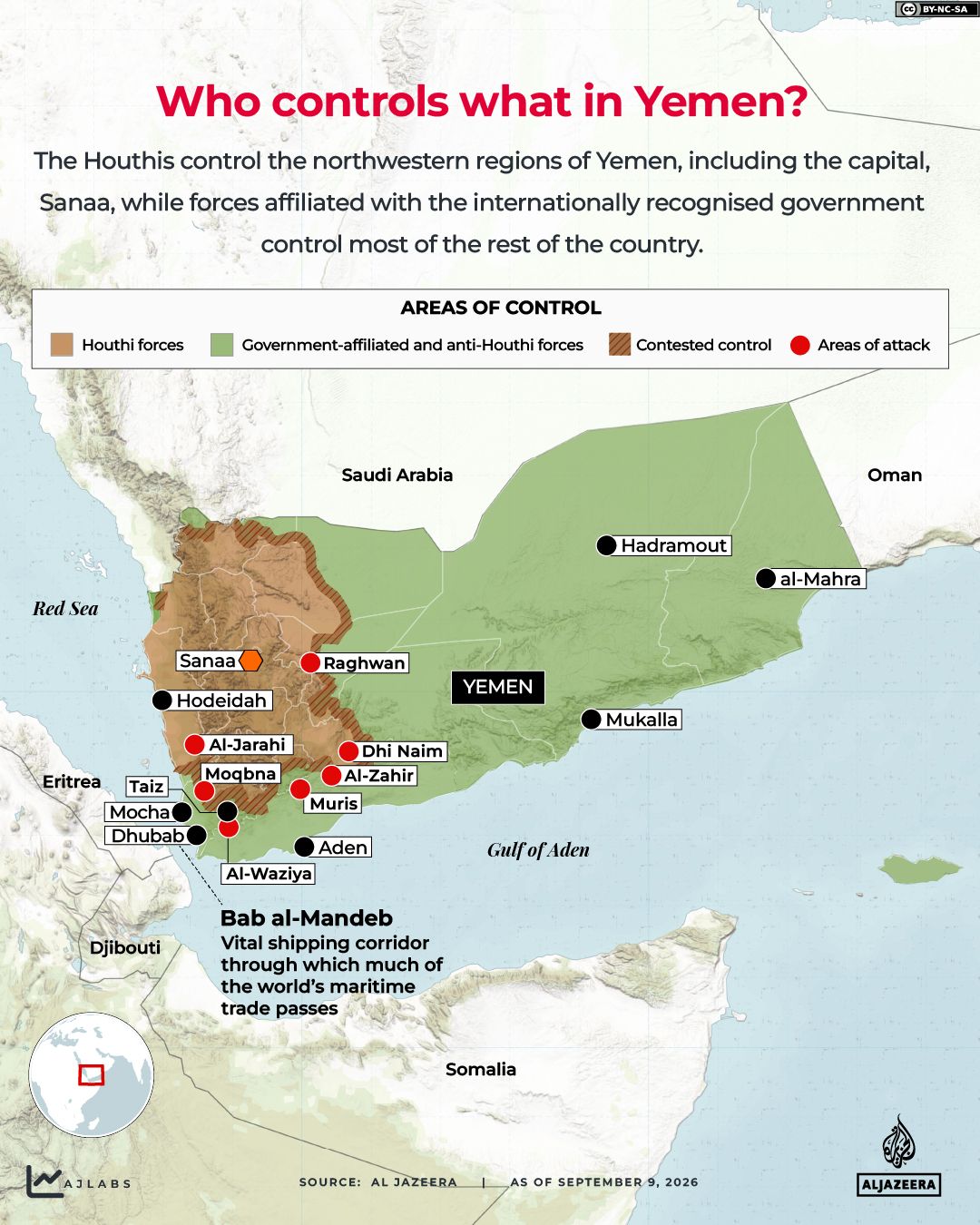
The Houthis captured the Red Sea port of Mokha on Thursday and the nearby island of Mayun, also known as Perim, on Friday. The advances give the group greater proximity to the Bab el-Mandeb Strait, a strategically important maritime passage linking the Red Sea and the Gulf of Aden. The strait is a major route for global commerce and energy shipments. Its importance has increased since shipping through the Strait of Hormuz was restricted by fears of Iranian attacks, although Houthi attacks on Saudi-linked tankers have created new risks in the Bab el-Mandeb.
The Houthis already control much of northern Yemen, including the capital, Sanaa, and the western port city of Hodeida. Their latest territorial gains have prompted renewed concern about shipping security, despite assurances that vessels not covered by their embargo on Saudi-linked shipping would remain safe.
The conflict has also driven people across the Red Sea to Djibouti. Djibouti’s economy and finance minister said about 1,400 refugees arrived from Yemen within 24 hours. The IOM reported that vulnerable people, including women and children, had reached the shores of Obock, with more arrivals expected.
Entities: Houthis, Yemen, Aden, Mokha, al-Khawkha district • Tone: urgent • Sentiment: negative • Intent: inform
13-09-2026
About 1,400 people fled Yemen for Djibouti within 24 hours as Houthi fighters expanded their control around the Bab al-Mandeb strait, according to Djibouti’s economy and finance minister, Ilyas Moussa Dawaleh. The arrivals included women and children, some of whom were rescued at sea after their boats ran out of fuel while attempting the crossing.
The coastal city of Obock, located approximately 20 kilometres from Yemen, has long been a major arrival point for people escaping Yemen’s war. Safiya Ibrahim of the International Organization for Migration (IOM) said that vulnerable groups had reached Obock and that more arrivals were expected. The IOM reported that at least 46,000 people had been displaced inside Yemen since fighting intensified the previous week. Its director general, Amy Pope, said many families were being forced to flee for a second or third time and had very few resources left. She also warned that expanding violence was making it increasingly difficult to deliver lifesaving assistance and called for safe, unimpeded humanitarian access.
Djibouti already hosts tens of thousands of refugees and asylum seekers. United Nations Refugee Agency figures from March 2026 recorded more than 36,000 registered refugees, primarily from Somalia, Ethiopia and Yemen.
The latest displacement followed the reported Houthi seizure of the Red Sea port city of Mocha on Thursday and their advance across the coastline and islands around the Bab al-Mandeb. The offensive has reportedly emptied entire villages in districts including Maqbanah, Jabal Habashi and al-Maafer. The strait is also a migration route in the opposite direction, used by people from the Horn of Africa traveling through Yemen toward Gulf countries.
Entities: Yemen, Djibouti, Obock, Bab al-Mandeb strait, Houthi fighters • Tone: urgent • Sentiment: negative • Intent: inform
13-09-2026
Fighting has intensified across several fronts in Yemen after the Iran-aligned Houthi movement captured the strategic port city of Mocha and the island of Mayyun, giving it control over both sides of the Bab al-Mandeb strait, a major Red Sea shipping chokepoint. Forces loyal to Yemen’s internationally recognised government, backed by Saudi Arabia, have launched air attacks against Houthi positions near Mocha, along the Mocha-Dhubab road, and elsewhere. Government officials say the attacks destroyed vehicles and weapons and killed Houthi fighters, although casualty figures remain unclear.
Saudi Arabia has reportedly carried out more than 100 air attacks in 48 hours, while an Al Jazeera correspondent reported 129 strikes against areas recently captured or contested by the Houthis, including locations near Marib and Taiz. The Houthis have also claimed missile and drone attacks against southern Saudi cities and a military base in Najran province. Saudi officials have not been quoted responding to all of the Houthi claims.
Government forces that withdrew from the western coast are regrouping in Marib, according to Sultan al-Arada, a member of Yemen’s Presidential Leadership Council. He said they would return to the battlefield and continue pursuing the restoration of Sanaa. Analysts cited in the article attribute the government’s setbacks partly to political infighting and fragmented command structures among its various armed factions.
The principal front lines include the western coast and Bab al-Mandeb, Taiz, Marib and al-Jawf, and Dhalea. The conflict has produced a severe humanitarian crisis: the International Organization for Migration says more than 82,000 people have been displaced since the beginning of September, while more than 2,000 Yemenis have fled to Djibouti. The loss of Mocha has also made it harder for aid agencies to reach vulnerable populations. The latest escalation follows a period of relative calm under a UN-brokered truce that ended when fighting resumed in July.
Entities: Yemen conflict escalation, Houthi movement (Ansar Allah), Internationally recognised Yemeni government, Saudi Arabia, Iran • Tone: analytical • Sentiment: negative • Intent: inform
13-09-2026
The supplied material contains only the headline and a brief liveblog marker; the substantive 21 updates referenced by the page are not included. The headline identifies the article as an Al Jazeera live report concerning an “Iran war” and reporting that Saudi Arabia and the Houthis exchanged strikes around Bab al-Mandeb, a strategically important maritime chokepoint. It also labels the page within Al Jazeera’s Hamas News coverage. No details are provided about the timing, targets, casualties, weapons, official statements, or broader political and military consequences of the reported strikes. The available text therefore supports only a limited summary: the liveblog appears intended to provide ongoing coverage of regional hostilities involving Saudi Arabia and the Houthis, with a focus on developments near Bab al-Mandeb and their possible connection to a wider Iran-related conflict. Because the article body is absent, it is not possible to verify the sequence of events, determine which side initiated the reported exchanges, or assess the impact on shipping, civilians, or regional security. The advertisement and alert prompts surrounding the liveblog marker are website interface elements rather than journalistic content. Any fuller account would require the missing update entries from the original Al Jazeera page.
Entities: Iran, Saudi Arabia, Houthis, Bab al-Mandeb, Hamas News • Tone: urgent • Sentiment: negative • Intent: inform
13-09-2026
The article examines the Houthis’ rapid territorial advance along Yemen’s Red Sea coast, including the capture of Mocha, movement into Dhubab, and control of Mayyun (Perim Island) near the Bab al-Mandeb strait. It argues that these gains give the Houthis unprecedented leverage over a vital maritime corridor and transform Yemen’s civil war into part of a wider confrontation involving Iran, Saudi Arabia, Israel, Egypt, the United States and international shipping.
The escalation followed what the article describes as a flawed and misleading period of peace. A UN-mediated truce and subsequent Saudi-Houthi confidence-building measures reduced fighting, but the internationally recognised Yemeni government failed to use the pause to improve governance, build legitimacy or unify its divided military forces. The Houthis, by contrast, consolidated their administration, expanded their missile and drone capabilities, recruited extensively and strengthened their forces. The war in Gaza also provided the movement with a powerful mobilising cause, allowing it to portray attacks on Israel and Red Sea operations as actions taken in defence of Palestinians.
The article distinguishes between Iranian support and direct Iranian control. Iran initially appears to have sought to prevent a broader Red Sea confrontation, but a Saudi strike on Sanaa airport reportedly changed the strategic calculation. Although Iran benefits from disruption to Gulf trade and higher costs for the United States, the Houthis also have independent aims: they want to secure a strong bargaining position and ensure that no future regional settlement can be negotiated without them.
The escalation could produce an unintended advantage for Washington by encouraging Saudi Arabia, Egypt, European countries and Israel to cooperate in defending maritime navigation. However, the article warns that such a naval coalition would not resolve Yemen’s land conflict or reduce civilian suffering. It could instead widen the regional war, deepen Israeli-Saudi-Egyptian coordination and ultimately expose the Houthis to a larger coalition than they can sustain.
Entities: Houthis, Yemen, Sultan Barakat, Mocha, Dhubab • Tone: analytical • Sentiment: negative • Intent: analyze
13-09-2026
The article reports that Yemen’s Houthi movement has seized Mayun Island, also known as Perim Island, a strategically important location in the Red Sea. The island lies near the Bab al-Mandeb Strait, a major maritime chokepoint connecting the Red Sea with the Gulf of Aden and an important route for international shipping. According to the report, the seizure strengthens the Houthis’ control over the strait and expands their strategic position in the region.
The article also states that the Houthis now control millions of dollars’ worth of US-made military hardware that they seized. This suggests that the group’s gains involve not only territory but also access to significant military equipment. However, the brief report does not provide details about when or how the island was captured, whether there was fighting or resistance, the origin of the military hardware, or how the seizure may affect commercial shipping and regional security.
The report frames the development as a major consolidation of Houthi power around the Bab al-Mandeb Strait. Because the strait is strategically important, control of Mayun Island could have implications for maritime traffic, military operations, and the wider Yemen conflict. The article does not include statements from Houthi officials, the internationally recognized Yemeni government, the United States, or other regional actors, nor does it describe any immediate international response. Its primary purpose is to inform viewers of the reported territorial and military gains by the Houthis.
Entities: Yemen, Houthi movement, Mayun Island, Perim Island, Red Sea • Tone: urgent • Sentiment: negative • Intent: inform
13-09-2026
The live update describes a rapid escalation of the Iran-linked conflict in Yemen and its growing threat to regional energy shipments. Yemen’s Houthi movement has seized the strategic Red Sea port of Mokha and the last two islands outside its control in the Bab el-Mandeb Strait. The gains give the group greater ability to target ships passing through the strait, which has become increasingly important for Saudi Arabian oil exports after Iran restricted traffic through the Strait of Hormuz. The Houthis have also declared a maritime blockade of Saudi Red Sea ports.
Saudi-backed Yemeni government forces said they launched strikes against Houthi positions in Mokha, destroying weapons and vehicles and killing fighters. Saudi Crown Prince Mohammed bin Salman has reportedly urged President Donald Trump to take military action against the Houthis, with the two leaders speaking several times as the group advanced along Yemen’s Red Sea coast. The Houthis separately claimed to have attacked a Saudi military base near Sharurah with drones and missiles aimed at weapons depots and command centers.
The update also reports that the Houthis freed 210 members held by Saudi-backed forces after capturing areas near the Bab el-Mandeb. Elsewhere, explosions were reported off Iran’s Qeshm Island in the Strait of Hormuz amid reciprocal attacks involving Iranian targets, oil tankers, U.S. bases and ships attempting to breach a U.S. counterblockade.
At a BRICS summit in New Delhi, leaders including Iranian President Masoud Pezeshkian condemned attacks on civilian infrastructure and safeguarded nuclear facilities, as well as sanctions not authorized by the United Nations. Iran advocated greater use of national currencies in trade to reduce reliance on Western financial systems. India continued balancing its relationships with Russia and Iran against efforts to deepen ties with the United States and Europe. The overall picture is of expanding military confrontation, increasing risks to maritime commerce and heightened pressure on global oil supplies.
Entities: Houthi movement, Yemen, Mokha, Bab el-Mandeb Strait, Red Sea shipping lane • Tone: urgent • Sentiment: negative • Intent: inform
13-09-2026
The live update reports escalating military and political tensions around Iran, Yemen, Saudi Arabia, and key regional shipping routes. Iranian state media said one person was killed and three wounded when a commercial Iranian vessel was struck near the Strait of Hormuz. The United Kingdom Maritime Trade Operations monitor separately confirmed that a vessel was hit by a projectile while transiting the strait, though details remained limited and there was no immediate U.S. military comment.
The report says Iran-backed Houthi forces have expanded their control over Yemen’s Red Sea coast and the strategic Bab el-Mandeb Strait, a development that could further restrict Saudi oil exports after disruptions in the Strait of Hormuz. Yemen’s internationally recognized government, supported by Saudi Arabia, said it had launched strikes against Mokha, a port city recently captured by the Houthis. Government officials described the defeat as painful but said their forces were regrouping for a counteroffensive. One military official attributed the collapse to poor coordination among the army and allied militias, while also questioning why Saudi airpower did not prevent Mokha’s capture.
The Houthis claimed responsibility for drone and missile attacks aimed at a Saudi military base in Sharurah province. Saudi authorities reported sirens, a projectile landing near the Yemen border, two injuries, and damage to a mosque and other buildings, but no independently verified details of the Houthi claims were provided.
Diplomatically, Iranian President Masoud Pezeshkian said Iran and the United Arab Emirates had agreed to “turn the page” after deteriorating relations and attacks linked to the wider Middle East war. At a BRICS summit in New Delhi, Iran and Russia also criticized Western sanctions not authorized by the United Nations, while the group expressed concern about attacks on civilian infrastructure and safeguarded nuclear facilities. Iran advocated greater use of national currencies in trade to reduce dependence on Western financial systems.
Entities: Iran, Strait of Hormuz, Iranian commercial vessel, Yemen’s Houthi movement, Bab el-Mandeb Strait • Tone: urgent • Sentiment: negative • Intent: inform
13-09-2026
A vessel was struck by an unknown projectile while transiting the Strait of Hormuz, according to the United Kingdom Maritime Trade Operations Centre (UKMTO). The attack, reported late Saturday, caused a fire onboard and led local authorities to assist with evacuating the crew. The incident came as direct negotiations between the United States and Iran appeared increasingly unlikely to resume.
Iranian officials rejected the prospect of immediate talks. Ebrahim Azizi, who chairs the Iranian parliament’s national security committee, said negotiations would be futile until Iran’s conditions were met. At the same time, Iran was reportedly pursuing discussions with neighboring Gulf states. Iranian and Gulf officials are expected to meet in Muscat, Oman, to sign an agreement establishing an Iran-Oman shipping route through the Strait, although the agreement would not involve the United States.
Iranian President Masoud Pezeshkian also adopted a defiant stance at the BRICS Summit in New Delhi, saying Iran would not surrender and had resisted aggression from the U.S. and Israel. His remarks followed President Donald Trump’s defense of U.S. military action against Iran and his prediction that the war could end shortly after the November midterm elections.
The report describes weeks of retaliatory attacks affecting shipping in and around the Strait. U.S. Central Command said it had destroyed 10 Iranian tankers and redirected 100 commercial vessels during the previous 60 days of a renewed naval blockade. Oil and cargo shipments through the strategic waterway have slowed sharply, contributing to elevated energy prices. Brent crude settled at $104.61 per barrel and West Texas Intermediate at $100.05 after both benchmarks recently exceeded $100.
Saudi Arabia has attempted to bypass the Strait using its East-West crude pipeline, but the kingdom temporarily shut the facility after drone attacks caused fires and damage near Riyadh and Medina, injuring several people.
Entities: Strait of Hormuz, United Kingdom Maritime Trade Operations Centre (UKMTO), Iran, United States, Masoud Pezeshkian • Tone: urgent • Sentiment: negative • Intent: inform
13-09-2026
Abu Dhabi Crown Prince Sheikh Khaled bin Mohamed bin Zayed Al Nahyan met Iranian President Masoud Pezeshkian on the sidelines of the BRICS summit in India, marking the highest-level UAE-Iran meeting since the start of the US-Israel war with Iran. The meeting took place weeks after the UAE suspended all trade and financial dealings with Tehran because of regional escalation and attacks on Gulf countries.
The UAE said the two leaders discussed efforts to reduce tensions and promote regional stability. However, the meeting did not produce an announcement that the trade restrictions would be lifted or that a specific bilateral agreement had been reached. UAE diplomatic adviser Anwar Gargash has said that geography makes engagement with Iran unavoidable, but that trust will have to be rebuilt through actions rather than statements.
Analysts described the UAE’s approach as an effort to manage the risks posed by Iran rather than isolate or confront Tehran. Maintaining diplomatic channels could help Abu Dhabi avoid becoming a frontline participant in another regional conflict, although restoring even limited confidence is expected to take years.
As BRICS members, the UAE and Iran also backed the summit’s New Delhi Declaration, which called for maximum restraint in the Middle East, protection of civilians and infrastructure, respect for sovereignty, and a diplomatic settlement. The declaration also urged cooperation to protect trade, supply chains and energy flows. Pezeshkian separately criticized unilateral sanctions and attacks on economic and energy infrastructure, advocating the use of national currencies and a stronger role for the BRICS New Development Bank.
The article also reports plans for Arab foreign ministers to meet in Oman to establish a joint Iran-Oman shipping route through the Strait of Hormuz. The UAE has rejected any single country’s control over the waterway and warned that energy exports and trade cannot be held hostage. Iran has linked reopening the strait to the end of the US blockade and attacks. Meanwhile, a merchant vessel was reportedly struck near Iran’s Hengam and Qeshm islands, killing one person, although the source of the strike was not identified.
Entities: Sheikh Khaled bin Mohamed bin Zayed Al Nahyan, Masoud Pezeshkian, United Arab Emirates, Iran, BRICS • Tone: analytical • Sentiment: neutral • Intent: inform
13-09-2026
The article reports a sharp escalation of fighting in Yemen around the Bab el-Mandeb Strait, a strategically important maritime chokepoint linking the Red Sea with the Gulf of Aden. Iran-backed Houthi forces are said to have seized strategic territory near the strait, prompting counterstrikes by Yemen’s government forces and reported air raids by Saudi Arabia. The developments indicate a widening confrontation involving the Houthis, the Yemeni government, and Saudi Arabia, with potential consequences beyond Yemen’s borders.
The Houthis also claimed to have carried out attacks inside southern Saudi Arabia. The article does not provide details about the targets or scale of those attacks, but the claims suggest that the conflict is affecting neighboring territory and increasing regional tensions. The Houthis further threatened to disrupt shipping through the Bab el-Mandeb Strait, raising concerns about the security of one of the world’s key maritime trade routes.
Any disruption in the area could affect commercial shipping and global trade, particularly traffic using the Red Sea. The reported fighting therefore carries implications for both regional security and international economic activity. The article presents the situation as rapidly deteriorating, while distinguishing between confirmed developments, such as the reported territorial seizure and counterstrikes, and claims made by the Houthis or reports of Saudi air raids. It provides a concise account of the escalation but does not include casualty figures, detailed military assessments, or statements from the Yemeni government, Saudi authorities, or international maritime organizations.
Entities: Yemen, Bab el-Mandeb Strait, Houthi forces, Iran, Saudi Arabia • Tone: urgent • Sentiment: negative • Intent: warn
13-09-2026
The article reports a new displacement crisis in Yemen following an offensive by Iran-backed Houthi rebels aimed at seizing the Bab el-Mandeb Strait, a strategically important waterway linking the Red Sea and the Gulf of Aden. More than 70,000 people have reportedly fled their homes as a result of the fighting. Many have sought safety in Aden, while approximately 1,400 people have crossed the sea into neighbouring Djibouti.
The new movement of civilians is described as worsening Yemen’s already severe humanitarian situation. The country has endured 12 years of war, leaving communities vulnerable and placing significant pressure on humanitarian agencies and host areas. The United Nations and the International Organization for Migration have warned that the latest displacement wave is adding to the needs of people already affected by conflict, insecurity and instability.
The Houthi offensive also has wider regional implications because of the Bab el-Mandeb Strait’s importance to international maritime trade and Red Sea shipping. Control of the waterway could give the Houthis significant strategic leverage and increase risks to commercial vessels and regional security. The report places the displacement within a broader series of developments involving Houthi territorial gains and mounting tensions around key Middle Eastern shipping routes.
Although the supplied article excerpt is brief and does not provide detailed figures on casualties, aid requirements or the military response, it emphasizes the immediate humanitarian consequences of the offensive: mass flight, cross-border movement and further pressure on a population already devastated by prolonged conflict. The UN and IOM’s warnings underscore the urgency of responding to the new displacement while addressing Yemen’s longstanding humanitarian crisis.
Entities: Yemen, Houthi rebels, Iran, Bab el-Mandeb Strait, Aden • Tone: urgent • Sentiment: negative • Intent: inform
13-09-2026
The France 24 video report examines how an intensifying Houthi offensive in Yemen is testing Iran’s ability to project influence across the Middle East. The article says that Iran-backed Houthi attacks on Saudi Arabia have increased as fighting spreads near the Bab el-Mandeb Strait, a strategically important maritime chokepoint through which global trade and oil shipments pass. The escalation therefore has consequences beyond Yemen’s civil war, potentially affecting regional security and international shipping.
The report features Farea Al-Muslimi, chairman of the Sanaa Center for Strategic Studies, who assesses the Houthis’ relationship with Iran and the broader significance of the current fighting. Al-Muslimi suggests that the escalation could represent “the last round in Yemen’s current war,” though the article does not provide further details about what might bring the conflict to an end.
The report also frames the Houthi campaign as a growing challenge for Washington. By targeting US allies, the Houthis are increasing pressure on the United States to respond while Donald Trump approaches a crucial election. This connects the conflict in Yemen to wider US strategic and political concerns.
Overall, the article presents the fighting as a dangerous regional escalation centered on the Bab el-Mandeb Strait. It focuses on the Houthis’ ties to Iran, the risks to Saudi Arabia and other US partners, and the potential leverage created by threats to a vital trade and energy route. The report’s central question is whether the latest offensive marks a decisive phase in Yemen’s war or becomes the starting point for an even broader confrontation involving Iran, the United States, and regional allies.
Entities: Yemen, Houthi movement, Iran, Saudi Arabia, Bab el-Mandeb Strait • Tone: analytical • Sentiment: negative • Intent: analyze
13-09-2026
Houthi fighters said they launched drone and missile attacks against the Sharurah military base in southern Saudi Arabia, claiming they targeted weapons depots and command-and-control facilities involved in military operations against Yemen. Houthi military spokesman Yahya Saree announced the operation on social media, but did not specify when the attack occurred.
The reported strike comes amid a renewed escalation between the Iran-aligned Houthis and Yemen’s internationally recognised government forces, which receive backing from Saudi Arabia. Fighting has intensified during the week, prompting increasing numbers of civilians to flee their homes. The article places the developments within a broader regional context, noting that the Houthis have consolidated their position around the Bab el-Mandab Strait, an important maritime route for oil exports following Iran’s blockade of the Strait of Hormuz.
Yemeni government forces said on Saturday that they had attacked Houthi fighters in the Red Sea port city of Mocha and later struck additional Houthi positions in southwestern Yemen. On Sunday, Yemen’s military reported that its air force had carried out three strikes against Houthi positions and barracks in the Taiz region, describing the group as terrorist.
The report also cites US news outlet Axios, which said Saudi Crown Prince Mohammed bin Salman had twice asked US President Donald Trump to approve strikes against the Houthis the previous week. According to Axios, Trump rejected the requests. The article does not provide independent confirmation of the Houthi claim about the Saudi base or further details about casualties, damage, or the reported US decision.
Entities: Houthi movement, Yemeni government forces, Saudi Arabia, Sharurah military base, Bab el-Mandab Strait • Tone: analytical • Sentiment: negative • Intent: inform
13-09-2026
A reported projectile struck a vessel transiting the Strait of Hormuz on Sept 13, according to the British navy-affiliated United Kingdom Maritime Trade Operations agency, although the extent of damage and the crew’s condition remained unknown. The incident intensified concerns over the security of global energy supplies amid an expanding Middle East conflict and came shortly after Saudi Arabia temporarily closed its East-West oil pipeline following a drone attack attributed by Baghdad and Riyadh to Iraq, where Iranian-backed militias operate.
The 1,200km pipeline has been a critical alternative export route during the conflict, carrying an estimated 4 million to 5 million barrels of oil per day, or about 4 per cent to 5 per cent of global supply. Its closure, combined with attacks involving the United States, Iran and Yemen’s Iran-aligned Houthis, has contributed to a sharp rise in energy prices. Brent crude rose above US$100 a barrel, while US diesel prices exceeded US$6 a gallon. Satellite imagery showed smoke near the pipeline south of Medina, and Saudi authorities reported injuries and damage, though the effect on exports was still being assessed.
The attacks have also created pressure on Washington. Saudi Crown Prince Mohammed bin Salman reportedly asked US President Donald Trump for military assistance against the Houthis, but Washington declined direct intervention for now and offered intelligence support. Yemeni officials separately said the Houthis had seized Perim island in the Bab el-Mandeb Strait, another strategically important oil-shipping route.
Diplomatic efforts remain limited. Iran is due to meet Gulf Arab states in Oman to discuss the future of the Strait of Hormuz, but Iranian officials have played down the prospect of a breakthrough. Iran reportedly wants recognition of its control over the strait and the right to collect fees from ships, demands rejected by the United States. Tehran has also set conditions for reopening the waterway, leaving the security of a major global energy corridor uncertain.
Entities: Strait of Hormuz, United Kingdom Maritime Trade Operations (UKMTO), Iran, Saudi Arabia, East-West oil pipeline • Tone: urgent • Sentiment: negative • Intent: inform
13-09-2026
The supplied page extract is a live-news presentation dated September 13, 2026, focused on the regional consequences of the Iran war and related attacks involving Yemen, Saudi Arabia, Iran, Iraq, Bahrain, Israel and Gaza. Its main headline reports that a Houthi projectile strike near the Saudi border injured two people. The accompanying update says the Houthis claimed responsibility for an attack on a Saudi military base, although the extract does not provide further details about the weapon, casualties or damage.
Other listed developments indicate a widening humanitarian and security crisis. About 1,400 refugees reportedly arrived in Djibouti from Yemen within 24 hours, highlighting displacement linked to the conflict. A strike on an Iranian commercial vessel reportedly killed one person, while an Iranian attack left a hole in a tanker off the Iraqi coast. The page also lists a US claim that five Iranian oil tankers were destroyed, as well as an Israeli strike on a residential area in Gaza.
The update list includes political statements from US President Donald Trump and Defence Secretary Pete Hegseth, who denounced Iran at a September 11 memorial. Trump is also quoted as saying he had “no regrets” about US action against Iran, calling for an end to Iran’s nuclear programme and predicting that the war would end after the US midterm elections. Bahrain, meanwhile, is reported to have declined to join a proposed ministerial meeting on the Strait of Hormuz.
The supplied content contains headlines, video titles and timestamps but no full article paragraphs or detailed reporting. Consequently, it establishes the reported developments and the article’s regional focus but does not provide independent verification, official responses, casualty breakdowns or broader context.
Entities: Houthi movement, Saudi Arabia, Iran war, Yemen, Djibouti • Tone: urgent • Sentiment: negative • Intent: inform
13-09-2026
Yemeni government forces and Houthi fighters clashed on several fronts in Taiz as the Iran-backed group continued its rapid expansion along Yemen’s western coast. Yemeni military sources said fighting was concentrated near the Air Defence site west of Taiz city and in Jabal Habashi district, with Houthi forces reportedly retreating after suffering losses. Yemeni aircraft also struck Houthi reinforcements, vehicles, armoured units, positions and barracks in areas including Al Sitteen Road, Al-Rabiei, Hayfan, Al Kadha, Al Mokha and Al Ahkoum. The Houthis reportedly shelled the Al Qasr crossing and residential areas east of Taiz.
The escalation has created a major humanitarian crisis. The International Organisation for Migration said displacement in Yemen had reached 85,818 people, including more than 82,000 displaced during the month. More than 2,000 people fleeing the fighting reportedly reached Djibouti, many of them women and children.
The article also reports a widening confrontation involving Saudi Arabia. The Houthis claimed to have launched missiles and drones at a Saudi military base near the border. Saudi Civil Defence said a projectile struck Jazan, injuring two people and damaging a mosque, buildings and vehicles. Houthi military spokesman Yahya Saree claimed that weapons depots and command centres in Sharurah had also been targeted, although Saudi authorities had not confirmed that claim. US President Donald Trump said Iran was probably responsible for a separate drone attack on Saudi Arabia’s East-West oil pipeline.
The Houthis’ territorial gains include the ports and islands of Mokha, Dhubab, Perim and Zuqar, giving them control of Yemen’s Red Sea coastline and a strategically important position around Bab Al Mandeb. Shipping through the strait reportedly fell from 30 vessels to 15 in one day. The advance is increasing pressure on the US and Saudi Arabia while intensifying displacement and threatening regional trade and energy routes.
Entities: Houthi movement, Yemeni government forces, Taiz, Saudi Arabia, Yemen’s Red Sea coast • Tone: urgent • Sentiment: negative • Intent: inform
13-09-2026
The article reports that US President Donald Trump said the Iran-backed Houthi movement had contacted Washington to express that it did not want to fight the United States and preferred that US forces remain out of the conflict. Trump made the comments during a meeting with Irish Prime Minister Micheál Martin in Dublin as fighting between the Houthis and Saudi-backed Yemeni government forces intensified.
The escalation has included attacks on regional energy infrastructure and missile launches toward southwestern Saudi Arabia. A drone strike on Saudi Arabia’s East-West oil pipeline caused injuries and damage, according to the Saudi foreign ministry. Trump said Iran was probably responsible for the attack, although Iran publicly denies directing the Houthis militarily.
The developments have placed Washington in a difficult position. Saudi Crown Prince Mohammed bin Salman reportedly asked Trump for US military assistance against the Houthis. According to sources cited by Reuters, Washington declined to intervene directly for the time being but agreed to provide intelligence support. Trump confirmed speaking with the crown prince and said the Houthis had separately asked the US not to become directly involved.
The article also notes that the Houthis announced the release of more than 200 members detained by Saudi-backed pro-government forces in areas recently captured by the movement. The Houthis already controlled large parts of northern Yemen, including Sana’a and Hodeida, before making major advances the previous week. The situation reflects the broader regional rivalry involving the United States, Saudi Arabia, Iran, and the Houthis, while raising concerns that direct US involvement could further expand the war.
Entities: Donald Trump, Houthis, Saudi Arabia, Iran, Yemen • Tone: analytical • Sentiment: negative • Intent: inform