13-09-2026
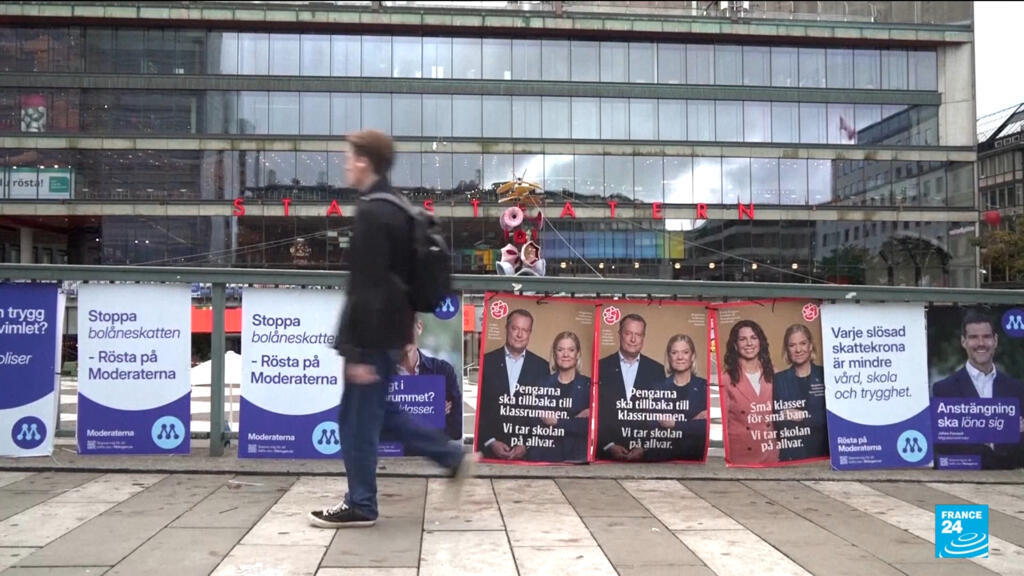
Sweden is preparing for a closely contested general election that could either return the center-left opposition to power or bring the far-right Sweden Democrats into government for the first time. The election pits a four-party left-wing alliance led by former Prime Minister Magdalena Andersson and the Social Democrats against a right-wing coalition headed by incumbent Prime Minister Ulf Kristersson.
Although opinion polls initially suggested a comfortable advantage for Andersson’s bloc, the gap has narrowed in the final days of the campaign. Andersson has framed the election as a choice between a government led by her and one dominated by the Sweden Democrats. The Social Democrats, which have governed Sweden for much of the past century, are campaigning on strengthening the welfare state and addressing rising living costs.
Kristersson’s campaign has emphasized his government’s efforts to reduce violent and organized crime and restrict immigration. Supporters say a right-wing victory would demonstrate public approval of those policies, while critics argue that the agenda threatens civil liberties and unfairly targets immigrants.
The Sweden Democrats, led by Jimmie Akesson, entered parliament in 2010 and could gain formal governmental power under Kristersson’s coalition. Unlike Germany’s major parties, which have generally maintained a political firewall against the far-right Alternative for Germany, Kristersson has promised the Sweden Democrats ministerial positions. Akesson is expected to become migration minister if the alliance wins.
Approximately eight million people are eligible to vote in a country of 10.6 million, where turnout commonly exceeds 80%. Polling stations close at 8 p.m. local time, with initial results expected several hours later. About half of the votes have already been cast in advance.
Entities: Sweden, Swedish general election, Magdalena Andersson, Ulf Kristersson, Jimmie Akesson • Tone: analytical • Sentiment: neutral • Intent: inform
13-09-2026
Sweden is holding a closely contested parliamentary election in which Prime Minister Ulf Kristersson’s centre-right governing bloc is competing against an opposition alliance led by former prime minister and Social Democratic leader Magdalena Andersson. Opinion polls indicate an extremely narrow race between the two main political blocs.
Kristersson currently heads a minority government consisting of his Moderate Party, the Christian Democrats and the Liberals. The government depends on parliamentary support from the Sweden Democrats, a far-right party that has become increasingly influential in Swedish politics. Kristersson has said that, if his bloc wins, he may formally bring the Sweden Democrats into the government rather than continue relying on their external support.
Such a move would represent a historic breakthrough for the Sweden Democrats, allowing the party direct access to government for the first time. It would also confirm the party’s growing influence over Sweden’s political agenda and could significantly reshape the country’s governing arrangements.
Approximately eight million people are eligible to vote in Sweden, whose population is about 10.6 million. More than half of eligible voters had already cast ballots in advance, consistent with Sweden’s traditionally high voter turnout. Polling stations are open from 8 a.m. to 8 p.m. local time. Two exit polls are expected immediately after voting ends, while more reliable partial results are due several hours later.
The election is therefore being closely watched not only as a contest between Kristersson and Andersson, but also as a potential turning point in the role of the far right in Swedish national government.
Entities: Sweden, Ulf Kristersson, Magdalena Andersson, Sweden Democrats, Moderate Party • Tone: analytical • Sentiment: neutral • Intent: inform
13-09-2026
Sweden’s general election is presented as a major test for Prime Minister Ulf Kristersson’s center-right government. Polls place Kristersson’s party slightly behind the center-left Social Democratic Party, led by former Prime Minister Magdalena Andersson. Voters are focused on migration, gang violence, Islamist extremism, unemployment, pressure on public services and the condition of the welfare state.
The Sweden Democrats, a hard-right anti-immigration party led by Jimmie Åkesson, could enter government if Kristersson’s coalition wins another term. The party has supported the government from outside parliament but is reportedly seeking cabinet positions. Although it was founded by activists associated with far-right and neo-Nazi groups, it has attempted to move toward the political mainstream under Åkesson by moderating its rhetoric and removing racist members.
The article describes Sweden’s economic and social model as being under strain. Once viewed as a leading humanitarian and welfare-state example, the country has restructured parts of its welfare system while continuing to provide extensive benefits. Persistent unemployment, crime and public-service pressures have fueled dissatisfaction among both foreign-born and native-born residents.
Crime is a central campaign issue. When Kristersson’s government took office in 2022, Sweden recorded 391 shootings and 62 deaths, according to the Swedish National Council for Crime Prevention. The article says Sweden’s homicide rate is approximately four deaths per million residents, compared with a European average of about 1.6. Although shootings have since declined sharply, experts argue that the reduction does not mean integration problems have been resolved.
Migration is closely linked to these concerns. Sweden accepted more than 160,000 asylum seekers in 2015, many fleeing the Syrian civil war and conflicts in Iraq and Afghanistan. The pressure placed on the reception system prompted successive governments to tighten immigration policy, with the current government taking that approach further.
Entities: Sweden, Ulf Kristersson, Magdalena Andersson, Sweden Democrats, Jimmie Åkesson • Tone: analytical • Sentiment: negative • Intent: inform
13-09-2026
France 24 examines Sweden’s upcoming general election as a potentially significant moment for the country’s far right. The central issue is whether the far right could enter government for the first time, an outcome the article presents as a major development in Swedish politics. The report describes an electoral contest that has become much closer over the course of the summer. Opinion polls had initially indicated a comfortable lead for the centre-left, but that advantage narrowed into a tight race ahead of the election.
The article also focuses on the broader ideological shift taking place in Sweden. It states that far-right ideas have gained ground since the previous election in 2022, suggesting that the campaign is not only about the balance of power between political blocs but also about the changing boundaries of acceptable political discourse and policy. The report relies on commentary from Markus Karlsson-Bourrioux, a journalist with TV4 News, to explain both the movement in public opinion and the increasing influence of far-right positions.
Rather than reporting a confirmed election result, the article presents the election as an uncertain and consequential turning point. Its framing emphasizes the high stakes, the volatility of the polls, and the possibility that a new political configuration could emerge. The article provides limited detail on individual parties, policy proposals, or the precise polling figures, instead offering a concise overview of the electoral dynamics and the significance of the far right’s rising support. Overall, it informs readers about the political context surrounding the Swedish election while analyzing why the result could have wider implications for the country’s government and political direction.
Entities: Sweden, Swedish general election, Far right, Centre-left, TV4 News • Tone: analytical • Sentiment: neutral • Intent: analyze
13-09-2026
The France 24 report examines the growing influence of Sweden’s far-right ahead of a closely fought national election. It says the movement is gaining support by focusing on crime and security, subjects that some voters increasingly connect with migration. This framing has allowed the far right to appeal to concerns about public safety and immigration among parts of the electorate.
The report features Zeth Isaksson, a sociologist at Stockholm University, who explains that Sweden’s far-right movement has attempted to moderate or soften its public image in recent years. According to Isaksson, this shift has made the movement more acceptable to a wider range of voters and may improve its prospects for influencing government after the election.
However, the report also includes a caution against exaggerating the far right’s strength in Sweden. Although the movement is gaining ground and may seek a role in government, its support should not necessarily be interpreted as evidence that it dominates Swedish politics. The report therefore presents a mixed picture: the far right has expanded its appeal through issues of crime, security, and migration, while also facing limits that observers say should be recognized.
Overall, the article places Sweden’s electoral contest within a broader European context in which far-right parties are seeking greater political legitimacy and institutional influence. It informs viewers about the movement’s strategy, its changing public image, and the debate over how powerful it has actually become, without asserting a definitive election outcome.
Entities: Sweden, Swedish far right, Swedish election, Crime, Security • Tone: analytical • Sentiment: neutral • Intent: analyze
13-09-2026
Sweden is holding a closely contested parliamentary election focused heavily on immigration and the country’s political direction. The centre-left opposition, led by former prime minister Magdalena Andersson and the Social Democrats, has maintained a narrow advantage over the governing right-wing bloc in recent opinion polls. However, Prime Minister Ulf Kristersson has narrowed the gap during the final weeks of campaigning, while Andersson’s party has lost support.
The election could produce a major political shift in either direction. If Kristersson’s bloc wins, he has pledged to bring the far-right Sweden Democrats into government for the first time. This would mark a significant development in Swedish politics, where the country has historically been associated with liberalism and a relatively open social model. Alternatively, a victory for the centre-left opposition could move Sweden back toward those traditional political values.
Immigration is a central issue in the campaign. Critics accuse Kristersson’s government of weakening civil liberties and pressuring immigrants to adopt Swedish cultural norms more closely or leave the country. They say the government is using a combination of incentives and penalties to promote conformity. Kristersson, however, argues that cooperation among political parties and voters will allow his administration to act more effectively.
The result will therefore determine not only which bloc governs Sweden, but also whether the Sweden Democrats gain formal power and whether the country continues its recent shift toward stricter immigration policies. The election is described as closely fought, with polls showing a narrow margin and the final outcome uncertain.
Entities: Sweden, Ulf Kristersson, Magdalena Andersson, Sweden Democrats, Social Democrats • Tone: analytical • Sentiment: neutral • Intent: inform
13-09-2026
Swedes are voting in a closely contested parliamentary election that could determine whether the far-right Sweden Democrats enter government for the first time or whether the country returns to a centre-left administration. The centre-left opposition, led by Social Democrat Magdalena Andersson, held a narrow polling advantage over Prime Minister Ulf Kristersson’s right-wing bloc before election day. However, Kristersson narrowed the gap during the final weeks of the campaign as Andersson and the Social Democrats lost support.
The governing bloc argues that its policies have reduced immigration and helped curb gang violence. Kristersson has promised to bring the Sweden Democrats into government if his alliance wins, after relying on the party’s parliamentary support for the past four years. A strong result for the Sweden Democrats, led by Jimmie Akesson, would represent a major breakthrough for the party and reinforce the broader rise of far-right movements across Europe.
Opponents say the government’s policies have weakened civil liberties, pressured immigrants to conform to Swedish cultural norms, and contributed to a harsher and less prosperous society. Andersson has argued for stronger welfare provision, greater public spending and social solidarity, although her potential coalition is divided over immigration, taxation, nuclear power and the role of the Left Party.
The election’s outcome could hinge on whether the Liberals pass the 4 per cent threshold required to win parliamentary seats. If they do, they could strengthen the right-wing bloc, which also includes the Moderates and Christian Democrats. The left-leaning parties face their own coalition difficulties, including the Centre Party’s refusal to support a government involving the Left Party. Both blocs broadly support Ukraine, military rearmament and measures to ease the cost-of-living crisis, but forming a stable government may prove challenging regardless of the result.
Entities: Sweden, Ulf Kristersson, Magdalena Andersson, Sweden Democrats, Social Democrats • Tone: analytical • Sentiment: neutral • Intent: inform