13-09-2026
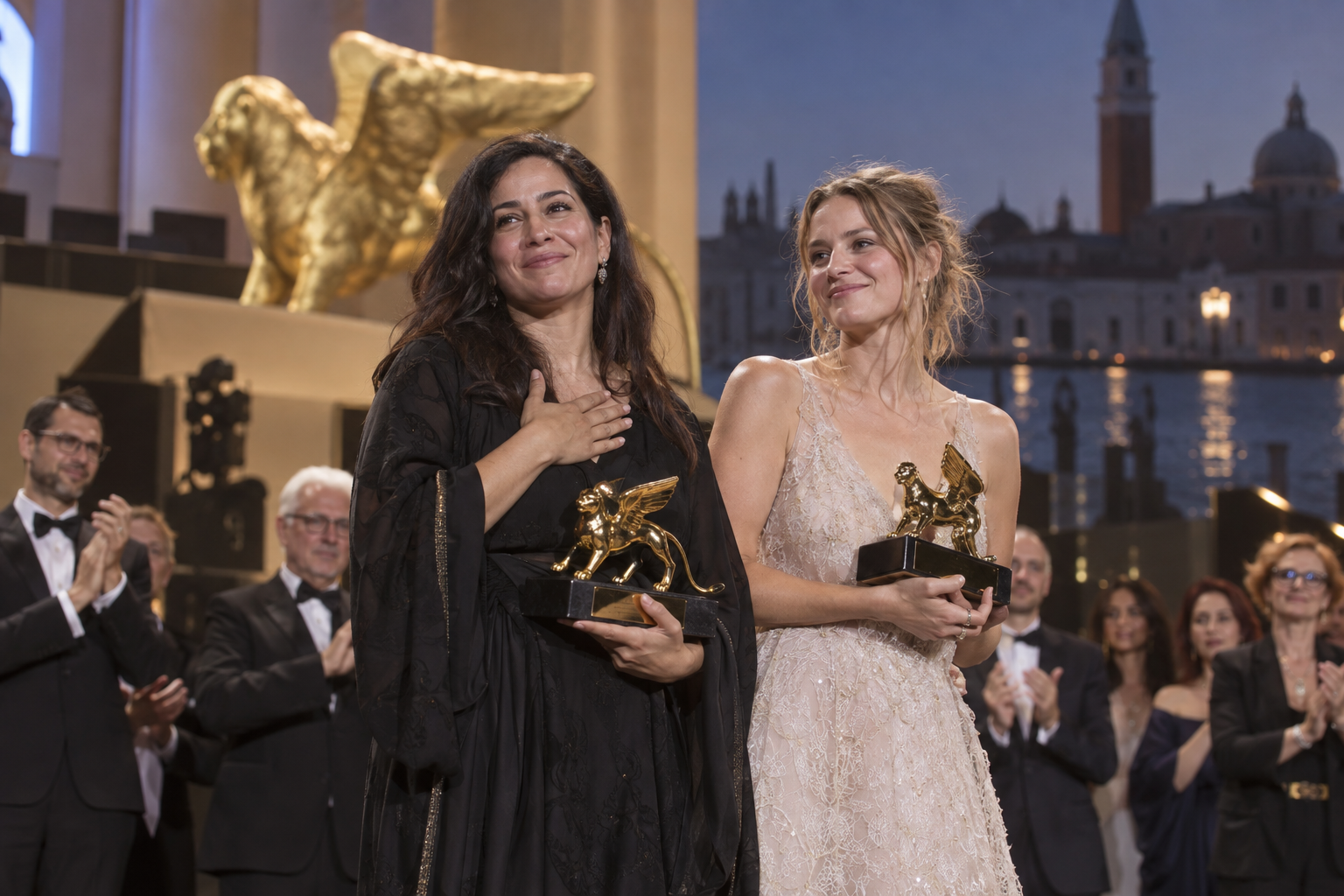
May el-Toukhy’s postwar drama “Woman Unknown” won the Golden Lion, the top prize at the 83rd Venice Film Festival. The film follows Marie, a young nanny and housekeeper who marries her wealthy, older widower employer in Denmark after World War II. Her secret past relationship with a German soldier threatens her reputation and newly acquired social status. Mathilde Arcel, who plays Marie, also won the Best Actress award, giving the film a rare double victory. El-Toukhy was the only woman to have solely directed a film in the festival’s main competition.
South Korean director Lee Chang-dong won the Silver Lion Grand Jury Prize for “Possible Love,” a poetic examination of class and labour and his first feature since 2018’s acclaimed “Burning.” “NAZA,” a documentary by Israeli filmmakers Yuval Abraham and Rachel Szor about military strategies and the war in Gaza, received the Special Jury Prize. The film, made in secrecy over three years and featuring testimony from 24 Israeli military insiders, generated a record-breaking 25-minute standing ovation after its premiere. Abraham said it was especially important for Israelis to see the film.
Ilya Krzhanovsky won the Silver Lion for Best Director for “Dau,” his two-decade project about Soviet physicists who built the atomic bomb. Krzhanovsky, who renounced his Russian citizenship in protest of the war in Ukraine, dedicated the award to Ukrainians, including his mother.
The jury, led by Maggie Gyllenhaal, also honored John Malkovich as Best Actor for Martin McDonagh’s dark CIA comedy “Wild Horse Nine.” Stéphane Brizé won Best Screenplay for “A Good Little Soldier,” while Malou Khebizi received the Marcello Mastroianni Award for emerging actor for “15/18 (A Place to Heal).”
Entities: 83rd Venice Film Festival, Golden Lion, Woman Unknown, May el-Toukhy, Mathilde Arcel • Tone: analytical • Sentiment: neutral • Intent: inform
13-09-2026
The documentary Naza, directed by Yuval Abraham and Rachel Szor, has won the Special Jury Prize at the Venice Film Festival. The film examines Israel’s military operations in Gaza through an investigation conducted over nearly three years and interviews with 24 Israeli military intelligence officers and soldiers. To protect their identities, the participants were filmed at night on Tel Aviv rooftops with their faces and voices digitally altered.
Venice juror and Tunisian filmmaker Kaouther Ben Hania praised the documentary for recording events that are still unfolding. She described the film as brave, necessary and cinematically powerful, emphasizing that the interviewees are presented not primarily through their personal emotions but as participants in a larger military system. Ben Hania also said the film was especially important amid widespread denial about the conflict and its consequences.
Naza was produced by The Guardian and James Wilson, with Jonathan Glazer as executive producer. It explores the use of artificial intelligence in selecting targets and includes testimonies from soldiers who describe military operations conducted despite awareness that civilians were present. The title refers to an Israeli military term for the estimated number of civilians expected to be killed in an air strike.
The award was presented at a ceremony where Danish-Egyptian director May el-Toukhy’s Woman Unknown won the Golden Lion. The film’s recognition followed a lengthy ovation at its premiere, during which audience members displayed Palestinian flags.
Abraham and Szor previously co-directed No Other Land, which won the 2025 Oscar for best documentary feature and focused on the displacement of Palestinian communities in Masafer Yatta in the occupied West Bank. The article also notes Ben Hania’s participation in the Venice jury a year after The Voice of Hind Rajab, a Gaza-set film, won the festival’s Silver Lion Grand Jury Prize.
Entities: Naza, Yuval Abraham, Rachel Szor, Kaouther Ben Hania, Venice Film Festival • Tone: analytical • Sentiment: neutral • Intent: inform
13-09-2026
Danish-Egyptian filmmaker May el-Toukhy discusses Woman Unknown, the historical drama that won the Venice Film Festival’s Golden Lion for Best Film. Her film’s lead actor, Mathilde Arcel, also won the Volpi Cup for Best Actress. El-Toukhy, who previously directed the Sundance audience award winner Queen of Hearts and worked on Netflix’s The Crown, was the only woman directing a main competition entry solo at Venice, making gender representation an unavoidable part of the conversation around her victory.
Woman Unknown is set in Denmark after the Second World War and follows Marie, a young nanny preparing to marry her wealthy employer while concealing a wartime relationship with a German soldier. El-Toukhy and co-writer Maren Louise Kaehne developed the story from 1943 newspaper photographs showing a woman publicly humiliated for allegedly having an intimate relationship with a German soldier. The film examines how women’s bodies became sites of national punishment and propaganda, as well as the moral complexities of guilt, collaboration and retribution after the war.
El-Toukhy also uses the film to question Denmark’s own conduct during the German occupation. She argues that the country’s decision to cooperate with Germany in order to avoid casualties contributed to a later rewriting of the national narrative, in which individuals were punished while broader political compromises were less openly confronted.
The director connects these themes to her upbringing as the daughter of a Danish social worker and an Egyptian computer scientist. Growing up as a brown person in predominantly white Denmark, she became sensitive to the judgment and exclusion experienced by her immigrant father. El-Toukhy says she feels fully connected to both her Danish and Egyptian identities and wants to explore stories about growing up outside Egypt with an Egyptian Muslim background, particularly amid the right-wing political wave that swept across Europe during the 1980s and 1990s.
Entities: May el-Toukhy, Woman Unknown, Venice Film Festival, Golden Lion Award for Best Film, Mathilde Arcel • Tone: analytical • Sentiment: neutral • Intent: analyze