04-10-2026
The Al Jazeera news item reports that ballot boxes have reached remote Indigenous communities in Brazil ahead of the country’s presidential election. It places the delivery in the context of a highly consequential contest, describing it as the country’s most important election in years. Flavio Bolsonaro is seeking to unseat incumbent President Lula, and the article identifies Amazon conservation as a key issue in the campaign. The report therefore connects the practical challenge of making voting accessible in remote Indigenous communities with the wider political stakes of the election and debate over the Amazon. The supplied text does not provide further details about where the ballot boxes were delivered, how they were transported, how Indigenous voters view the candidates, or what either candidate proposes on conservation. It also does not describe the election process or predict an outcome. The item is a brief, factual news introduction rather than a detailed account: it highlights the arrival of ballots, names the principal candidates, and singles out conservation as an issue to watch. Its focus is access to voting in remote communities ahead of the election.
Entities: Brazil, Remote Indigenous communities, Ballot boxes, Flavio Bolsonaro, President Lula • Tone: neutral • Sentiment: neutral • Intent: inform
04-10-2026
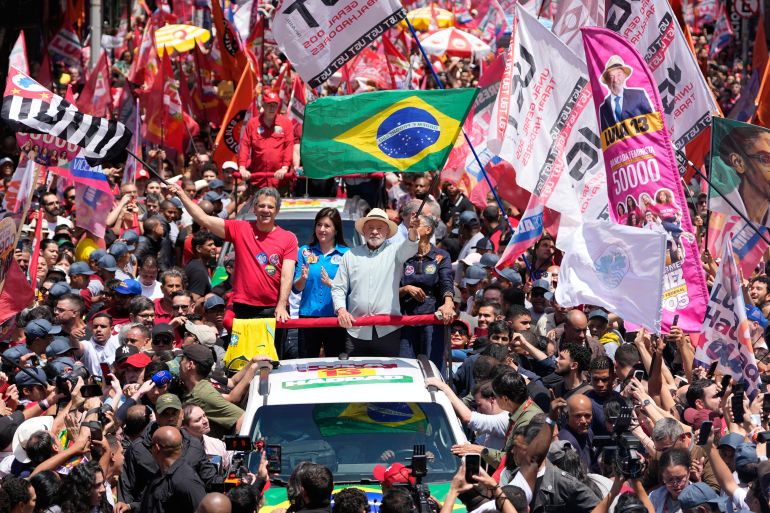
Brazilian President Luiz Inacio Lula da Silva and Senator Flavio Bolsonaro have concluded their campaigns ahead of a closely contested first-round presidential election. Lula, 80, held a march and closing rally in Sao Paulo, where he predicted a first-round victory and described the contest as a choice between “democracy and barbarism.” He also presented the election as a test of Brazil’s sovereignty, warning against US interference. Flavio Bolsonaro, 45, campaigned in Sao Paulo state and Rio de Janeiro, expressing confidence that he could also win outright. He is the son of former President Jair Bolsonaro, who is serving a 27-year prison sentence for attempting to overturn his 2022 election defeat to Lula.
US President Donald Trump’s interest in the election has become a point of contention. Although Trump has not formally endorsed Flavio Bolsonaro, he said he was watching the vote closely. Lula’s supporters view this as possible US meddling, while some Bolsonaro supporters frustrated by living costs say they would welcome outside pressure if it brought change.
Polls published on Saturday showed Lula still leading, but with a narrowing advantage. Neither candidate was considered likely to secure an outright first-round victory, which would send the contest to a runoff on October 25. The race is tighter than Lula’s 2022 victory, when he defeated Jair Bolsonaro by less than two percentage points.
Flavio Bolsonaro’s campaign has also faced scrutiny over financing for Dark Horse, a film about his father. The project was bankrolled by a jailed banker connected to a major Brazilian financial scandal, and Flavio is under investigation in a separate matter concerning alleged defamatory statements about Lula. He has pledged to seek his father’s release if elected and repeated unsubstantiated doubts about the electronic voting system, which analysts say could help lay the groundwork for challenging a loss. Voters will also elect lawmakers, governors, and senators, amid recent gains for right-wing candidates in Latin America.
Entities: Luiz Inacio Lula da Silva, Flavio Bolsonaro, Jair Bolsonaro, Donald Trump, Brazil • Tone: analytical • Sentiment: neutral • Intent: inform
04-10-2026
Brazil’s presidential election is a close and highly polarised contest between incumbent Luiz Inacio Lula da Silva of the Workers’ Party and Senator Flavio Bolsonaro, son of former President Jair Bolsonaro. Around 160 million registered voters are eligible to vote in elections for president, lawmakers, governors and senators. If no presidential candidate wins more than half of valid votes, the top two will face each other in a runoff on October 25. Pre-election polls showed Lula with a narrow lead, which shrank further in projections for a second round.
Flavio Bolsonaro, who voted in Rio de Janeiro, called for change and cited high taxes and violence against women, while expressing confidence that he could win in the first round. Lula, 80, is seeking a fourth, nonconsecutive presidential term and has campaigned on continuing social programmes intended to reduce inequality. Flavio Bolsonaro, 45, has promised a tough approach to crime and insecurity and closer cooperation with the United States under President Donald Trump.
The campaign has unfolded against the backdrop of Jair Bolsonaro’s 27-year prison sentence for his role in a coup plot after losing the 2022 election to Lula by 1.8 percentage points. The conviction of the former president and several military officers has raised concerns about the resilience of Brazil’s democracy and recalled the country’s 21-year military dictatorship. Al Jazeera correspondent Lucia Newman also described Brazil as caught in a broader contest between Washington and China for influence.
Crime, insecurity and the cost of living have dominated the campaign, alongside corruption and concerns about US intervention. A Quaest survey found violence was the most frequently cited concern, followed by corruption, the economy and healthcare. Historian Andre Pagliarini characterised the election as a clash between opposing interpretations of Brazil’s recent history: Lula’s supporters see him as representing democratic consolidation, while the Bolsonaro family portrays the country’s democratic institutions as rotten and unresponsive.
Entities: Luiz Inacio Lula da Silva, Flavio Bolsonaro, Jair Bolsonaro, Brazil, Workers’ Party • Tone: analytical • Sentiment: neutral • Intent: inform
04-10-2026
Brazil’s October 4, 2026 presidential election pits incumbent Luiz Inacio Lula da Silva, 80, against far-right Senator Flavio Bolsonaro, son of jailed former President Jair Bolsonaro. The contest is presented as consequential not only for Brazil but also for Latin America, where recent right-wing victories and the Trump administration’s renewed assertion of US influence have shifted the regional political landscape. Lula has framed his opponent as part of this wider movement and as a challenge to Brazil’s democratic institutions.
Lula, a Workers’ Party leader serving his third presidential term, is associated with social programmes that reduced poverty, efforts to strengthen democracy after military rule, and closer ties with developing countries. Flavio Bolsonaro, running for the Liberal Party, promises a hard line on crime, cooperation with the Trump administration, and measures to curb inflation and government spending. He also describes his father’s conviction as political persecution. Polls show Lula narrowly ahead, but suggest a close race and a likely October 25 run-off if no candidate wins more than half of valid votes. Voters appear to favor Bolsonaro on inflation, corruption and crime, while Lula has an advantage on poverty, inequality, foreign affairs and healthcare.
The article describes Lula as a potential counterweight to the region’s rightward movement, but notes that his government faces frustration over living costs and persistent polarization at home. Brazil’s international position has also become more complicated amid right-wing gains elsewhere and tensions with Washington. Supporters of Lula’s re-election see it as a source of resistance and hope, while European diplomats are watching his policies on human rights and the Amazon. The outcome, the article argues, could redirect Brazil’s role and influence across the continent.
Entities: Luiz Inacio Lula da Silva, Flavio Bolsonaro, Jair Bolsonaro, Brazil, Latin America • Tone: analytical • Sentiment: neutral • Intent: analyze
04-10-2026
Brazil’s general election pits incumbent President Luiz Inácio Lula da Silva against Flávio Bolsonaro, son of former president Jair Bolsonaro, among 12 presidential candidates. Lula narrowly defeated Jair Bolsonaro in 2022; Jair was later convicted of plotting a coup after his supporters stormed Congress. He is now serving a 27-year sentence under house arrest and barred from public statements and social media, but remains central to his son’s campaign. An AI-generated image of Jair endorsing Flávio was shown at the younger Bolsonaro’s campaign launch.
Polls put Lula and Flávio near 40% each, with Lula slightly ahead. A run-off between the top two on 25 October is considered likely if no candidate wins more than half of valid votes on 4 October. However, undecided voters and the limits of polling leave uncertainty. Nearly 160 million people are eligible to vote; voting is compulsory for literate citizens aged 18–70.
Lula, 80, is seeking a fourth presidency for the Workers’ Party. His earlier administrations were praised for reducing poverty through Bolsa Família, though his party was later hit by corruption scandals. Lula’s own corruption convictions were annulled in 2021. In office again, he has faced criticism from environmentalists for supporting exploratory oil drilling near the Amazon, while arguing oil revenues can fund the clean-energy transition. His government points to falling deforestation as evidence of progress. Lula has also defended Brazil’s sovereignty amid strained relations with Donald Trump’s administration and warned against foreign or domestic interference in the election.
Flávio Bolsonaro, a senator and Liberal Party candidate, promises continuity with his father’s politics. His positions include tougher criminal penalties, looser gun laws, courting evangelical and agricultural constituencies, and reducing regulations on farmers. He has questioned whether extreme climate events reflect climate change, while describing them as cyclical. He has also cultivated ties with Trump and pledged to join the US-led “Shield of the Americas” anti-crime alliance if elected. The article begins discussing voters’ concerns, noting that crime and security had been leading issues before a jailed banker scandal emerged; the supplied text ends mid-sentence.
Entities: Luiz Inácio Lula da Silva, Flávio Bolsonaro, Jair Bolsonaro, Brazil, Workers’ Party • Tone: analytical • Sentiment: neutral • Intent: inform
04-10-2026
Brazil’s presidential election opened with a close contest between incumbent Luiz Inácio Lula da Silva and Senator Flávio Bolsonaro, son of former president Jair Bolsonaro. Polls cited in the article show the candidates nearly tied in the first round, making a runoff likely; Quaest’s first-round figures put Lula at 46% and Bolsonaro at 45%. In a projected runoff, the same poll gives Bolsonaro a slight lead, 44% to Lula’s 42%. A second round would take place on October 25. Both candidates ended their campaigns in São Paulo. Lula, 80, drew supporters to a rally where organizers estimated attendance at 150,000 and urged voters to reject the far right. His Workers’ Party platform emphasizes welfare programs, state-funded development, and income redistribution. Flávio Bolsonaro, 45, campaigned on tougher security policies and tax cuts, criticizing Lula over the cost of living and saying Brazil needs change. He has also promised to pardon his father, who is serving a 27-year sentence after being convicted of attempting to overturn his 2022 election loss. The article describes the campaign as bitter and the country as politically divided, with online teams on both sides using gaffes, accusations, rumors, and AI-generated material. It also notes Flávio Bolsonaro’s stated ties to his father’s politics, including relaxed gun laws and skepticism about human-caused climate change, while reporting that he calls himself more moderate. The candidates’ positions intersect with international politics: Lula’s team has criticized the Bolsonaros’ relationship with US President Donald Trump, whose administration imposed tariffs on Brazilian imports and defended Jair Bolsonaro during his coup trial. Besides the presidential contest, Brazil’s roughly 160 million registered voters are choosing lawmakers, governors, and some senators.
Entities: Luiz Inácio Lula da Silva, Flávio Bolsonaro, Jair Bolsonaro, Brazil, São Paulo • Tone: analytical • Sentiment: neutral • Intent: inform
04-10-2026
Brazil’s presidential election is shaping up as a close contest between incumbent Luiz Inacio Lula da Silva and Senator Flavio Bolsonaro, the son of former president Jair Bolsonaro. The candidates concluded their campaigns in Sao Paulo on Saturday, ahead of Sunday’s first-round vote. Lula, 80, is seeking a fourth, non-consecutive term and presented the election as a struggle between democracy and the far right. His Workers’ Party campaign emphasizes welfare programs, public investment and income redistribution. Organizers said about 150,000 supporters attended his rally in Sao Paulo.
Flavio Bolsonaro, 45, has represented Rio de Janeiro in the Senate since 2019. His campaign has stressed tough security policies, tax cuts and the high cost of living, while criticizing Lula’s record. He has also said he would pardon his father, who is serving a 27-year prison sentence for attempting to overturn his defeat in the 2022 election. Flavio portrays himself as more moderate than his father but has described Jair Bolsonaro as his political compass; the two share positions including relaxed gun laws and skepticism of human-caused climate change.
The campaign has unfolded amid deep political division and bitter online exchanges, including slick videos and AI-generated images. Lula’s team has criticized the Bolsonaros’ ties to US President Donald Trump. The article says Trump imposed a 50% tariff on Brazilian imports in response to Jair Bolsonaro’s coup trial, which Trump called a “witch hunt.” Flavio Bolsonaro is also under investigation over alleged corruption, money laundering and tax evasion connected to financing a biopic about his father; he denies wrongdoing.
Polling cited from Quaest puts Lula at 46% and Flavio Bolsonaro at 45% in the first round, with neither expected to clear the 50% threshold needed to avoid a runoff scheduled for October 25. In a possible runoff, the poll gives Bolsonaro 44% and Lula 42%. Brazil’s 160 million registered voters will also elect lawmakers, governors and some senators. The article recalls that Lula narrowly defeated Jair Bolsonaro in 2022, by 1.8 percentage points.
Entities: Luiz Inacio Lula da Silva, Flavio Bolsonaro, Jair Bolsonaro, Brazilian presidential election, Sao Paulo • Tone: analytical • Sentiment: neutral • Intent: inform
04-10-2026
The article examines Brazil’s October 4 presidential election as a closely watched test of whether the country will shift toward the conservative governments that have recently gained ground elsewhere in Latin America. Incumbent Luiz Inácio Lula da Silva, an 80-year-old left-wing president, is narrowly ahead of right-wing senator Flavio Bolsonaro, son of former president Jair Bolsonaro. The article says neither candidate is expected to win the first round outright. A Datafolha poll gives Lula 42% and Bolsonaro 38%, while other polling aggregators cited by electoral strategist Roberto Reis show a closer contest and even a slight Bolsonaro lead in a projected runoff. Reis argues that Datafolha has historically underestimated candidates opposing Lula or his Workers’ Party, citing its 2018 polling of Jair Bolsonaro.
The article presents Brazil’s political direction as consequential beyond the country itself. It describes Brazil as the largest and most economically important remaining obstacle to a broader conservative shift in the Western Hemisphere, noting its standing as one of the world’s largest economies.
A central focus is Flavio Bolsonaro’s effort to cultivate ties with U.S. President Donald Trump and portray himself as a potential American partner. At a White House meeting in May, they discussed organized crime, tariffs, and Brazil’s reserves of rare earths and critical minerals, which the article says could reduce U.S. and European dependence on Russia and China. Bolsonaro also requested that Washington designate Brazil’s two largest criminal organizations—the First Capital Command and Red Command—as terrorist groups. The U.S. State Department accepted the designations in May, effective in June. The article says Lula and his allies viewed the move as U.S. interference in Brazilian domestic affairs and as criticism of Lula’s efforts against organized crime. The supplied article text ends mid-sentence while describing that dispute.
Entities: Luiz Inácio Lula da Silva, Flavio Bolsonaro, Jair Bolsonaro, Donald Trump, Brazil • Tone: analytical • Sentiment: neutral • Intent: analyze
04-10-2026
The France 24 item is a short video portrait of Flavio Bolsonaro, presented in the context of Brazil’s approaching election. It says Brazilians are voting for governors and lawmakers, while the presidential contest is attracting the greatest attention. Although twelve candidates are on the ballot, the race is described as a toss-up between incumbent President Luiz Inacio Lula da Silva and senator Flavio Bolsonaro, the son of Jair Bolsonaro.
Lula is seeking what the article calls a fourth and final term. He warns that Brazil’s sovereignty is at stake, pointing to pressure from US President Donald Trump. Flavio Bolsonaro, by contrast, has emphasized his relationship with the White House and argued that Brazil needs better agreements with the United States. The article specifically mentions potential deals involving Brazil’s rare mineral resources. It identifies the senator as controversial and credits Nick Rushworth with the report; the video credit names Nicholas Rushworth.
The supplied text offers only a brief description of the video’s subject and electoral context, rather than a detailed account of Bolsonaro’s biography, policies, or controversies. It does not provide polling figures, explanations of why the race is considered close, or further detail about the candidates’ positions. The item’s main purpose is therefore to introduce the competing themes framing the presidential contest: Lula’s warning about national sovereignty and Flavio Bolsonaro’s emphasis on ties to Washington and economic agreements. The story is dated October 4, 2026, and categorized under the Americas.
Entities: Brazil, Flavio Bolsonaro, Luiz Inacio Lula da Silva, Jair Bolsonaro, Donald Trump • Tone: analytical • Sentiment: neutral • Intent: inform
04-10-2026
Brazilian voters began casting ballots in a closely contested presidential election between incumbent Luiz Inácio Lula da Silva and Senator Flávio Bolsonaro, son of former far-right president Jair Bolsonaro. Nearly 159 million people are eligible to vote, alongside elections for state governors, legislators and members of Congress. If no presidential candidate wins more than 50 percent, the top two will face each other in a runoff scheduled for October 25. The result could signal whether Brazil joins a regional shift to the right associated with US President Donald Trump.
The candidates offer sharply different foreign-policy orientations. Flávio Bolsonaro has emphasized his relationship with Trump and argued Brazil should negotiate better deals with Washington, including over rare minerals. He has also campaigned to free his father, who is serving a 27-year sentence for attempting a coup, and return him to politics. Lula has strengthened ties with Beijing and criticized Washington, including over tariffs on Brazilian exports and US actions against Brazilian officials. Bolsonaro denies receiving help from the US government.
The contest is highly polarized, with observers saying voters have little meaningful choice beyond the two leading candidates and that accusations often overshadow policy proposals. The previous presidential election was narrowly won by Lula, who defeated Jair Bolsonaro by 2.1 million votes. The current president faces voter frustration over affordability and a corruption scandal involving a Supreme Court justice. Flávio Bolsonaro also faces corruption allegations, including claims that a banker paid him millions of dollars for a film about his father, as well as criticism from Roman Catholics concerned about his relationship with evangelical supporters. Analysts say the close race may turn on late campaign mistakes and undecided voters.
Entities: Brazil, Luiz Inácio Lula da Silva, Flávio Bolsonaro, Jair Bolsonaro, Donald Trump • Tone: analytical • Sentiment: neutral • Intent: inform
04-10-2026
Brazil’s presidential election is described as a closely contested race between incumbent Luiz Inácio Lula da Silva and right-wing Senator Flávio Bolsonaro, the son of former president Jair Bolsonaro. Voters began casting ballots on Sunday, with polls indicating a close contest. Mara Nogueira, a Senior Lecturer in Urban Geography at Birkbeck, University of London, says the tight race reflects the consolidation of Brazil into two opposing political camps. In her assessment, many voters are motivated less by enthusiasm for either candidate than by a desire to prevent the other from taking power. Nogueira identifies the cost of living, religion, and social media echo chambers as important forces shaping voter choices. She also notes a major banking scandal, which has so far had limited impact on Flávio Bolsonaro’s campaign. The article presents the election as a polarized contest influenced by economic concerns, religious and media environments, and negative partisanship, while emphasizing that the scandal has not substantially shifted the campaign to date.
Entities: Luiz Inácio Lula da Silva, Flávio Bolsonaro, Jair Bolsonaro, Mara Nogueira, Birkbeck, University of London • Tone: analytical • Sentiment: neutral • Intent: analyze
04-10-2026
The France 24 article preview describes Brazil’s presidential contest as a race focused chiefly on two candidates, despite twelve candidates appearing on the ballot: incumbent President Luiz Inacio Lula da Silva and Senator Flavio Bolsonaro. Lula is seeking what the preview calls a fourth and final term. His campaign frames the election as a matter of national sovereignty, warning that Brazil is under pressure from US President Donald Trump. Flavio Bolsonaro, by contrast, is presented as emphasizing his connections to the White House and arguing that Brazil should secure better agreements with the United States, including concerning the country’s rare mineral resources. The preview identifies Flavio as a controversial senator and says reporter Nick Rushworth provides further coverage. It also introduces Dr Andrea Aruska de Souza Santos, director of King’s College Brazil Institute in London, as a contributor offering additional insight. The material supplied is a short program description rather than the full report: it does not include the interview, detailed campaign positions, polling, or evidence supporting either candidate’s claims. The central contrast it presents is therefore between Lula’s emphasis on sovereignty and Flavio Bolsonaro’s emphasis on closer ties and improved US trade arrangements. The article’s framing is informational and political, presenting the candidates’ competing messages without declaring a winner or endorsing either position.
Entities: Luiz Inacio Lula da Silva, Flavio Bolsonaro, Jair Bolsonaro, Donald Trump, Brazil • Tone: analytical • Sentiment: neutral • Intent: inform
04-10-2026
France 24 reports that Brazilians began voting in a closely contested presidential election between incumbent Luiz Inácio Lula da Silva and right-wing Senator Flavio Bolsonaro, the son of former president Jair Bolsonaro. The report says nearly 160 million voters are also choosing lawmakers, senators and governors, making the election a broader decision about Brazil’s political direction and institutions as well as its next president.
The article presents the contest in regional and international context. It says the result will help determine whether Latin America’s largest country joins a regional shift to the right championed by US President Donald Trump. It does not provide polling figures, candidate platforms, vote totals or a forecast; instead, it introduces the election and directs viewers to an on-the-ground update from France 24 correspondent Jan Onoszko in Rio de Janeiro. The supplied page identifies the report as a 4-minute, 42-second video, issued on October 4, 2026.
Overall, this is a brief election-day news introduction rather than a detailed analysis. Its focus is the two leading presidential contenders, the large electorate voting across several levels of government, and the possible significance of the outcome for Brazil and the wider region. The wording describes the race as closely watched and closely contested, but does not express a preference for either candidate or report the election’s outcome.
Entities: Luiz Inácio Lula da Silva, Flavio Bolsonaro, Jair Bolsonaro, Jan Onoszko, Brazil • Tone: analytical • Sentiment: neutral • Intent: inform
04-10-2026
Brazilian voters are choosing a president in a closely divided election shaped by corruption scandals, economic pressures and allegations of foreign interference. President Luiz Inacio Lula da Silva, 80, is seeking a fourth term, while Senator Flavio Bolsonaro, son of former president Jair Bolsonaro, is attempting to return his father’s right-wing movement to power. Polls suggest the two are roughly even in a potential October 25 runoff; neither has won over many voters who reject both leading candidates. The campaign has featured little policy discussion, with both front-runners skipping major televised debates.
Relations with the United States have become a prominent issue. President Donald Trump imposed tariffs on Brazil, including measures linked to Jair Bolsonaro’s conviction for plotting a coup, and has publicly praised Flavio Bolsonaro without formally endorsing him. Lula has portrayed the tariffs and US actions as attempts to influence the election. The United States denies interfering. Brazil’s critical mineral reserves are another point of strategic interest for Washington.
Economic concerns include high living costs, household debt, crime, and public finances. Lula has expanded welfare and proposed debt relief, while Flavio Bolsonaro has emphasized cost-of-living concerns and is expected to favor spending cuts, privatizations and other market-oriented policies. Brazil’s government has lowered growth forecasts, and public debt exceeds 82% of GDP.
A fraud investigation involving the failed Banco Master has intensified the campaign’s corruption concerns. Its former head, Daniel Vorcaro, was arrested and accused of a multibillion-dollar fraud scheme. Investigators have examined his connections to public figures, including Flavio Bolsonaro, who denies wrongdoing, and Supreme Court Justice Alexandre de Moraes. Lula has also sought distance from an investigation involving his son, who denies allegations of influence peddling. Voters will additionally elect the lower house and two-thirds of the Senate, where some lawmakers seek to impeach Moraes. These legislative contests matter as Congress has gained influence since 2016.
Entities: Brazil, Luiz Inacio Lula da Silva, Flavio Bolsonaro, Jair Bolsonaro, Donald Trump • Tone: analytical • Sentiment: neutral • Intent: inform
04-10-2026
Brazilian voters are choosing between incumbent Luiz Inácio Lula da Silva and far-right senator Flávio Bolsonaro in a closely contested presidential election with potential consequences for Latin America’s political direction. Lula is seeking a fourth, non-consecutive term. Bolsonaro, an ally of Donald Trump, is the son of former president Jair Bolsonaro, who is serving a 27-year sentence for attempting a coup after losing the 2022 election. The article presents Brazil as one of the region’s remaining leftwing governments following recent rightwing electoral gains and US intervention in Venezuela. Lula has criticized Trump for allegedly trying to influence Brazil’s election in Bolsonaro’s favour, while Flávio Bolsonaro has praised Trump and promised to join a US-led anti-drug-cartel coalition.
Polls showed the race too close to call. Both candidates sought undecided voters and hoped to win outright with more than half the vote; otherwise, a runoff was scheduled for 25 October. Lula framed the choice as one between democracy and “barbarism,” while Bolsonaro called on voters from other rightwing campaigns to support him. A Bolsonaro supporter quoted in the article said he preferred Jair Bolsonaro but saw Flávio as the strongest available alternative to Lula.
Flávio Bolsonaro’s campaign faced questions over a recorded request for $26.8m from a banker accused of corruption to fund a film about his father, as well as speculation about the country’s patron saint. Analysts attributed his competitiveness both to the transfer of his father’s voter base and to opposition to Lula. Lula’s high rejection ratings and corruption allegations involving his son and a former aide have also weighed on his campaign; a separate supreme court scandal has fed anti-system sentiment, although it has no connection to Lula.
The election also includes contests for state governors, state legislatures, all 513 seats in the federal Congress, and 54 Senate seats. A Lula supporter from Amazonas cited his social programmes and record on Indigenous protections and Amazon conservation, warning that these policies could be threatened under Flávio Bolsonaro.
Entities: Luiz Inácio Lula da Silva, Flávio Bolsonaro, Jair Bolsonaro, Donald Trump, Brazil • Tone: analytical • Sentiment: neutral • Intent: inform