04-10-2026
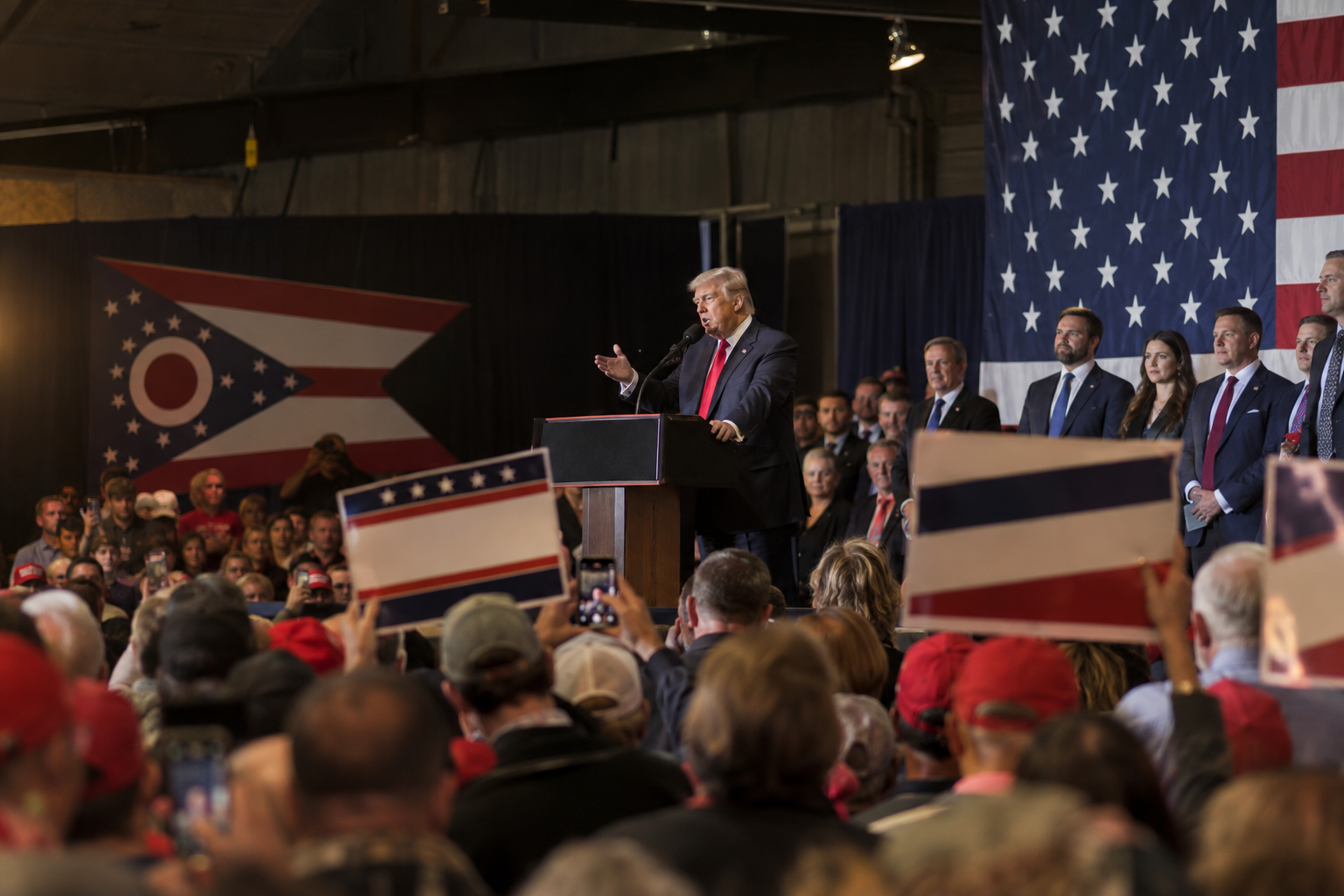
US President Donald Trump rallied for Republican candidates in Vandalia, Ohio, on October 3, expressing confidence that his party would outperform expectations in the November 3 midterm elections. He predicted a “big surprise” and urged supporters to vote, campaigning alongside Republican Senator Jon Husted, gubernatorial candidate Vivek Ramaswamy and other candidates. The article notes that polling has indicated Democrats may gain ground, while Trump’s approval ratings have fallen amid persistent increases in petrol and other household costs.
Ohio is a key test of whether Trump can motivate Republican voters. Husted faces a competitive Senate race against Democrat Sherrod Brown and is counting on the president to energize supporters who might otherwise not vote. Although Trump won more than 55 percent of Ohio’s vote in 2024, economic concerns have weighed on his standing. Ohio’s average petrol price rose 35 percent in a year to $4.16 per gallon, and Canadian retaliatory tariffs linked to Trump’s trade policy affect roughly $3bn in Ohio exports, according to reported 2025 figures. Before the rally, Husted said the US needed to win the Iran war “on our terms” and emphasized his efforts to lower prices.
Trump also defended the growth of data centres, particularly facilities supporting artificial intelligence, arguing they could bring economic benefits to Ohio and would otherwise be built in China. Data centres have become a contentious campaign issue because of concerns about electricity costs, farmland and water supplies. Husted has faced criticism over his role in attracting such facilities as lieutenant governor. A Republican-backed Senate proposal sponsored by Husted would have asked utility regulators to charge large power users more as consumers face high energy bills, but nearly all Democrats blocked it. Brown accused Husted of granting Big Tech billions in tax breaks for data centres and making Ohio residents bear the costs.
Entities: Donald Trump, Jon Husted, Vivek Ramaswamy, Sherrod Brown, Vandalia, Ohio • Tone: analytical • Sentiment: neutral • Intent: inform
04-10-2026
At a campaign rally in Vandalia, Ohio, on Oct. 3, President Donald Trump urged voters to support Republicans in the Nov. 3 midterm elections, combining profane attacks on Democrats with promises of federal assistance and a warning that he would be less willing to help Ohio if Democrats won key races. He appeared alongside Republican Senate candidate Jon Husted and gubernatorial candidate Vivek Ramaswamy. Trump argued that Republican control would give Ohio officials better access to his administration, while polls suggest Democrats may gain ground nationally. Ohio is one of eight states with a competitive Senate race, and Husted faces former Senator Sherrod Brown; Ramaswamy faces Amy Acton.
The article describes economic and political pressures shaping the campaigns. Trump’s approval ratings have fallen amid higher prices and the US-Israeli war with Iran. Ohio gasoline prices rose 35 percent over the past year to an average of $4.16 per gallon, and Canadian retaliatory tariffs linked to Trump’s trade policy affect billions of dollars’ worth of Ohio exports. Husted says he is advocating for lower prices and argues the US must win the Iran war on its own terms. Brown’s campaign, meanwhile, criticized Husted’s support for Trump’s Iran policy and tax arrangements benefiting data centres.
Voters at and around the rally expressed varied views. A young independent voter said higher fuel costs were making it harder to save for his wedding and had not decided how to vote. Rallygoers also disagreed about data centres: one young voter was skeptical, while another attendee advocated building one in place of a steel mill. The Senate contest has attracted tens of millions of dollars in outside spending, making it the country’s second-most-expensive race. The article portrays Ohio as a closely contested battleground where energy costs, trade, data-centre development, and national political issues are influencing voter choices.
Entities: Donald Trump, Jon Husted, Vivek Ramaswamy, Sherrod Brown, Amy Acton • Tone: analytical • Sentiment: neutral • Intent: inform
04-10-2026
Donald Trump defended the expansion of large data centres in the United States during a campaign rally near Dayton, Ohio, arguing that blocking them would shift investment and technological advantage to China. He said the projects could bring substantial economic benefits to Ohio and other communities, and connected data-centre growth to competition with China in artificial intelligence, claiming the US was ahead in “superintelligence.” Trump urged voters to support Republican Senator Jon Husted and gubernatorial candidate Vivek Ramaswamy, and asked them to treat the November 3 midterm elections as if he himself were on the ballot.
Trump also endorsed legislation promoted by Husted, the Ratepayer Protection Act. The measure aims to prevent data centres from raising electricity costs for other consumers and to require the facilities to pay costs associated with their power use. Trump said nearly every Senate Democrat had recently voted to block the bill and promised to sign it within 24 hours if Republicans retained control.
The article places Trump’s defence of data centres against growing local opposition. Residents and officials have raised concerns about the facilities’ substantial electricity and water consumption, land requirements, noise, and the infrastructure needed to serve them. Utilities may need to build power plants, substations, and transmission lines, with uncertainty over whether some costs could ultimately fall on households and other businesses. Critics also question tax incentives for facilities that can cost billions of dollars to build but employ relatively few permanent workers.
In response to such concerns, some states are reconsidering tax breaks and permitting policies, while others are exploring special electricity rates and requirements to make developers cover more project-related costs. Trump’s Ohio appearance was part of a 32-day campaign tour that had also taken him to Texas, Oklahoma, and Alabama ahead of the midterm elections.
Entities: Donald Trump, Ohio, Dayton, China, Jon Husted • Tone: analytical • Sentiment: neutral • Intent: inform