04-10-2026
The article reports claims by Yemen’s Saudi-backed government forces that they killed 700 Houthi fighters in a 24-hour period. The reported deaths occurred as the government forces sought to retake areas of territory they had previously lost. The account presents the figure as a claim by the Saudi-backed forces; it does not independently verify the reported death toll or provide further details about the fighting, the locations involved, or the methods used to establish the number.
The article also notes a separate claim by the Houthis: they said they had targeted an Aramco facility in Riyadh. Saudi authorities had not confirmed that a strike took place. Thus, the report describes competing military claims amid the conflict, while distinguishing what each side said from what had been confirmed. It does not establish whether the alleged attack on the Aramco facility caused damage or casualties, nor does it provide a response from the Saudi-backed forces to the Houthi claim.
Published on October 4, 2026, this brief news report offers only a snapshot of the conflict: government forces say they are trying to recover lost territory, they claim a high number of Houthi deaths, and the Houthis claim to have targeted a facility in Saudi Arabia. The supplied article contains no additional evidence or context with which to assess either claim.
Entities: Yemen, Saudi-backed Yemeni government forces, Houthis, Saudi Arabia, Riyadh • Tone: neutral • Sentiment: neutral • Intent: inform
04-10-2026
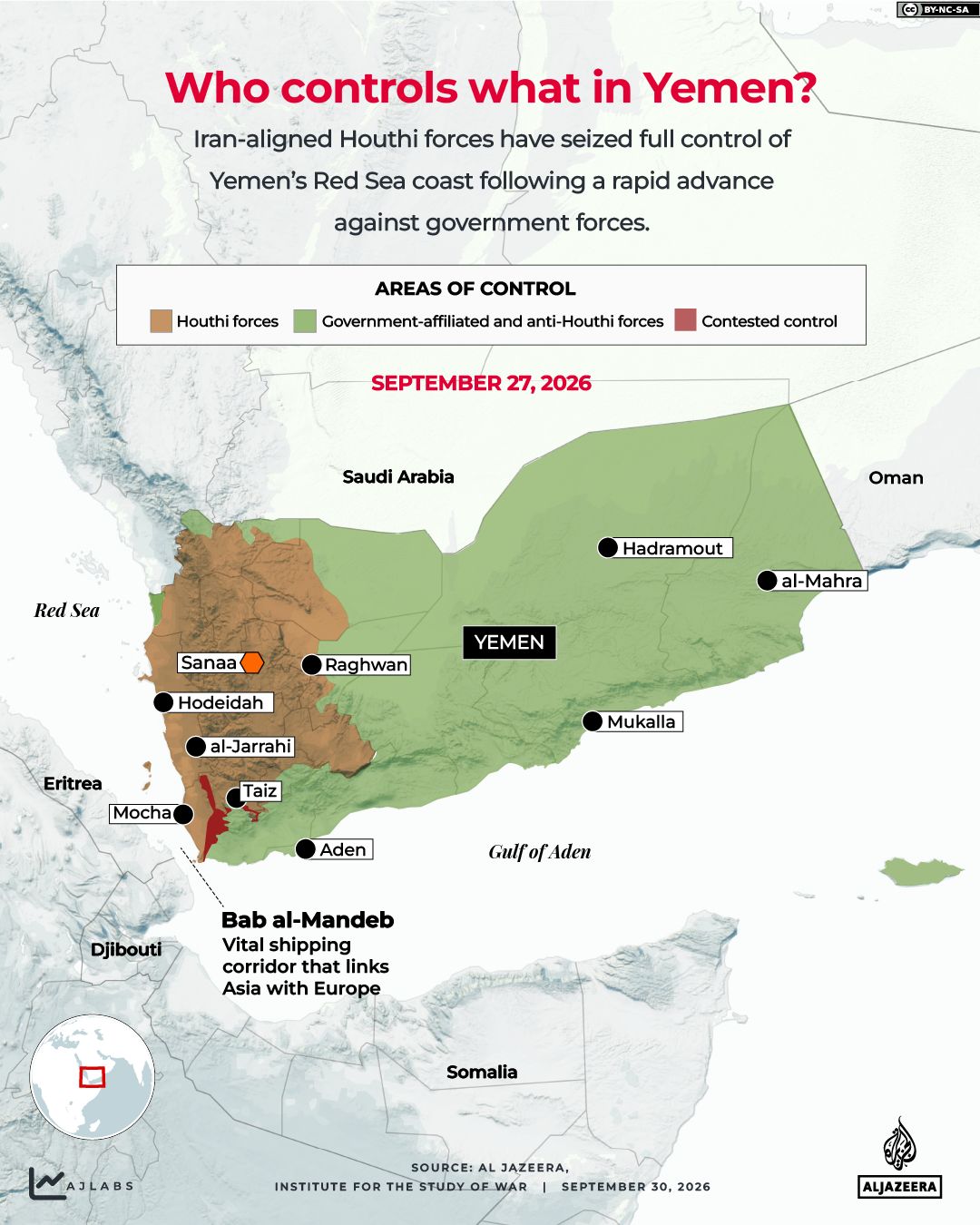
Yemen’s internationally recognised government and the Iran-backed Houthis are fighting for control of Taiz, a populous and strategically important governorate in the country’s southwest. The conflict intensified after Houthi forces seized much of the Red Sea coast in early September, including areas that provide key supply routes to Taiz and lie near the Bab al-Mandeb strait, a vital international shipping route. On October 4, Presidential Leadership Council chief Rashad al-Alimi announced a major government offensive to regain territory.
Taiz’s importance is both geographic and political. Its coastal areas include Mocha, while its capital, Taiz City, remains under government control and is a major source of the government’s legitimacy. The governorate lies between Houthi-controlled northern Yemen and the government-held south; a Houthi advance could cut off government forces from Aden, where important state institutions are based. Fighting is concentrated around Jabal Han, whose position overlooking the city could give the Houthis the ability to threaten access routes.
Neither side has established a clear advantage, and observers describe the battle as a stalemate. Government forces have conducted air strikes and shelling, while Houthi fighters have used artillery, tanks, mortars and rockets in attempts to advance. Both sides report military gains and casualties, but Al Jazeera says it could not verify the government’s claims. Local tribes and government forces have cooperated in resisting Houthi advances.
The renewed fighting is worsening an already severe humanitarian crisis. Nearly 200,000 people have been displaced in Yemen since the escalation began, most from Taiz, and closures of roads into the city threaten access to food, aid and medical care. UNHCR and WHO have warned that the conflict endangers Yemen’s fragile health system. Across the country, nearly half of the population faces acute food insecurity, and about half a million people suffer severe malnutrition.
Entities: Taiz governorate, Taiz City, Rashad al-Alimi, Presidential Leadership Council (PLC), Houthis • Tone: analytical • Sentiment: negative • Intent: inform
04-10-2026
Yemen’s internationally recognised government has announced a new military operation aimed at retaking territory held by the Houthi armed group and restoring state authority nationwide. Presidential Leadership Council head Rashad al-Alimi, who is backed by Saudi Arabia, made the announcement in a televised address on Sunday. He said armed forces, security forces and other military formations had been instructed to carry out assigned tasks under an approved plan, and that state institutions would remain on full alert until the mission was completed.
The announcement follows a sharp escalation in fighting. Colonel Majed Abdullah al-Nazili, a spokesman for government forces, said Yemeni forces carried out 257 precision targeting operations against Houthi positions and capabilities on Saturday. He reported that preliminary estimates suggested at least 700 Houthi fighters were killed. Turki al-Malik, spokesman for the Saudi-led coalition supporting the government, blamed the Houthis’ ties to external agendas for bringing chaos and devastation to Yemen. The coalition separately said it had conducted 97 operations against Houthi reinforcements on the Tor al-Baha front and Taiz axis, deploying aircraft, drones, artillery, missiles and snipers.
The renewed fighting comes after a fragile truce dating to 2022 collapsed in July, prompting the displacement of hundreds of thousands of people, according to the article. In mid-September, the Houthis seized Mocha and strategic islands in the Bab al-Mandeb Strait, a major passage for global oil shipments, before anti-Houthi forces stabilised the front lines. Yemen’s conflict began in 2014, when the Houthis took the capital, Sanaa, forcing the government to retreat to Aden. The article reports the government’s announcement and military claims but does not independently verify casualty figures or describe the operational plan in detail.
Entities: Rashad al-Alimi, Yemen, Presidential Leadership Council, Houthi armed group, Saudi-led coalition • Tone: neutral • Sentiment: negative • Intent: inform
04-10-2026
Yemen’s Presidential Council head, Rashad al-Alimi, announced the start of a major military operation intended to retake territory held by the Iran-backed Houthis and restore the government’s authority across the country. His announcement came as Houthi forces advanced around Taiz, a government-held city in southwestern Yemen, and reportedly seized al-Safiya, cutting the main supply road and a key route connecting Taiz with Aden. Security and military sources told AFP that the move had effectively isolated the city, although government forces still controlled Taiz itself and fighting in the surrounding area continued.
The latest escalation follows a Houthi offensive that began in September and captured large stretches of Yemen’s Red Sea coast, including the strategically important Bab al-Mandab Strait. The article describes the renewed fighting as part of a wider deterioration in a war that had seen several years of relative calm before reigniting in July amid a broader regional conflict. Houthi media also reported Saudi airstrikes in northern governorates, while Yemen’s government said its forces had struck Houthi positions around the country. However, the Yemeni government’s own air capabilities are limited, and experts believe recent air operations were likely carried out by Saudi aircraft.
The conflict began in 2014, when the Houthis took the capital, Sanaa, and expanded their control across parts of northern Yemen. Saudi Arabia intervened the following year in support of the government. The renewed fighting is unfolding alongside severe humanitarian hardship in one of the world’s poorest countries and amid regional pressure on shipping and energy exports. An analyst quoted by AFP said the Houthi operation had achieved the objective of isolating Taiz from Aden, even without capturing the city.
Entities: Rashad al-Alimi, Taiz, Aden, Sanaa, Yemen • Tone: analytical • Sentiment: negative • Intent: inform
04-10-2026
Yemen’s Saudi-backed President Rashad al-Alimi announced on Oct. 4 that government forces would begin a major operation to retake territory held by the Iran-backed Houthis and restore state authority nationwide. The announcement follows reports that Saudi Arabia and its Yemeni allies had been preparing an offensive, with Saudi forces expected to provide aerial support and Yemeni forces to fight on the ground.
The Houthis have recently made major advances. They seized the strategically important Bab el-Mandeb Strait after a rapid coastal offensive that reportedly caused government forces to collapse. The strait is a key passage between the Red Sea, the Mediterranean and Asia, and has become more important as the Iran conflict has effectively closed the Strait of Hormuz. The Houthis have also gained ground on hilltops near Taiz, advancing toward the last road connecting the city with Aden, where the Saudi-backed government is based. If they control that route, Taiz—Yemen’s third-largest city, home to hundreds of thousands of civilians—could face an effective siege.
A siege would deepen an already severe humanitarian crisis and could make it harder for government forces to retake the surrounding coastal area. Analyst Mohammed Al-Qadhi said Houthi control of the mountains overlooking the coast would help protect their position and complicate any future counteroffensive. The renewed fighting follows a truce agreed in 2022 that largely held until 2026, when Houthi missile and drone attacks on Saudi shipping and oil infrastructure escalated amid the wider Iran conflict. The World Food Programme reported that three in four families in parts of Yemen are going hungry, while fighting has displaced tens of thousands and disrupted supplies to millions.
Entities: Rashad al-Alimi, Mohammed Al-Qadhi, Yemen, Saudi Arabia, Iran-backed Houthis • Tone: analytical • Sentiment: negative • Intent: inform
04-10-2026
Yemen’s armed forces said on Sunday, October 4, that they were conducting strikes against the Iran-aligned Houthi movement in the capital, Sanaa, and in Saada, a Houthi stronghold. A spokesperson for forces aligned with Yemen’s internationally recognised government said the targets were “vital targets” but provided no further details. Houthi-run Al Masirah TV had earlier reported an attack on Sanaa, which it attributed to Saudi Arabia. Saudi Arabia had not immediately confirmed that report, and the article does not establish whether the reported attack and the armed forces’ announcement refer to the same strikes.
The report places the latest hostilities in the context of Yemen’s broader conflict. Fighting between the Houthis and forces aligned with the Saudi-backed government had largely stopped after a 2022 truce, but, according to the article, hostilities resumed this year amid spillover from the wider war between Iran and the United States. The Houthis declared a naval blockade on Saudi Arabia in July and began attacks on Saudi territory and shipping. Houthi forces also made significant territorial gains along Yemen’s Red Sea coast. Saudi Arabia responded with air strikes in Yemen and support for government forces fighting the Houthis. The article, attributed to Reuters, provides no casualty figures or details about the strikes’ results.
Entities: Yemen, Sanaa, Saada, Yemen's armed forces, Houthis • Tone: neutral • Sentiment: neutral • Intent: inform