27-08-2026
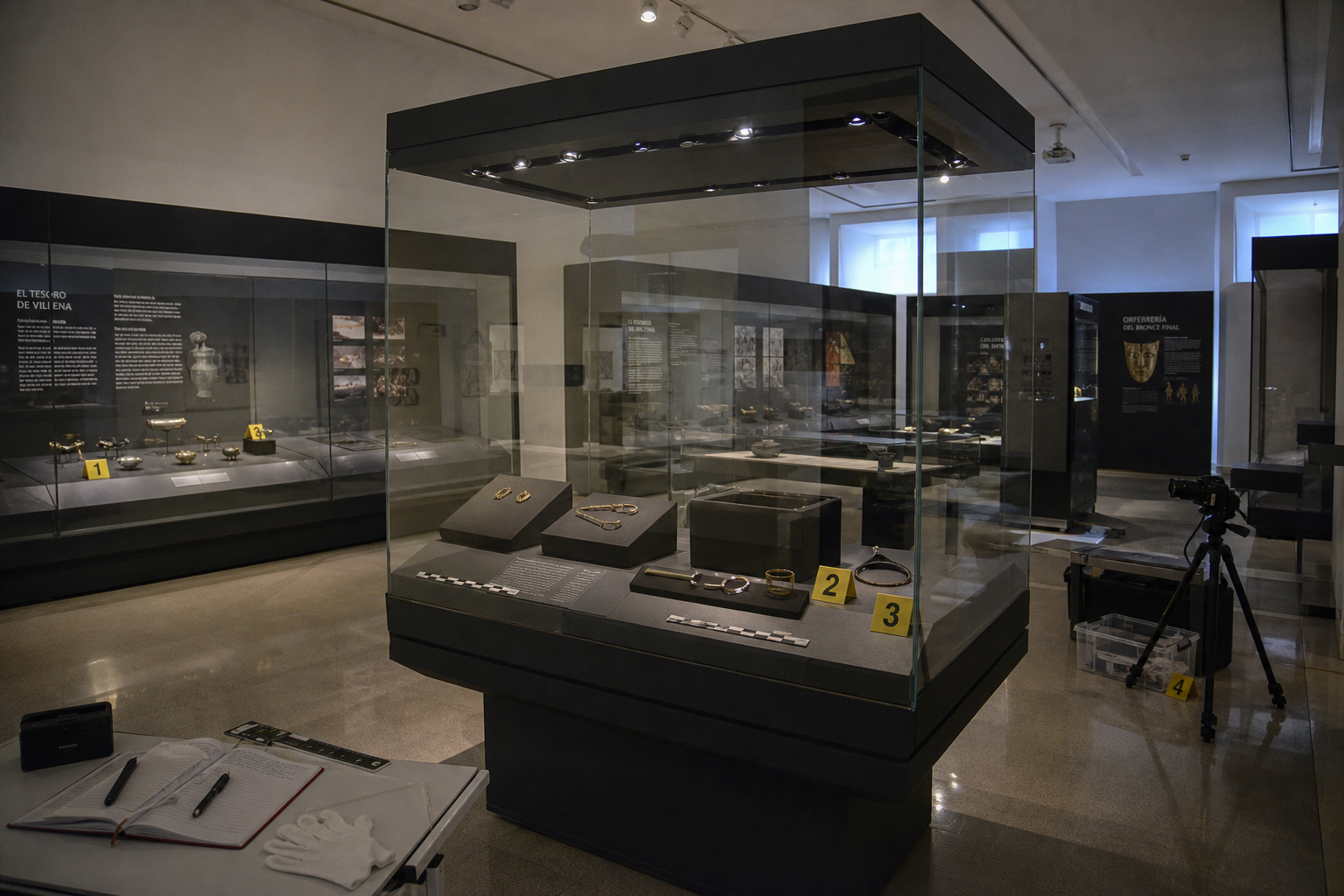
Thieves stole gold jewellery and other Bronze Age artefacts from the Villena Museum in Alicante province, Spain, during a four-minute overnight raid. The stolen objects came from the Treasure of Villena, one of Europe’s most important prehistoric gold collections, which contains nearly 10kg of gold along with silver, iron and amber items dating to around 1,000 BC. Police are still determining the precise number of missing objects, but the museum confirmed that rings, bowls and bracelets were taken. Villena’s mayor, Fulgencio Cerdán, said the thieves had taken “a large part of the treasure”, including all the gold.
The robbery reportedly began with a diversion at a nearby sports centre. At about 05:15 local time, its alarms activated, drawing police officers away from the museum. The museum alarm sounded approximately five minutes later, and the thieves reportedly entered and left within four minutes, before officers arrived. A spokesman for Villena town council described the operation as “super fast and super professional” and said that all the museum’s security systems had worked, with no apparent security failure.
The collection consists of more than 60 objects, including 29 bracelets, 11 bowls, three bottles and other pieces. It was discovered in 1963 by archaeologist José María Soler inside a vessel buried in a dried-out riverbed. The mayor said the town was devastated because the collection formed part of Villena’s heritage and wealth.
The theft is the latest in a series of high-profile museum raids in Europe. The article also cites the 2025 Louvre robbery in Paris, the theft of four works by Renaissance artist Antonello da Messina in Sicily, and the recovery of paintings by Renoir, Cézanne and Matisse stolen from a museum near Parma.
Entities: Treasure of Villena, Villena Museum (MUVI), Villena, Alicante province, Spain • Tone: urgent • Sentiment: negative • Intent: inform
27-08-2026
Thieves raided the Villena Museum in southeastern Spain early Thursday, stealing most of the Treasure of Villena, one of Europe’s most important Bronze Age gold collections. The alarm sounded at about 5:20 a.m., and officials said the thieves had left by 5:24 a.m., making the operation exceptionally fast. Investigators believe the group entered through a window after arriving in several vehicles. Authorities are examining whether a separate alarm at a nearby sports center was deliberately triggered as a diversion.
The stolen collection consists of more than 50 objects, including 29 bracelets, 11 bowls, three bottles and other pieces made primarily of gold, along with items crafted from silver, iron and amber. The objects date to approximately 1,000 B.C. and were discovered in 1963 by archaeologist José María Soler in a vessel buried in a dried riverbed near Villena. Although the treasure’s historical value is considered incalculable, the gold alone is estimated to be worth about $2 million.
Villena Mayor Fulgencio Cerdán said the town was devastated by the loss, describing the collection as part of its heritage and wealth. Museum and municipal officials rejected the suggestion that a security failure enabled the robbery, saying all security systems were activated.
The theft is the latest in a series of high-profile museum robberies across Europe. The article references the Louvre jewelry heist in Paris, the theft of Renaissance paintings in Sicily, the recovery of works by Renoir, Cézanne and Matisse stolen near Parma, and recent robberies involving Lalique jewelry and French national treasures. The incidents have renewed attention on security at cultural institutions.
Entities: Treasure of Villena, Villena Museum, Villena, Spain, Alicante province, Bronze Age • Tone: urgent • Sentiment: negative • Intent: inform
27-08-2026
Thieves carried out a rapid early-morning raid on the Villena Museum in eastern Spain, stealing almost the entire Treasure of Villena, one of Europe’s most important Bronze Age gold collections. The alarm sounded at about 5:20 a.m., and the group reportedly escaped within four minutes after entering through a window. Museum security systems were activated, and local officials said there had been no apparent security failure.
The stolen collection consists of more than 50 objects dating from approximately 1300 to 1000 BCE, including gold bowls, bottles, bracelets, and other ceremonial items. Only three silver vessels, a bracelet, an earring, and one of the collection’s four crowns were left behind, apparently after being dropped by the thieves. The collection was discovered in 1963 by archaeologist José María Soler in a buried vessel in a dried riverbed.
The treasure is considered historically invaluable. Recent research has shown that two iron pieces in the collection were made from meteoritic metal, making them among the earliest known examples of iron use in Western Europe. Although the artifacts could be difficult to sell on the black market because of their fame and recognizability, the mayor estimated the gold’s raw value at about €1.7 million ($2 million).
Villena Mayor Fulgencio Cerdán expressed deep distress, describing the collection as part of the town’s heritage and wealth. The theft is the latest in a series of high-profile European museum heists. The article cites the Louvre robbery, in which jewelry worth millions was stolen in under 10 minutes, as well as the theft of four works by Renaissance painter Antonello da Messina in Sicily and the recovery of paintings by Renoir, Cézanne, and Matisse near Parma.
Entities: Villena Museum, Villena, Spain, Alicante province, Treasure of Villena, Bronze Age gold artifacts • Tone: urgent • Sentiment: negative • Intent: inform