26-08-2026
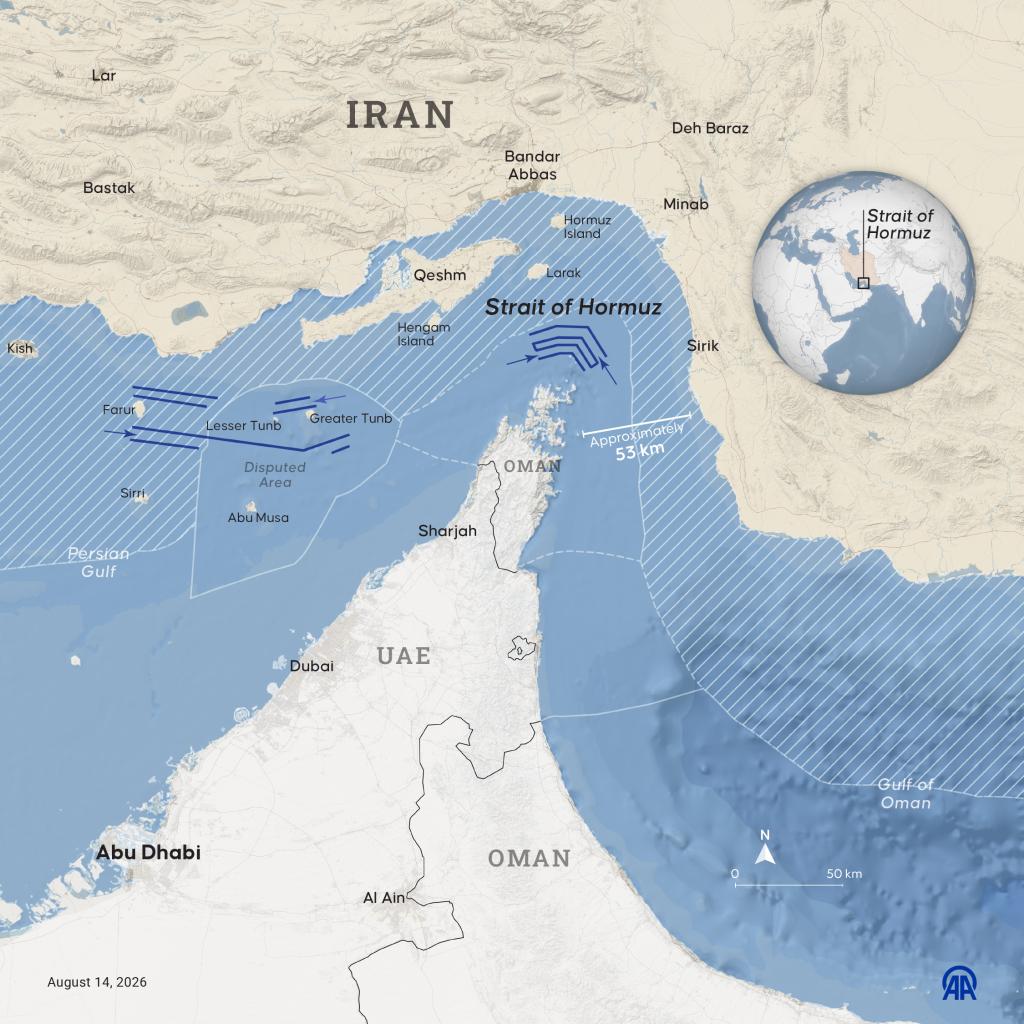
Iran and Oman have agreed to establish a temporary shipping corridor through the Strait of Hormuz, allowing commercial vessels to transit the strategically important waterway despite ongoing tensions over its security and reopening. Under the arrangement, inbound commercial ships may use Iranian waters, while outbound vessels would pass through both Iranian and Omani waters. Military vessels will be excluded from the corridor, and Iran emphasized that the agreement does not represent a full or immediate reopening of the strait.
Iranian Deputy Foreign Minister for Legal and International Affairs Kazem Gharibabadi said the temporary route would operate while the two countries negotiate a permanent arrangement over the next 30 to 60 days. He warned that Iran could keep the waterway closed if its conditions are not met. The agreement is part of a broader phased framework discussed by the two governments.
The deal also includes plans for Iran and Oman to pursue a joint project to clear mines from the waterway. Gharibabadi rejected U.S. claims that mines in international waters had already been removed or detonated, calling those assertions propaganda. He further warned that U.S. minesweepers entering the area would be targeted. His remarks followed U.S. President Donald Trump’s statement that all mines in the international waters of the strait had been cleared or detonated, along with his warning that vessels laying new mines would be destroyed.
The understanding followed a visit to Tehran by Omani Foreign Minister Sayyid Badr bin Hamad Al Busaidi, who met Iranian Foreign Minister Seyed Abbas Araghchi. The Strait of Hormuz connects the Persian Gulf with the Gulf of Oman and the Arabian Sea and is a major global energy and shipping chokepoint. The temporary corridor may offer limited relief to commercial shipping, but disputes over mine clearance, military access, Iran’s conditions and the prospects for a permanent reopening remain unresolved.
Entities: Iran, Oman, Strait of Hormuz, Kazem Gharibabadi, Donald Trump • Tone: analytical • Sentiment: negative • Intent: inform
26-08-2026
The live report covers escalating tensions surrounding Iran, the Strait of Hormuz, US sanctions and the possibility of renewed military confrontation, while also including related developments involving Israel and cyberwarfare. Iranian newspaper editor Mokhtar Haddad says ongoing Iran-Oman discussions about managing the Strait of Hormuz should not be interpreted as an agreement to reopen it. He says Tehran considers the Strait’s status separate from negotiations and will only reconsider it if the United States returns to implementing an existing memorandum of understanding and accepts Iranian conditions.
Haddad also rejects the idea that Iran will wait until after the US midterm elections before responding to Washington. He argues that US officials may be seeking to delay broader military action until after the elections, but says Iran will take necessary measures if the United States fails to meet its commitments. He characterizes newly announced sanctions and a blockade as largely repeating existing measures, while warning that Iran’s military outlook and doctrine have changed.
Reporting from Tehran, Tohid Asadi describes worsening economic conditions, including high inflation, rising prices and a sharp decline in the value of Iran’s currency. Diplomatic activity by Oman and Pakistan offers some hope, but new US sanctions and deep mistrust continue to undermine prospects for rapprochement.
The sanctions target five sectors: shipping, gold, digital assets, aviation and technology. The measures are intended to close channels Iran uses to bypass restrictions and affect trade, payments, transportation and long-term industrial and military capacity.
The report also notes that more than 20 Marvel actors have joined a campaign seeking the release of Palestinian politician Marwan Barghouti, who campaigners say has been held in solitary confinement and mistreated by Israel. Separately, an analysis warns that cyberattacks on critical infrastructure could become an increasingly important dimension of the Iran conflict, with consequences extending well beyond the Middle East.
Entities: Iran, United States, Strait of Hormuz, Oman, Pakistan • Tone: analytical • Sentiment: negative • Intent: inform
26-08-2026
The supplied material does not include the body of the Associated Press article. It consists primarily of AP News navigation menus, newsletter promotions, unrelated headlines, section labels and other website content, along with the article headline: “Iran warns of military ship ban in Hormuz under potential deal with Oman.”
Based on the headline alone, the article concerns a warning issued by Iran regarding a possible prohibition on military ships in the Strait of Hormuz. The proposed restriction would apparently be connected to a potential agreement between Iran and Oman. The headline indicates a significant maritime and regional-security issue because the Strait of Hormuz is a strategically important waterway linking the Persian Gulf with the Gulf of Oman and the Arabian Sea. Military-ship access in or around the strait could affect regional tensions, naval operations and broader security arrangements in the Middle East.
However, the supplied text does not provide the details needed for a full account. It does not identify the officials who issued the warning, explain the terms or status of the potential agreement, specify which military vessels might be restricted, or describe Oman’s position. It also contains no information about the timing, legal basis or expected consequences of such a ban, and it provides no reactions from other governments or military organizations. Therefore, this summary is limited to the information explicitly conveyed by the headline. The article body would be required to produce a complete, evidence-based summary of the reported proposal and its implications.
Entities: Iran, Oman, Strait of Hormuz, Persian Gulf, Gulf of Oman • Tone: analytical • Sentiment: neutral • Intent: inform
26-08-2026
The article reports escalating economic and diplomatic pressure in the nearly six-month Iran-U.S. war, while regional governments pursue negotiations over the Strait of Hormuz. Iranian Economy Minister Ali Madanizadeh said Tehran had prepared for the latest U.S. sanctions for two years and was ready to withstand them. U.S. Treasury Secretary Scott Bessent, however, argued that Iranian leaders were “panicking” and that the sanctions were beginning to work. Iranian officials rejected that assessment, saying the United States lacked the economic leverage to isolate Iran and that the sanctions would fail.
The new U.S. measures are intended to sever Iran’s remaining economic ties with trading partners and break a diplomatic stalemate through increased financial pressure. China warned Washington not to interfere with its lawful business dealings with Iran. Pakistan also continued mediation efforts, with Interior Minister Mohsin Naqvi describing talks with Iranian President Masoud Pezeshkian as positive and productive. Pakistan helped mediate a June memorandum of understanding between Washington and Tehran.
A major focus of the negotiations is reopening the Strait of Hormuz, a vital maritime route. Iranian, Omani, Qatari and Pakistani officials discussed a temporary shipping corridor, joint mine-clearing operations and the future management of the strait. Oman said it was hopeful that a temporary corridor and practical arrangements for safe navigation could soon be announced. Qatar expressed support for diplomatic efforts aimed at restoring maritime freedom and achieving sustainable peace.
Oil prices fell for a second consecutive day despite the new sanctions, with Brent crude declining 3.8% to $87.14. The market has fluctuated sharply as expectations for a U.S.-Iran agreement have changed.
Separately, Israeli forces seized a UNRWA-run vocational school near Jerusalem. The United Nations called the action unlawful and said it deprived 340 Palestinian refugees of educational services. Israel defended the seizure by arguing that UNRWA did not own the land and reiterated its broader opposition to the agency.
Entities: Iran, United States, Strait of Hormuz, Persian Gulf, Scott Bessent • Tone: analytical • Sentiment: negative • Intent: inform
26-08-2026
The live updates describe escalating economic pressure on Iran, diplomatic efforts to reopen the Strait of Hormuz, and related developments involving Israel and the United Nations. Iranian Economy Minister Ali Madanizadeh said Tehran had prepared for the new U.S. sanctions for two years and was ready to withstand them. Treasury Secretary Scott Bessent, however, argued that Iranian leaders were increasingly concerned and threatened to sever Iran’s remaining trade relationships as part of a strategy to break the stalemate in the nearly six-month U.S.-Iran war. Iranian officials rejected that assessment, saying the sanctions would fail and that the United States lacked the ability to dictate Iran’s relations with other countries. China also warned Washington not to interfere with its lawful trade dealings with Iran.
Diplomatic activity focused heavily on the Strait of Hormuz, a crucial route for global energy shipments. Iranian Foreign Minister Abbas Araghchi held discussions with Pakistani and Omani officials about creating a temporary shipping corridor, jointly clearing mines, and establishing future management arrangements for the strait. Oman said the talks were constructive and expressed hope that safe navigation would soon resume. Qatar separately reaffirmed its support for diplomacy and a comprehensive regional peace agreement. Pakistan’s interior minister described talks with Iranian President Masoud Pezeshkian as positive and productive, while Pakistan continued its mediation efforts.
Despite heightened tensions and the new sanctions, Brent crude prices fell for a second consecutive day, reaching $87.14 per barrel. The article also reports that Israeli forces seized a UNRWA vocational-school facility near Jerusalem. The United Nations called the seizure unlawful and said it deprived 340 Palestinian refugees of educational services, while Israel maintained that UNRWA did not own the land and repeated its broader accusations against the agency.
Entities: Iran, United States, Economic sanctions, Scott Bessent, Ali Madanizadeh • Tone: analytical • Sentiment: negative • Intent: inform
26-08-2026
Iran’s Revolutionary Guard says Iran and Oman have agreed on terms for a deal to establish safe transit through the Strait of Hormuz, including arrangements for administering the waterway and distributing related revenues. The group claims the United States is obstructing the agreement and warns that the strait will remain closed unless Washington accepts Tehran’s conditions. However, Iran and Oman’s public joint statement described only a proposed framework for a temporary navigational corridor, joint mine-clearing operations, and continued technical negotiations toward a permanent system.
The dispute comes as President Donald Trump maintains that the strait is already functioning, despite sharply reduced traffic. Five commodity vessels crossed on Tuesday, compared with a 10-day average of 15, while the waterway previously carried roughly one-fifth of global crude shipments. Oil prices nevertheless continued to decline, with Brent crude falling below $90 per barrel.
The article also highlights uncertainty over U.S.-Iran diplomacy. Trump has alternated between claiming behind-the-scenes negotiations and saying talks have ended, while stating that he is in no hurry to resume discussions. He said both economic pressure and military operations against Iran were effective. Russia’s RIA Novosti reported that a new ceasefire could soon be announced, including freedom of shipping through Hormuz, but the report was not independently verified.
The United States has threatened an economic campaign against Iran’s enablers, including 60 individuals, entities, and vessels, but has not yet imposed major secondary sanctions on foreign firms—especially Chinese financial institutions—accused of facilitating Iranian oil sales. Treasury Secretary Scott Bessent said Washington was allowing a brief period for compliance before moving quickly. China, which purchases about 90% of Iran’s oil, warned that it would take necessary measures to defend its interests if broader sanctions were imposed.
Entities: Iran, Oman, United States, Strait of Hormuz, Islamic Revolutionary Guard Corps (IRGC) • Tone: analytical • Sentiment: negative • Intent: inform
26-08-2026
Oil prices declined on Wednesday as markets reacted to the United States favoring economic sanctions and other pressure against Iran rather than immediately pursuing military action. Brent crude futures for October delivery fell 2.52% to $86.35 per barrel, while U.S. West Texas Intermediate futures dropped 2.17% to $80.56. The retreat reflected reduced concerns that a military confrontation would disrupt oil supplies from the Gulf region, particularly through the strategically important Strait of Hormuz.
Dan Coatsworth, head of markets at AJ Bell, said U.S. sanctions were less severe than investors had expected. He added that the resulting decline in oil prices helped financial markets regain stability as government bond yields eased from recent highs. Paolo Broccardo, chief executive of BankPro, similarly said the shift away from military action lowered perceived risks to Gulf energy supplies, although the United States had not ruled out further interventions.
The article also highlights diplomatic and logistical developments surrounding the Strait of Hormuz. Pakistan reportedly made meaningful progress in talks intended to de-escalate tensions and restore navigation through the waterway. Separately, Iran and Oman were discussing a joint temporary shipping route, alongside a mine-clearing effort, as a possible precursor to a permanent system for administering the strait. Oman’s foreign minister said future management arrangements would be developed in due course, with regional discussions focused on peace, cooperation, stability, and freedom of navigation.
Overall, the combination of less aggressive-than-expected U.S. sanctions and signs of diplomatic progress reduced immediate fears of a supply disruption, putting downward pressure on crude prices. However, the situation remains uncertain because Washington has not completely excluded additional action.
Entities: United States, Iran, Oman, Pakistan, Strait of Hormuz • Tone: analytical • Sentiment: neutral • Intent: inform
26-08-2026
Oil prices were relatively stable on Wednesday after Iran’s Islamic Revolutionary Guard announced that Tehran and Oman had reached an agreement to share revenue from shipping through the Strait of Hormuz. Although the Guard did not explicitly mention a transit toll, the proposed revenue-sharing arrangement indicates that Iran may seek to charge vessels using the strategic waterway. Iran also said that the United States must approve the agreement before the strait can reopen.
Brent crude futures fell 74 cents to settle at $87.84 per barrel, while U.S. West Texas Intermediate declined 13 cents to $82.23. Prices had dropped more than 3% earlier in the session as the United States emphasized economic pressure on Iran rather than military action, temporarily reducing fears of renewed conflict. Oil prices were down more than 5% for the week.
Under the proposed arrangement, ships would enter the Persian Gulf through Iranian waters and leave through a joint corridor crossing the territorial waters of Iran and Oman, according to Iranian Deputy Foreign Minister Kazem Gharibabadi. RBC Capital Markets strategist Helima Croft questioned whether Washington would accept Iran’s proposed role in managing Hormuz. She also said Gulf countries attacked by Iran during the war would be unlikely to pay Tehran for access to the strait.
The announcement followed a meeting between the Iranian and Omani foreign ministers concerning a temporary joint shipping route. The Strait of Hormuz is approximately 21 miles wide at its narrowest point and is a critical route for global oil shipments. President Donald Trump said the waterway was operating and that 10 million barrels of oil exited it Tuesday. He has repeatedly claimed that the United States controls the strait, while U.S. Central Command said 660 million barrels had passed through under military protection since May.
Entities: Iran, Oman, Strait of Hormuz, Islamic Revolutionary Guard Corps, United States • Tone: analytical • Sentiment: neutral • Intent: inform
26-08-2026
Iran and Oman have agreed to pursue a phased plan for managing maritime traffic through the Strait of Hormuz, a strategically important waterway that the article says has remained effectively closed since the war in Iran began in February. The countries’ foreign ministers, Oman’s Badr Albusaidi and Iran’s Abbas Araghchi, met in Tehran and discussed establishing a joint temporary navigational corridor as well as a project to clear mines from the strait.
According to a joint statement, the arrangement is intended to provide a practical basis for restoring shipping while negotiations continue on a permanent system. Future talks will address the creation and administration of a permanent corridor, information-sharing, traffic management, and navigational and security services. Albusaidi said he hoped a temporary corridor could be announced soon and that the two countries would also resolve who would administer the waterway.
Iranian Deputy Foreign Minister Kazem Gharibabadi said the proposed inbound route, carrying vessels from the Gulf of Oman into the Persian Gulf, would run entirely through Iranian waters. The outbound route would cross both Iranian and Omani waters. He said Iran and Oman would continue negotiations over the next 30 to 60 days.
The discussions took place amid heightened pressure from the United States. A week earlier, President Donald Trump threatened military action against Oman if it obstructed Washington-Tehran talks concerning the Strait of Hormuz. The article says it remains unclear whether Trump will accept the Iran-Oman arrangement, particularly after a June US-Iran memorandum of understanding expired.
Iranian officials also held separate discussions with a Pakistani delegation that departed Tehran on Tuesday. Pakistan’s military said those talks were aimed at reviving negotiations to end the war in Iran. Overall, the article presents the proposed corridor as a temporary maritime and security measure, while emphasizing that a permanent agreement remains unresolved.
Entities: Iran, Oman, Strait of Hormuz, Badr Albusaidi, Abbas Araghchi • Tone: analytical • Sentiment: neutral • Intent: inform
26-08-2026
Iran and Oman are negotiating an interim arrangement to restore controlled navigation through the Strait of Hormuz, a strategically vital waterway for global oil and gas shipments. Their proposed framework would create a temporary shipping corridor and include efforts to clear mines from the strait, which has been blockaded during the Middle East war. However, the two countries have not yet agreed on the conditions for reopening the waterway.
The negotiations follow a US-Iran memorandum of understanding signed in June that called for reopening Hormuz and assigned Iran and Oman responsibility for defining its future administration and maritime services, in consultation with Gulf states and in accordance with international law. That broader agreement has since broken down, complicating the bilateral discussions.
Iranian officials say the proposed interim system would route ships entering the Gulf through Iranian waters and outbound vessels through Omani waters. Iran and Oman could then have 30 to 60 days to negotiate a permanent route. Iran’s Revolutionary Guards are participating in the talks, and the two countries are reportedly discussing sharing revenue from navigation fees—an idea Washington has rejected.
The talks are stalled by major disputes over sovereignty, jurisdiction, vessel control, fees and the role of the United States. Tehran has linked the full reopening of Hormuz to an end to the war, the lifting of blockades and sanctions, compensation for war damage, security guarantees and a resolution of the conflict in Yemen. Oman is trying to separate freedom of navigation from the wider conflict and preserve its role as an intermediary between Iran and Washington.
The United States has not formally responded to the latest joint statement, but President Donald Trump has claimed that the strait is under US control and threatened Oman over its policies. Oman is therefore seeking broader participation by Gulf states to create a regional navigation agreement rather than a bilateral arrangement dependent on either US military power or unilateral Iranian control. Analysts describe the effort as a practical postwar governance and security arrangement, rather than a comprehensive peace settlement.
Entities: Iran, Oman, Strait of Hormuz, Badr Albusaidi, Kazem Gharibabadi • Tone: analytical • Sentiment: neutral • Intent: inform
26-08-2026
Iran and Oman have agreed to temporarily reopen the Strait of Hormuz under a jointly managed arrangement while continuing negotiations toward a permanent navigational and administrative framework. Their joint statement proposes a temporary navigation corridor, coordinated management of ship traffic, and a joint project to clear mines from the waterway. Under the interim plan, vessels entering the Persian Gulf from the Gulf of Oman would travel through Iranian territory, while outbound traffic would use both Iranian and Omani waters.
Iranian Deputy Foreign Minister Kazem Gharibabadi said technical discussions would continue for several months to establish a sustainable route, information-sharing procedures, traffic management rules, and navigational and security services. Oman’s Foreign Minister Sayyid Badr bin Hamad al-Busaidi described the negotiations as constructive and expressed optimism that the strait would soon reopen.
However, Iran stressed that the agreement would not immediately restore normal shipping. Tehran said the waterway would only be fully open after the United States accepts its peace conditions, including lifting the naval blockade of Iranian ports and removing sanctions that prevent Iran from selling oil at market prices. President Trump has opposed such a move and reportedly threatened military action against Oman if it obstructed US objectives.
The agreement coincides with mediation efforts by Pakistan, whose Army Chief Asim Munir and Interior Minister Mohsin Naqvi met Iranian officials in Tehran. Naqvi said the talks produced significant progress toward ending the war in Iran, which was nearing its seventh month.
Trump separately claimed that the entire strait had been de-mined and was being monitored by the US Space Force, while warning that new mine placement would face a zero-tolerance policy. Shipping through the strait remains well below pre-war levels of more than 130 vessels per day. The waterway is strategically important because approximately 20% of the world’s oil supply passes through it.
Entities: Iran, Oman, Strait of Hormuz, Kazem Gharibabadi, Sayyid Badr bin Hamad al-Busaidi • Tone: analytical • Sentiment: neutral • Intent: inform
26-08-2026
Iran and Oman have reportedly agreed to share revenue and divide control of the Strait of Hormuz under an interim arrangement intended to reopen the strategically important waterway, according to Iran’s Islamic Revolutionary Guard Corps. IRGC spokesman Hossein Mohebbi said agreements had been reached concerning each country’s portion of the strait’s waters and their respective shares of revenues. The announcement suggests that ships could face fees for passage, despite repeated warnings from the Trump administration that the strait should remain free and open, as it was before the war.
The United States has opposed any charges imposed on commercial vessels. Iran and Oman did not explicitly mention fees when announcing their temporary reopening plan, but both countries have supported collecting payments to fund management and security operations in the waterway. The arrangement would place inbound traffic from the Gulf of Oman into the Persian Gulf through Iranian waters, while outbound vessels would travel through a combination of Iranian and Omani waters.
The two countries also plan to cooperate on removing underwater mines, apparently contradicting President Trump’s claim that the explosives had already been cleared. Iran cautioned that the agreement would not immediately restore normal traffic, saying the strait would only be fully open once the United States accepts Iran’s peace conditions.
Trump, however, maintained that the waterway is already functioning, even as ships have reportedly faced repeated attacks from Iran. Speaking to radio host Glenn Beck, he acknowledged occasional drone and rocket attacks but said significant amounts of oil were still moving through the strait. The dispute highlights continuing tensions over maritime security, control of the waterway, transit fees and the broader conflict between Iran and the United States.
Entities: Strait of Hormuz, Iran, Oman, Islamic Revolutionary Guard Corps (IRGC), Sepah News • Tone: analytical • Sentiment: negative • Intent: inform
26-08-2026
Iran and Oman have reportedly reached an agreement on how they would share control of the Strait of Hormuz and divide revenues generated from the strategically important waterway. However, Iran’s Islamic Revolutionary Guard Corps (IRGC) says the agreement will not lead to the strait’s reopening unless the United States accepts conditions set by Tehran and stops obstructing the negotiations.
IRGC spokesman Hossein Mohebbi said Iran and Oman had negotiated for about a month and reached mutually acceptable results concerning each country’s share of the strait’s waters and revenues. The negotiations are significant because the Strait of Hormuz carried approximately one-fifth of global oil and liquefied natural gas shipments before the war began in February.
Most shipping through the strait has reportedly been suspended since the conflict began, contributing to higher global energy prices. Iran and the United States have each attempted to assert control over the channel through separate blockades, further complicating efforts to restore maritime traffic.
The IRGC accused Washington of deliberately hindering the Iran-Oman talks, saying that US obstruction had delayed the agreement. Mohebbi stated that the waterway could be reopened within the framework of the deal if the United States returned to the agreement and stopped interfering. He also issued a firm warning that the strait would remain closed “under any circumstances” if Washington rejected Iran’s conditions.
The report presents the agreement as a possible framework for restoring shipping, but makes clear that reopening remains dependent on broader US-Iranian negotiations. It does not provide details about the countries’ specific revenue shares, the nature of the US conditions, or an independent confirmation of the agreement.
Entities: Iran, Oman, Strait of Hormuz, Islamic Revolutionary Guard Corps (IRGC), Hossein Mohebbi • Tone: urgent • Sentiment: negative • Intent: inform