26-08-2026
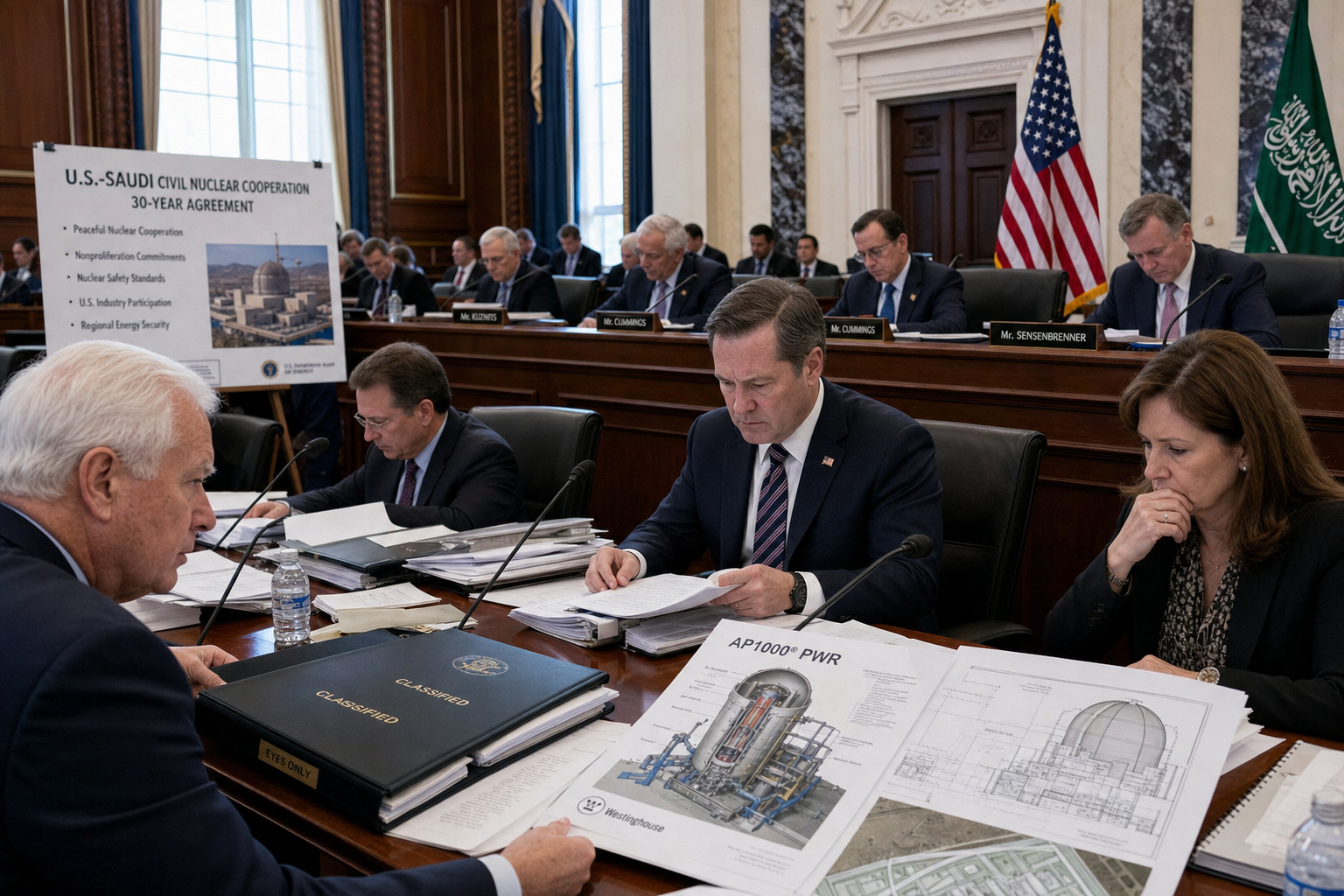
President Donald Trump has submitted a proposed civil nuclear cooperation agreement with Saudi Arabia to Congress, beginning a mandatory 90-day review under the Atomic Energy Act. The 30-year accord would allow U.S. companies to export civilian nuclear technology to the kingdom and would support the construction of AP1000 reactors, a project potentially worth tens of billions of dollars for Westinghouse, which is jointly owned by Cameco and Brookfield Asset Management.
The agreement would take effect unless Congress objects during the review period. An administration official said the pact is consistent with the Atomic Energy Act and reiterated that Trump will only allow it to proceed if Saudi Arabia joins the Abraham Accords, the U.S.-backed framework for normalizing relations with Israel. Trump has also claimed that the agreement would prevent Saudi Arabia from enriching uranium.
The deal has drawn criticism from Democratic lawmakers and nuclear nonproliferation specialists because it does not permanently prohibit uranium enrichment or spent-fuel reprocessing. Instead, it proposes a U.S.-built and operated enrichment facility, subject to a two-year feasibility study. Experts worry that this approach could weaken safeguards intended to prevent civilian nuclear technology from being converted to military purposes.
Atlantic Council fellow Matthew Kroenig said the study should conclude that Saudi Arabia relies on imported fuel-cycle services, while Council on Foreign Relations fellow Erin Dumbacher warned that the agreement departs from the stricter nonproliferation standards historically used by the United States. She said expanding access to nuclear materials without adequate safeguards could increase accident, security, and proliferation risks.
The agreement also faces geopolitical complications. Saudi Arabia has said it will not normalize relations with Israel without recognition of an independent Palestinian state, and Saudi officials have indicated that the kingdom could pursue nuclear weapons capabilities if Iran develops them.
Entities: Donald Trump, Saudi Arabia, U.S. Congress, U.S. Department of Energy, Atomic Energy Act • Tone: analytical • Sentiment: negative • Intent: inform
26-08-2026
US President Donald Trump has submitted a classified civilian nuclear cooperation agreement with Saudi Arabia to Congress for its required review, according to administration officials and congressional sources familiar with the matter. The agreement, sent to Capitol Hill on Monday under the US Atomic Energy Act, is intended to expand Saudi Arabia’s civilian nuclear program. However, its future remains uncertain because Trump has said the deal will not proceed unless Saudi Arabia normalizes relations with Israel under the Abraham Accords.
The agreement was signed in Washington last month by US Energy Secretary Chris Wright and his Saudi counterpart. Trump’s subsequent announcement that normalization with Israel would be a condition of the nuclear deal reportedly surprised Saudi officials and raised doubts about whether the pact can be finalized. It is unclear whether the normalization requirement is included in the classified document submitted to Congress.
Congress has 90 days while in session to review the agreement. Unless lawmakers adopt a joint resolution rejecting it, the pact can enter into force without a vote in either chamber. The unusually high level of classification has also drawn attention, since previous civilian nuclear agreements—commonly called 123 agreements—have generally been made public, apart from classified annexes.
Critics in Congress are concerned that the arrangement could help Saudi Arabia develop the ability to enrich uranium, potentially intensifying nuclear proliferation and competition in the region. Riyadh has said that normalization with Israel would require a clear path toward Palestinian statehood. Israeli Prime Minister Benjamin Netanyahu has rejected Palestinian statehood as incompatible with Israel’s security needs, creating another obstacle.
If approved, the agreement is expected to remain in effect for 30 years and involve US companies in developing Saudi Arabia’s nuclear program following a joint US-Saudi study.
Entities: Donald Trump, Saudi Arabia, United States Congress, US Atomic Energy Act, Chris Wright • Tone: analytical • Sentiment: neutral • Intent: inform
26-08-2026
US President Donald Trump has submitted a civilian nuclear-cooperation agreement with Saudi Arabia to Congress, but the pact is conditional on Riyadh establishing official diplomatic relations with Israel through the Abraham Accords. The agreement, negotiated in July and submitted by the Department of Energy under the 1954 Atomic Energy Act, would allow US companies to export civilian nuclear technology to Saudi Arabia and strengthen the US-Saudi relationship.
A Trump administration official said the president’s position had not changed and that the nuclear agreement would proceed only if Saudi Arabia joined the Abraham Accords. This represents a shift from the administration’s earlier position that nuclear cooperation and Saudi-Israeli normalisation could be negotiated separately.
Saudi Arabia has consistently said that normalisation with Israel requires a credible path towards the creation of a Palestinian state. Israel’s government, led by Prime Minister Benjamin Netanyahu, has expressed interest in relations with Saudi Arabia but opposes Palestinian statehood. Negotiations appeared close in 2023, before stalling after Hamas’s October 7 attack on Israel and the ensuing war in Gaza.
Congress has 90 legislative days to review the agreement. If lawmakers do not reject it during that period, it will automatically take effect. Trump could veto a congressional resolution rejecting the pact, although Congress could override such a veto with a two-thirds majority in both chambers. Republicans hold narrow majorities in the House of Representatives and Senate, making the congressional review a significant factor in the agreement’s future.
Entities: Donald Trump, Saudi Arabia, Saudi Crown Prince Mohammed bin Salman, US Congress, US Department of Energy • Tone: analytical • Sentiment: neutral • Intent: inform