26-08-2026
Massive flash floods in the Nepal-Tibet border region have killed more than 160 people and left hundreds missing, including 24 Canadian tourists. Nepalese police reported 162 deaths, while China’s state broadcaster said at least three people died and more than 558 were missing in Tibet’s Gyirong county, including 260 foreign nationals. Nepal Tourism Board officials separately reported 403 missing people, including 341 foreign nationals, although casualty and missing-person figures remain preliminary and vary among authorities.
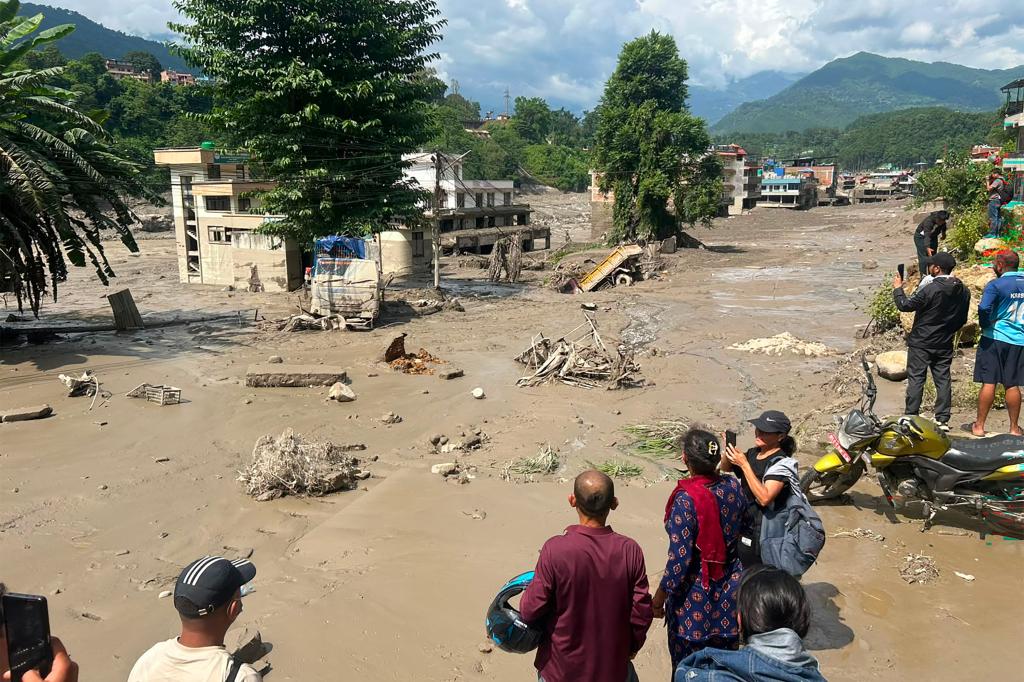
The disaster began when the Bhotekoshi River flooded at about 9 a.m. local time Wednesday. Villages, roads, vehicles, buildings and hydropower infrastructure were destroyed. Officials believe an avalanche or the collapse of glacial rock and ice triggered the flash floods. Initial reports suggested an earthquake, but the U.S. Geological Survey said the tremor recorded at the time was caused by the collapsing material striking the valley floor.
Those missing include 133 Indian pilgrims travelling to Mount Kailash, 47 Americans, 34 Australians, 33 Britons, at least 62 Nepali trekkers and 28 police officers. Citizens of South Korea and Malaysia were also reported missing. The affected area includes popular hiking and pilgrimage routes, including routes near Gosaikunda Lake and the Langtang region.
Rescue teams are searching through mud and debris, but power outages, damaged roads and difficult mountainous terrain are complicating efforts. Nepal has asked India and China for help, while the United Nations is mobilizing support. Indian Prime Minister Narendra Modi and Chinese President Xi Jinping have pledged assistance.
Canadian Prime Minister Mark Carney described the flooding as “absolutely devastating.” Global Affairs Canada said consular officials are working to establish contact with affected Canadians and urged people in the region to register with the Registration of Canadians Abroad system. The disaster struck an area that experienced similar glacial flooding last year, raising concerns about the vulnerability of Himalayan communities and infrastructure to climate-related hazards.
Entities: Flash floods, Glacial rock-and-ice avalanche, Nepal-Tibet border, Nepal, Tibet • Tone: urgent • Sentiment: negative • Intent: inform
26-08-2026
Flash floods and mudslides along the Nepal-China border have killed at least 95 people and left 484 tourists missing, according to Nepalese authorities. At least three of the missing tourists are U.S. citizens, while reports suggest that several dozen additional Americans may be unaccounted for. The U.S. government has not released an official count but said its embassy is coordinating with Nepalese authorities and local tour agencies to assist affected Americans.
The disaster occurred after a 4.4-magnitude earthquake struck the region. Video from Gyirong, Tibet, showed people fleeing as mudslides engulfed buildings near the border. Nepal’s foreign minister, Shishir Khanal, said the earthquake may have triggered an ice-rock avalanche that entered the Lhende Khola River, causing the flooding. Authorities warned that another flood could occur because debris remains lodged in the river.
Sixty-five people were receiving medical treatment in and around Nepal’s capital, Kathmandu. China sent 574 rescuers to the Gyirong crossing, although officials warned that reaching the inundated area could take hours. India and the European Union offered humanitarian assistance, mapping support and other resources. Indian Prime Minister Narendra Modi expressed solidarity with Nepal and said his government was prepared to provide all possible assistance. European Commission President Ursula von der Leyen said the EU’s Copernicus satellite-monitoring program had been activated to help map the affected areas.
The article includes video and photographic evidence of the destruction, including mudslides, damaged homes and rescue operations. Nepalese, Chinese and international authorities continued rescue and relief efforts as families awaited information about missing people.
Entities: Nepal, China, Gyirong, Tibet, Lhende Khola River, Kathmandu • Tone: urgent • Sentiment: negative • Intent: inform
26-08-2026
At least 24 Canadians are reported missing after severe flash floods struck villages and tourist routes along the Nepal-China border on Wednesday, according to Nepal’s embassy in Ottawa. Nepalese authorities reported at least 157 deaths, while Global News reported the overall toll at 160. China’s state broadcaster said a mudslide in Tibet’s Gyirong County killed at least three people and left 265 missing.
Nepalese officials said 403 people were missing, including 341 foreign nationals. Many had been travelling to Mount Kailash in Tibet, a sacred Hindu pilgrimage site. Those reported missing included 133 Indians, 47 Americans, 34 Australians, 33 Britons and 24 Canadians. At least 62 Nepali citizens were also missing after trekking near Gosaikunda Lake during the Janai Purnima festival, and 28 police officers were reported missing.
The floods destroyed villages, hydropower projects and at least 19 bridges. Drone and news footage showed roads buried or washed away, buildings covered in mud, submerged vehicles and survivors coated in debris. Residents were warned to stay away from the Bhotekoshi, Trishuli and Narayani rivers. Nepal asked India and China to assist with rescue operations.
Experts said a glacier-related avalanche was likely responsible, amid a warming Himalayan climate. The U.S. Geological Survey initially recorded a magnitude 4.4 earthquake near Kathmandu but later revised the event to a magnitude 5.2 landslide.
Global Affairs Canada said it was monitoring the situation and preparing to provide consular assistance. The department said 820 Canadians were registered in Nepal and five in Tibet through its citizens-abroad program, while cautioning that voluntary registration figures may not represent the actual number of Canadians in the region. The supplied article ends mid-sentence while describing the Kailash trekking route through Nepal’s Rasuwa district.
Entities: Nepal, China, Tibet, Nitesh Sapkota, Nepal’s embassy in Ottawa • Tone: urgent • Sentiment: negative • Intent: inform
26-08-2026
Massive flash floods struck a border region of Nepal and China on August 26, killing at least 98 people and leaving hundreds missing. Nepal’s prime minister’s office reported at least 95 deaths, while China’s state broadcaster said a mudslide in Tibet’s Gyirong County killed at least three people and left 265 missing. Drone footage showed destroyed roads and buildings buried under mud.
In Nepal, officials said 403 people were missing, including 341 foreign nationals. Many were traveling through the Rasuwa district on pilgrimages to Mount Kailash in Tibet or trekking near Gosaikunda Lake during the Janai Purnima festival. Those reported missing included citizens of India, the United States, Australia, Britain, Canada, South Korea, Malaysia and Russia. At least 28 Nepali police officials were also missing. Flooding damaged villages, roads and hydropower projects along the Bhotekoshi River, while officials warned residents to avoid the banks of several swollen rivers.
Nepal requested assistance from India and China. Indian Prime Minister Narendra Modi offered humanitarian support, and several countries expressed concern about their missing citizens and solidarity with affected communities.
Climate and disaster experts said an avalanche involving glacial ice or rock likely blocked a tributary before releasing a sudden flood surge. Water levels on the Trishuli River rose by as much as nine meters in 30 minutes. Experts emphasized the need for early-warning systems in a warming Himalaya, where glaciers are melting rapidly and extreme rainfall, flooding and landslides are becoming more frequent. The same area experienced deadly flash floods in August 2025 after a glacial lake in Tibet overflowed, killing nine people and damaging infrastructure linking Nepal and China.
Entities: Nepal, China, Tibet’s Gyirong County, Nuwakot district, Rasuwa district and Gosaikunda Lake • Tone: urgent • Sentiment: negative • Intent: inform
26-08-2026
Flash floods caused by a glacial collapse and debris flow have devastated areas along the Nepal-Tibet border, killing at least 157 people and leaving hundreds missing. In Nepal, authorities reported 403 missing people, including 341 foreign nationals from countries such as India, the United States, the UK, Australia, South Korea and Malaysia. More than 100 missing people were Indian religious pilgrims traveling toward Mount Kailash, while at least 62 Nepali citizens were among trekkers in the badly affected Rasuwa district. China reported three deaths and 265 missing people in Tibet.
The torrent of mud, water, ice and debris swept away homes, roads, bridges and hydroelectric plants. Nepal’s electricity supply was significantly disrupted, and communications and transport links were cut in Tibet’s Shigatse region. Flood alerts were issued along the Bhote Koshi, Trishuli and Narayani rivers in Nepal, as well as in India’s downstream states of Bihar and Uttar Pradesh. Officials warned that flooding could worsen because ice and debris were still blocking sections of the river.
Search-and-rescue operations by Nepali police, soldiers and Chinese authorities were hindered by heavy monsoon rains, dangerous conditions and the inability of helicopters to land in some mountainous areas. Nepal’s prime minister, Balendra Shah, ordered evacuations from low-lying areas, while Indian Prime Minister Narendra Modi offered humanitarian assistance. UN Secretary-General António Guterres said the UN was mobilizing supplies and personnel.
The disaster occurred in a Himalayan region increasingly vulnerable to floods and landslides. Scientists and international organizations have linked more frequent extreme weather, shrinking glaciers and accelerating ice loss to the climate crisis. Experts called for stronger monitoring and early-warning systems, especially after a previous Bhote Koshi flood killed nine people and destroyed a bridge linking Nepal and China.
Entities: Nepal, Tibet, China, Rasuwa district, Bhote Koshi River, Mount Kailash pilgrimage • Tone: urgent • Sentiment: negative • Intent: inform
26-08-2026
Thirty-three British citizens, including a 13-year-old girl, are among more than 400 travellers reported missing after a flash flood struck the Nepal-Tibet border. Nepal’s tourism board said at least 341 foreign nationals were unaccounted for, although the nationalities of more than 100 missing people had not yet been confirmed. The flood occurred at about 8.30am local time on Wednesday on the Tibetan side of the Bhote Koshi River, near a border crossing used by tourists travelling from Nepal to Tibet.
The tour operator Alpine Eco Trek said the missing British nationals were part of a nine-day journey to Mount Kailash. The group became trapped while crossing into Tibet, and contact with four Nepali guides was lost at about 8.40am. The company said the missing group also included two Irish citizens and four of its Nepali guides. Travel records identified several of the missing British travellers by age and gender.
Officials said 157 bodies had been recovered and more than 40 injured people were being treated in hospitals. A wall of mud and rock may have collapsed into the river, causing catastrophic flooding on the Nepali side. Houses, roads and energy infrastructure were destroyed, while authorities in Tibet reported fears of major casualties. Eight South Koreans working at a hydropower plant were also missing, with 10 others stranded.
Nepalese authorities urged tourists and residents in Rasuwa, Nuwakot and areas along the Bhote Koshi and Trishuli rivers to move to higher ground if necessary, remain in safe locations and maintain contact with hotels and travel agencies. Travellers were advised to postpone journeys to the affected areas. The British government and several foreign embassies expressed concern and urged people to follow official safety guidance.
Entities: Nepal, Tibet, China, Bhote Koshi River, Trishuli River • Tone: urgent • Sentiment: negative • Intent: inform
26-08-2026
At least 160 people were reported killed and hundreds remained missing Wednesday after flash floods struck the Himalayan border region between Nepal and China. Nepal suffered the overwhelming majority of reported deaths, with Nepali police saying at least 157 people had died. Nepali authorities also reported that 403 people were missing, including 47 U.S. citizens. The figures indicate a major humanitarian emergency affecting both local residents and foreign nationals in the border area.
Across the border in China, state media described the flooding as causing “severe casualties.” Chinese authorities reported at least three deaths and 265 missing people. Taken together, the reported figures from the two countries amounted to at least 160 deaths and 668 missing people, although the numbers could change as rescue and recovery operations continued and authorities reconciled their accounts.
The available report provides no further details about the specific locations affected, the cause or timing of the floods, the status of rescue operations, or the conditions of those missing. It centers on the preliminary casualty figures and the scale of the disaster, highlighting the extensive human toll on both sides of the Nepal-China border. The report attributes the figures to Nepali police, Nepali authorities and Chinese state media, underscoring that the information was based on early official accounts during an unfolding emergency.
Entities: Joshua Yang, The Washington Post, Nepal, China, Himalayan border region • Tone: urgent • Sentiment: negative • Intent: inform
26-08-2026
Catastrophic flash flooding struck the Himalayan border between Nepal and China-controlled Tibet on Wednesday, killing at least 160 people and leaving hundreds missing. Nepal reported at least 157 deaths, while Chinese state media confirmed three deaths on the Tibetan side. More than 341 foreign nationals remain unaccounted for, including 47 Americans, 133 Indians, 34 Australians, 33 Britons, 24 Canadians, 53 Ukrainians, 17 Malaysians and South Korean engineers working on a hydropower project.
The disaster appears to have been caused by a massive wall of mud, rock and water that entered a river, devastating communities in Nepal’s Trishuli River basin and Gyirong County in Tibet. Nepal’s foreign minister initially suggested an earthquake-triggered avalanche, after a 4.4-magnitude tremor was detected. The United States Geological Survey later clarified that the seismic signal was generated by the landslide itself and registered as the equivalent of a 5.2-magnitude earthquake.
Floodwaters swept away homes, businesses, vehicles, bridges and roads. At least 19 bridges and nearly 25 miles of roadway were destroyed, while 15 hydropower plants under construction were damaged, eliminating more than 400 megawatts of planned capacity. Numerous cargo trucks and imported electric vehicles were also washed away. At least 62 Nepali citizens, including 28 police officers, were still missing.
China deployed more than 570 emergency personnel and equipment to Gyirong County after President Xi Jinping ordered an all-out search. Nepal and foreign governments began consular and humanitarian responses, with the United States monitoring affected citizens and offering assistance. India announced it would send 10 metric tons of humanitarian supplies and essential medicines. Flood alerts were issued downstream in Nepal and in India’s Uttar Pradesh and Bihar states because blocked waterways could cause additional outburst floods.
Entities: Catastrophic flash flooding and landslide disaster, Nepal-China Himalayan border, Nepal, Gyirong County, Tibet, China, Trishuli River basin • Tone: urgent • Sentiment: negative • Intent: inform