27-08-2026
U.S. President Donald Trump signed an executive order directing Interior Secretary Doug Burgum to rename Lake Ontario “Lake America,” intensifying an already strained relationship with Canada. Trump defended the move by criticizing Canada’s government, repeating claims that the country takes advantage of the United States and saying Canadian officials have treated the U.S. badly. The order comes amid a worsening trade dispute following the collapse of negotiations between the two countries. Prime Minister Mark Carney said the agreement became untenable after what he described as excessive U.S. demands, while Canada has announced retaliatory measures scheduled to take effect on Sept. 8.
The proposed name change prompted ridicule and rejection from Canadian leaders. Carney said Canadians would continue calling the lake Lake Ontario “now and always.” Nova Scotia Premier Tim Houston dismissed the initiative as “real foolishness,” and Manitoba Premier Wab Kinew compared Trump’s actions to an aging performer repeating old hits for his supporters. Trump’s dispute with Ontario Premier Doug Ford, who called him a bully, also contributed to the escalation.
Lake Ontario is one of the five Great Lakes and lies between Ontario and New York. The province of Ontario takes its name from the lake, whose name derives from a Huron Indigenous term meaning “lake of shining waters.” Carney noted that the name predates both Canada and the United States by more than 400 years.
The article places the move in the context of Trump’s earlier effort to rename the Gulf of Mexico as the Gulf of America. That change applies to U.S. federal documents and geographic services, although some online map providers adopted it. The controversy also led to a dispute between the White House and The Associated Press over the news agency’s refusal to use the new name.
Entities: Donald Trump, Lake Ontario, Lake America, Canada–United States trade war, Executive order and geographic renaming • Tone: analytical • Sentiment: negative • Intent: inform
27-08-2026
President Donald Trump signed an executive order on August 27, 2026, directing the U.S. government to rename Lake Ontario “Lake America.” The Great Lake straddles the U.S.-Canada border, and the announcement came amid a sharp deterioration in relations following the collapse of bilateral trade negotiations and the imposition of new retaliatory tariffs. A White House official said Interior Secretary Doug Burgum would direct the Geographic Names Information System to update its records.
Canadian Prime Minister Mark Carney rejected the change, saying Canada would continue to use the name Lake Ontario. He argued that the lake’s established name should remain unchanged, while noting that countries can use different names for geographic features. The action represents Trump’s second attempt to rename an internationally recognized body of water after he changed the Gulf of Mexico to the “Gulf of America” earlier in his second term. That move also faced international opposition and resistance from media organizations.
Trump denied that the renaming was intended to send a message, but immediately linked it to his longstanding complaints about Canada’s trade relationship with the United States. He accused Canada of taking economic advantage of the U.S. and reiterated his criticism of Canadian trade deficits and his past proposal that Canada become the 51st U.S. state. He also joked that the Atlantic or Pacific oceans could eventually be renamed.
The symbolic action threatens to further inflame tensions after the United States imposed 50% tariffs on approximately $20 billion in Canadian goods. Canada announced matching tariffs of up to 50%, although it later reduced some measures affecting seafood and fish products. The article also provides historical and geographic context about Lake Ontario and describes mocking reactions from Democratic critics, including Illinois Governor JB Pritzker and Wisconsin Governor Tony Evers.
Entities: Donald Trump, Mark Carney, Doug Burgum, United States, Canada • Tone: analytical • Sentiment: negative • Intent: inform
27-08-2026
US President Donald Trump has signed an executive order attempting to rename Lake Ontario “Lake America,” escalating an already tense relationship with Canada. The lake is one of the five Great Lakes and lies along the US-Canadian border, sharing its name with the Canadian province of Ontario. Trump said Canadian officials had treated the United States badly and called them “nasty people.”
Canadian Prime Minister Mark Carney rejected the proposed renaming, saying the body of water would continue to be known as Lake Ontario. He emphasized that the name derives from the Wendat Indigenous language and is more than 400 years old, predating both the Canadian Confederation and the founding of the United States. Carney framed the issue as one of historical and cultural continuity.
The move follows Trump’s January 2025 attempt to rename the Gulf of Mexico as the “Gulf of America,” a change that has not gained broad acceptance outside the White House. Trump joked that the United States might eventually rename the Atlantic and Pacific oceans as well.
The announcement came during a broader US-Canada trade dispute. After negotiations broke down over issues including French-language product labeling and Quebec streaming-content requirements, the United States imposed 50% tariffs on Canadian goods worth approximately $20 billion. Canada responded with tariffs of its own on an equivalent value of US imports.
Ontario is a major export destination for more than a dozen US states. Provincial Premier Doug Ford said the province was considering all retaliatory options, including using exports of nickel, uranium, electricity, and potash as leverage. He warned that restricting potash supplies could severely damage the US agricultural sector.
Entities: Donald Trump, Mark Carney, Doug Ford, Lake Ontario / proposed Lake America renaming, United States–Canada trade war • Tone: analytical • Sentiment: negative • Intent: inform
27-08-2026
US President Donald Trump has signed an executive order directing the US agency responsible for geographic names to rename Lake Ontario “Lake America” within the United States. The order cannot compel Canada to use the new designation, since the lake borders both countries. The announcement comes as trade relations between Washington and Ottawa deteriorate.
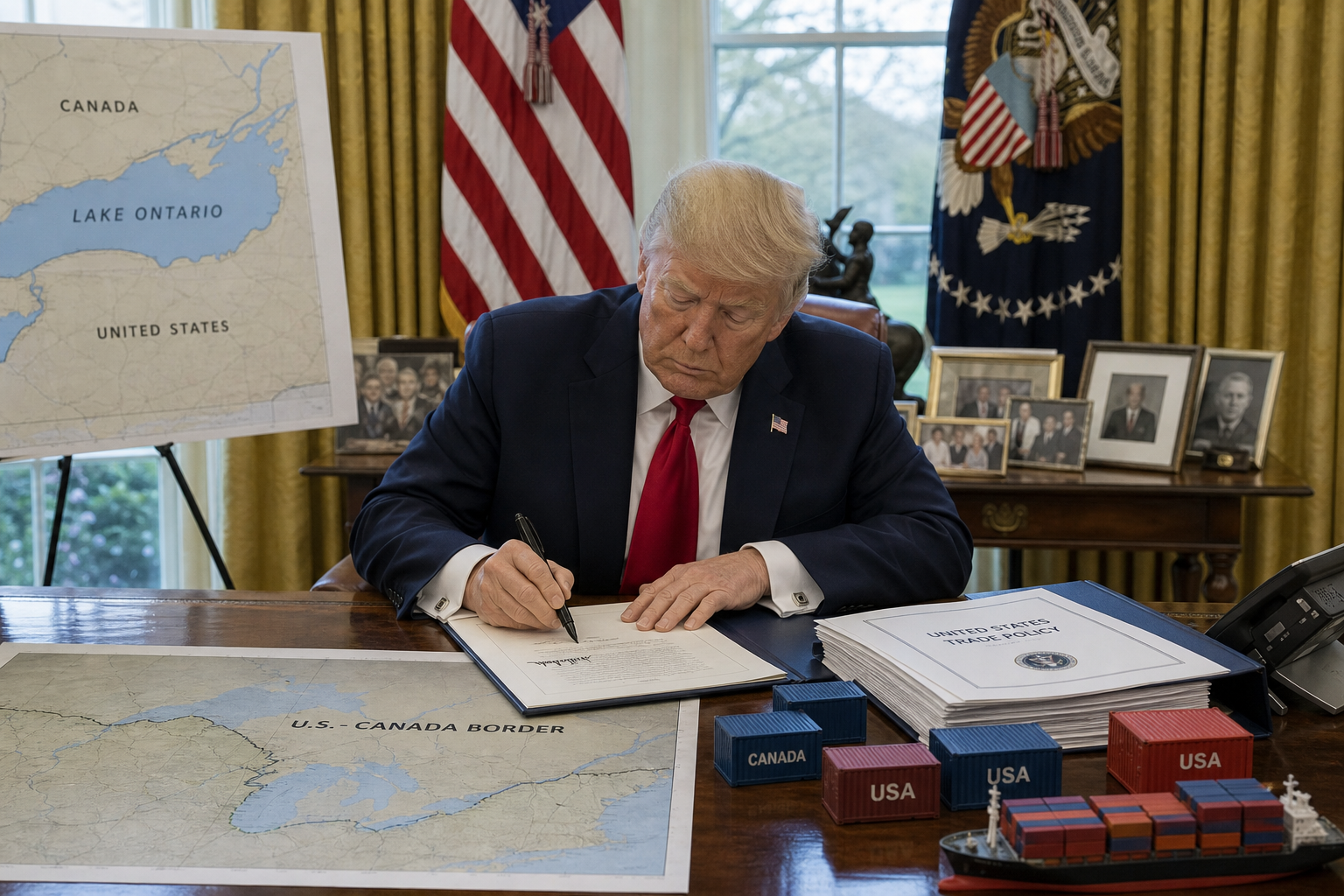
Trump made the announcement on Thursday and signed the order at the Resolute Desk in the Oval Office, with a map of the Great Lakes displayed behind him and “Lake America” shown in large red lettering over Lake Ontario. The move follows his earlier decision to rename the Gulf of Mexico the “Gulf of America,” reflecting his administration’s broader effort to promote US-centered geographic terminology.
Speaking to reporters, Trump sharply criticized Canada’s trade policies, calling it “the worst” country to deal with and saying that Canada believed it was “entitled to everything.” His comments came after the United States announced 50% tariffs on approximately $20 billion (€17.17 billion) worth of Canadian goods. The tariffs followed the collapse of negotiations between the two countries.
The article places the renaming decision within a broader pattern of pressure on Canada since Trump returned to the White House the previous year. In addition to escalating tariffs and trade rhetoric, Trump has repeatedly suggested that Canada should become the United States’ 51st state, despite Canada being a longstanding US ally. The order therefore has both a geographic and political significance, serving as a symbolic assertion of US authority while intensifying an already serious dispute with Ottawa.
Entities: Donald Trump, Lake Ontario, Lake America, United States, Canada • Tone: analytical • Sentiment: negative • Intent: inform
27-08-2026
US President Donald Trump signed an executive order on August 27, 2026, directing the US government to rename Lake Ontario “Lake America” in its official geographic naming system. The move comes amid a sharp deterioration in US-Canada relations and an escalating trade dispute. Trump said Canada had taken advantage of the United States in trade and military matters, while also repeating his criticism of Canadian leaders and his suggestion that Canada could become the 51st US state.
Canadian Prime Minister Mark Carney rejected the proposed name, emphasizing the lake’s Indigenous origins and stating that Canadians would continue to call it Lake Ontario. Nova Scotia Premier Tim Houston also dismissed the order as foolish, while Ontario Premier Doug Ford characterized the idea as rhetoric. The name Ontario is derived from a Huron Indigenous term meaning “lake of shining waters.”
The executive order applies only to the US government and cannot compel Canada to adopt the new name. The article notes that no single international authority determines the names of bodies of water shared by multiple countries, although Trump has broad power over how US agencies identify geographic features. Despite Trump’s claim that the change was effective immediately, the order reportedly gives the Interior Department 30 days to implement it.
The renaming announcement follows the United States’ imposition of 50 percent tariffs on $20 billion worth of Canadian goods after bilateral talks failed. Canada responded with retaliatory tariffs on an equivalent value of US products, including steel, dairy goods, appliances and agricultural equipment. The move echoes Trump’s earlier effort to rename the Gulf of Mexico as the “Gulf of America.” Trump suggested that the Atlantic or Pacific oceans could also eventually be renamed, adding another provocative element to the dispute.
Entities: Donald Trump, Mark Carney, Lake Ontario / “Lake America”, United States, Canada • Tone: analytical • Sentiment: negative • Intent: inform
27-08-2026
The article reports that US President Donald Trump signed an executive order directing the US Interior Department to rename Lake Ontario “Lake America” in the United States. The order requires the US geographic naming service to update its records, but it cannot compel Canada to adopt the new name for the lake, which lies between the two countries. The move comes amid a worsening trade dispute between Washington and Ottawa.
The United States recently announced 50 per cent tariffs on approximately US$20 billion worth of Canadian goods after trade negotiations broke down. Canada responded with retaliatory tariffs covering a similar value of US goods, including steel, dairy products, appliances and farm equipment. The article places the proposed renaming within a broader pattern of antagonistic comments and policies from Trump toward Canada since his return to the White House. Trump has suggested that Canada should become the 51st US state, despite the countries’ historically close relationship.
Trump said the renaming was not intended to convey a particular geopolitical message, but also claimed that “Canada’s been ripping us off for a long time.” He signed the order at the Resolute Desk in the Oval Office, where a map of the Great Lakes displayed behind him already labeled Lake Ontario as “Lake America” in large red letters. The report presents the renaming as a symbolic escalation occurring alongside concrete economic measures, while noting the practical limitation that Canada is not required to recognize the new US terminology.
Entities: Donald Trump, Lake Ontario, Lake America, United States, Canada • Tone: neutral • Sentiment: negative • Intent: inform
27-08-2026
US President Donald Trump signed an executive order on August 27, 2026 directing the federal government to refer to Lake Ontario as “Lake America,” adding a symbolic dispute with Canada to escalating economic tensions between the two countries. Trump said the renaming had been under consideration for some time and joked that the United States might eventually rename the Atlantic or Pacific oceans as well. The move follows his earlier decision to rename the Gulf of Mexico as the “Gulf of America,” a change that was criticized and mocked in Mexico and other countries. Although US technology companies such as Google updated their maps for US users to reflect the Gulf’s new name, Lake Ontario had not yet been renamed online when the article was published. The lake is shared by the United States and Canada, raising broader questions about whether a US president can unilaterally alter the name of a shared international body of water.
The order came after three days of unsuccessful US-Canada trade negotiations. Washington and Ottawa blamed each other for the collapse, and the United States moved to impose 50 percent tariffs on about $20 billion worth of Canadian products. Trump also announced a 50 percent tariff on Canadian vehicles and auto parts, saying the United States should produce more cars domestically. He claimed that the US economy had lost $60 billion annually over the previous 15 years by supporting Canada.
The tariffs affect hundreds of Canadian goods, including plywood, liquor, electrical equipment and hockey gear, representing about 5 percent of Canada’s exports to the United States. Prime Minister Mark Carney said Canada would respond with equivalent, “dollar for dollar” tariffs on US steel, dairy products, appliances, agricultural equipment, pulp and paper, electronics and other goods. The dispute threatens to deepen economic and political friction between the neighboring countries.
Entities: Donald Trump, Doug Burgum, Mark Carney, United States, Canada • Tone: analytical • Sentiment: negative • Intent: inform