26-09-2026
Chinese President Xi Jinping used the idea of the “Thucydides Trap” at his meeting with U.S. President Donald Trump to argue that competition between the two countries need not end in conflict. His statement that “The Thucydides Trap can be overcome” marked a shift from his framing at a May summit, when he posed the question of whether the U.S. and China could avoid the trap. The concept, popularized by Harvard scholar Graham Allison, describes the historical danger that tensions between a rising power and an established power can lead to war. It draws on Thucydides’ account of the Peloponnesian War, in which Athens’ rise alarmed Sparta.
Xi has invoked the idea before, including in a 2014 interview, when he called for countries to work together to avoid destructive tensions. Chinese commentary on his 2015 U.S. visit likewise emphasized that conflict was not inevitable: mutual suspicion among major powers, rather than the power transition itself, could bring it about. Allison has met Xi and visited China several times, and previously held senior academic and U.S. government roles.
At the latest summit, Xi paired his claim that the trap could be overcome with calls for peaceful coexistence and “healthy” competition without confrontation. He characterized competition as a race in which each side catches up with the other, rather than a winner-take-all struggle. He also called for stronger military crisis communications and prevention. Renmin University professor Cui Shoujun described establishing a boundary against military conflict as the summit’s most significant political outcome, saying it brought greater certainty to a volatile relationship.
Trump’s public remarks on Xi’s arrival focused broadly on collaboration. The article notes that Trump had not commented on Taiwan at the time, even though Beijing’s account said Xi urged the U.S. to oppose Taiwan independence. The meeting was Xi’s first state visit to the U.S. in 11 years.
Entities: Xi Jinping, Donald Trump, Graham Allison, Cui Shoujun, United States • Tone: analytical • Sentiment: neutral • Intent: analyze
26-09-2026
China agreed to buy at least 10 million metric tons of U.S. coal annually in 2027 and 2028, one of several trade commitments announced by the White House following a three-day state visit between President Donald Trump and Chinese President Xi Jinping. The coal agreement supports Trump’s effort to revive the U.S. coal industry, but the leaders did not announce major breakthroughs on several prominent disputes. The countries also reached an agreement through the U.S.-China Board of Trade covering $30 billion in non-sensitive goods. It provides more favorable treatment for U.S. products such as agricultural goods, medical devices, fish, wood and cosmetics, while covered Chinese exports include small appliances, toys, holiday decorations and children’s car seats. U.S. Trade Representative Jamieson Greer said the countries had reached agreements on a number of issues.
The commitments come as Trump seeks to boost exports and reduce consumer costs, with inflation a concern ahead of the midterm elections. However, China has previously fallen short of promises to buy U.S. soybeans and $17 billion in U.S. agricultural products, according to Agriculture Department data. U.S. farmers also face high diesel prices affected by the U.S. war with Iran. China relies heavily on coal, although it has followed through on a pledge made at the United Nations five years earlier to stop funding overseas coal plants. Trump also told Xi that China’s support for Iran was “totally unacceptable,” according to the U.S. ambassador to China.
Another unusual outcome of the summit was an agreement to use “super intelligence” instead of “artificial intelligence” to describe relevant emerging technologies, a terminology change Trump had publicly advocated.
Entities: Donald Trump, Xi Jinping, Jamieson Greer, United States, China • Tone: analytical • Sentiment: neutral • Intent: inform
26-09-2026
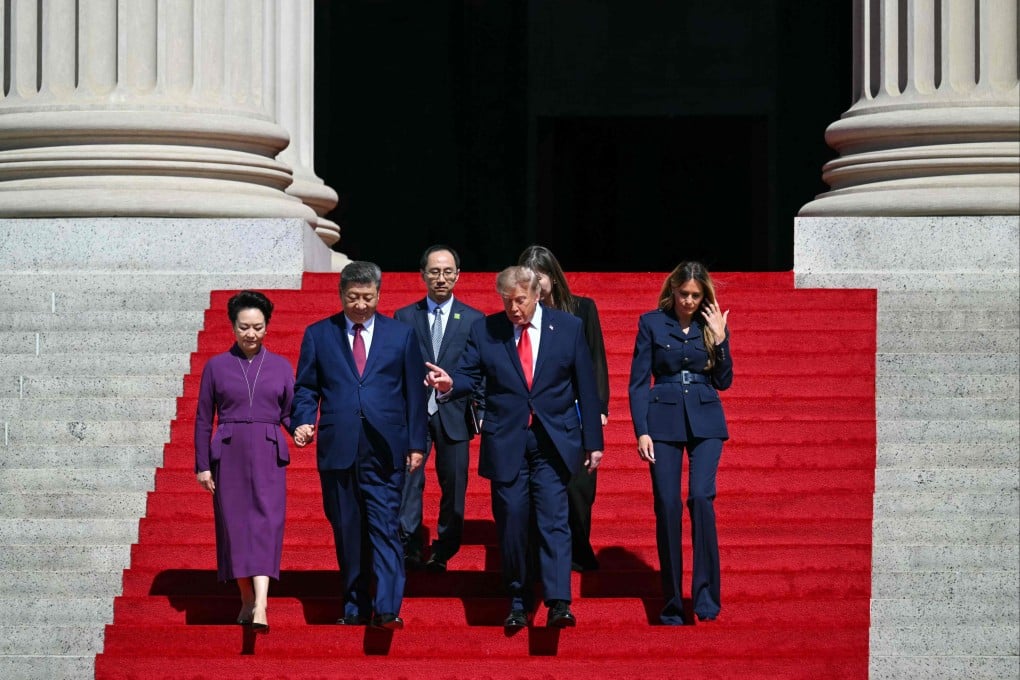
The article describes how Chinese President Xi Jinping and U.S. President Donald Trump appeared with their wives, Peng Liyuan and Melania Trump, during the final day of Xi’s three-day state visit to the United States. Their visit to the National Archives Museum in Washington provided a public setting in which observers could compare the couples’ interactions. According to the article, body-language experts saw a marked contrast in how the two couples held hands, and their joint activities during the trip had attracted close attention.
The article cites body-language expert Patti Wood’s observations of the couples arriving at the museum. Xi and Peng walked up the building’s stairs holding hands. Wood characterized the gesture as appearing natural and noted that they walked closely in sync. The headline and introduction frame these details as revealing differences in the couples’ dynamics, but the supplied excerpt ends before describing Trump and Melania’s behavior or offering further expert commentary. It therefore does not provide enough information to specify the nature of the contrast beyond saying that experts observed one. The article is presented as a brief report about public gestures and expert interpretation, rather than as a detailed account of the state visit’s political outcomes.
Entities: Xi Jinping, Donald Trump, Peng Liyuan, Melania Trump, Patti Wood • Tone: analytical • Sentiment: neutral • Intent: analyze
26-09-2026
The article interprets Chinese President Xi Jinping’s decision to bring his own state limousine, the Hongqi N701, to Washington as more than a logistical choice. It presents the heavily armoured vehicle as a symbol of China’s growing independence and its ambition to be treated as a global peer of the United States. “Hongqi” means “Red Flag”; the limousine’s exact specifications are classified, but it is believed to weigh more than three tons and to have features including armour, bullet-resistant glass, run-flat tyres, secure communications and protection against contaminated air.
The article contrasts this practice with China’s earlier reliance on host countries for presidential transport, noting that Beijing now reportedly sends a primary and backup car ahead of Xi. The N701 has accompanied him on trips to numerous countries, including Russia, France, Saudi Arabia and India. The article also mentions Russian President Vladimir Putin’s use of the Aurus Senat, suggesting that bringing a leader’s own vehicle is a way for states to avoid depending on a host’s courtesy.
The limousine becomes a metaphor for China’s broader transformation: from a country once associated with building American railroads to one seeking to compete on the global “highway.” The writer acknowledges US advantages, including its military, alliances, technical capabilities and the presidential limousine known as “the Beast,” while emphasizing China’s industrial strength and technological ambitions. The piece ends with a pointed, humorous aside about Donald Trump’s physical familiarity with Xi during the visit, using it to suggest that Trump—not Xi—appeared to be the supplicant.
Entities: Xi Jinping, Donald Trump, Chidanand Rajghatta, China, United States • Tone: analytical • Sentiment: neutral • Intent: analyze
26-09-2026
The Straits Times roundup presents five international stories published on Sept 26, 2026. First, US President Donald Trump and Chinese President Xi Jinping concluded a three-day summit with tea at the White House and a visit to the National Archives. Their public remarks emphasized goodwill and a more stable relationship, but the article notes that the summit produced no major announced breakthroughs in economic relations. Trump alluded to benefits for American farmers without giving details; Xi described the relationship as one of strategic stability based on respect, fairness and reciprocity.
Second, Trump again urged Ukrainian President Volodymyr Zelensky to travel to Moscow for talks with Russian President Vladimir Putin. Zelensky rejected the suggestion during a meeting at the United Nations and reportedly took offense. Asked when he would go to Moscow, he answered, “On a missile,” followed by an expletive.
Third, Volkswagen confirmed a worldwide recall of more than three million vehicles over a potential steering risk identified by Germany’s transport authority. The affected vehicles include several Volkswagen models made from 2013 to 2024 and about 700,000 Audi models made from 2017 to 2024. A German newspaper also reported that Seat and Skoda vehicles were included.
Fourth, reports said Manchester City had been found guilty of all but one of 115 Premier League financial-regulation charges. No sanctions had been decided, and the club was reportedly preparing to appeal; the Premier League declined to comment to AFP.
Finally, a woman who had accused Jay-Z and Sean “Diddy” Combs of assaulting her when she was 13 said in a court filing that her accusations were false and that she had never met Jay-Z. She had dropped her civil lawsuit against the two in 2025. The roundup briefly reports these developments without extended analysis.
Entities: Donald Trump, Xi Jinping, United States–China relations, Volodymyr Zelensky, Vladimir Putin • Tone: neutral • Sentiment: neutral • Intent: inform