25-09-2026
French President Emmanuel Macron welcomed Pope Leo XIV at Orly Airport at around 10 a.m., where the arrival was followed by military honours and introductions to French and Vatican officials. Macron and the Pope then travelled to the Élysée Palace for talks. Leo XIV’s four-day visit, from Friday to Monday, includes stops in Paris, Saint-Denis, Lourdes and Metz, and is the first official papal state visit to France since Pope Benedict XVI’s visit in September 2008.
The Pope’s programme includes meetings with Macron, French officials, civil-society representatives and diplomats, a visit to UNESCO, and encounters with young Catholics. Discussions are expected to address Europe’s future, social issues and technology. Artificial intelligence may be part of the broader conversation, although it is not explicitly listed as a formal item on the published programme.
Church bells rang for seven minutes across France to mark the arrival. The ringing included Notre-Dame Cathedral in Paris and churches in Lourdes, Marseille, Lyon and Orléans. On Friday evening, Leo XIV is scheduled to attend a prayer vigil at the Stade de France in Saint-Denis with young people aged 17 to 35. Organisers expect about 80,000 participants. The itinerary also includes a mass in Paris and subsequent visits to Lourdes and Metz. In Metz, the Pope is scheduled to address the theme “At the roots of Europe for peace and unity.” The article presents the visit as a major public and diplomatic event, combining official meetings, religious ceremonies and engagement with young people.
Entities: Pope Leo XIV, Emmanuel Macron, Orly Airport, Élysée Palace, France • Tone: neutral • Sentiment: neutral • Intent: inform
25-09-2026
Pope Leo XIV began a four-day visit to France with a warning about the risks of artificial intelligence, telling officials at the Élysée Palace that people should not lose their humanity “amid a paradise of machines”. The warning echoes his earlier call for AI to be “disarmed” and his concern that it could lead to the exploitation of people. His visit comes amid preparations for large gatherings, including a Mass in Paris expected to draw more than half a million people, an event at the Stade de France with 80,000 young people, and a Mass in Lourdes for which 150,000 people have registered.
Leo met President Emmanuel Macron, who described the visit as a “great honour”. The two also addressed the relationship between religion and France’s strict secularism. Macron said secularism does not negate religion, while Leo argued that it should not exclude religion from public life or education. The article notes that secularism has been invoked to support restrictions on religious symbols in public spaces and schools. Macron will not attend the Pope’s Masses, in keeping with the separation of state and religion.
The visit includes meetings with migrants and survivors of clergy sexual abuse, as well as a tribute to European Union founder Robert Schuman. The article also describes France’s long, complex history with the Catholic Church and its recent decline in religious affiliation and practice. However, adult baptisms have more than doubled in five years, reaching 10,000 in 2025. Cardinal François Bustillo interprets this as evidence that people are searching for meaning and sees the Pope’s visit as a reminder of France’s religious roots.
Entities: Pope Leo XIV, Emmanuel Macron, Artificial intelligence (AI), Élysée Palace, France • Tone: neutral • Sentiment: neutral • Intent: inform
25-09-2026
Pope Leo XIV is making the first official papal visit to France in 18 years. His four-day trip includes meetings with survivors of sexual abuse by Church personnel, speeches to European leaders, public prayer events and visits to prominent Catholic sites. The French Bishops’ Conference has arranged for church bells to ring for seven minutes to mark the journey. Leo, the first US-born pope, also has French family heritage through his paternal grandmother.
The visit requires extensive logistics and security. It is estimated to cost €27 million, mostly covered by the Catholic Church in France through donations; the cost of the French security operation has not been disclosed. Interior Minister Laurent Nuñez said authorities had detected no specific threat but would maintain a major security presence. In Paris, the Pope is scheduled to meet President Emmanuel Macron, speak at UNESCO about topics including artificial intelligence and peace, celebrate Vespers at Notre-Dame, and lead events expected to draw very large crowds. Authorities estimate around 600,000 people for the open-air Mass and a total of one million pilgrims and visitors in Paris.
In Lourdes, Leo is due to meet seven survivors of sexual abuse. The article cites a 2021 report estimating that 330,000 children were abused over seven decades by Church personnel in France. Survivor and child-protection activist Arnaud Gallais has questioned the ceremonial welcome and urged the Church to make concrete commitments, while acknowledging the importance of the meeting. The Pope will also address EU leaders in Metz with a speech on Europe, peace and unity.
Macron will not attend the papal Masses. His absence follows controversy over his attendance at a 2023 papal Mass and concerns that it could conflict with France’s secularism principle. The Élysée says France can welcome religious enthusiasm while remaining committed to secularism; Prime Minister Sébastien Lecornu and Brigitte Macron are expected to represent the president at the Paris Mass.
Entities: Pope Leo XIV, Pope Benedict XVI, Pope Francis, Emmanuel Macron, Arnaud Gallais • Tone: analytical • Sentiment: neutral • Intent: inform
25-09-2026
France 24’s brief video report covers Pope Leo XIV’s visit to Notre-Dame de Paris on Friday, September 25, 2026. During the visit, the pope praised the cathedral’s “splendor” after its restoration following the devastating 2019 fire. He also described Notre-Dame as a place where “the heart of a people” beats. The report notes that Leo XIV is the first pope to visit the cathedral since it reopened in 2024. The item is presented as a look at the evening Vespers prayer at Notre-Dame, though the text provided offers only a short description and does not give further details about the service, the pope’s remarks, or the people in attendance. It identifies Ava Luquet as the video’s reporter or producer. Overall, the article provides a concise account of the significance of the visit: it connects the cathedral’s restored state with its importance to the people of France and marks the occasion as a notable papal visit after the reopening. The supplied page also lists other France 24 stories about Leo XIV’s Paris visit, but those are related links rather than part of this report.
Entities: Pope Leo XIV, Notre-Dame de Paris, Paris, France, Vespers evening prayer • Tone: neutral • Sentiment: neutral • Intent: inform
25-09-2026
The France 24 liveblog preview reports on Pope Leo XIV’s first day of a four-day apostolic visit to France on September 25, 2026. Its main focus is an anticipated speech by the pope at UNESCO headquarters in Paris, where he is expected to call for regulation of artificial intelligence. The article’s introduction links that expected appeal to earlier remarks in which Leo warned that an AI-driven “paradise of machines” could undermine humanity. The report frames the speech as part of the pope’s broader visit and invites readers to follow a liveblog for developments throughout the day. The page credits France 24, with Louise Nordstrom named in the byline, and says the live coverage draws on reporting from the Associated Press, Agence France-Presse and Reuters. A caption identifies Leo delivering a speech at UNESCO headquarters in Paris on September 25. The supplied page text contains no further live updates or details about what he said at the event; instead, it ends with a notice that the requested content is not available. Consequently, the article provides a brief preview rather than a full account of the speech or the visit. Its central topic is the relationship between artificial intelligence and humanity, specifically the possibility that technological development could threaten human interests and the need for regulation. The tone is straightforward and news-oriented, with the warning attributed to the pope rather than presented as an independently established conclusion.
Entities: Pope Leo XIV, Paris, France, UNESCO, FRANCE 24 • Tone: neutral • Sentiment: neutral • Intent: inform
25-09-2026
The article is a France 24 video segment about Pope Leo XIV leading Vespers at Notre-Dame Cathedral in Paris on September 25, 2026, during a four-day visit to France. Its accompanying description says France 24 journalists followed the event live from outside the cathedral, while guests joined the programme to discuss the significance of the service within the pope’s visit. The supplied text does not include a transcript, details of the service, or the guests’ analysis, so it does not support further claims about what was said or what conclusions were drawn. The page also lists related coverage of the visit, including Pope Leo’s travel through Paris, his address at UNESCO, meetings at the Élysée, and reporting on the visit’s focus on faith, peace, human dignity, technology, and politics. These headlines provide context about the broader trip but are not part of the main segment’s description. Website notices about video tracking and a missing page, along with navigation and related-story links, are not article content. Overall, the item presents the cathedral service as a key moment in the pope’s Paris visit and offers live reporting and discussion of its significance, without providing enough information in the supplied text to summarize that discussion in detail.
Entities: Pope Leo XIV, Notre-Dame Cathedral, Paris, France, FRANCE 24 • Tone: analytical • Sentiment: neutral • Intent: inform
25-09-2026
France 24 presents special coverage of Pope Leo XIV’s visit to Paris on 25 September 2026. The segment follows the pontiff as he travels through the French capital in the popemobile on his way to Notre-Dame Cathedral. France 24 journalist Claire Paccalin reports live from Notre-Dame, while the programme also features analysis from Father Michael Baggot, identified as a professor of theology.
Baggot discusses themes that the page says have recurred during Leo XIV’s pontificate: transhumanism and the ethical challenges posed by artificial intelligence. The item therefore combines coverage of the Pope’s public movement through Paris with commentary on the broader ideas associated with his papacy. The supplied text does not provide a transcript, detailed account of the journey, or the substance of Baggot’s analysis, so it is not possible to draw further conclusions about what was said or shown in the video.
The page identifies the coverage as a replay and includes an image caption describing the papamobile travelling toward Notre-Dame. The surrounding webpage also lists related reports about the Pope’s visit, including coverage of his appearances at UNESCO and the Élysée, his speeches, and themes such as peace, human dignity, technology, secularism, and surrogacy. These are related headlines rather than additional details in the video description itself. The main item’s focus is the Paris journey to Notre-Dame and the programme’s accompanying discussion of technology-related ethical questions.
Entities: Pope Leo XIV, Paris, France, Notre-Dame Cathedral, FRANCE 24 • Tone: neutral • Sentiment: neutral • Intent: inform
25-09-2026
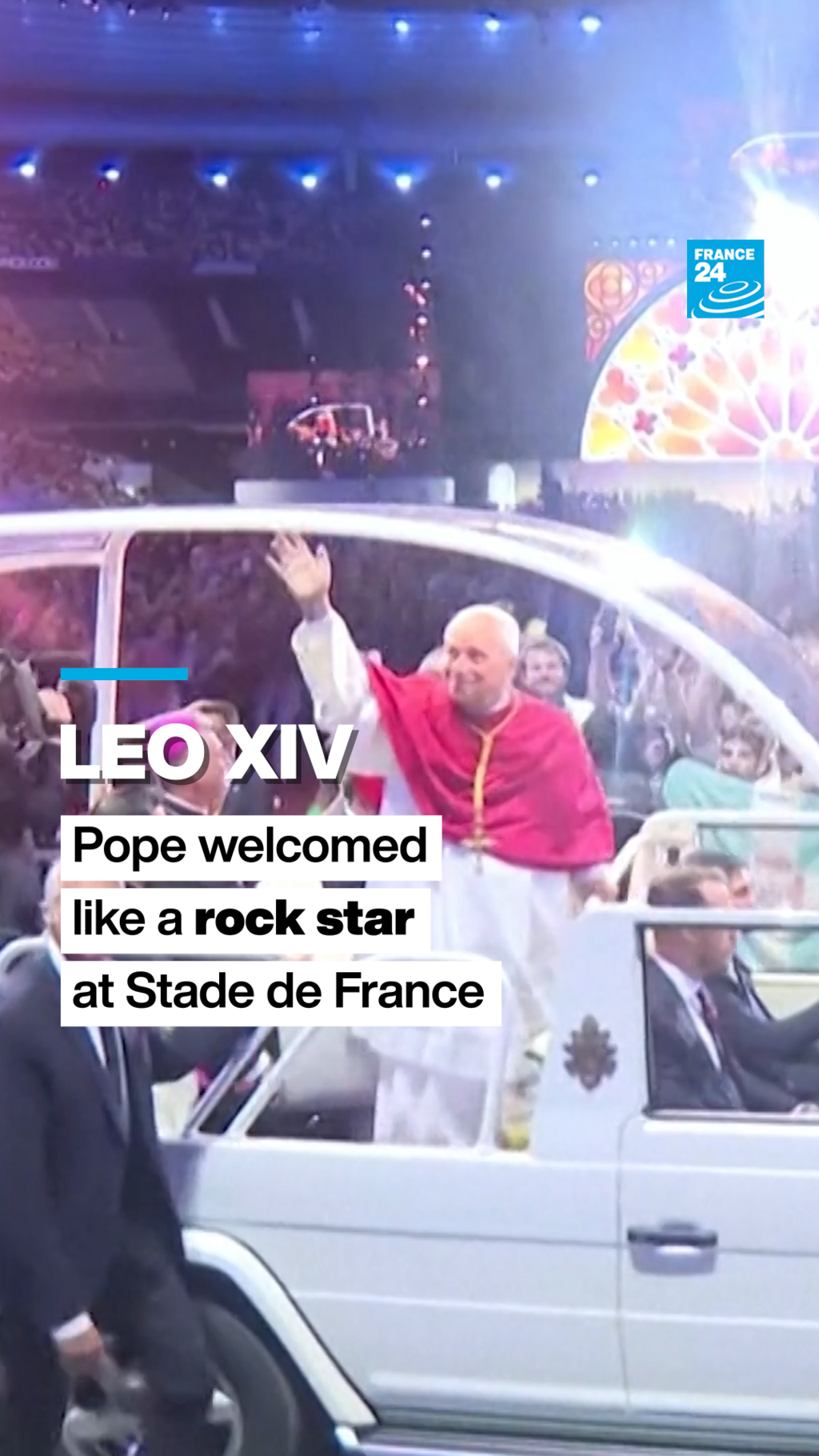
France 24 reports that Pope Leo XIV received an enthusiastic welcome at the Stade de France, near Paris, on Friday evening, September 25, 2026. The 39-second video article describes a gathering of 80,000 young Catholics who filled the stadium to proclaim their faith. Their event blended gospel music with contemporary Christian music, and the crowd greeted the pope in a manner likened to welcoming a rock star as he arrived in his popemobile. The article quotes a call to the audience: “For the pope, for God, make some noise!” The report is brief and focused on the scale and atmosphere of the stadium gathering rather than on a speech, policy issue, or detailed account of the pope’s visit. It credits the video to Ava Luquet and identifies AFP in the cover-image credit. The page also lists other France 24 reports about Leo XIV’s visit to Paris, including events at Notre-Dame and UNESCO, but those are related links rather than part of this video report. Based on the text provided, the central point is the large, faith-centered gathering and the crowd’s exuberant reception of the pope. No further details about the event’s programme, the pope’s remarks, or the attendees are included in the article text.
Entities: Pope Leo XIV, Stade de France, Paris, France, 80,000 young Catholics • Tone: positive • Sentiment: positive • Intent: inform
25-09-2026
The available text reports that Pope Leo XIV arrived in France on Friday, presenting his visit against a surprising shift in the country’s religious landscape. France is described as long having been considered a “graveyard of Catholicism,” but it is now experiencing what the article calls a sudden surge of converts. The excerpt frames this development as significant because France is also characterized as a fiercely secular nation. In the article’s telling, the growth in conversions makes France an unexpected testing ground for efforts to revive the Catholic Church’s fortunes across the West.
The passage establishes a contrast between the Church’s historically flagging position in France and the recent increase in people converting to Catholicism. It suggests that the change could have implications beyond France, since the country may offer lessons or possibilities for a wider Western revival. However, the supplied material ends after this introductory paragraph. It does not provide figures for the number of converts, explain why people are converting, include reactions from the pope or French Catholics, or describe the details of his visit. Those topics therefore cannot be summarized from the text provided. This summary reflects only the headline and opening passage, not the full article.
Entities: Pope Leo XIV, France, Paris, Catholicism, Catholic Church • Tone: analytical • Sentiment: neutral • Intent: analyze
25-09-2026
Pope Leo reaffirmed the Catholic Church’s opposition to assisted dying during a speech in France, two months after the country established a legal right to die for people with incurable illnesses. Speaking at the Élysée Palace to French President Emmanuel Macron and other politicians, the pope did not name France’s new law directly. He expressed concern, however, about social trends that could turn science and technology into profit-driven ventures, citing genetic manipulation, surrogacy, organ trading and arranging one’s own death. He said the right to life is the indispensable foundation of every other human right.
The article describes the French law as the outcome of years of intense debate and notes that it has faced strong opposition from local Catholic bishops. The legislation permits a person meeting strict conditions to request a lethal substance, which the person can take themselves or have administered by a doctor or nurse if physically unable to do so. Supporters say the measure gives people with incurable illnesses and unbearable suffering greater autonomy at the end of life. Opponents, including religious groups and some medical professionals, warn that legalisation could put pressure on vulnerable people. One bishop threatened to deny communion to lawmakers who supported the measure.
Assisted dying is already permitted in several European countries and some US states. The article also addresses surrogacy: it is banned in France, although the country’s top court has ruled that children born through surrogacy abroad should be recognised as the children of their intended parents. The report presents the pope’s intervention alongside the competing arguments and legal context surrounding end-of-life policy in France.
Entities: Pope Leo, Emmanuel Macron, Catholic Church, France, Élysée Palace • Tone: neutral • Sentiment: neutral • Intent: inform