24-05-2026
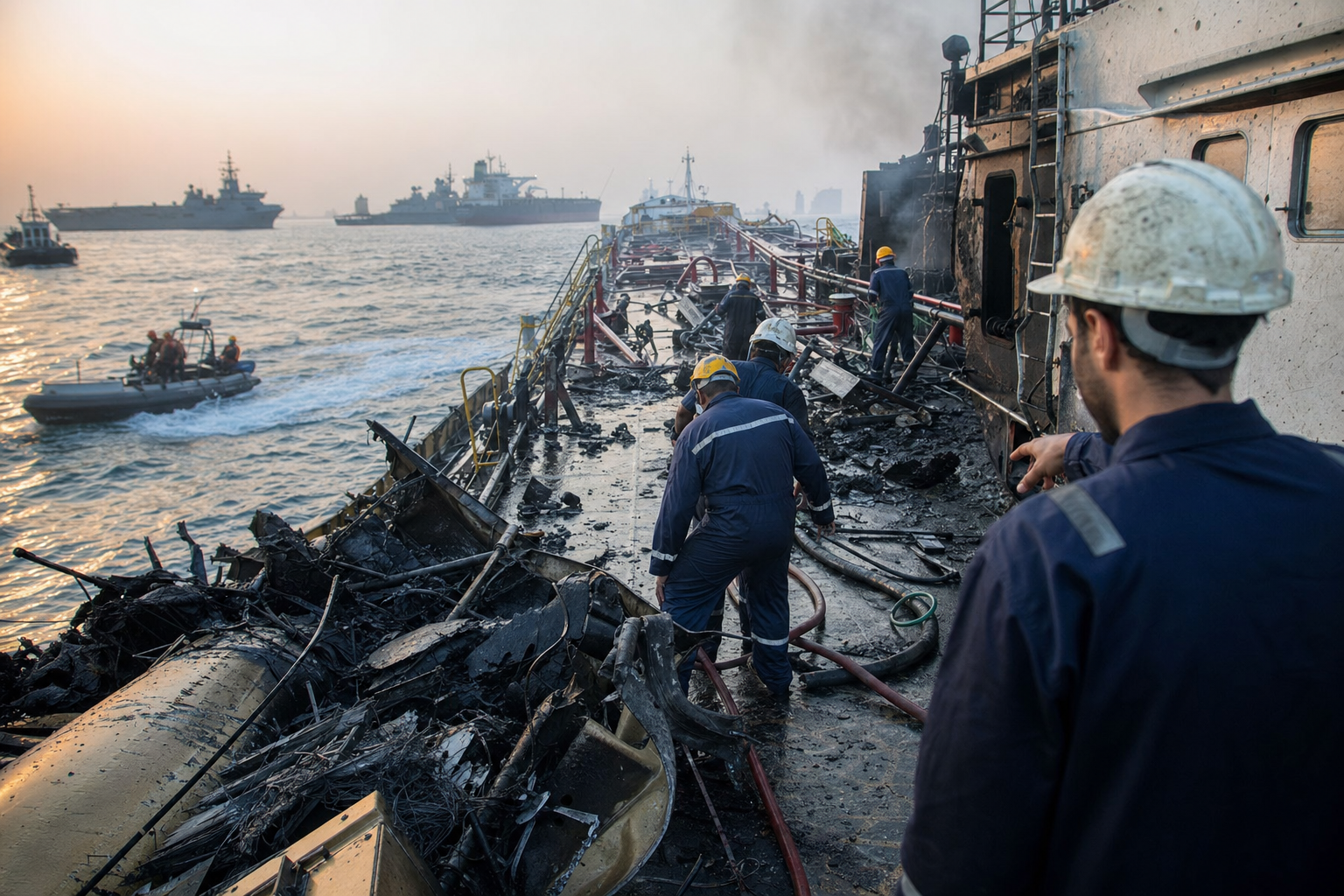
The article tells the story of Sunil Puniya, a young Indian seafarer who survived a missile strike on the oil tanker Skylight in the Strait of Hormuz but lost his friend and coworker Dalip Rathore, whose body has not been found. The attack, which occurred during heightened regional conflict involving Iran and the US-Israel war, caused a fire, blackout, and panic aboard the vessel before crew members jumped into the sea and were rescued by the Oman Navy. The piece uses this incident as a window into a broader crisis affecting commercial shipping in the region, where dozens of vessels have been attacked and more than 20,000 seafarers are reportedly stranded in the Gulf. It highlights problems including abandonment, unpaid wages, unsafe conditions, poor food and water, and the difficulty of determining who is responsible for vessels operating under opaque ownership and sanction-driven arrangements. The article also cites shipping unions and industry groups, showing that seafarer welfare is being strained by both conflict and longstanding labor abuses. Through Sunil’s and Rex Pereira’s accounts, the story underscores the human cost of maritime insecurity and weak accountability in global shipping.
Entities: Sunil Puniya, Dalip Rathore, Ashish Kumar, Rex Pereira, Strait of Hormuz • Tone: analytical • Sentiment: negative • Intent: inform
24-05-2026
The article reports that Britain is preparing a new military role in the aftermath of the war with Iran: helping clear the Strait of Hormuz of mines so international shipping can resume. Although the conflict was not initiated by Britain, the country has become deeply involved through air support, defensive missions, and now a planned maritime mine-clearing operation. British officials appear to be using the deployment to demonstrate commitment to the United States and to counter criticism from President Trump that Britain has not done enough.
The centerpiece of the effort is the R.F.A. Lyme Bay, which is being equipped as a “mother ship” for autonomous mine-hunting systems. Britain has also deployed the H.M.S. Dragon, and France and Germany are contributing forces in a broader multinational mission to reopen the waterway. British personnel described advanced autonomous drones that can scan the seabed, detect mines, and reduce the danger to human crews. Officials said Iran has a range of highly destructive mines and that the first practical goal would be to create safe shipping lanes through the strait.
The article underscores the strategic importance of the Strait of Hormuz, which had carried a large share of the world’s oil supply before the war and now has around 850 large vessels and 20,000 seafarers stranded. It also notes the strained political backdrop: the Trump administration remains dissatisfied with NATO and with allies like Britain, even as Britain tries to show it is pulling its weight in the crisis. A correction at the end clarifies that the Lyme Bay is an amphibious landing ship, not a destroyer.
Entities: Britain, United Kingdom, Iran, Strait of Hormuz, President Trump • Tone: analytical • Sentiment: neutral • Intent: inform
24-05-2026
A war-related disruption in the Middle East is triggering an early industrial supply shock in East Asia, where a shortage of naphtha—a key petroleum derivative used to make plastics, inks, solvents, rubber, and medical materials—is already affecting manufacturers in Japan and South Korea. The shortage stems from the blockade of the Strait of Hormuz, which has cut off exports from key suppliers such as Qatar and Kuwait and severed much of the region’s traditional supply chain. Because Japan and South Korea depend heavily on Middle Eastern crude and finished naphtha products, they are especially exposed to the disruption.
The article explains that the consequences are beginning to show in everyday life and industry: Japanese companies are stripping color from food packaging to save ink, supermarkets are reporting shortages of plastic wrap, diaper makers are raising prices, and construction projects are being delayed because of shortages of naphtha-derived materials. In South Korea, petrochemical firms have reduced operating rates, some have declared force majeure, and consumers are reportedly hoarding goods. More serious concern is growing that shortages could spread to medical devices and other sensitive sectors that cannot easily substitute materials.
Governments are trying to stabilize supply by seeking imports from outside the Middle East, including Russia and the United States, but officials and analysts warn that alternative supplies may be insufficient. Japanese authorities say they have secured needed volumes, yet companies continue to warn of impending shortages, public concern is rising, and economic indicators suggest the disruption may intensify by June. The piece frames naphtha as a critical industrial “building block” and warns that unless shipping through the Strait of Hormuz resumes safely, manufacturing across East Asia may face deeper disruption.
Entities: naphtha, Japan, South Korea, Strait of Hormuz, Middle East • Tone: analytical • Sentiment: negative • Intent: inform