23-10-2026
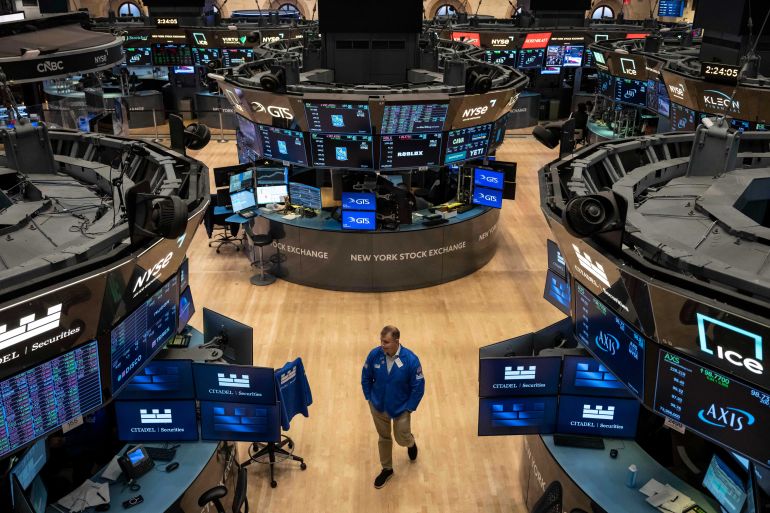
US technology stocks fell sharply on Thursday as investors questioned whether the enormous sums companies are spending on artificial intelligence infrastructure can be sustained. The Nasdaq Composite dropped 2.6 percent, its steepest decline since June 5, while the S&P 500 fell 1.21 percent, its largest daily loss since July 29. The sell-off affected nearly all of the “Magnificent 7” technology companies: Meta fell nearly 7 percent after increasing its projected capital spending for the year to $135bn–$145bn and reporting net profit below expectations. Amazon, Nvidia, Tesla, Alphabet and Microsoft also declined, while Apple gained 1.2 percent. Intel and Advanced Micro Devices each lost about 8 percent, and Broadcom fell 4.3 percent. The Nasdaq ended about 5.8 percent below its October 6 record high.
Rising oil prices added to the gloomy market mood. Brent crude rose 4 percent on Thursday and continued climbing on Friday, passing $114.20 a barrel, its highest level since May. Major Asian markets also opened lower, with Japan’s Nikkei 225 and South Korea’s KOSPI recording notable declines before or during morning trading.
Seaport Research Partners analyst Jay Goldberg said market movements seemed to reflect investor sentiment more than any change in underlying fundamentals. He acknowledged legitimate concerns about AI investment but characterized the scale of the market shift as driven primarily by fear and uncertainty. The article places those concerns within a wider debate about whether AI spending is creating a bubble comparable to the one before the 2000 dot-com crash. Some analysts consider investment in data centres and graphics processing units unsustainable; others argue that AI’s potential societal impact could justify the expense. Gartner forecasts global AI investment will reach $2.7 trillion in 2026 and $3.6 trillion in 2027.
Entities: John Power, Jay Goldberg, Al Jazeera, Nasdaq Composite, S&P 500 • Tone: analytical • Sentiment: negative • Intent: analyze
23-10-2026
CNBC Daily Open reports a sharp U.S. market sell-off driven by renewed concern over the cost of artificial-intelligence investment and escalating geopolitical risks. The Nasdaq fell more than 2%, its worst session since June, while the S&P 500 declined 1.2%, its largest drop since July. Meta lost nearly 7% after reporting negative third-quarter free cash flow of $2.12 billion and lifting the lower end of its expected 2026 capital expenditures to $135 billion. In a flight toward bonds, the 10-year Treasury yield dropped more than 17 basis points to 4.972%, falling below 5% for the first time in about a month and recording its steepest one-day decline since March 2023.
Oil moved in the opposite direction. Brent crude rose 4% to $113.17 per barrel and U.S. West Texas Intermediate gained 2.4% to $99.47. The increases followed a New York Times report, citing U.S. officials, that the U.S. and Israeli militaries had prepared plans for possible renewed strikes on Iran after the midterm elections.
The article also examines Elon Musk’s political and business activity. SpaceX had secured at least $6.78 billion in federal work by October 1, while Musk had committed about $366 million to the 2026 election cycle, mostly to Republican groups and his America PAC. He had also reportedly invested roughly $1 billion in Skydance.
Looking ahead, Pershing Square CEO Bill Ackman predicted a strong 2027 if the wars in Ukraine and Iran end, arguing that lower energy prices could ease inflation and support markets. Nvidia CEO Jensen Huang, meanwhile, said he saw no reason to expect a memory glut by 2029, noting that demand for memory, including high-bandwidth memory, can continue to grow. The newsletter also announces that this is the final Daily Open edition; readers will receive Morning Squawk instead.
Entities: Nasdaq, S&P 500, Meta, Artificial intelligence capital spending, 10-year U.S. Treasury yield • Tone: analytical • Sentiment: neutral • Intent: inform
23-10-2026
CNBC’s final Daily Open newsletter covers a difficult session for technology stocks, shifting fortunes in Elon Musk’s businesses and political activities, and several economic developments in Asia. The Nasdaq Composite fell 2.6%, its worst day since early July, as investors renewed doubts about the scale and financing of artificial-intelligence spending. Nvidia CEO Jensen Huang described demand from neocloud companies as “off the charts,” while warning that capital is scarce, though he expects the funding gap to be resolved.
In South Korea, SK Hynix shares rebounded after the company abandoned plans to list its Solidigm unit in the United States. Regulators had raised concerns about dual-listing rules, and the company cited market conditions while saying it would continue exploring ways to finance a new U.S. factory.
The newsletter reports that President Donald Trump asked Musk to restore Ukraine’s access to Starlink after restrictions reportedly hampered Ukrainian drone operations. Trump said access was restored, but Ukrainian President Volodymyr Zelenskyy said service speeds had not fully returned. Separately, SpaceX reported a $561 million unrealized gain on its stake in Musk’s Boring Co., raising third-quarter net income to about $4.4 billion; it nevertheless recorded a $413 million net loss for the first nine months. Musk has also spent about $366 million in the current election cycle, mainly supporting Republicans, prompting House Democrats to seek investigations into SpaceX’s government contracts.
Other developments include wealthy Chinese transferring offshore assets to U.S. banks amid expanded Chinese tax enforcement, and Japan’s core inflation rising to 2.1% in September. The article says the Bank of Japan is expected to hold rates at its next meeting, while a December increase remains possible.
A closing analysis broadens the focus to credit-market risks. Credit-default-swap spreads widened for AI-related companies including CoreWeave, Oracle and SoftBank, as well as for France and Italy. The newsletter frames the move as a warning that borrowing costs and financing concerns are rising for both AI infrastructure projects and heavily indebted governments. It also marks the final edition of Daily Open, with Morning Squawk set to replace it.
Entities: Anniek Bao, Elon Musk, Donald Trump, Volodymyr Zelenskyy, Jensen Huang • Tone: analytical • Sentiment: neutral • Intent: analyze
23-10-2026
Oil prices climbed to their highest levels since May as attacks in Saudi Arabia and fears of a wider war involving Iran raised concerns about disruptions to global energy supplies. Brent crude traded at $113.73 a barrel early Friday after rising 4% the previous day, while US West Texas Intermediate reached $100.08. Shipping costs have also surged, and European natural-gas futures rose above €90 per megawatt-hour, adding to inflation worries.
At the same time, a sell-off in artificial-intelligence-related shares weighed on global markets. The S&P 500 fell 1.2% on Thursday, its worst daily performance since July, and the Nasdaq dropped 2.6%. Investors are questioning whether the large costs of borrowing to build data centres and buy AI chips can be justified, despite continued company growth. Meta shares fell 7% despite stronger-than-expected revenue, Tesla lost 3.1%, Nvidia dropped 4.4%, and debt-laden AI cloud provider CoreWeave declined 10.1%. Microsoft, Amazon and Alphabet are due to report earnings the following week, alongside the Federal Reserve’s next rate decision.
Bond markets reflected competing concerns over government debt, inflation and risk. France’s 10-year bond yield remained elevated at about 5.07%, above Germany’s 3.34%, amid political pressure for increased spending. However, investors sought the relative safety of US Treasuries as technology shares fell, pushing the 10-year Treasury yield down to 4.97% from 5.13% the previous day. The move came despite data showing US jobless claims at their lowest level since July. Investors were also awaiting business activity surveys from the eurozone, UK and US for clues about the effects of higher energy prices and borrowing costs on economic growth.
Entities: Doloresz Katanich, Euronews, Brent crude, West Texas Intermediate, Saudi Arabia • Tone: analytical • Sentiment: negative • Intent: inform