22-10-2026
Iran’s Islamic Revolutionary Guard Corps says the country has shifted from a primarily defensive military doctrine to an “offensive and asymmetrical” one. Under the announced approach, Iran could respond to attacks not only with retaliation but with offensive operations, including against countries that enable US military action. The announcement comes amid a prolonged war, stalled diplomacy, threats of renewed US-Israeli attacks, and escalating incidents around the Strait of Hormuz. The IRGC also claims Iran’s missile stockpile has grown since the 2025 Iran-Israel war and that its missiles have improved in range, accuracy, and destructive power; it offered no figures to support the stockpile claim.
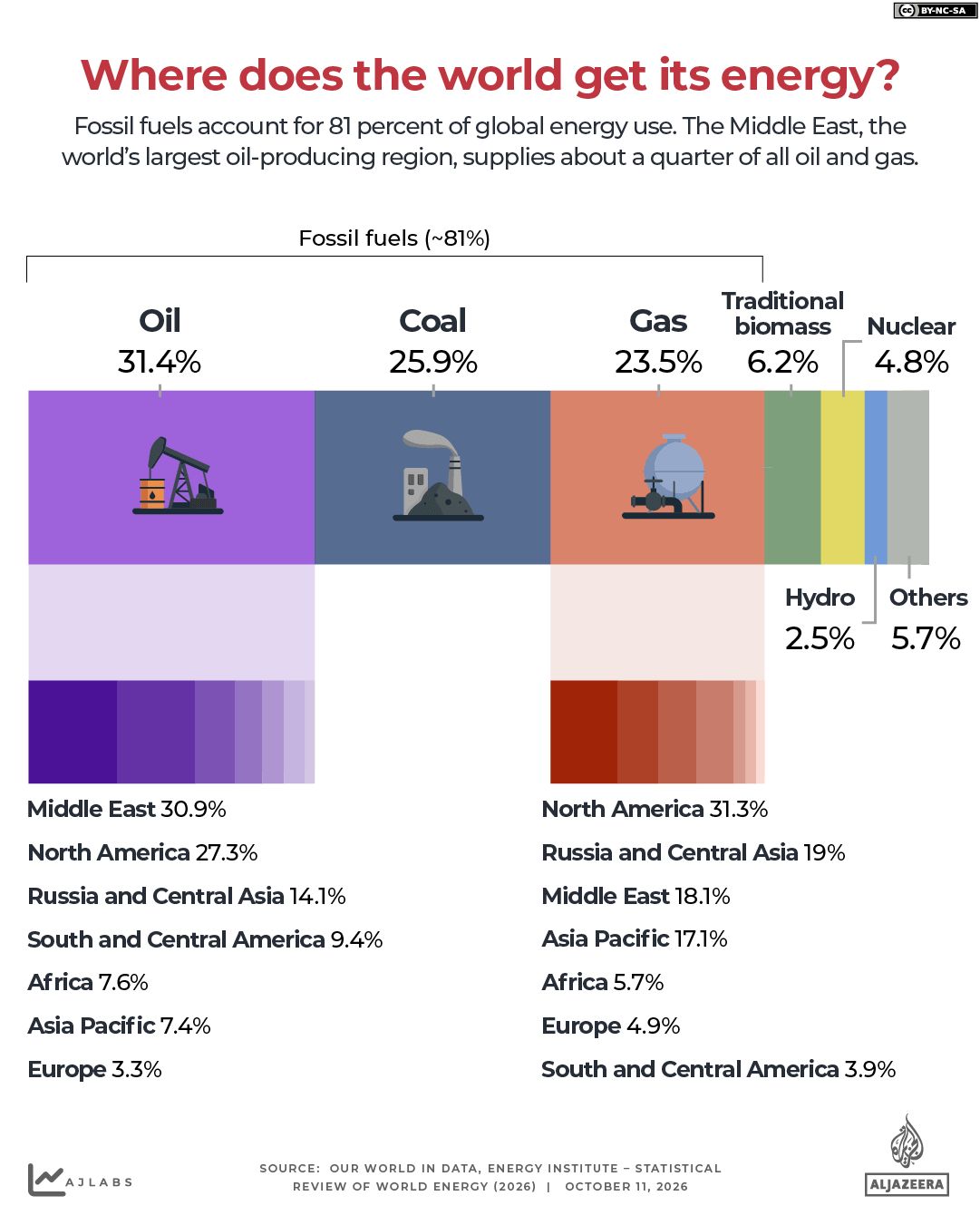
Attacks on vessels in and near the Strait of Hormuz are disrupting a waterway that carried about one-fifth of global oil and natural gas supplies before the war. Although exporters have found alternative routes and regional oil shipments had recovered, renewed attacks and fighting involving Yemen’s Houthis have pushed Brent crude above $110 a barrel.
Analysts quoted by Al Jazeera interpret Iran’s shift as an effort to deter future attacks by making their military, economic, and political costs greater. They point to Iran’s reliance on missiles, drones, and leverage over the strait, and say the consequences could reach global energy, transport, insurance, and goods shipments. One analyst also suggests Tehran hopes economic fallout could affect the US midterm elections.
US President Donald Trump has sent mixed signals, saying negotiations have ended and developments may come soon, while also saying Washington wants a durable outcome. Secretary of State Marco Rubio says a deal is difficult and must prevent Iran from obtaining nuclear weapons; Iran says its enrichment rights are protected under the Non-Proliferation Treaty. Iran has proposed reopening shipping for seven days in exchange for an end to the US blockade of Iranian ports, sanctions relief, and the release of frozen assets. Separately, Washington has ordered nonemergency diplomatic personnel and their families to leave Saudi Arabia after Houthi attacks. The supplied article ends mid-sentence while describing US personnel departure orders.
Entities: Iran, Islamic Revolutionary Guard Corps (IRGC), Hossein Mohebi, Donald Trump, Marco Rubio • Tone: analytical • Sentiment: negative • Intent: analyze
22-10-2026
Iranian state television says seven oil tankers caught fire or were damaged overnight in the Strait of Hormuz after being struck by Iran or hitting naval mines. The Associated Press could not independently verify the claims, and the report gave no casualty figures. Iran’s Revolutionary Guard navy renewed its threat to target U.S. military bases if Washington continues helping commercial vessels navigate the strait. A British maritime monitor says October has seen the most reported attacks on commercial shipping since the war’s opening weeks in March, although it has not reported these latest incidents and says some shippers have become less willing to report attacks.
The article describes mounting risks to regional security and global energy supplies. Oil producers have kept crude moving, but at increasing cost. A return to full-scale fighting could endanger civilians and disrupt shipments of oil, natural gas and fertilizer, potentially driving prices higher. The United States has imposed a maritime blockade and sanctions on Iran, while sending additional forces, including a third aircraft carrier and thousands of troops, to the region. The possibility of renewed U.S.-Israeli attacks is also linked to upcoming Israeli and U.S. elections and voter concern over high fuel prices.
The conflict has also expanded as Iran-backed Houthi forces in Yemen have intensified attacks involving Saudi Arabia. The Saudi-led coalition says it intercepted drones over Riyadh and Medina. The Houthis claimed attacks on Saudi defence and energy facilities and an airport; Saudi authorities reported two deaths in Dammam, but did not immediately confirm attacks in Riyadh and Yanbu. After repeated Houthi attacks, the United States ordered some personnel and family members to leave Saudi Arabia, and Saudi Aramco reportedly evacuated its Dhahran headquarters and asked employees to work remotely.
Mediators are seeking to restart U.S.-Iran negotiations. Iranian Foreign Minister Abbas Araghchi says Tehran remains open to diplomacy while prepared to defend itself. Iran’s proposal would end the war and reopen the strait within a week if the United States meets conditions including ending its blockade of Iranian ports, echoing terms in a deal that collapsed in June.
Entities: Strait of Hormuz, Iran, United States, Israel, Saudi Arabia • Tone: analytical • Sentiment: negative • Intent: inform
22-10-2026
The live update reports escalating security and economic pressure across the Middle East as the U.S. and Iran continue indirect discussions over a proposed seven-day ceasefire. Brent crude rose about 3% to $112 a barrel after Iran’s Revolutionary Guard said it attacked four vessels near the Strait of Hormuz, alleging they used a route Tehran rejects. The IRGC also said three other ships struck sea mines and stopped. Separately, U.S. forces have quietly reduced their presence at some Middle Eastern posts because of continuing threats from Iran and its Houthi allies. An attack on King Fahd International Airport in Dammam, Saudi Arabia, reportedly killed at least two people and wounded eight.
Iranian Foreign Minister Abbas Araghchi said negotiations with Washington are continuing, although the U.S. is seeking additional clauses in the ceasefire proposal President Trump rejected last month. Iran’s army chief said the country is prepared for asymmetric warfare and has developed its drone capabilities. Meanwhile, a Saudi-led coalition said it intercepted four drones over Riyadh and Medina, while the Houthis have denied targeting the two holy cities. The Houthis also accused Saudi Arabia of attacking an Indian yacht near Zuqar Island; the claim had not been independently corroborated.
The update describes wider diplomatic and commercial consequences. Kpler told The Wall Street Journal that Iran’s offshore oil stocks held on tankers in Asian waters had run out in mid-October, with a U.S. naval blockade preventing replenishment and costing Iran at least $25 billion in oil revenue, according to U.S. Central Command. Egypt called for a political solution between Saudi Arabia and the Houthis, while a group of European and Middle Eastern diplomats is scheduled to meet in Istanbul to discuss Yemen, the Strait of Hormuz, Palestine and other issues. Reuters also reported that Saudi Aramco instructed staff to leave its Dhahran headquarters and work remotely amid Houthi attacks.
Entities: Iran, United States, Saudi Arabia, Yemen's Houthi movement, Strait of Hormuz • Tone: analytical • Sentiment: negative • Intent: inform
22-10-2026
The U.S. State Department has ordered non-emergency embassy personnel and their families to leave Saudi Arabia as Houthi attacks on the kingdom intensify. The order applies to Saudi Arabia only, spokesperson Tommy Pigott said, correcting reports that other Gulf states might also be subject to mandatory departures. Several other U.S. embassies have instead adopted “restricted operations,” allowing them to reduce staffing and services while remaining open. U.S. military personnel have also been quietly drawn down at some Middle Eastern posts amid threats from the Houthis and Iran, according to U.S. officials.
The attacks have included drone and missile strikes on Saudi airports and oil facilities. A recent strike on Riyadh’s King Khalid International Airport killed 12 people, including one American, and injured more than 300. Saudi authorities and a Saudi-led coalition have reported intercepting further drones, including an attack near the Shaybah oil field; two people were killed and two injured by falling debris there, though officials did not identify the attacker.
The Houthis, who control a large part of Yemen including Sanaa, are aligned with Iran. Some Saudi officials accuse Iran of supporting their actions, while Tehran denies involvement. The article notes that the conflict could threaten shipping and energy flows because the Houthis are near the Bab al-Mandab Strait, an important maritime chokepoint whose significance has grown amid disruptions in the Strait of Hormuz.
Yemeni political adviser Marwan Ali Noman called for international assistance, warning that the Houthi threat could expand. The United Kingdom has offered Saudi Arabia support, including defensive air operations. It remains unclear whether the Trump administration will provide assistance; President Trump has not ruled out strikes on the Houthis and has described their actions as very bad.
Entities: U.S. State Department, Saudi Arabia, Houthi militants, Iran, Tommy Pigott • Tone: analytical • Sentiment: negative • Intent: inform
22-10-2026
Oil prices rose Thursday amid concerns that the Middle East conflict could escalate and that the U.S. may resume strikes against Iran. Brent crude gained 3.3% to $112.37 a barrel by 9:15 a.m. ET after briefly approaching $113, while U.S. West Texas Intermediate rose 2.8% to $99.88 after earlier topping $100. The New York Times, citing unnamed U.S. officials, reported that U.S. and Israeli militaries had developed plans for renewed strikes on Iran following next month’s midterm elections. Officials described preparations for a possible “short but intensive” operation. President Donald Trump said the U.S. was not negotiating with Iran and that “something one way or the other” would happen “fairly soon,” while noting that many expected developments after the election. Separately, the U.S. ordered non-emergency government employees and their families to leave Saudi Arabia. State Department spokesman Tommy Pigott said the directive applied only to Saudi Arabia, not the wider Gulf region, and cited rising attacks by Iran-aligned Houthi forces on Saudi civilian targets. The article also examines the potential economic impact of higher oil prices. David Wagner of Aptus Capital Advisors argued that consumers may be less exposed to energy shocks than in past decades. He noted that oil remains below its inflation-adjusted historical highs and cited government data showing gasoline’s share of average disposable income has fallen from about 5% a decade ago to roughly half that level today. Wagner said households may therefore be better able to withstand elevated energy costs.
Entities: Brent crude, West Texas Intermediate (WTI), Iran, Saudi Arabia, United States • Tone: analytical • Sentiment: neutral • Intent: inform
22-10-2026
The United States has ordered non-emergency government employees and their families to leave Saudi Arabia, citing escalating attacks by Iran-aligned Houthi forces on civilian targets. The withdrawal comes amid reports that U.S. and Israeli militaries have developed plans for renewed strikes on Iran after the November 3 midterm elections. The New York Times, citing unnamed U.S. officials, described preparations for a possible “short but intensive” operation, although President Donald Trump has not approved new strikes and has previously rejected plans to resume major combat this year. U.S. and Iranian officials are still negotiating over Tehran’s nuclear program and the Strait of Hormuz, even as threats and military preparations raise concern that the nearly eight-month conflict could expand.
Recent attacks in Saudi Arabia have killed at least three people: a strike at King Fahd International Airport in Dammam killed one and injured eight, while a drone attack on the Shaybah oil field killed two. Saudi authorities said the oil field’s operations were unaffected. The article also reports stepped-up U.S.-Israeli military exercises and an unannounced visit by U.S. Defense Secretary Pete Hegseth to meet Israeli Prime Minister Benjamin Netanyahu. Potential targets in any renewed strikes could include Iran’s energy infrastructure, nuclear facilities, and missile and drone arsenal. Iranian officials, meanwhile, have threatened to widen attacks to data centers and undersea internet cables and have refused nuclear concessions.
The developments are affecting energy markets. Brent crude rose above $110 per barrel, while West Texas Intermediate gained 1% to $98.12. Although oil flows through the Strait of Hormuz have recovered to near pre-war levels, Kpler analyst Muyu Xu said recovering Chinese demand could support prices. China’s crude inventories have been falling sharply, but the country retains an estimated 1.1 billion barrels in reserves. Chinese refiners may increasingly seek Middle Eastern crude and alternatives to Iranian oil, potentially limiting further declines in Dubai crude pricing.
Entities: United States, Saudi Arabia, Iran, Houthi attacks, Strait of Hormuz • Tone: analytical • Sentiment: negative • Intent: inform
22-10-2026
The article examines whether Iran is prepared for renewed US and Israeli attacks after the countries’ elections, and how political calculations may shape the conflict. US midterm elections on November 3 and Israel’s October 27 election have become factors in leaders’ decisions. High energy prices linked to the war are hurting Donald Trump’s party, and Trump said the United States would not attack Iran before the midterms. After the elections, however, he may face fewer domestic political constraints, while Israeli Prime Minister Benjamin Netanyahu has campaigned on regime change in Iran.
Reports say Washington and Jerusalem have developed plans for a short, intensive operation targeting Iranian nuclear facilities, energy infrastructure, missiles and drones. The United States has increased its regional military presence, while maintaining a blockade of Iranian oil exports. Trump has also discussed striking Pickaxe Mountain, near Natanz, and reportedly considered a powerful bomb, though its usefulness against underground facilities is uncertain.
Iranian officials say the country is preparing to respond to any attack, including strikes on US bases and energy infrastructure in the Gulf. They acknowledge US military superiority but argue that Iran’s resilience, replacement of officials killed in earlier attacks, and rebuilding of missile and drone capabilities are central to its strategy. Preparations also include domestic security measures aimed at preventing foreign military pressure from fueling unrest.
Diplomacy remains stalled, with disputes over Iran’s nuclear program and the scope of US demands. Iran has proposed reopening the Strait of Hormuz under its control in exchange for lifting the US blockade, releasing frozen assets and ending military action. Yet oil flows through the strait are nearing prewar levels, potentially weakening Tehran’s leverage. Ordinary Iranians face severe economic hardship and fear renewed fighting, internet restrictions and street confrontations.
Entities: Donald Trump, Benjamin Netanyahu, Masoud Pezeshkian, Ali Asghar Shafieian, Abbas Araghchi • Tone: analytical • Sentiment: negative • Intent: analyze
22-10-2026
The United States has ordered non-essential employees and family members to leave its embassy in Riyadh as Houthi attacks on Saudi Arabia intensify. The announcement came on Wednesday, the same day a strike at King Fahd International Airport in Dammam killed two people and injured eight. Saudi Arabia’s Civil Aviation Authority said the airport was assessing material damage. It did not identify who carried out the attack, and the Houthis did not claim responsibility. Flightradar24 reported that flights were diverted as airport operations halted.
Separately, Saudi Arabia’s Energy Ministry said forces intercepted a drone targeting an oil facility. Falling debris killed two people and injured two others; those killed were identified as Filipino and Nepali nationals.
US State Department spokesperson Tommy Pigott said the departure order applied to staff and family members in Saudi Arabia. He cited increasingly hostile actions by Iranian-supported Houthis, including attacks on civilian airports and critical infrastructure that have caused casualties and severe travel disruption. Reports by Reuters and AFP said a similar order had been issued for other Gulf countries, with AFP naming the UAE, Jordan, Qatar and Bahrain. Pigott called those reports inaccurate and said only US employees in Saudi Arabia were ordered to leave.
The article notes that Washington has issued similar evacuation orders more than once this year amid the Iran war and Iranian strikes on Saudi Arabia, which were described as retaliation for the US-Israeli war against Tehran. A four-year truce between Saudi Arabia and the Houthis has collapsed during the broader conflict, and Saudi Arabia has faced near-daily attacks this month. The developments heighten concerns about the security of civilian infrastructure and travel in the region.
Entities: Saudi Arabia, Riyadh, Dammam, King Fahd International Airport, United States Department of State • Tone: analytical • Sentiment: negative • Intent: inform
22-10-2026
The article describes growing fears that the United States and Israel could resume major military strikes on Iran, potentially triggering a wider conflict across the Gulf. The concern is fueled by election timing in Israel and the United States, a substantial US military build-up, heightened readiness by Israeli and Iranian forces, and reports that Washington and Jerusalem have developed plans for new strikes. The US State Department ordered non-emergency government personnel and their families to leave Saudi Arabia, citing the possibility that hostilities could escalate rapidly. Although reports suggested similar departures elsewhere, a State Department spokesperson said the order applied only to Saudi Arabia and attributed it to increasing Houthi attacks. A separate US warning urged citizens in 12 Middle Eastern countries to remain alert to threats against US interests.
Iran says it has reorganized its defences and would respond severely to any attack, including against US interests and civilian infrastructure around the region. Reports say Iran has activated a decentralized defence doctrine intended to allow local forces to continue fighting if central command is destroyed. Meanwhile, media reports identify Iranian energy infrastructure, nuclear facilities, and missile and drone arsenals as possible targets of US-Israeli strikes intended to force Tehran into a deal and reopen the Strait of Hormuz. President Donald Trump has said decisions about a new attack would come after US midterm elections. Israeli Prime Minister Benjamin Netanyahu has called for the overthrow of Iran’s government, while opposition leader Yair Lapid has argued against an attack before Israel’s election.
The article also reports that seven oil tankers were damaged or caught fire in the Strait of Hormuz, with Iran attributing the incidents to attacks or naval mines. French President Emmanuel Macron urged extreme caution, warning that election-related tensions could lead to renewed conflict. Qatar and Pakistan are working as mediators, but uncertainty remains. A return to all-out war, the article warns, would put civilians at risk, disrupt energy and other global supplies, and could drive another rise in worldwide energy prices.
Entities: United States, Iran, Israel, Persian Gulf, Strait of Hormuz • Tone: urgent • Sentiment: negative • Intent: inform
22-10-2026
Iranian state television reported that seven oil tankers caught fire or were damaged overnight in the Strait of Hormuz after being hit by Iran or striking naval mines. The Associated Press said it could not independently verify the claims, and the report cited Iran’s Revolutionary Guard Corps navy without mentioning casualties. Iran again threatened U.S. military bases in the region if Washington continues helping commercial ships navigate the strait, which Tehran considers a key source of leverage in negotiations.
The reported attacks come amid fears that the conflict could return to full-scale fighting. Those concerns are heightened by an upcoming Israeli election and the U.S. midterm election, where war-related price increases have angered voters. Danny Citrinowicz, a former Israeli military and intelligence Iran specialist, said Israeli Prime Minister Benjamin Netanyahu wants to attack Iran and argued that a clear Netanyahu victory could make an attack almost certain. Citrinowicz also accused Israel of moving toward another confrontation without revising its strategy. He expects the region to face another escalation, although opposition candidates may initially focus on domestic issues.
A British maritime monitor, United Kingdom Maritime Trade Operations, said October had seen the most reported attacks on commercial shipping since the war’s opening weeks in March. It did not report the latest incidents and has observed that some shipping companies are becoming less willing to report attacks. Experts say oil producers have managed to keep crude flowing, but at increasing cost.
Iran’s Foreign Minister Abbas Araghchi said Tehran remains open to diplomacy while preparing to defend itself. Iran says it learned military lessons from the war, which began with U.S. and Israeli attacks on February 28, and has suggested it might target infrastructure such as undersea cables and data centers. The United States is sending a third aircraft carrier, thousands of troops, and other military assets to the region. Mediators are seeking to restart formal U.S.-Iran talks. Iran has proposed ending the war and reopening the strait within a week if the United States meets conditions including ending its blockade of Iranian ports; the article’s final sentence is cut off after saying President Donald Trump rejected a proposal in late September.
Entities: Iran, Strait of Hormuz, Seven reported tanker attacks, Danny Citrinowicz, Israel Institute for National Security Studies • Tone: analytical • Sentiment: negative • Intent: inform
22-10-2026
The U.S. and Israel are preparing for a possible renewed attack on Iran in early November, after the U.S. midterm elections, according to a person briefed on their planning who spoke to NPR anonymously. Israel had reportedly considered striking in mid-October, before its Oct. 27 election, but President Trump objected. The U.S. is now assembling forces in the region, though the preparations may also be intended to pressure Iran into a diplomatic agreement. The U.S. midterms are scheduled for Nov. 3, and Israeli Prime Minister Benjamin Netanyahu is campaigning on a pledge to topple Iran’s government.
Iranian Foreign Minister Abbas Araghchi said the country is prepared for diplomacy as well as war and described an attack by the U.S. and Israel as a possibility. Iranian state media reported a security source’s warning that Iran would retaliate against U.S. interests and the infrastructure and assets of countries involved in a conflict. Iranian officials and the Revolutionary Guard have also threatened regional targets, including data centers and underwater internet cables in the Gulf. Iranian media said the Revolutionary Guard targeted seven oil tankers in the Strait of Hormuz on Thursday, with four catching fire and three striking naval mines.
The report situates these preparations in a conflict that began on Feb. 28, when the U.S. and Israel attacked Iran, killing its supreme leader and senior officials. A ceasefire has not held, and the sides have exchanged strikes amid a struggle over the Strait of Hormuz. Iran has blocked the waterway and targeted commercial vessels; the U.S. has imposed a blockade on Iranian ports and oil shipments. Although U.S. strikes have damaged Iran’s military capabilities, Iran remains a threat to Gulf states, Israel and U.S. bases in the region.
The conflict has also inflicted serious economic costs. The International Monetary Fund says disruptions to energy, shipping, tourism and trade have hit Gulf economies. Iraq, Kuwait and Qatar are projected to contract by about 16%, while Saudi Arabia and the United Arab Emirates are also in recession. If the conflict and supply disruptions continue, the IMF projects oil will average $130 a barrel in 2027.
Entities: United States, Israel, Iran, Donald Trump, Benjamin Netanyahu • Tone: analytical • Sentiment: negative • Intent: inform
22-10-2026
The article reports that Iranian officials are deliberately prolonging peace negotiations with the United States to deny President Donald Trump a political win before the November 3 midterm elections. Three Iranian officials and an insider told Reuters that Tehran believes Trump cannot be trusted and expects him to renew strikes against Iran after the vote. One official said Iran is preparing for renewed Israeli and U.S. attacks rather than seeking an agreement to end the war. The article says Iran’s clerical establishment is determined not to give Trump a political victory.
The negotiations are unfolding amid political pressure on Trump and his allies over high gasoline and diesel prices linked to the war. Although Trump has predicted that fuel prices will fall after the elections, and has referred to a Russian diesel deal, the article says there is no clear route to reopening the Strait of Hormuz, where Iran has intensified attacks. Tehran has also used the conflict—which is approaching its ninth month—to criticize Trump and encourage Americans to express their views in the midterms.
According to the officials, Iran has avoided concessions that could produce a breakthrough before Election Day. Instead, it is pressing for a cease-fire that would reopen the Strait of Hormuz in exchange for the United States lifting its naval blockade and sanctions. The article further reports that Iran is preparing for a large-scale retaliation campaign in the Middle East, based on its assumption that Trump will resume regional strikes after the elections.
Entities: Donald Trump, Iran, United States, Tehran, Islamic Revolutionary Guard Corps (IRGC) • Tone: analytical • Sentiment: negative • Intent: inform
22-10-2026
The United States and Israel have developed plans for renewed strikes on Iran following the American midterm elections, according to officials and people familiar with the discussions. The proposed operation would be short but intensive, with potential targets including Iran’s energy infrastructure, nuclear facilities, and missile and drone capabilities. The two militaries have increased exercises, including flights over Iraq to practise strike manoeuvres, and US Defence Secretary Pete Hegseth reportedly discussed possible attacks with Israeli Prime Minister Benjamin Netanyahu during an October visit.
Some officials believe another major round of strikes could put further pressure on Iran’s economy and encourage diplomatic concessions. However, the article outlines substantial doubts about whether renewed attacks would achieve more than the earlier US-Israeli campaign, which lasted from February to April. That fighting raised energy prices and inflation internationally, weakened regional security, and depleted US missile-interceptor supplies. President Donald Trump has also repeatedly rejected plans to resume major combat operations, so his approval is uncertain.
Iranian officials have threatened broader retaliation, potentially targeting data centres and underwater internet cables in addition to commercial shipping and energy infrastructure. Meanwhile, the United States is building up its military resources as diplomats use the prospect of renewed war to press Iran on its nuclear programme and control of the Strait of Hormuz. Iran’s negotiators have so far resisted nuclear concessions, preferring to defer the issue.
Israel’s October 27 election could further complicate the plans. If Netanyahu loses, his status as caretaker prime minister may make it difficult to launch a war. Alternatively, analysts say, he could use the prospect of joint strikes to push political rivals into a unity government, potentially extending his time in power. The article presents renewed conflict as a possibility shaped by military preparations, stalled diplomacy, political calculations, and significant risks.
Entities: United States, Israel, Iran, Donald Trump, Benjamin Netanyahu • Tone: analytical • Sentiment: negative • Intent: inform
22-10-2026
The supplied page is a live Middle East news update from The National, dated October 22, 2026, and marked updated at 4:20 a.m. Its headline reports that one person was killed in an attack on Dammam airport in Saudi Arabia. The extracted page text does not include a full report describing the incident, identifying the victim, or giving details about the attacker, the weapon, or the circumstances. It therefore supports only the limited conclusion that the outlet was reporting a fatal attack at the airport.
The page’s other headlines indicate a wider regional-security focus. They mention Iranian President Masoud Pezeshkian saying negotiations cannot proceed under sanctions and threats, Foreign Minister Abbas Araghchi seeing little prospect of progress in US talks, and Saudi-led forces intercepting drones launched toward Madinah and the Eastern Province. Other listed updates concern Middle East oil exports recovering to prewar levels through alternatives to the Strait of Hormuz, Israeli Prime Minister Benjamin Netanyahu describing regime change in Iran as a key objective, and a report that Donald Trump opposed a multi-day Israeli bombing campaign.
The page also promotes related video coverage, with titles about Saudi forces striking vessels carrying Houthi weapons, the UAE president meeting Saudi Arabia’s defence minister, Egypt’s president pledging to defend Saudi Arabia, and an Egyptian flight attendant killed in a Riyadh attack. These are headlines and video teasers, not detailed accounts in the provided text. Overall, the material presents a fast-moving picture of conflict, diplomacy, drone threats, and regional economic disruption. Because the underlying live-update entries are absent from the supplied content, further specifics or connections among the events cannot be verified from this page extract.
Entities: Dammam airport, Saudi Arabia, Madinah, Eastern Province, Iran • Tone: analytical • Sentiment: negative • Intent: inform
22-10-2026
The article examines whether the United States and Israel might resume military strikes against Iran before Israel’s October 27 general election or the US midterm elections on November 3. Regional concern has grown amid the deployment of two US aircraft carrier strike groups, another carrier reportedly heading to the region, the evacuation of non-emergency US government personnel and their families from Saudi Arabia, and reports of Israeli military activity near Iran. The State Department said the Saudi departure order was prompted by threats from Yemen’s Houthis, while also warning that hostilities could escalate rapidly beyond the immediate area.
Reports cited by the article point to differing timelines. Drop Site News, citing Iranian and US officials, reported that a large-scale attack could begin before Israel’s election, potentially with Israeli strikes on Iranian air defences preceding US bombing. The New York Times, citing US officials and other sources, reported that the two militaries had prepared plans for renewed attacks after the US midterms. Those plans could target energy and nuclear facilities as well as missile and drone capabilities, with the aim of pressuring Tehran into diplomatic concessions. A pre-midterm strike was not ruled out, but President Donald Trump could decide against further action.
Analyst Alex Vatanka argues that political considerations—particularly in Israel—could shape decisions about escalation, but considers an attack before the elections unlikely. He warns that renewed fighting could devastate the region and harm US interests. Iran’s national security chief, Mohsen Rezaei, has threatened continued missile and drone attacks on US assets and suggested Tehran might expand its targets to include data centres, artificial intelligence sites and undersea cables.
The article recalls that Trump and Israeli Prime Minister Benjamin Netanyahu launched the conflict on February 28. The administration initially expected a short war, but it has not toppled Iran’s government, secured a lasting agreement or fully defeated Iran militarily. Trump has made statements suggesting possible future action, while reports of Israeli fighter jets conducting a “power projection” sortie near Iran add to uncertainty.
Entities: Donald Trump, Benjamin Netanyahu, Alex Vatanka, Mohsen Rezaei, Tommy Pigott • Tone: analytical • Sentiment: negative • Intent: inform
22-10-2026
The article reports that the United States and Israel have prepared options for renewed military strikes against Iran, potentially after the US midterm elections. According to The New York Times, the proposed campaign could be brief but intense, targeting Iran’s energy infrastructure, nuclear facilities, and missile and drone capabilities. US and Israeli forces have reportedly increased exercises, and Washington is assembling a substantial military presence, including aircraft carriers, Marines, fighter jets, and special operations forces. President Donald Trump has not decided whether to authorize an operation, while the White House says it is keeping options open to prevent Iran from obtaining nuclear weapons.
Iran has warned that it would respond to any new attack. IRGC spokesperson Hossein Mohebbi said Tehran was preparing to unveil a weapon dubbed the “Father of All Bombs,” but provided no details. He also claimed that Iran’s missile stockpile and capabilities had grown since the 12-day war with Israel in June 2025, and described a shift toward deterrence and asymmetric warfare. Iranian officials have rejected the prospect that a new conflict could be ended quickly, warning that attacks could extend to shipping, energy infrastructure, data centres, and undersea internet cables.
The article also examines speculation that the US might use its GBU-43/B MOAB, or “Mother of All Bombs,” against Iran’s deeply buried Pickaxe Mountain nuclear facility. Experts question whether the surface-blast weapon could penetrate the site’s granite protection, and officials have raised concerns about the vulnerability of the aircraft needed to deliver it.
Diplomatic efforts continue alongside military preparations. Washington reportedly hopes the threat of force will influence negotiations over Iran’s nuclear programme and the Strait of Hormuz, but Iranian negotiators have resisted concessions. The article notes that earlier strikes raised global energy prices and inflation and strained US missile-interceptor supplies. Iranian President Masoud Pezeshkian described the situation as a “super-challenge” for Iran and said the country would remain firm.
Entities: United States, Israel, Iran, Donald Trump, Pete Hegseth • Tone: analytical • Sentiment: negative • Intent: inform
22-10-2026
The supplied material does not include the body of the Al Jazeera liveblog. It contains a headline, a URL, and website advertising text, so the article’s reported events, supporting details, and updates cannot be summarized reliably. The headline says that Donald Trump denies that the United States is engaged in talks with Iran and says the situation will resolve soon. It also refers to a vow by Iran’s Islamic Revolutionary Guard Corps (IRGC) to invade and to a change in Iran’s defence doctrine toward an offensive posture. The headline frames these developments as part of the US-Israel war on Iran and presents the page as a live news update. Without the article text, it is not possible to establish what Trump said in context, what the IRGC’s vow referred to, how the doctrine change was described, or whether the liveblog contains later developments or responses. The advertising and alert prompt in the supplied content are not substantive reporting and have been excluded from the clean text. The tone, sentiment, and intent assessments below therefore apply only to the headline and the limited accompanying material, not to the unavailable full article.
Entities: Iran, Donald Trump, Islamic Revolutionary Guard Corps (IRGC), United States, Israel • Tone: urgent • Sentiment: neutral • Intent: inform
22-10-2026
CNBC’s Daily Open surveys geopolitical, technology and labor-market developments, with uncertainty over a possible renewed U.S.-Israeli campaign against Iran at its center. Although Washington says it does not plan to strike before the Nov. 3 midterms, The New York Times reported that military plans for strikes afterward have been drawn up, potentially targeting energy infrastructure, nuclear facilities, and missile and drone arsenals. Oil has remained above $108 a barrel, while gas prices in Asia and Europe are at multiyear highs, raising the prospect of prolonged pressure on households.
The briefing also describes damage to Russian oil infrastructure from Ukrainian drone attacks and the collapse of a short-lived energy ceasefire declared by Donald Trump. In a separate dispute, The Wall Street Journal reported that Elon Musk ordered a Starlink slowdown affecting Ukraine; Trump denied involvement, while the article notes that both men have criticized Ukrainian President Volodymyr Zelenskyy.
Corporate and technology news includes a strong SpaceX earnings reaction and Musk’s hint at a possible Tesla tie-up; Meta CEO Mark Zuckerberg’s eight-year residency commitment, linked to the creation of non-voting Class C shares; and Anthropic’s preview of Claude Duet, an AI agent designed to perform tasks while seeking approval before sending messages or making payments. EBay, meanwhile, plans to eliminate about 1,000 jobs, or 9% of its workforce, as it streamlines operations and focuses on priority areas. The article connects this announcement to growing central-bank concern about AI and employment.
The briefing additionally reports that PHP vulnerabilities briefly took government websites offline and that South Korea is expected to leave interest rates unchanged. In its closing item, BlackRock fixed-income chief Rick Rieder argues that high-quality bonds offer an unusually attractive opportunity: he says a diversified portfolio could yield more than 7% with short duration and A- average credit quality.
Entities: Anniek Bao, Donald Trump, Elon Musk, Volodymyr Zelenskyy, United States and Israel • Tone: analytical • Sentiment: neutral • Intent: inform
22-10-2026
In a France 24 video interview issued on October 22, 2026, presenter Jean-Emile Jammine speaks with Federico Donelli, an associate professor of international relations at the University of Trieste, about reports that the United States and Israel may be planning further strikes on Iran. The discussion asks whether a three-day joint offensive could accomplish what eight months of confrontation have not.
Donelli challenges the idea that a short, intensive military campaign would necessarily produce a decisive political result. He says the central issue is the purpose of military pressure: whether it is meant to restrict Iran’s capabilities or to push the country into negotiations. Even if strikes weaken Iran militarily, Donelli cautions, that does not ensure the pressure can be converted into a durable political outcome. Doing so could also risk triggering a wider regional crisis.
The interview’s framing places the possibility of strikes ahead of US and Israeli elections, but the supplied text does not describe specific electoral calculations or provide details of any operational plans. It instead focuses on the limits of military action and the challenge of translating force into political change. Donelli also emphasizes that Iran retains leverage over the United States, suggesting that the balance of pressure is not one-sided.
The article is a brief presentation of the interview rather than a full transcript. It identifies Donelli and Jammine, states the main question and argument, and lists related topics such as Iran, Israel, Donald Trump, Benjamin Netanyahu, and elections. Its central point is that another short round of attacks would not automatically resolve the conflict or produce a lasting political settlement.
Entities: Federico Donelli, Jean-Emile Jammine, Iran, United States, Israel • Tone: analytical • Sentiment: neutral • Intent: analyze
22-10-2026
France 24’s Thursday, October 22 press review surveys reports on possible renewed US-Israeli military action against Iran and several other stories covered by the press. The New York Times, citing US administration officials, reports that fresh strikes could follow the US midterm elections. Officials reportedly believe another major attack might push Iran’s economy toward collapse and prompt diplomatic concessions. The paper also reports increased joint US-Israeli training exercises and a recent meeting between US Defense Secretary Pete Hegseth and Israeli Prime Minister Benjamin Netanyahu. Haaretz connects the reporting to Donald Trump’s comments that the United States is “not negotiating” with Iran and that events may unfold soon, possibly after the election. The review stresses that The New York Times also cautions that Trump has repeatedly cancelled plans to resume major combat.
The article then turns to France, where the Senate has issued a 30-proposal report on maintaining public order after protests escalated into riots. Proposals cited by Le Figaro and L’Opinion include using state benefits to pay for damage, expanding CCTV and algorithmic surveillance, increasing mounted police, and criminalizing “illegal protesting.” Libération, by contrast, reports criticism from a collective of lawyers, teachers and elected officials over teenagers’ detention conditions after the unrest. The group describes severe overcrowding and unsanitary conditions at the Bobigny courthouse, and argues that the treatment is intended to deter future protests.
Finally, the review describes a security vulnerability in PHP, a programming language used by a large share of websites. After a security firm used AI to identify bugs, engineers and researchers secretly prepared roughly 10,000 lines of patches. A leak accelerated the release schedule so the vulnerability would not remain exposed; government websites going offline had alerted many people that a problem existed. The review also briefly mentions a story about a man for whom “what happened in Vegas did not stay there,” without providing further details.
Entities: Donald Trump, Pete Hegseth, Benjamin Netanyahu, Iran, United States • Tone: analytical • Sentiment: neutral • Intent: inform
22-10-2026
The National’s October 22, 2026 opinion-cartoon page presents a cartoon by Shadi about oil shipments passing through the Strait of Hormuz. Its brief caption, “Shadi’s take on oil shipments getting through the Strait of Hormuz,” identifies the subject, while the accompanying topic labels connect it with the Strait of Hormuz, the United States, Iran, and the Middle East. The supplied article text does not include the cartoon image or any further explanation, so it is not possible to determine what argument, joke, or specific development the cartoon depicts. The page therefore offers a topical pointer rather than a reported account: it signals that oil transit through the strategically significant strait is the focus of the cartoon, without providing details about shipment volumes, disruptions, policy decisions, or the positions of the countries named in the tags.
A list of related cartoons places this item among Shadi’s recent work on international and regional affairs. Those subjects include World Food Programme cutbacks, Syria and a proposed national recovery fund with the World Bank, the collapse of an energy truce between Ukraine and Russia, and US considerations regarding Iran. The page also links the cartoon to broader themes such as energy prices and US elections. These surrounding headlines establish the editorial context of an ongoing series, but they do not add reporting or evidence about the October 22 cartoon itself.
Overall, the available content identifies the cartoon’s creator, publication date, and subject, but leaves its visual message unstated. Any interpretation beyond the stated focus on oil shipments moving through the Strait of Hormuz would require access to the cartoon image.
Entities: Shadi, The National, Strait of Hormuz, oil shipments, Iran • Tone: analytical • Sentiment: neutral • Intent: analyze
22-10-2026
Israeli Prime Minister Benjamin Netanyahu said he had directed the Israel Defense Forces, Mossad and other security agencies to pursue the overthrow of Iran’s government, describing regime change as the only way to eliminate the threat he says Iran’s nuclear program poses to Israel. Speaking at an IDF officer graduation ceremony, he said Iran had resumed its nuclear efforts after Operation Rising Lion and was trying to conceal its project underground. Netanyahu said those developments prompted the joint Israeli-U.S. Operation Roaring Lion, whose opening strike killed former Supreme Leader Ali Khamenei on February 28. He accused Khamenei’s successor, Mojtaba Khamenei, of continuing his father’s pursuit of nuclear weapons and called on the graduating officers to make overthrowing Iran’s government their mission.
Netanyahu said U.S. President Donald Trump supported toppling the Iranian regime and quoted Trump as saying, “We are ready to finish the job,” while emphasizing cooperation with Israel. Netanyahu also pledged to target Iran-backed groups Hamas and Hezbollah, saying people in Lebanon, Gaza and Iran hoped for Israel’s victory.
At the same ceremony, Defense Minister Israel Katz warned that Iran would face severe consequences if it attacked Israel. Katz said Iran and its proxies might attempt terror attacks to affect Israel’s October 27 Knesset elections. He described the Iranian regime as being at its weakest point and said Israel was prepared to thwart potential attacks and respond forcefully, whether they occurred before or after the vote.
Trump separately praised the strikes on Iran, saying they had prevented it from obtaining a nuclear weapon. On negotiations, he gave mixed messages: he first said talks were continuing “a little bit,” then said the United States was not negotiating with Iran and that a development would come “fairly soon.” He said many expected it to happen after the Israeli election, but added that the outcome remained to be seen.
Entities: Benjamin Netanyahu, Iranian regime, Israel Defense Forces (IDF), Mossad, Donald Trump • Tone: neutral • Sentiment: negative • Intent: inform