21-09-2026
Qatar has ruled out building a pipeline to bypass the Strait of Hormuz, arguing that the project would not be commercially or technically viable. Energy Minister and QatarEnergy chief executive Saad Sherida Al-Kaabi said an alternative route would require Qatar to transport natural gas by pipeline and construct new facilities abroad to convert it into liquefied natural gas (LNG). This would duplicate facilities already being developed in Qatar as part of the North Field expansion. Al-Kaabi also rejected US Treasury Secretary Scott Bessent’s prediction that the Strait of Hormuz could become “worthless” within two years, emphasizing that the waterway carries a wide range of trade beyond oil and gas.
Qatar’s LNG expansion has been affected by regional disruption. The North Field project is intended to increase annual production capacity from 77 million tonnes to 142 million tonnes by 2030, but the first North Field East production unit has been delayed from 2026 to the first half of 2027. Further delays are possible if equipment cannot reach Qatar. Attacks on Ras Laffan damaged two LNG production units, cutting export capacity by about 17%; repairs are expected to take three years. Qatar’s GDP also fell 7% year on year in the first quarter of 2026.
Alongside the energy update, Qatar announced a significant restructuring of its domestic investment strategy. Prime Minister Sheikh Mohammed bin Abdulrahman Al Thani launched Doha Investment, a platform designed to manage and expand the Qatar Investment Authority’s domestic holdings. The platform will initially oversee 45 companies, including Qatar Airways Group, QNB Group, Ooredoo Group, Qatari Diar, Katara Hospitality and Hassad Food.
Qatar also outlined more than $60bn in infrastructure, real estate and hospitality opportunities over the next five years. The government expects to award approximately $38.5bn in infrastructure projects, including public-private partnerships, while private investment in real estate and hospitality could reach $22.5bn. Doha Investment will also seek to support new businesses in technology, manufacturing, supply chains and healthcare and increase private-sector participation.
Entities: Qatar, Strait of Hormuz, Saad Sherida Al-Kaabi, QatarEnergy, Liquefied natural gas (LNG) • Tone: analytical • Sentiment: neutral • Intent: inform
21-09-2026
The closure of Saudi Arabia’s East-West crude pipeline could tighten oil supplies for Asia’s four largest crude-importing countries, with South Korea viewed as the most exposed. Saudi crude represented 34.1% of South Korea’s crude imports in July, compared with 27.3% for Japan, 14.9% for China and 10.2% for India. However, those percentages do not directly indicate how many barrels are threatened because the disruption at the Strait of Hormuz has already redirected substantial Saudi exports from Gulf terminals to the pipeline-linked port of Yanbu on the Red Sea.
Analysts estimate that between 3.5 million and 4.5 million barrels per day of Asia-bound supply could be at risk if the pipeline remains closed and inventories at Yanbu and in Egypt are depleted. Kpler estimates that a month-long closure could remove approximately 120 million barrels from the market under assumptions that the pipeline carries 4.5 million barrels per day and Yanbu holds 15 million barrels in storage. Existing inventories, alternative Gulf loadings and a partial restart could reduce the eventual disruption.
The immediate effect is expected to be higher spot prices, wider premiums for medium-sour crude and more expensive freight, rather than an immediate physical shortage. Stored crude could sustain exports for roughly one to two weeks, while replacement cargoes from the Americas or West Africa may take more than a month to reach Asia. Asian refiners’ growing ability to process a wider range of crude grades may provide some flexibility.
Saudi Arabia has not given a restoration timeline. Reports from the Associated Press and Reuters suggest repairs could take three to six weeks, although U.S. Energy Secretary Chris Wright said the pipeline would resume operations “very soon.”
Entities: Saudi Arabia, Saudi East-West pipeline, South Korea, Japan, China • Tone: analytical • Sentiment: negative • Intent: analyze
21-09-2026
A tanker was struck by an unknown projectile while entering the Strait of Hormuz, injuring two crew members, according to the United Kingdom Maritime Trade Operations Center (UKMTO). The injuries were minor, and the vessel was reportedly able to continue under its own power toward its next port of call. No environmental damage had been reported. The incident occurred amid heightened tensions in the strategic waterway, where Iran has asserted control since the United States and Israel launched a war on February 28. Although some tankers have resumed using the strait, maritime traffic remains far below normal levels. In peacetime, the route carries roughly 20 million barrels of oil per day, or about one-fifth of global oil supplies.
The article also reports worsening violence in Yemen. The World Health Organization said 164 people were killed and 516 injured between September 13 and 18 in fighting between Iran-backed Houthi rebels and Saudi-backed government forces. Since August 6, the conflict has caused 3,672 casualties, including 674 deaths, and displaced 129,438 people across seven provinces. Lahj province has become a particularly active front line, while the International Organization for Migration reported that more than 11,000 people were displaced in three days.
Elsewhere, Pakistan’s interior minister visited Tehran as Pakistan sought to help facilitate dialogue between Iran and the United States. Israel remained on heightened alert during Yom Kippur following the killing of an Israeli settler in the occupied West Bank. France planned to summon Iran’s ambassador over the closure of a French Embassy-affiliated language centre in Tehran. Finally, Saudi Arabia’s Red Sea International Film Festival was postponed until late 2027, with organizers citing timing and logistical considerations rather than explicitly linking the decision to regional security tensions.
Entities: Strait of Hormuz, Tanker projectile attack, United Kingdom Maritime Trade Operations Center (UKMTO), Iran, United States and Israel war • Tone: neutral • Sentiment: negative • Intent: inform
21-09-2026
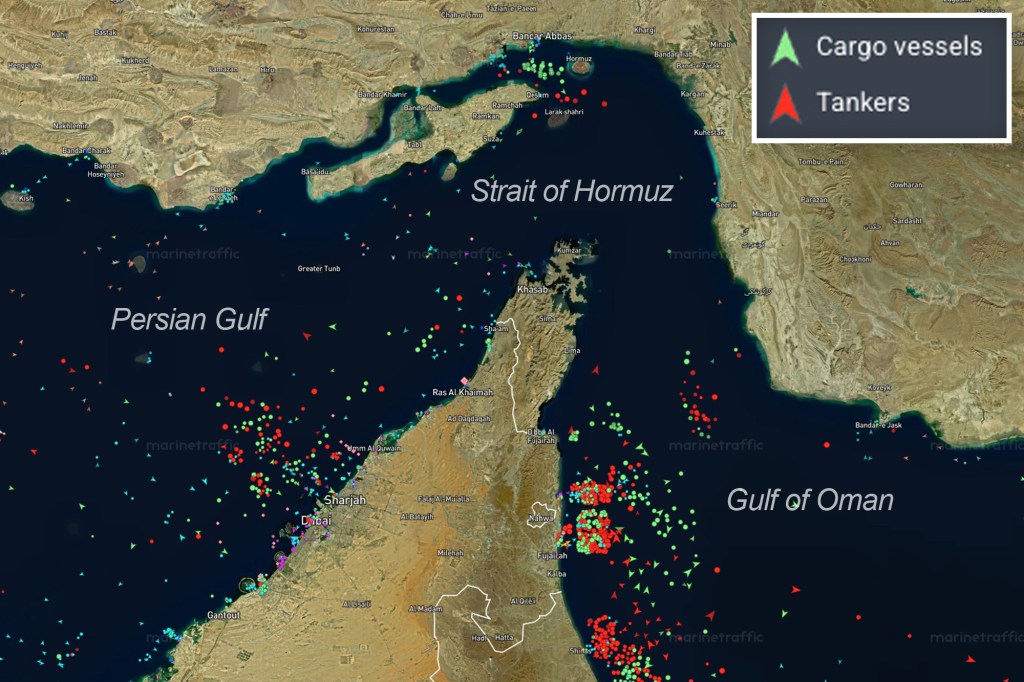
Commercial shipping through the Strait of Hormuz has fallen sharply as the conflict involving the United States, Israel and Iran continues, with only 12 commodity vessels crossing during the most recent weekend compared with 35 the previous weekend. The strait, which carried roughly one-fifth of global oil and liquefied natural gas shipments before the war, is now seeing very limited visible traffic. Despite the decline in trackable vessels, Middle Eastern oil producers continue exporting crude using tankers whose transponders are switched off.
Provisional data from analytics firm Kpler showed that four vessels exited the strait on Sunday, including two tankers carrying refined products and two empty bulk and gas carriers. Two smaller oil tankers entered the Gulf. On Saturday, five vessels carrying agricultural products, liquefied petroleum gas and fertilizer left the Gulf, while an empty very large gas carrier entered. Before the war began on February 28, the waterway typically handled about 125 large commercial vessels per day.
Saudi Arabia has increased oil exports through Hormuz after Houthi attacks on Saudi Aramco’s East-West pipeline disrupted shipments through Yanbu. Saudi exports recovered to more than 4 million barrels per day in September, up from 2.4 million barrels per day in August, their lowest level since at least 2013. Thirteen tankers carrying about 34 million barrels of crude exited the strait during the week of September 13, with Saudi Arabia accounting for half the exports and Iraq for 35%.
JPMorgan analysts said regional oil flows remained stronger than expected, averaging 17.1 million barrels per day over the previous 10 days. Saudi shipments through Hormuz averaged 2.9 million barrels per day over the previous six days, compared with 700,000 barrels per day in August.
Entities: Strait of Hormuz, United States-Iran stalemate, Middle East conflict, global oil and liquefied natural gas shipments, Kpler • Tone: analytical • Sentiment: negative • Intent: inform