14-10-2026
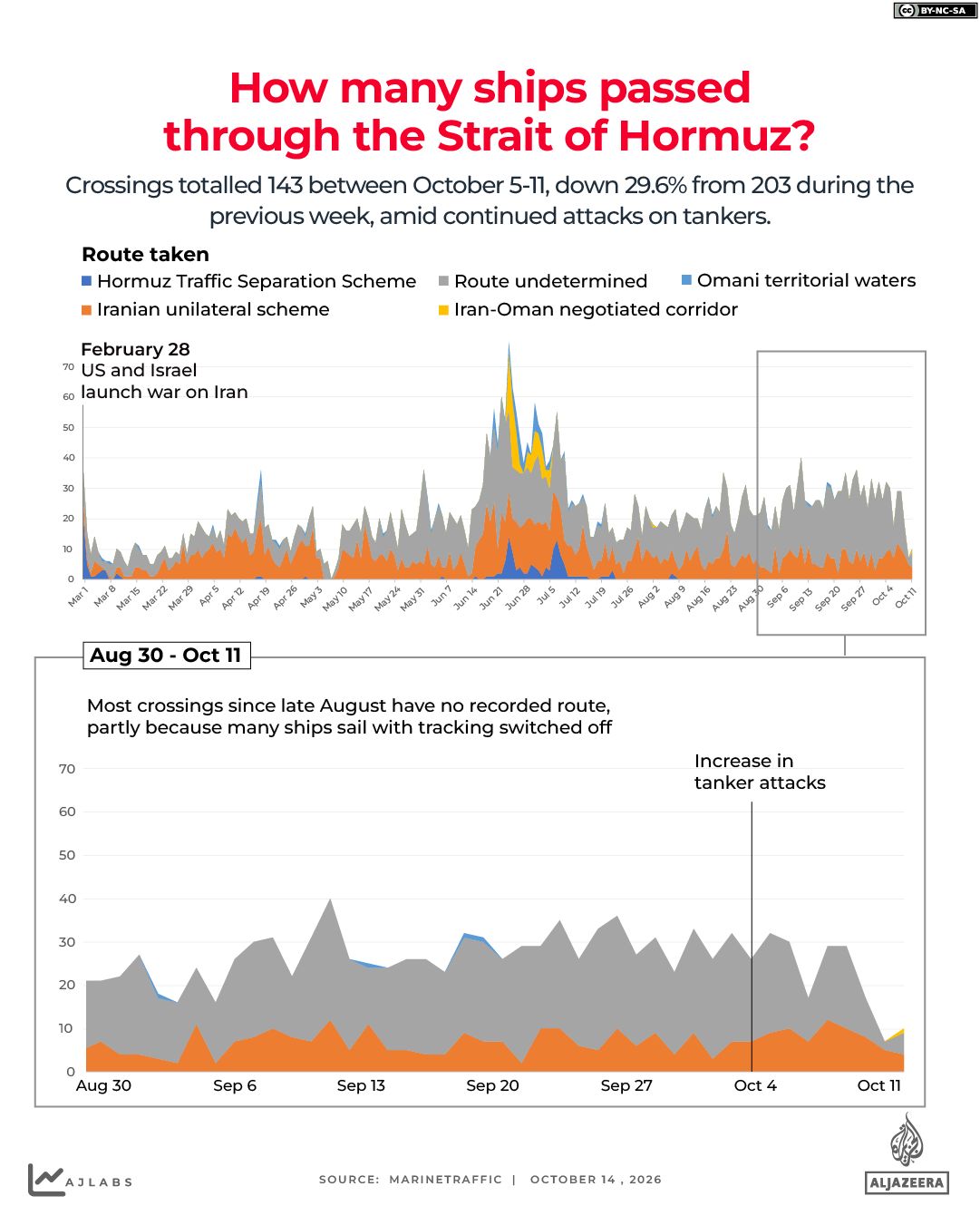
Iran says it has expanded naval surveillance east of the Strait of Hormuz and into the Sea of Oman and Arabian Sea, deploying operational units to monitor maritime traffic and what it describes as enemy activity. Its navy has warned ships not to disable transponders and urged them to coordinate with Iranian forces. An Iranian official says Tehran has recently changed the type and pace of attacks against vessels it considers to be violating its restrictions, with the strategy also intended to affect the outcome of the US midterm elections.
The announcement comes amid a sharp rise in attacks on shipping. Kpler recorded strikes on 10 tankers from September 28 to October 4 and another on October 5. UKMTO reported 15 further attacks from October 6 to 14, including 11 in the most recent four days. The US-led Joint Maritime Information Center assesses the threat to merchant shipping as “severe,” citing attacks or attempted attacks, drone overflights, surveillance, and radio contact with ships. Iran describes its actions as national security and self-defence in response to the US-Israel war.
The attacks have disrupted oil shipments through a waterway that carried about 20 percent of global crude and liquefied natural gas supplies before the war. Although Gulf oil flows through Hormuz recovered to more than 81 percent of pre-war levels in September, transit fell sharply in October: Kpler counted 2.9 million barrels on October 11, compared with nearly 20.8 million on October 8 and a pre-war daily average of 17.1 million. Brent crude rose to $106.58 a barrel.
Washington says Iran has adapted to the destruction of much of its radar capability by using unarmed observers in small boats to identify targets. CENTCOM disputes Tehran’s claim to control the strait, saying US forces and regional partners control it and have helped move oil through. Iranian security chief Mohsen Rezaei, meanwhile, says Iran is targeting a US-assisted shuttle system for transferring oil to larger tankers. The article depicts control of Hormuz as contested, with military threats and attacks undermining the reliability of a critical energy route.
Entities: Strait of Hormuz, Iran, United States, Sea of Oman, Arabian Sea • Tone: analytical • Sentiment: negative • Intent: inform
14-10-2026
A Singapore-flagged container ship, GFS Pride, sank in the Strait of Hormuz after being struck by an unknown projectile on Tuesday, Singapore’s Maritime and Port Authority said. All 21 crew members were evacuated without injuries. A second Singapore-flagged ship, GFS Giselle, was hit by a projectile the following day and sustained hull damage, but reached a safe anchorage with its 22 crew members unharmed. Iran’s Revolutionary Guards said the GFS Pride had struck naval mines while using an “unauthorised” route. Images released by the Guards appeared to show a damaged vessel and containers floating in the water. Other maritime authorities also reported projectile strikes on container ships in the strait, though those ships sustained minor damage and continued their voyages.
The incidents come amid repeated attacks on commercial shipping since the US and Israel’s war with Iran began in February. The International Maritime Organization has recorded 106 confirmed incidents and at least 24 seafarer deaths. The article also reports that the Malta-flagged Safeen Prestige previously sank after an attack, while the bulk carrier Cape Dao was reported to be sinking after a failed rescue attempt. One crew member died when the Cape Dao was struck in September.
The Strait of Hormuz, a route normally carrying about a fifth of global oil and gas shipments, was effectively closed after the war began. A preliminary US-Iran agreement to reopen it collapsed within weeks, and Iran continued targeting ships using a southern route through Omani waters. The US military has been protecting tankers carrying oil from Gulf Arab states. Despite renewed attacks, analysts said crude exports through the strait had recovered to about 80% of their pre-war average in the previous month.
Entities: GFS Pride, GFS Giselle, Strait of Hormuz, Singapore Maritime and Port Authority, Iranian Revolutionary Guards • Tone: analytical • Sentiment: negative • Intent: inform
14-10-2026
A container ship, the Singapore-registered GFS Pride, sank in the Strait of Hormuz on Wednesday after being struck by an unidentified projectile and catching fire. All 21 crew members were evacuated safely, and no injuries were reported, according to Singapore’s Maritime and Port Authority. The sinking is the third commercial-vessel loss during the Iran war, the International Maritime Organization said. Containers from the wreck were left floating in the water, prompting Pakistani maritime authorities to issue a navigational alert.
A second Singapore-registered container ship, the GFS Giselle, was also hit by an unidentified projectile on Wednesday and sustained hull damage. It reached safe anchorage, with no crew injuries reported. Iran’s Revolutionary Guard said the Pride exploded and sank after hitting a naval mine, but maritime security firm Marisks said there was no independent evidence confirming that explanation. Marisks characterized Iran’s claims as consistent with a psychological campaign intended to create fear and uncertainty and deter commercial shipping.
The article says Iran has increased attacks on commercial vessels as it seeks to choke off a recovery in crude oil exports through Hormuz. United Kingdom Maritime Trade Operations Centre incident reports show that more than 20 vessels, mostly oil tankers, have been attacked this month in the strait, the Persian Gulf, and the Gulf of Oman. The attacks have left two sailors missing and more than a dozen injured, according to the IMO.
Oil shipments through Hormuz had returned to prewar levels in September while the U.S. military guided tankers through the strait, but flows have since declined as attacks rose. Kpler data put Hormuz exports at an average of 8.5 million barrels per day in the week ending Oct. 12, nearly 40% below normal prewar levels. Broader Middle Eastern shipments, including pipeline flows to the Gulf of Oman and Red Sea, were nearly 20% below prewar levels. Daily flows varied substantially, from 3 million barrels on Monday to 6 million on Friday.
Entities: GFS Pride, GFS Giselle, Strait of Hormuz, Iran, Iranian Revolutionary Guard • Tone: analytical • Sentiment: negative • Intent: inform
14-10-2026
The article reports a sharp escalation in the U.S.-Iran conflict and related threats to shipping and regional infrastructure. Ali Ozmaei, identified as the chief of Iran’s Revolutionary Guard, said Tehran was waiting for U.S. warships to approach the Strait of Hormuz so Iranian forces could sink them. His remarks were reported by Iranian state-affiliated media. CNBC sought comment from the White House.
Saudi officials also reported that an administrative building belonging to Saudi Aramco was targeted overnight in Dhahran. The strike caused a fire but no injuries, according to the Saudi Ministry of Energy. The attack came amid a series of Houthi strikes on Saudi targets. Recent attacks on Riyadh’s King Khalid International Airport caused fatalities, flight cancellations and property damage; the airport was reported closed until Saturday. Yemen’s civil war has also returned to full-scale fighting between the Houthis and the internationally recognized government, amid the wider regional escalation.
The article says the Wall Street Journal reported that Iran has been reinforcing defenses near sensitive sites, including nuclear facilities, and warning regional officials that it would retaliate across the Middle East against any further U.S. strikes. President Donald Trump said U.S. forces would not attack Iran before the November 3 midterm election.
Maritime risks were highlighted by reports that a cargo ship caught fire and sank in the Strait of Hormuz after striking a naval mine. CNBC said it could not independently verify those reports. The United Kingdom Maritime Trade Operations Centre later cited a verified source saying a container ship had been hit by an unknown projectile. Meanwhile, U.S. Central Command rejected Iranian claims that Iran controlled the strait, asserting that U.S. forces and regional partners had helped move more than 19 million barrels of crude oil through it the previous day. The article includes a correction clarifying that Trump made his statement on Thursday.
Entities: Ali Ozmaei, Donald Trump, Islamic Revolutionary Guard Corps (IRGC), Iran, United States • Tone: analytical • Sentiment: negative • Intent: inform