14-10-2026
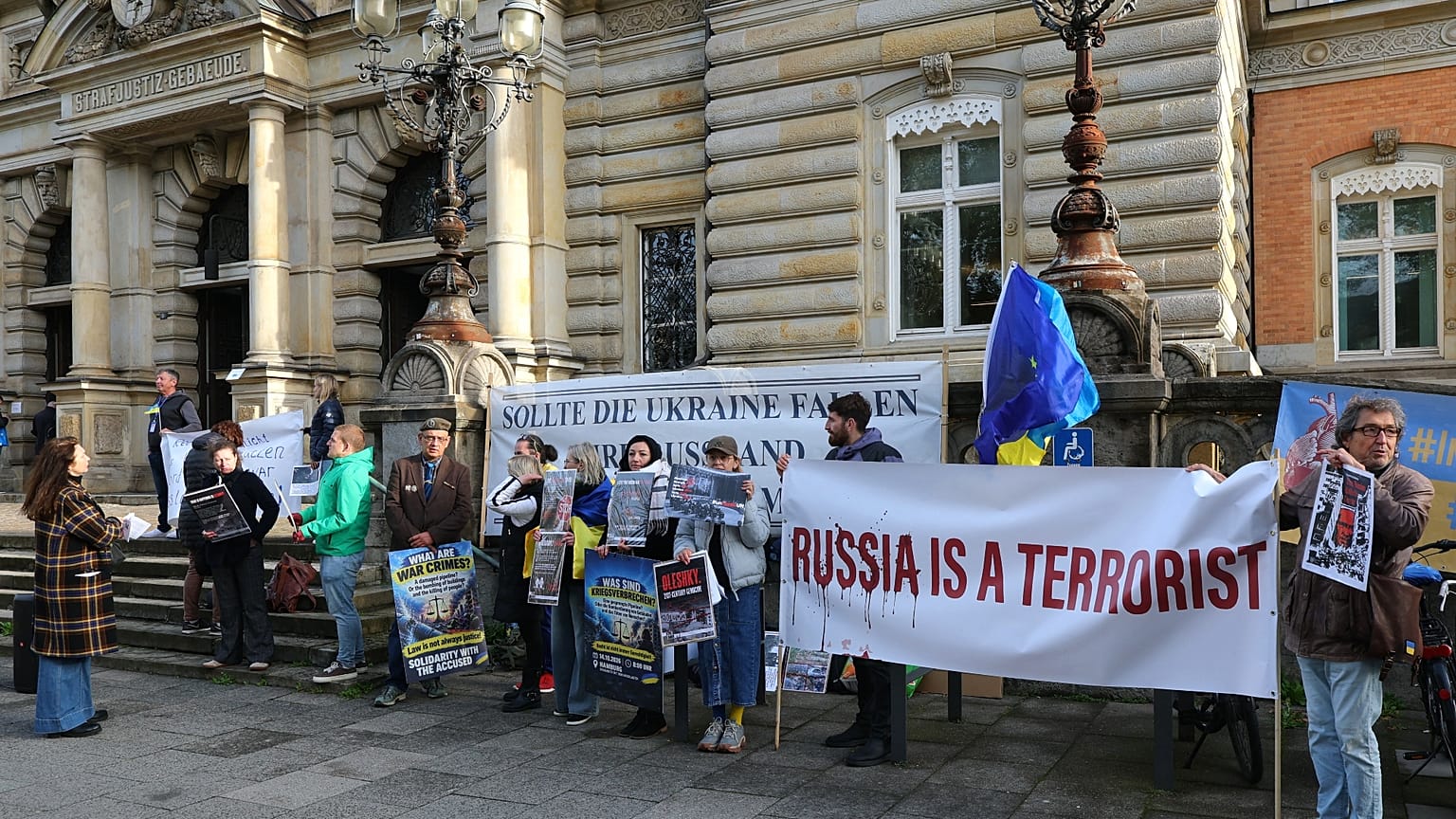
Supporters of Serhii Kuznietsov rallied outside Hamburg’s Hanseatic Higher Regional Court as his trial opened under tight security over the September 2022 explosions that damaged the Nord Stream 1 and 2 pipelines. Demonstrators displayed signs, including one reading “Russia is a Terrorist,” and questioned the decision to bring war crimes charges. Another placard distinguished damage to a gas pipeline from attacks on buildings or the killing of civilians. Ivan Kuritsyn, representing Citizens’ Initiative Vilni De Ua, said the group had come to express solidarity with Kuznietsov. The nonprofit was established by Ukrainians displaced by the war. German prosecutors identify the 50-year-old defendant as Serhii K. They accuse him of helping organize the pipeline operation and allege that he led a team consisting of divers, a boat captain and an explosives expert. The charges include offenses connected to the blasts, property damage, disruption of public services and an alleged war crime involving civilian infrastructure. Kuznietsov has not been convicted. The pipelines were built to carry Russian gas to Germany. The trial is expected to continue for several months, with hearings scheduled through February.
Entities: Serhii Kuznietsov (Serhii K.), Ivan Kuritsyn, Citizens’ Initiative Vilni De Ua, Hanseatic Higher Regional Court, Hamburg • Tone: analytical • Sentiment: neutral • Intent: inform
14-10-2026
A Ukrainian former military officer identified as Serhii K. has gone on trial in Hamburg, Germany, accused of organising the 2022 sabotage of the Nord Stream gas pipelines. The trial opened on Wednesday at the Hamburg Higher Regional Court and is expected to continue into February. It is the first public presentation of evidence in a multiyear investigation. Serhii K., 50, denies involvement and is the only defendant currently on trial. Prosecutors allege he led a team of Ukrainian agents, including divers and an explosives expert, and planned the operation with other military members on behalf of unidentified Ukrainian state entities. They say he entered Germany from Poland using a forged passport, then joined the group aboard a sailboat hired in Rostock. The team allegedly placed timed, military-grade explosives on the pipelines near Denmark’s Bornholm island. Prosecutors say the attack on civilian infrastructure could constitute a war crime.
The explosions were detected by Swedish seismologists on September 26, 2022. Three of the four pipelines ruptured, releasing large quantities of methane. Nord Stream 1 had supplied about half of Germany’s natural gas imports; Nord Stream 2 had been built but never opened, after Berlin cancelled approval shortly before Russia’s invasion of Ukraine. Russia denied responsibility for destroying the pipelines, while Ukraine’s government has also denied involvement. Moscow says it expects a just verdict that identifies those responsible and those who ordered the operation.
The case has also led to arrests elsewhere in Europe. Another suspect, Vladimir Z., whom prosecutors describe as a trained scuba diver on the team, was arrested in Croatia in August, and a Croatian court approved his transfer to Germany the previous month. The investigation has strained relations between Germany and Ukraine, despite Germany’s continued role as one of Kyiv’s strongest supporters amid the continuing war with Russia.
Entities: Serhii K., Vladimir Z., Nord Stream pipelines, Nord Stream 1, Nord Stream 2 • Tone: neutral • Sentiment: negative • Intent: inform
14-10-2026
Serhii Kuznetsov, a 50-year-old Ukrainian man, has gone on trial in Hamburg over the September 2022 explosions that ruptured three of the four Nord Stream gas pipelines in the Baltic Sea. German prosecutors allege that Kuznetsov, then a serving Ukrainian army officer, led a team of divers, a boat captain and an explosives expert, and characterize the attack on civilian infrastructure as a war crime. Kuznetsov denies the charges, and his defence has asked for the case to be dismissed, arguing that investigators produced no witnesses or forensic evidence and that his military secrecy obligations could prevent him from presenting a full defence. His lawyers also dispute the legality of his extradition from Italy, saying the war-crime allegation was not included at the time.
The case is politically delicate because Germany has strongly supported Ukraine since Russia’s 2022 invasion. Ukrainian President Volodymyr Zelensky has denied Ukraine was involved, while Ukrainian MP Oleksandr Merezhko describes the German account as only one possible explanation and argues that Nord Stream 2 served Russian strategic interests. German Council on Foreign Relations analyst Stefan Meister says Berlin has sought to leave the matter to the courts rather than politicize it.
After initial suspicions focused broadly on Russia, German investigators eventually pursued a group of deep-sea divers who had rented the yacht Andromeda in Rostock; prosecutors say explosive traces were found in samples from the boat. A German court ruled in January 2025 that the case fell within Germany’s jurisdiction and should be prosecuted because it affected the country’s internal security. Kuznetsov was arrested in Italy in August 2025 and extradited to Germany later that year. A second Ukrainian suspect, Volodymyr Zhuravlov, has also faced extradition proceedings: a Polish court released him, but Croatia later approved his extradition. The article notes uncertainty over whether and when his case could join the Hamburg trial, and whether the prosecution will affect Germany-Ukraine relations.
Entities: Serhii Kuznetsov, Volodymyr Zhuravlov, Volodymyr Zelensky, Oleksandr Merezhko, Stefan Meister • Tone: analytical • Sentiment: neutral • Intent: inform
14-10-2026
The article examines the trial of Serhii K., a Ukrainian citizen accused of participating in the September 2022 sabotage of the Nord Stream pipelines. Three of the four pipeline sections linking Russia and Germany were destroyed in explosions near Denmark’s Bornholm island. Serhii K., arrested in Italy in August 2025 and extradited to Germany, is due to face the Hanseatic Higher Regional Court in Hamburg. The charges include complicity in a war crime against civilian energy infrastructure, disrupting public services, causing an explosion and destroying structures.
The case is politically sensitive because Germany remains a major supporter of Ukraine, while Ukrainian President Volodymyr Zelenskyy has denied that his country took part in the attack. Germany’s AfD and BSW parties have used the arrest to argue that Ukraine should explain itself or compensate Germany, though the article notes that claims of Ukrainian responsibility have not been proven. Perspectives on who benefited from the explosions remain disputed. A German naval commander previously argued that the operation likely required state-level organization, while a foreign-policy expert said the blasts ended Russia’s ability to use gas supplies as leverage and lowered gas prices.
The article outlines a dilemma for Berlin: it must respect judicial independence and pursue accountability for an attack on infrastructure, while avoiding Russia’s exploitation of the case and considering the consequences for relations with Kyiv. A CDU lawmaker says support for Ukraine should continue even if Ukrainian involvement is established, framing it as a matter of German security and European responsibility. Meanwhile, public support for Ukraine, particularly weapons deliveries, is declining, and the AfD has gained electoral and polling strength. Some German politicians have also called for repairing Nord Stream and restoring Russian gas supplies, a position critics say would undermine European unity and repeat past mistakes. The supplied article ends mid-sentence while discussing the prospects for a return to prewar relations with Russia.
Entities: Serhii K., Volodymyr Zelenskyy, Sahra Wagenknecht, Alice Weidel, Göran Swistek • Tone: analytical • Sentiment: neutral • Intent: analyze
14-10-2026
Supporters of Ukraine gathered outside Hamburg’s Hanseatic Higher Regional Court on Wednesday, 14 October, as proceedings began against a former Ukrainian army officer accused of involvement in the September 2022 explosions that damaged the Nord Stream 1 and Nord Stream 2 pipelines in the Baltic Sea. The trial opened under tight security. Demonstrators waved Ukrainian flags, expressed solidarity with the defendant, and disputed the decision to bring war-crimes charges. Some signs argued that damaging a gas pipeline should be distinguished from attacks on buildings or the killing of civilians. Ivan Kuritsyn, representing Citizens’ Initiative Vilni De Ua, a nonprofit founded by Ukrainians displaced by the war, said the group had come to support Serhii Kuznietsov. German prosecutors identify the 50-year-old defendant as Serhii K. They allege that he helped organise the operation and led a team comprising divers, a boat captain and an explosives expert. He faces several charges connected to the blasts, property damage, disruption of public services, and an alleged war crime involving civilian infrastructure. The allegations have not been proven, and he has not been convicted. The Nord Stream pipelines were built to carry Russian gas to Germany. The trial is expected to continue for several months, with hearings scheduled through February. The article reports the opening of the case and the public demonstration, while distinguishing prosecutors’ accusations from established facts and presenting the protesters’ objections to the charges.
Entities: Serhii Kuznietsov (identified by prosecutors as Serhii K.), Ivan Kuritsyn, Citizens’ Initiative Vilni De Ua, Hanseatic Higher Regional Court, Hamburg, Germany • Tone: neutral • Sentiment: neutral • Intent: inform
14-10-2026
A former Ukrainian army officer has gone on trial in Hamburg, Germany, over the September 2022 explosions that damaged the Nord Stream gas pipelines beneath the Baltic Sea. Prosecutors allege that Serhii Kuznietsov, identified in court under German privacy rules as Serhii K., helped organize and carry out the attack. He faces charges including causing an explosion, damaging property, disrupting public service, and complicity in war crimes for allegedly targeting civilian infrastructure. He is believed to have been the operation’s ringleader.
According to prosecutors, the suspects used a yacht that left the German port of Rostock, rented with forged identification and help from intermediaries. The defendant allegedly arranged the detonation of at least four bombs near Denmark’s Bornholm island, at depths of roughly 230 to 263 feet. The blasts ruptured Nord Stream 1, once Russia’s main natural-gas supply route to Germany, and damaged Nord Stream 2, which never entered service. Prosecutors say the alleged goal was to permanently stop gas deliveries and prevent Russia from using the revenue to fund its military operations.
Kuznietsov was detained in Italy in 2025 and extradited to Germany in November. A second suspect was arrested in Croatia and is seeking asylum there to contest extradition. The pipeline attack has prompted competing allegations: Russia has accused US and British intelligence agencies and NATO, while Western countries initially blamed Moscow. Ukrainian President Volodymyr Zelensky has denied Ukrainian involvement. Germany has declined to comment on the pending case, emphasizing that the judiciary is independent and no verdict has been reached. Sixteen trial dates are scheduled through December, with further dates planned for January and February 2027; the timing of a verdict is unknown.
Entities: Serhii Kuznietsov (Serhii K.), Volodymyr Zelensky, Nord Stream 1, Nord Stream 2, Hanseatic Higher Regional Court • Tone: analytical • Sentiment: neutral • Intent: inform