13-09-2026
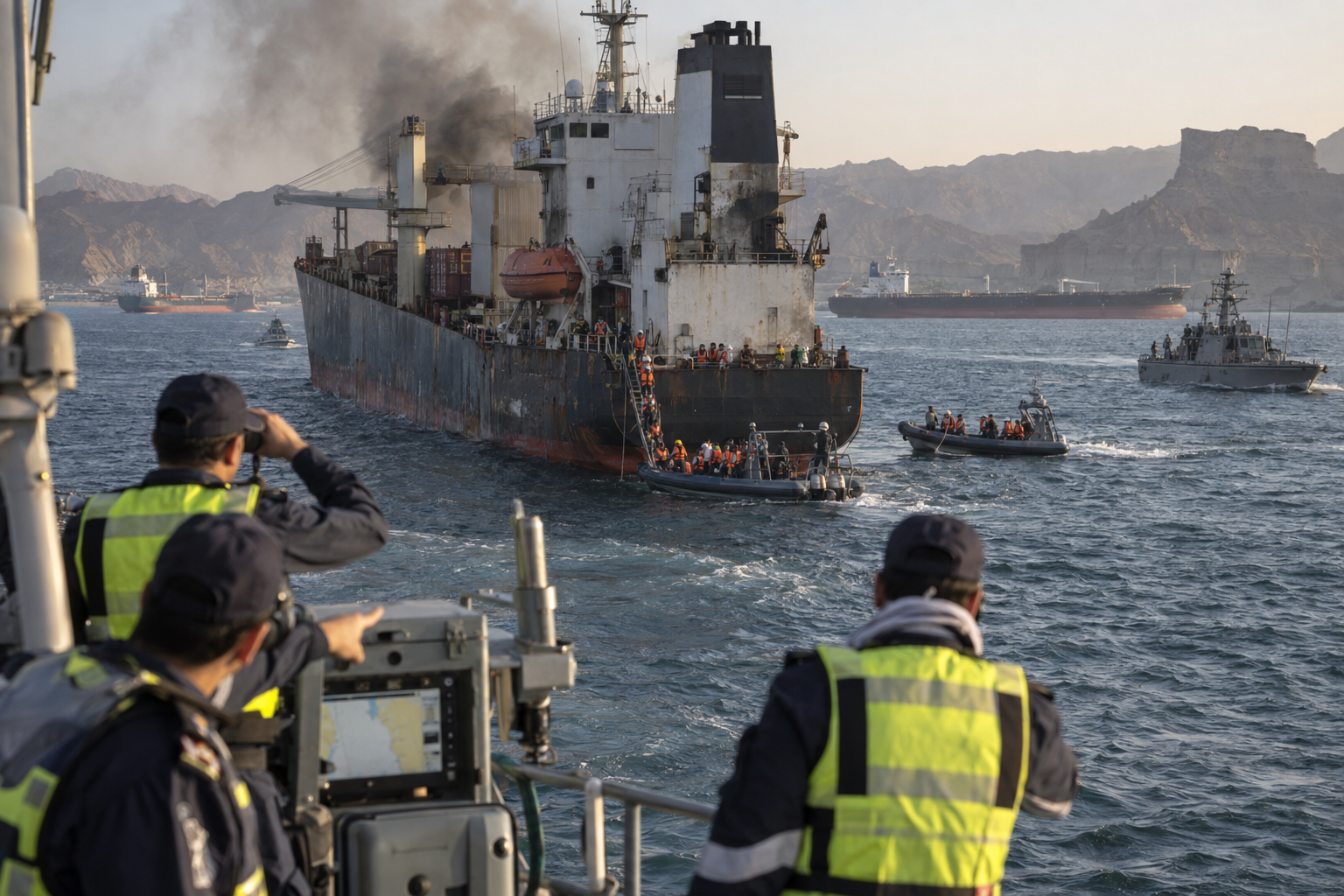
Iranian authorities say one person was killed and several others wounded after an Iranian commercial vessel was struck in the Strait of Hormuz on Sunday. The ship was hit at approximately 5:00 a.m. local time near the coasts of Hengam and Qeshm islands, according to Amir Teymouri, governor of Qeshm city. The article contains differing casualty figures: its opening reports one death and four wounded, while Teymouri is quoted as saying that one person died and three others were injured.
Teymouri blamed the United States, describing it as the “US terrorist enemy” and accusing it of launching the attack. The report does not provide independent confirmation of the attribution. The United Kingdom Maritime Trade Operations agency said it received a report that a vessel had been hit by an “unknown projectile” while passing through the strait. UKMTO later reported that a fire had started onboard and that local authorities were assisting with the evacuation of the crew.
The incident occurred amid continuing military exchanges between Washington and Tehran in the Strait of Hormuz, a strategically vital waterway through which significant oil and gas shipments pass. Qeshm, Iran’s largest island, lies near the reported location of the strike. UKMTO advised vessels to transit cautiously and report suspicious activity while authorities investigate. The article presents the attack as the latest escalation in an ongoing cycle of violence between Iran and the United States in the waterway.
Entities: Iran, United States, Strait of Hormuz, Qeshm Island, Hengam Island • Tone: urgent • Sentiment: negative • Intent: inform
13-09-2026
Iran and Oman have finalized details for new entry and exit routes through the Strait of Hormuz, according to Iranian officials, and plan to brief Gulf countries at a regional meeting in Muscat. The agreement followed intensive technical and diplomatic consultations that concluded in late August. Under the proposed arrangement, the route used by ships entering the Gulf would lie entirely within Iranian territorial waters, while part of the exit route would also pass through waters controlled by Iran. The routes would operate under Iranian arrangements, and the strait’s southern route would be closed once the new system takes effect.
Iranian officials emphasized that the agreement does not amount to reopening the Strait of Hormuz. Tehran says the waterway will remain closed until seven conditions presented to the United States are fulfilled, making any reopening dependent on US actions. Iranian Foreign Ministry spokesman Esmaeil Baghaei said foreign ministers from Gulf states, Iran and potentially Iraq would discuss regional issues and receive a briefing on the Iran-Oman consultations concerning safe passage for ships.
The announcement follows a joint statement by Iran and Oman describing discussions on a phased framework that could establish a temporary joint shipping corridor. The developments come after US-Israeli strikes on Iran on February 28, after which Tehran restricted passage through the strait and US forces imposed a naval blockade targeting vessels traveling to and from Iranian ports.
The Strait of Hormuz connects the Gulf with the Arabian Sea and is a critical global route for oil and gas shipments. Iran and Oman, which occupy opposite sides of the waterway, have continued consultations on maritime security and navigation despite the wider regional confrontation.
Entities: Iran, Oman, Strait of Hormuz, United States, Esmaeil Baghaei • Tone: analytical • Sentiment: neutral • Intent: inform
13-09-2026
The supplied excerpt reports that Oman was startled and confused by a public threat from U.S. President Donald Trump to bomb the country if it obstructed his efforts to reopen the Strait of Hormuz. Speaking to Fox News, Trump said, “If Oman gets in the way, we’ll bomb the s--- out of them.” The article opens in Muscat by emphasizing that the threat appeared unexpected: “The threat felt like it came out of nowhere.”
The central issue is the apparent tension between Oman’s role in regional affairs and Trump’s stated objective concerning the Strait of Hormuz, a strategically important waterway. The wording of Trump’s remark suggests a willingness to use military force against Oman, while the article’s framing highlights Omani uncertainty about why the country would be targeted or what actions might constitute “getting in the way.”
The passage presents the incident as a serious and destabilizing development in relations involving Oman and the United States. It uses Trump’s direct quotation to establish the nature and severity of the threat, while the opening sentence foregrounds the surprise surrounding it. The tone is concerned and analytical rather than openly argumentative, focusing on the disconnect between the threat and the apparent lack of context provided in the excerpt.
Because the supplied content ends after the opening paragraph and contains only a small portion of the Washington Post article, no further details about Oman’s official response, the broader diplomatic context, or subsequent developments can be reliably summarized without adding information not present in the source.
Entities: Oman, Muscat, Donald Trump, Fox News, The Washington Post • Tone: analytical • Sentiment: negative • Intent: inform