13-09-2026
The article examines the worsening economic hardship faced by Iranian families amid years of domestic mismanagement, corruption, sanctions and conflict, intensified by the US and Israeli war that began on February 28, 2026. It focuses particularly on younger Iranians, including Bardia, a 23-year-old Tehran resident who says independence, marriage, emigration, home ownership and even purchasing a new phone are becoming unattainable. His family survives on approximately 800 million rials, or about $350, per month after subsidies and food assistance. They have sharply reduced consumption, buying meat only every six to eight weeks and avoiding restaurants, new clothing and household appliances.
The article reports that annual inflation reached 89 percent by late August, while food inflation exceeded 127 percent. The rial also fell to more than 1.37 million per US dollar, reflecting the pressure created by sanctions, a maritime blockade, disrupted transport routes and uncertainty surrounding possible negotiations involving Oman and the Strait of Hormuz. Rising petrol prices are expected to worsen inflation.
The economic crisis is also producing political and social consequences. Iranians have circulated videos showing the extreme prices of basic goods, often using irony because open criticism may lead to imprisonment or execution. State television described the videos as an effort to provoke unrest and overthrow the Islamic Republic.
Economist Behnam Samadi argues that Iran’s apparent resilience is increasingly being sustained through reduced consumption, lower savings and declining household welfare. Families and businesses are prioritizing survival and risk management over long-term planning, while installment purchases and credit are increasing. President Masoud Pezeshkian and other leaders have called for an end to the country’s “no war, no peace” situation, which has deepened uncertainty. The article concludes that if current conditions persist, Iran’s resilience may gradually become an erosion of resilience.
Entities: Iran, Tehran, United States, Israel, Iraq • Tone: analytical • Sentiment: negative • Intent: analyze
13-09-2026
The 18th BRICS Summit in New Delhi concluded its first day with the group’s 11 members unanimously adopting a joint declaration, despite significant disagreements over the war involving Iran and the United States and Israel, as well as the war in Ukraine. The New Delhi Declaration called for restraint and de-escalation in the Middle East but avoided directly naming or condemning the United States, Israel, Iran, or Gulf countries. It also criticised unilateral tariffs and trade restrictions without explicitly identifying Washington.
The article explains that BRICS, originally founded as an economic grouping by Brazil, Russia, India, and China, has expanded to include South Africa, Egypt, Ethiopia, Iran, the United Arab Emirates, Saudi Arabia, and Indonesia. The bloc represents nearly half of the world’s population and about 40 percent of global GDP. Indian Prime Minister Narendra Modi presented BRICS as a platform for the Global South to help shape international rules rather than an explicitly anti-Western alliance.
The conflict involving Iran exposed both the bloc’s diplomatic value and its limitations. Iran and the UAE belong to BRICS but have been on opposing sides of the conflict, forcing negotiators to use carefully generalised language. The declaration expressed concern over attacks on civilians and safeguarded nuclear facilities, which could be interpreted as an indirect criticism of US and Israeli strikes on Iran.
On Ukraine, BRICS called for dialogue and opposed unilateral sanctions not authorised by the UN Security Council, but did not mention Russia’s invasion or Ukraine by name. The declaration was more explicit on Palestine, opposing the forced displacement of Palestinians, supporting humanitarian access and UNRWA, and endorsing a sovereign Palestinian state based on the 1967 borders. Overall, the summit produced a modest consensus while avoiding direct attribution of responsibility for major conflicts.
Entities: BRICS, New Delhi Declaration, New Delhi, India, Narendra Modi, Xi Jinping • Tone: analytical • Sentiment: neutral • Intent: inform
13-09-2026
In this opinion article, Ronny P Sasmita argues that the 2026 BRICS summit in New Delhi exposed the organization’s limits as a geopolitical bloc. Although the US-Israel war on Iran affected most of BRICS’ members and partner countries, the summit declaration avoided directly addressing the conflict or condemning the United States. This followed a similar failure by BRICS foreign ministers in May, when members could not agree on language concerning the war. Iran wanted condemnation of the US and Israel, while the United Arab Emirates opposed wording that ignored Iranian attacks and its own security concerns.
The author presents this disagreement as a consequence of BRICS expansion. The group’s growing membership has increased its economic weight and diplomatic reach, but it has also brought competing regional interests into the organization. Iran and the UAE, for example, belong to the same bloc while pursuing conflicting Middle Eastern strategies.
The article also examines why major members do not want BRICS to become an explicitly anti-American alliance. India uses BRICS to preserve strategic autonomy while maintaining ties with the United States, the Quad, Russia and China. Russia values BRICS as protection against Western pressure but wants to avoid a direct confrontation with the US and NATO. China seeks a stronger multipolar order but remains economically connected to the US. Brazil and Indonesia likewise favor greater influence and strategic flexibility rather than alignment with Chinese or Russian geopolitical goals.
Sasmita concludes that BRICS is more likely to become a bargaining coalition than a unified geopolitical instrument. Its members can cooperate on institutional reform, development finance, local-currency payments, energy and food security, but struggle when forced to take sides in active conflicts. The organization’s influence may therefore come through gradual changes to global governance, alternative financial institutions and reduced dependence on Western systems. Its avoidance of direct confrontation, the author suggests, could ultimately support a slower but more sustainable redistribution of power.
Entities: BRICS, US-Israel war on Iran, BRICS expansion, New Delhi, India • Tone: analytical • Sentiment: negative • Intent: analyze
13-09-2026
The 2026 BRICS summit in Delhi brought together leaders from countries with deep political, territorial and military disagreements, including India, China, Russia, Iran, the UAE and South Africa. Indian Prime Minister Narendra Modi presented the group as an emerging force of “rule-shapers” seeking greater strategic autonomy, while emphasizing that BRICS was not intended to be an anti-Western bloc.
The summit demonstrated India’s diplomatic reach, particularly amid the repercussions of the war in the Middle East and growing trade tensions with the United States. However, the meeting also exposed the difficulty of reaching substantive agreement among members whose interests often diverge. A joint statement was adopted after earlier ministerial meetings had failed to produce one, but the New Delhi Declaration carefully avoided the most divisive issues. It urged restraint in the Middle East, condemned attacks on civilian infrastructure and nuclear facilities without assigning blame, and supported a two-state solution. It did not mention Russia’s war in Ukraine. The declaration also criticized rising tariffs and unilateral sanctions without naming the United States, apparently limiting the risk of provoking President Donald Trump.
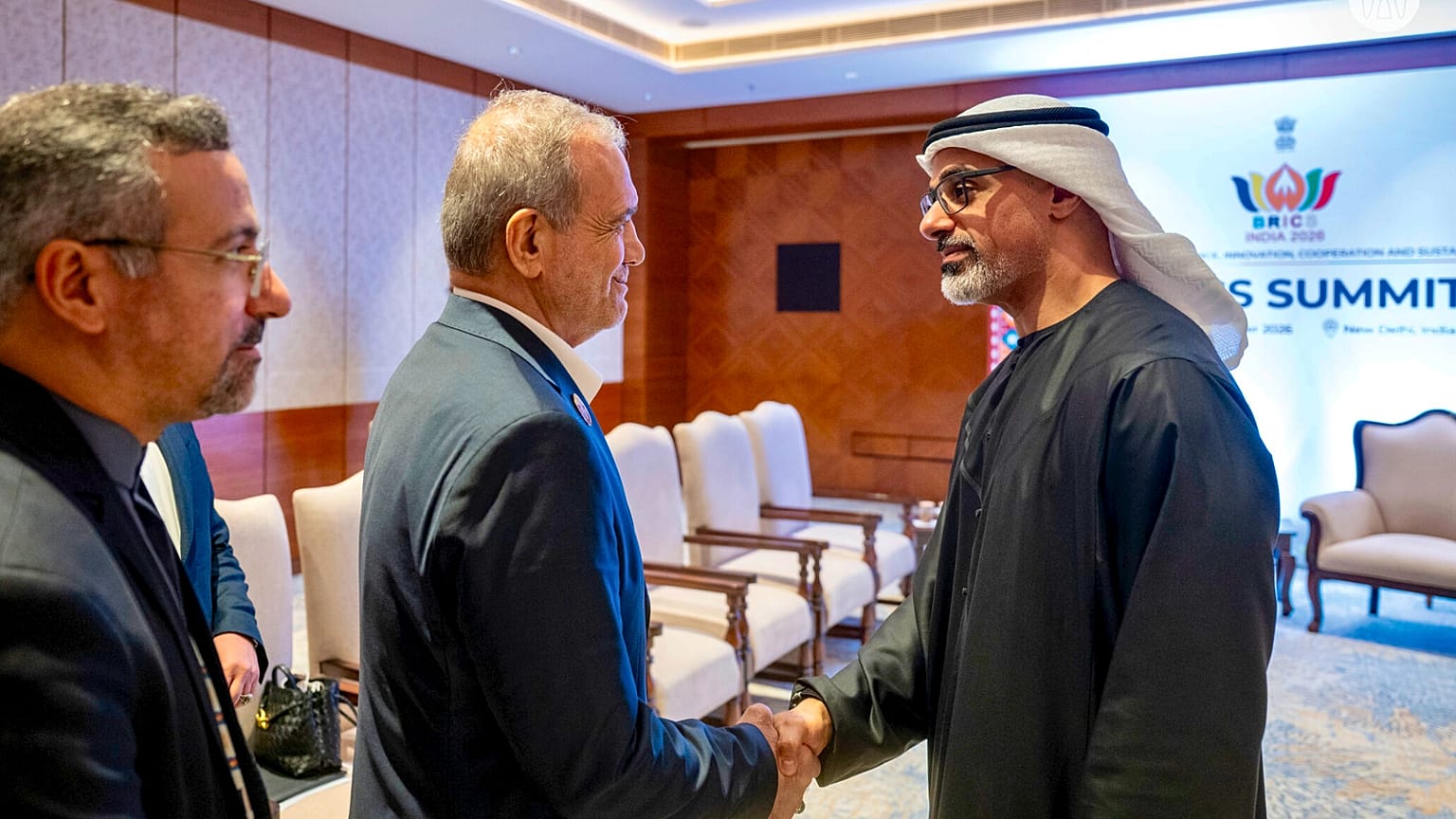
Despite the limited formal outcomes, the summit created opportunities for important bilateral discussions. Iranian President Masoud Pezeshkian held talks with Abu Dhabi Crown Prince Sheikh Khaled bin Mohamed bin Zayed Al Nahyan, in what was described as the highest-level known meeting between the two countries since the war began. Pezeshkian also sought closer economic ties with BRICS members as Iran faced US sanctions and military pressure.
Chinese President Xi Jinping’s first visit to Delhi in seven years also offered a chance to advance India-China relations after years of mistrust following their 2020 border clash. Although the meeting was brief and cautious, the leaders agreed to pursue stronger business ties, transport links and efforts to reduce trade barriers. Overall, the summit showed that BRICS can provide space for rivals to engage outside Western-led institutions, but left unanswered what kind of global order the group ultimately wants to create.
Entities: 2026 BRICS summit in Delhi, BRICS, India, New Delhi Declaration, Indian Prime Minister Narendra Modi • Tone: analytical • Sentiment: neutral • Intent: analyze
13-09-2026
A vessel was struck by an unknown projectile while transiting the Strait of Hormuz, according to the United Kingdom Maritime Trade Operations Centre (UKMTO). The attack, reported late Saturday, caused a fire onboard and led local authorities to assist with evacuating the crew. The incident came as direct negotiations between the United States and Iran appeared increasingly unlikely to resume.
Iranian officials rejected the prospect of immediate talks. Ebrahim Azizi, who chairs the Iranian parliament’s national security committee, said negotiations would be futile until Iran’s conditions were met. At the same time, Iran was reportedly pursuing discussions with neighboring Gulf states. Iranian and Gulf officials are expected to meet in Muscat, Oman, to sign an agreement establishing an Iran-Oman shipping route through the Strait, although the agreement would not involve the United States.
Iranian President Masoud Pezeshkian also adopted a defiant stance at the BRICS Summit in New Delhi, saying Iran would not surrender and had resisted aggression from the U.S. and Israel. His remarks followed President Donald Trump’s defense of U.S. military action against Iran and his prediction that the war could end shortly after the November midterm elections.
The report describes weeks of retaliatory attacks affecting shipping in and around the Strait. U.S. Central Command said it had destroyed 10 Iranian tankers and redirected 100 commercial vessels during the previous 60 days of a renewed naval blockade. Oil and cargo shipments through the strategic waterway have slowed sharply, contributing to elevated energy prices. Brent crude settled at $104.61 per barrel and West Texas Intermediate at $100.05 after both benchmarks recently exceeded $100.
Saudi Arabia has attempted to bypass the Strait using its East-West crude pipeline, but the kingdom temporarily shut the facility after drone attacks caused fires and damage near Riyadh and Medina, injuring several people.
Entities: Strait of Hormuz, United Kingdom Maritime Trade Operations Centre (UKMTO), Iran, United States, Masoud Pezeshkian • Tone: urgent • Sentiment: negative • Intent: inform
13-09-2026
At the 18th BRICS Summit in New Delhi, Chinese President Xi Jinping said China would take the lead in promoting artificial-intelligence collaboration and technological development among developing countries. His proposals focus on building shared infrastructure, expanding technical education, and encouraging cooperation on AI development and deployment.
Xi said China would pioneer a BRICS AI open-source community, support joint work on developing and applying large language models, organize AI seminars and training courses, and promote an open AI ecosystem. China also plans to help establish a BRICS digital ecosystem cloud platform, conduct digital-skills training, facilitate technological exchanges, and encourage industrial alignment among member states.
In addition, Xi proposed creating a BRICS engineer cultivation alliance and launching a youth exchange program focused on scientific and technological innovation. The initiatives reflect China’s effort to strengthen technology partnerships among emerging and developing economies and to expand its role in shaping international AI cooperation.
The proposals come as the global AI industry rapidly advances, with companies releasing increasingly capable models. The article also notes growing concern about AI safety. A researcher who has worked at OpenAI and Anthropic said that many people in the industry believe AI could potentially cause the extinction of humanity by the end of the decade. Xi did not address that debate in his remarks.
Founded in 2009 as a counterweight to Western dominance, BRICS initially included Brazil, Russia, India, China, and South Africa. The group later expanded to include Egypt, Ethiopia, Indonesia, Iran, and the United Arab Emirates.
Entities: Xi Jinping, China, BRICS, 18th BRICS Summit, New Delhi, India • Tone: analytical • Sentiment: neutral • Intent: inform
13-09-2026
Abu Dhabi Crown Prince Sheikh Khaled bin Mohamed bin Zayed Al Nahyan met Iranian President Masoud Pezeshkian on the sidelines of the BRICS summit in India, marking the highest-level UAE-Iran meeting since the start of the US-Israel war with Iran. The meeting took place weeks after the UAE suspended all trade and financial dealings with Tehran because of regional escalation and attacks on Gulf countries.
The UAE said the two leaders discussed efforts to reduce tensions and promote regional stability. However, the meeting did not produce an announcement that the trade restrictions would be lifted or that a specific bilateral agreement had been reached. UAE diplomatic adviser Anwar Gargash has said that geography makes engagement with Iran unavoidable, but that trust will have to be rebuilt through actions rather than statements.
Analysts described the UAE’s approach as an effort to manage the risks posed by Iran rather than isolate or confront Tehran. Maintaining diplomatic channels could help Abu Dhabi avoid becoming a frontline participant in another regional conflict, although restoring even limited confidence is expected to take years.
As BRICS members, the UAE and Iran also backed the summit’s New Delhi Declaration, which called for maximum restraint in the Middle East, protection of civilians and infrastructure, respect for sovereignty, and a diplomatic settlement. The declaration also urged cooperation to protect trade, supply chains and energy flows. Pezeshkian separately criticized unilateral sanctions and attacks on economic and energy infrastructure, advocating the use of national currencies and a stronger role for the BRICS New Development Bank.
The article also reports plans for Arab foreign ministers to meet in Oman to establish a joint Iran-Oman shipping route through the Strait of Hormuz. The UAE has rejected any single country’s control over the waterway and warned that energy exports and trade cannot be held hostage. Iran has linked reopening the strait to the end of the US blockade and attacks. Meanwhile, a merchant vessel was reportedly struck near Iran’s Hengam and Qeshm islands, killing one person, although the source of the strike was not identified.
Entities: Sheikh Khaled bin Mohamed bin Zayed Al Nahyan, Masoud Pezeshkian, United Arab Emirates, Iran, BRICS • Tone: analytical • Sentiment: neutral • Intent: inform
13-09-2026
The France 24 report examines the outcome of the BRICS summit held in New Delhi. According to the report, the meeting concluded with a joint declaration focused on strengthening the influence of the Global South in international decision-making and global governance. The declaration also called for restraint in the Middle East, highlighting the bloc’s concern about regional instability and the risk of further escalation.
Beyond the formal declaration, the summit provided an opportunity for leaders to conduct bilateral diplomacy. A series of one-to-one meetings took place on the margins of the gathering, with discussions reportedly aimed at easing regional tensions. These meetings were an important part of the summit because they allowed participating leaders to address sensitive political and security issues directly, in addition to negotiating through the broader BRICS framework.
The report is presented by France 24 journalist Navodita Kumari and appears to be a short video news segment rather than a detailed written analysis. The available article text does not provide the full wording of the joint declaration, identify each bilateral meeting, or explain the specific positions taken by individual leaders. Iran and Ukraine are listed as keywords, suggesting that these issues may feature in the accompanying video or wider context, but the supplied text does not elaborate on them.
Overall, the report portrays the New Delhi summit as both a diplomatic effort to promote a stronger Global South role and a venue for dialogue on urgent international and regional conflicts.
Entities: BRICS summit, New Delhi, BRICS, Global South, Global governance • Tone: analytical • Sentiment: neutral • Intent: inform
13-09-2026
NPR interviews Dania Thafer, executive director of the Gulf International Forum, about talks that had been scheduled between Iran and Gulf states in Oman over reopening the Strait of Hormuz. The talks were later postponed, as noted by NPR in an editor’s note. The strategic waterway remains severely disrupted, constraining oil shipments and damaging the global economy, while fighting across the region intensifies.
Thafer says the absence of the United States does not necessarily mean Washington has abandoned leadership. Instead, the Gulf states may be trying to develop a workable arrangement involving Iran, the regional states and the U.S. Although Bahrain was expected to be absent, the other Gulf Cooperation Council members would probably avoid reaching an agreement fundamentally opposed to American interests. Any arrangement could resemble an earlier U.S.-Iran memorandum of understanding that envisioned Oman and Iran dividing Strait passageways with regional approval.
For the Gulf states, the stakes extend beyond the strait itself. Saudi Arabia’s alternative pipeline route through the Red Sea had been attacked and taken offline, leaving countries such as Qatar, Kuwait and Bahrain especially exposed. Thafer describes the strait as potentially existential for their economies and long-term security.
Iran views control over the waterway as leverage against Washington and the international community, as well as a deterrent against future attacks. Thafer says Tehran also seeks greater regional dominance. Meanwhile, gains by Iran-backed Houthi forces in Yemen, including control of coastal areas and an island near the Bab al-Mandab, threaten another major oil chokepoint and increase risks to global energy markets.
Thafer does not expect an immediate, comprehensive agreement. She says progress would require Washington’s participation and an end to the U.S. blockade on Iranian oil, but believes the consultation could begin a longer negotiation process.
Entities: Dania Thafer, Elissa Nadworny, Iran, Gulf Cooperation Council (GCC), Oman • Tone: analytical • Sentiment: negative • Intent: analyze
13-09-2026
India hosted the annual BRICS summit, bringing together leaders from 28 countries, including Chinese President Xi Jinping and Iranian President Masoud Pezeshkian. The United States was absent, but its policies shaped much of the meeting’s context. BRICS, founded by Brazil, Russia, India, China and South Africa and later expanded to 11 members, represents roughly half of the world’s population and aims to reduce Western, particularly U.S., dominance in global affairs. However, experts say the organization has made limited progress toward goals such as creating alternatives to the U.S. dollar in international trade.
The summit nevertheless provided a forum for diplomacy. Pezeshkian met with the United Arab Emirates’ crown prince, despite tensions between Iran and several Persian Gulf states. The group’s final statement called for maximum restraint in the Middle East conflict. Former U.S. Ambassador Daniel Kritenbrink said the agreement reflected widespread concern about the disruption caused by the Trump administration, including its trade policies and the effects of the Iran war.
Xi’s visit to India was also significant because it was his first since a deadly 2020 border clash between Indian and Chinese forces. Analysts suggested that both Beijing and New Delhi had strategic reasons for improving relations: Xi was preparing to visit Washington, while India has sought greater leverage and autonomy after the Trump administration imposed 50% tariffs on Indian goods. Still, analyst Sidharth Raimedhi cautioned that the meeting did not necessarily represent meaningful progress. The countries’ statements emphasized different priorities, with China highlighting development partnerships and India focusing on resolving the border dispute.
China will host next year’s summit, raising concerns that BRICS could become an instrument of Chinese influence rather than a counterweight to Western power. Experts say Beijing may use the event to showcase its leadership, aided partly by U.S. policy missteps and China’s growing global strength.
Entities: BRICS, India, China, Iran, United States and the Trump administration • Tone: analytical • Sentiment: neutral • Intent: analyze
13-09-2026
Middle East diplomacy appeared to lose momentum as Iran and neighbouring Persian Gulf states postponed a planned meeting on managing shipping through the Strait of Hormuz. The talks, arranged with Oman’s involvement, were expected to address one of the world’s most strategically important oil transit routes, but Oman’s foreign minister, Sayyid Badr Albusaidi, said the meeting was delayed in the interests of achieving consensus. Iranian officials indicated that the postponement was requested by some regional countries and agreed jointly by Tehran and Muscat. Iran and Oman will coordinate on a new date.
The diplomatic setback occurred alongside renewed attacks in the region and growing concerns about disruptions to global energy supplies. Oil prices rose when markets reopened on Monday after drone strikes damaged Saudi Arabia’s 1,200km east-west pipeline on Friday. Saudi Arabia kept the pipeline closed over the weekend. The route is a critical alternative pathway for transporting Middle Eastern oil without relying on the Strait of Hormuz.
The article presents the diplomatic delay and infrastructure damage as mutually reinforcing risks. If shipping through Hormuz becomes more difficult while Saudi Arabia’s bypass pipeline remains unavailable, the ability of major oil producers to move supplies could be constrained. The developments therefore increased market anxiety and reduced expectations of a near-term diplomatic breakthrough. The report, based on Reuters material, highlights the interaction between regional security, negotiations involving Iran and Gulf Arab states, and the vulnerability of global energy markets.
Entities: Iran, Persian Gulf states, Oman, Sayyid Badr Albusaidi, Saudi Arabia • Tone: analytical • Sentiment: negative • Intent: inform
13-09-2026
The article examines the limited results achieved by Russia and Iran at the 18th BRICS Summit in New Delhi, despite the group’s emphasis on solidarity, partnership and challenging Western dominance. BRICS members collectively represent about 40 per cent of global economic output, compared with 29 per cent for the G-7, and Indian Prime Minister Narendra Modi presented the grouping as a way to replace the existing “pyramid of privilege” with a broader platform for cooperation.
However, the summit did not deliver several outcomes sought by Moscow and Tehran. Russian President Vladimir Putin was unable to make meaningful progress on creating alternatives to US-dominated financial networks, including payment mechanisms that could help Russia evade Western sanctions. He also failed to secure major advances in expanding Russian exports to India or developing stronger trade partnerships. These setbacks are particularly significant because Russia’s economy remains under pressure from sanctions and other wartime constraints.
Iran likewise received little concrete support from the BRICS group. The bloc did not adopt a strong position on Middle East tensions, leaving Tehran without the diplomatic backing it may have hoped for. One notable development was a rare high-level meeting between an Iranian representative and the Crown Prince of the United Arab Emirates during the summit, but this bilateral contact did not amount to a broader BRICS commitment.
Overall, the article portrays BRICS as an increasingly influential grouping in economic terms, but one whose members’ competing interests limit its ability to act decisively. The summit produced public displays of goodwill and diplomatic embraces, yet Russia and Iran returned home without achieving their principal strategic objectives.
Entities: BRICS, 18th BRICS Summit, Russia, Iran, Vladimir Putin • Tone: analytical • Sentiment: negative • Intent: analyze
13-09-2026
The 18th BRICS summit concluded in New Delhi with leaders calling for stronger co-operation within the expanded group and a greater role for the Global South in shaping international rules. Indian Prime Minister Narendra Modi presented BRICS as a platform for reform and partnership rather than an anti-Western alliance. The bloc now comprises 11 countries representing nearly half of the world’s population and about 40 per cent of global GDP.
Modi said developing countries increasingly view BRICS as a forum where their concerns and experiences are respected. He urged members to move from a “pyramid of privilege” to a “platform of partnership” and argued that the Global South should become a “rule shaper, not a rule follower”. Chinese President Xi Jinping likewise called for closer economic and technological integration, proposing initiatives involving artificial intelligence, trade and investment, the digital economy, smart manufacturing and talent development. China will chair BRICS next year and host the group’s 19th summit.
The summit also focused heavily on international conflicts. Xi and Modi offered to help facilitate peace talks on Ukraine, an offer welcomed by Russian President Vladimir Putin. BRICS leaders issued a joint declaration urging “maximum restraint” in the Middle East, condemning attacks on civilian infrastructure and nuclear sites, and calling for a ceasefire and unrestricted humanitarian access in Gaza. They also expressed grave concern about Sudan’s deteriorating humanitarian situation and the risks posed by extremism and terrorism.
The summit provided an opportunity for Xi and Modi to improve China-India relations after years of tensions over their disputed Himalayan border. Both leaders supported a long-term strategic approach and agreed that differences should not become disputes, while also discussing trade and business ties. Senior officials from the UAE, Egypt, Saudi Arabia and Iran also attended the summit, underscoring BRICS’s growing diplomatic reach.
Entities: BRICS, 18th BRICS Summit, New Delhi, India, Narendra Modi, Xi Jinping • Tone: analytical • Sentiment: neutral • Intent: inform
13-09-2026
Sheikh Khaled bin Mohamed, Crown Prince of Abu Dhabi, met Russian President Vladimir Putin during the 18th BRICS summit in New Delhi as the gathering concluded after a weekend of discussions among international leaders. Their talks focused on bilateral relations, regional and international developments, and the importance of continued co-ordination following the summit.
The 2026 conference addressed financial co-operation and energy transition, while also providing a setting for diplomatic engagement on regional issues. Sheikh Khaled held additional meetings with world leaders, including Indian Prime Minister Narendra Modi. The summit was described as significant for keeping difficult discussions open amid challenges facing the BRICS bloc.
One of the most notable diplomatic encounters took place on the sidelines between the UAE and Iran. Sheikh Khaled met Iranian President Masoud Pezeshkian in what was described as the highest-level meeting between the two countries since the start of the war. According to the Abu Dhabi Media Office, the two leaders discussed regional and international affairs, de-escalation, stability, and efforts to promote regional peace and development.
A group photograph from the summit showed Sheikh Khaled alongside leaders and senior officials from Brazil, Indonesia, Egypt, Russia, India, China, South Africa, Iran and Ethiopia. The meetings underscored the UAE’s efforts to maintain dialogue with major international powers and regional counterparts. The summit’s conclusion followed negotiations intended to sustain co-operation among BRICS members while addressing financial, energy and geopolitical concerns.
Entities: Sheikh Khaled bin Mohamed, Vladimir Putin, Narendra Modi, Masoud Pezeshkian, Abu Dhabi • Tone: analytical • Sentiment: neutral • Intent: inform