13-09-2026
Canadian Prime Minister Mark Carney is reportedly exploring an “associate member” relationship between Canada and the European Union as tensions with the United States intensify. According to The Wall Street Journal, the proposed status does not currently exist, but EU officials may be open to creating special arrangements that would provide closer ties without full membership. The European Commission did not comment on the report.
The proposal comes before Carney’s planned speech to the European Parliament in Strasbourg, where he is expected to outline his vision for Canada-EU relations amid worsening geopolitical and trade tensions. Canada is engaged in a major trade dispute with the United States, including steep tariffs and no clear indication of de-escalation.
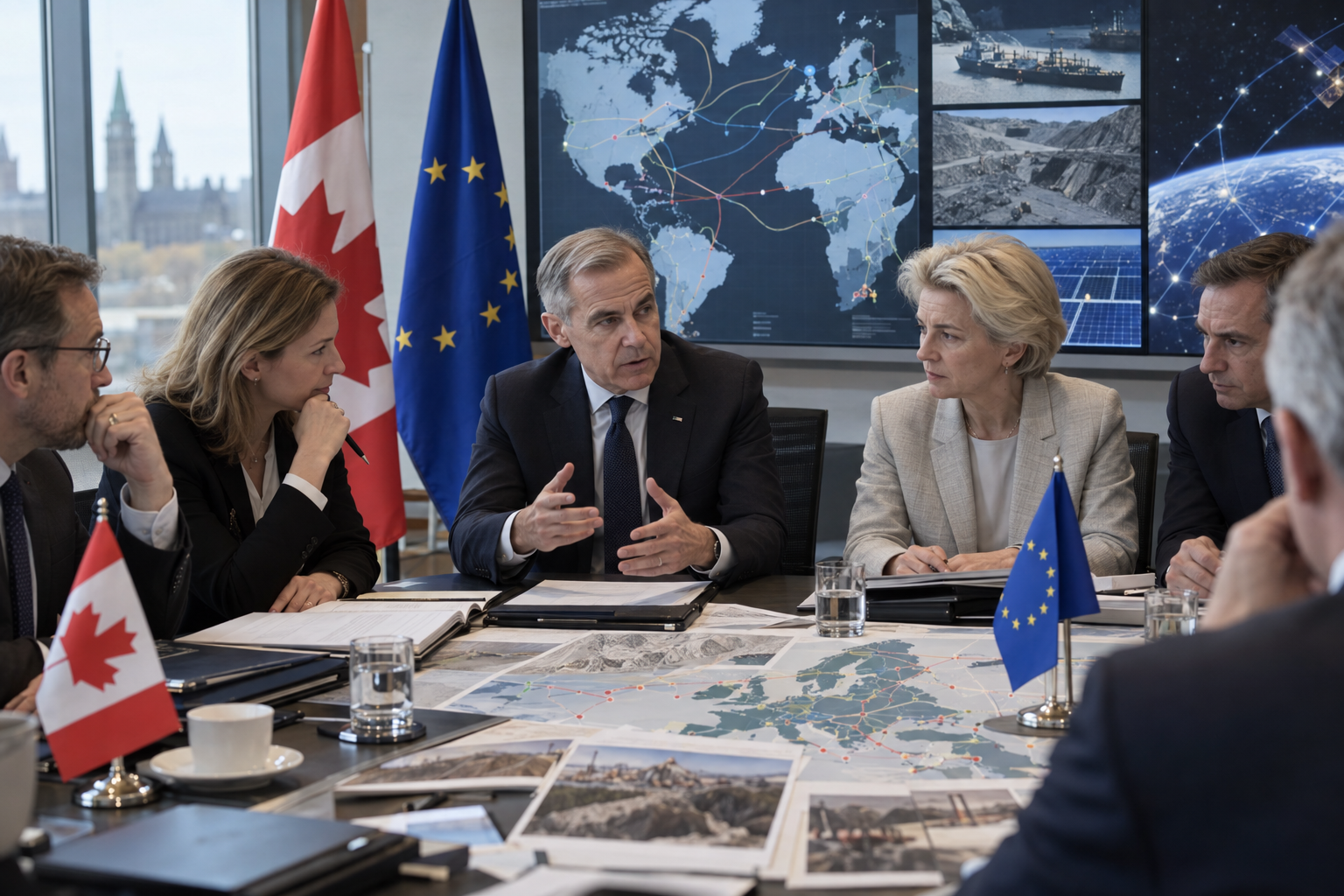
Canada and the EU are reportedly seeking to deepen cooperation in trade involving goods, services and workers, as well as in energy, artificial intelligence, defence and critical minerals. Possible joint projects include undersea cables, data centres, cloud infrastructure and satellite networks. Canada also wants to increase energy exports to Europe.
The article notes that establishing associate membership could be challenging because the EU has strict membership rules and a lengthy process for changing existing arrangements. However, US tariffs and broader threats under President Donald Trump could encourage the bloc to adopt a more flexible model. German Chancellor Friedrich Merz previously proposed an associate-member framework, initially with Ukraine in mind, that could potentially be adapted for Canada.
Separately, Carney and French President Emmanuel Macron are scheduled to visit the French territory of Saint-Pierre-and-Miquelon. The visit is intended to demonstrate close Canada-France ties and shared commitments to democracy, sovereignty and the rule of law amid tensions with Washington. It will be the first visit to the archipelago by a Canadian prime minister.
Entities: Mark Carney, Canada, European Union, United States, Wall Street Journal • Tone: analytical • Sentiment: neutral • Intent: inform
13-09-2026
Canadian Prime Minister Mark Carney is exploring a significantly closer relationship with the European Union, including the possibility of Canada receiving a new “associate member” status, according to a Wall Street Journal report cited by Reuters. The proposed arrangement would not necessarily make Canada a full EU member, but could create deeper economic and strategic ties with the bloc.
According to the report, Canada and the EU are discussing ways to enable more seamless movement of strategic goods and workers, as well as cooperation on technology, energy and satellite projects. EU officials are reportedly open to creating an associate-membership category for Canada, despite the bloc’s historically inflexible approach to membership rules. The proposed status does not yet exist, and the details of what rights and obligations it would involve remain unclear.
The reported initiative comes as Canada’s relationship with the United States deteriorates. Ottawa’s escalating trade dispute with Washington has affected tens of billions of dollars in cross-border commerce and increased pressure on Canada to diversify its strategic and commercial partnerships. Relations have worsened since Donald Trump returned to the White House, with disagreements over trade and other issues fueling tensions.
Neither Canada’s embassy in Brussels nor European Commission spokespeople responded to requests for comment. Trump renewed his criticism of Canada on Sunday, describing it as “the worst country to deal with,” while also saying he believed Canada was eager to reach an agreement. Against this backdrop, Carney’s outreach to the EU represents a potential strategic pivot, although the article provides no indication that an associate-membership deal has been formally agreed or that negotiations have reached an advanced stage.
Entities: Mark Carney, Canada, European Union, United States, Donald Trump • Tone: analytical • Sentiment: negative • Intent: inform
13-09-2026
Canadian Prime Minister Mark Carney is exploring closer institutional and economic ties between Canada and the European Union, including the possibility of Canada becoming an “associate member” of the bloc, according to a report by The Wall Street Journal citing unnamed Canadian and EU officials. The proposed status does not currently exist, but EU officials are reportedly open to creating one.
The initiative comes as Canada’s relationship with the United States has deteriorated since President Donald Trump returned to the White House in early 2025. Disputes over trade and other issues have resulted in tariffs affecting tens of billions of dollars in cross-border commerce, increasing the urgency of Canada’s effort to diversify its strategic partnerships.
Canada and the EU are discussing measures that could allow Canadian goods, services and workers involved in key sectors—including energy, artificial intelligence, defence and critical minerals—to move more freely across their markets. Other proposals reportedly include building underwater cables, jointly developing data centres and cloud-storage systems, creating satellite networks and infrastructure, and expanding routes for Canadian energy exports to Europe.
Carney has also discussed the possibility of visa-free residence and employment for Canadians in the EU with several European leaders, particularly French President Emmanuel Macron. The two leaders are expected to meet later in September.
However, the proposed relationship faces significant political and legal obstacles. The article notes that even the existing Canada-EU trade agreement, negotiated more than a decade ago and provisionally implemented nine years ago, has still not been ratified by several EU member states. Neither the Canadian embassy in Brussels nor the European Commission responded to requests for comment, and Macron’s press office also did not comment.
Entities: Mark Carney, Canada, European Union, Donald Trump, Emmanuel Macron • Tone: analytical • Sentiment: neutral • Intent: inform
13-09-2026
Canada is examining whether it could obtain a new “associate membership” status with the European Union as Prime Minister Mark Carney seeks closer economic and strategic relations with Europe amid worsening trade tensions with the United States. The Wall Street Journal reported, citing unnamed officials in Canada and the EU, that Brussels is open to creating such a status, despite the bloc’s traditional reluctance to alter its membership framework. Canadian and EU officials did not respond to requests for comment.
The discussions reportedly focus on easing the movement of goods, services and workers involved in strategic supply chains. Potential areas of cooperation include energy, artificial intelligence, defence and critical minerals. Canada and the EU are also considering collaboration on underwater cables, data centres, cloud storage, satellite networks and infrastructure that could support Canadian energy exports to Europe. Carney has separately held talks with several European leaders, especially French President Emmanuel Macron, about potentially allowing Canadians to live and work in the EU without visas. Carney and Macron are expected to meet later in the month.
The effort has gained urgency because Canada’s relationship with the US has deteriorated since Donald Trump returned to the White House in early 2025. Disputes over trade and other issues have resulted in US tariffs affecting tens of billions of dollars in cross-border commerce, encouraging Ottawa to diversify its economic partnerships.
However, closer Canada-EU institutional ties could face political and legal obstacles. The existing Canada-EU trade agreement was negotiated more than a decade ago and provisionally took effect nine years ago, but several EU member states have yet to ratify it. The unresolved ratification process highlights the difficulties Canada and the EU may encounter in establishing a more ambitious relationship.
Entities: Canada, Prime Minister Mark Carney, European Union, United States, US tariffs and Canada-US trade tensions • Tone: analytical • Sentiment: neutral • Intent: inform