12-10-2026
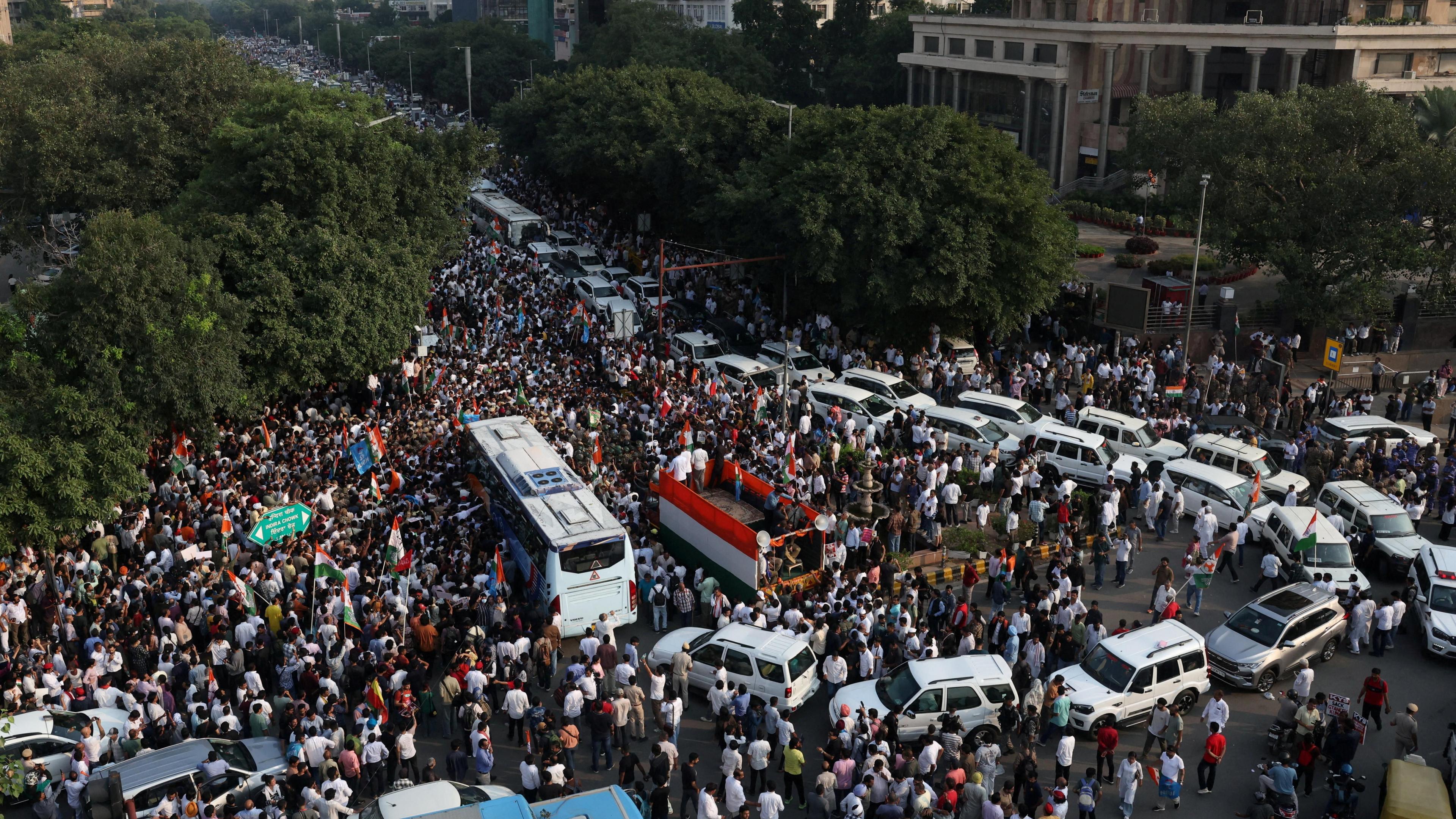
Thousands of opposition supporters marched through Delhi to India’s Supreme Court on Monday, demanding the resignation of Chief Election Commissioner Gyanesh Kumar over alleged voter-roll fraud. The protest, called the “March for Democracy,” followed days of demonstrations and mass detentions. Congress leader Rahul Gandhi submitted a petition challenging a voter-list revision that reportedly removed tens of millions of names. Opposition parties say the changes could benefit Prime Minister Narendra Modi’s Bharatiya Janata Party (BJP), while the Election Commission and BJP deny the allegation.
Gandhi and Congress President Mallikarjun Kharge also wrote to Chief Justice Surya Kant outlining concerns about Kumar’s conduct. Kant said the issue was already before the court and therefore sub judice, but promised that any petition would be heard as soon as possible in accordance with the law.
The march took place under heavy security, with roads barricaded and restrictions affecting traffic and some metro stations. Protesters waved flags, chanted slogans and described the right to vote as fundamental to democracy. Demonstrations had been difficult to organise: police had rejected requests to protest, and thousands were detained over the weekend when the Cockroach Janta Party (CJP), a pressure group, attempted to hold a march. The government has also said demonstrations will no longer be permitted at Jantar Mantar, naming three alternative sites subject to approval.
CJP leaders were detained upon arriving in Delhi, and thousands of people—including journalists—were detained and later released. Videos showed police using force against protesters; the BBC also recorded an officer slapping a detained person. Delhi police did not respond to questions about the alleged violence. Reporters Without Borders condemned the detention of at least 16 journalists. Gandhi said young, peaceful demonstrators had been beaten, while BJP President Nitin Nabin accused opposition groups and the CJP of seeking to destabilise India at the behest of unspecified foreign forces.
Entities: Rahul Gandhi, Narendra Modi, Gyanesh Kumar, Mallikarjun Kharge, Surya Kant • Tone: analytical • Sentiment: negative • Intent: inform
12-10-2026
Starlink has obtained important regulatory approvals and signed distribution agreements with Reliance Jio and Bharti Airtel, but it has not yet begun commercial service in India. The delay has prompted a public dispute between SpaceX CEO Elon Musk and people associated with Reliance, whose low-cost mobile-data business dominates a market Starlink hopes to enter. Musk criticized unnamed Indian “oligarchs,” sarcastically calling Reliance chairman Mukesh Ambani “Prime Minister Ambani” and arguing that Starlink could expand internet access in underserved areas. Opposition leader Rahul Gandhi joined the exchange, while the ruling Bharatiya Janata Party accused him of promoting Musk’s interests. Reliance Jio chairman Akash Ambani declined to respond directly and said the company was advancing its own indigenous satellite-broadband technology.
India’s Communications Ministry says security assessments are ongoing for all three licensed satellite operators and rejects claims that the regulatory framework is discriminatory. A satellite communications licence and space-sector authorization, which Starlink received in 2025, do not by themselves permit commercial operations; spectrum assignment can follow completion of security reviews. BJP lawmaker Nishikant Dubey has referred to security challenges but has not publicly specified the risks or requirements delaying Starlink.
Experts see several issues behind the impasse: competition, national-security safeguards and uncertainty about the approval process. Former intelligence officer Yashovardhan Jha Azad says India needs protections for traffic routing, lawful interception under due process and cybersecurity, but notes that the government has not identified what Starlink still needs to satisfy. Economist Lekha Chakrabarty argues that the issue is not a rejection of foreign investment but the difficulty of planning around an open-ended, opaque review process. Meanwhile, industry representative Pankaj Mohindroo says Starlink’s entry could benefit Indian manufacturers of satellite terminals, antennas and network equipment. The article presents the delay as a test of how India balances security and domestic competition with investment predictability and potential connectivity benefits.
Entities: Starlink, Elon Musk, SpaceX, India, Mukesh Ambani • Tone: analytical • Sentiment: neutral • Intent: analyze
12-10-2026
India’s opposition parties marched to the Supreme Court in New Delhi on Monday to challenge a nationwide revision of voter rolls that has removed more than 130 million names. They allege the purge is politically motivated and favors Prime Minister Narendra Modi’s Bharatiya Janata Party (BJP), and submitted a petition to the chief justice alleging irregularities. The protesters are demanding the resignation of Chief Election Commissioner Gyanesh Kumar. The BJP and Election Commission deny manipulating the lists, saying the revisions are intended to remove duplicate and ineligible voters.
The march followed a weekend crackdown in which authorities detained thousands of activists, including leaders of the youth movement known as “Cockroach” and journalists. The movement has led protests since the revision began last year. Ahead of Monday’s march, officials closed six metro stations and warned of traffic disruptions. Congress leader Rahul Gandhi framed the protests as a defense of the constitution and said demonstrators would not back down. He rode briefly through the crowd on an open bus, waving a copy of the Constitution, as party supporters, students and other protesters followed.
The turnout contrasted with the weekend’s restrictions, when authorities effectively locked down much of the capital to prevent large demonstrations. Modi has not publicly addressed the protests; members of his party have dismissed the activists, with some labeling them “anarchists.” Police also announced that Jantar Mantar, a longstanding protest site, would no longer be designated for rallies and that three replacement sites had been selected. Earlier this year, the “Cockroach” movement held a weeks-long sit-in at Jantar Mantar that contributed to the resignation of Modi’s education minister in July.
Entities: Rahul Gandhi, Narendra Modi, Gyanesh Kumar, Indian National Congress, Bharatiya Janata Party • Tone: analytical • Sentiment: neutral • Intent: inform