12-10-2026
The Australian embassy in Riyadh has told Australians to shelter in place as Saudi Arabia and Yemen’s Houthi movement continue exchanging attacks. The embassy advised people to stay indoors, follow local authorities’ instructions and avoid unnecessary travel. Saudi Arabia’s coalition said it was responding to drones and missiles headed toward the kingdom.
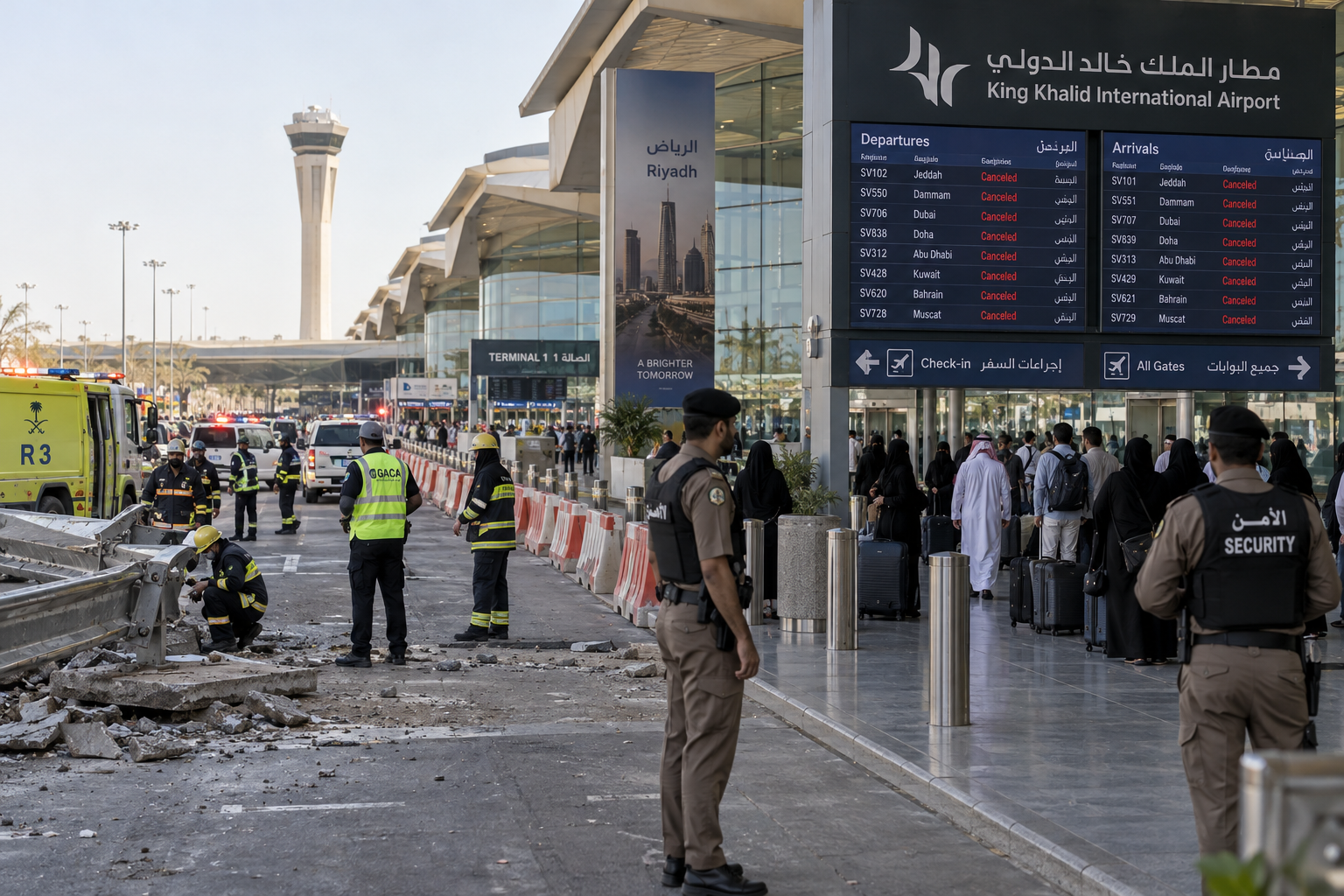
King Khalid International Airport in Riyadh was closed after consecutive attacks that killed 14 people and injured more than 320. The Houthis claimed responsibility and warned travellers and airline workers to stay away from Saudi airports. The airport closure was extended on Monday, with Saudi Arabia’s General Authority of Civil Aviation giving no reopening date. Airlines in Europe and Asia suspended services, and the US Federal Aviation Administration urged carriers to exercise caution when flying to or over Saudi Arabia. Riyadh businesses shifted employees to remote work, while schools were asked to move classes online.
Saudi authorities have opened an investigation into why air defences did not stop missiles that struck the airport, described as one of the kingdom’s most secure areas. Two regional officials said an initial assessment indicated that drones were sent first, followed by cruise and ballistic missiles. Some missiles may have manoeuvred to evade Patriot interceptors. Investigators are also examining why there was no early warning, given the weapons travelled more than 1,000 kilometres to reach Riyadh.
Separately, Yemen’s Houthi-run Health Ministry said air strikes in Sanaa killed one person and wounded 12. It reported casualties at a salt factory and a house; the Houthi media centre blamed Saudi Arabia, while Saudi state media said forces had responded to attacks without providing details. Iran said it was ready to mediate between the Houthis and Saudi Arabia. Its foreign ministry spokesperson said the conflict served Israeli interests, and confirmed that Iran’s and Saudi Arabia’s foreign ministers had discussed developments by phone.
Entities: Riyadh, Saudi Arabia, Yemen’s Houthis, Australian embassy in Riyadh, King Khalid International Airport • Tone: analytical • Sentiment: negative • Intent: inform
12-10-2026
The article reports a sharp escalation in fighting between Yemen’s Houthi movement and the Saudi-led coalition, with attacks affecting airports and energy infrastructure in Saudi Arabia and continued airstrikes in Yemen. Saudi Arabia’s General Authority of Civil Aviation said attacks on King Khalid International Airport in Riyadh killed a Pakistani resident and injured 11 people on Sunday. The airport had suffered multiple recent attacks, including one on Saturday that reportedly killed 12 and injured 309, leading to a temporary suspension of operations. King Fahd International Airport near Dammam was also attacked Sunday, with inspections and damage assessments underway.
The Houthis claimed four missile and drone operations over 24 hours, targeting the two airports and two facilities operated by Saudi energy company Aramco. Their spokesperson warned that most Saudi airports and airspace remained potential targets, excluding those in Mecca and Medina. The coalition vowed a firm response, while Houthi sources and a Yemeni military official reported extensive Saudi airstrikes across Houthi-held areas, including Sanaa and several provinces. An airstrike was also reported at Sanaa International Airport, though immediate information about casualties or damage was unavailable.
The attacks prompted condemnation from UN Secretary-General Antonio Guterres and numerous governments and regional organizations. Guterres said attacks on civilians and civilian infrastructure violate international law and must stop. Iran’s foreign minister offered assistance in facilitating Saudi-Yemeni dialogue and urged political solutions, warning that reliance on military action would worsen the crisis.
The article places the renewed violence in the context of Yemen’s conflict, which began in 2014 when the Houthis seized Sanaa and much of the north. A Saudi-led coalition intervened in 2015 in support of the internationally recognized government. A UN-brokered truce in 2022 had largely halted major hostilities before the current escalation.
Entities: Houthi movement, Saudi-led coalition, King Khalid International Airport, King Fahd International Airport, Riyadh • Tone: analytical • Sentiment: negative • Intent: inform
12-10-2026
Al Jazeera reports that CCTV footage released by Al Arabiya shows the moment of a Houthi strike on Riyadh’s international airport. The footage was described as showing an attack that took place on Saturday. The report says the strike killed at least 12 people and injured more than 300, indicating a high number of casualties. It warns viewers that the video contains distressing images. The article is a brief news-video item: it identifies the footage’s source, the target and alleged perpetrator, the reported timing, and the stated death and injury toll, but provides no further detail about how the strike occurred or the circumstances of those affected. It also does not offer comment from the Houthis, Saudi authorities, or other parties, nor does it provide independent verification or additional context. The item was published on 11 October 2026. Its central purpose is to alert readers to the availability and disturbing nature of the CCTV footage while conveying the reported human toll of the attack. Because the source text is limited, no conclusions beyond those statements can be drawn from the article itself.
Entities: CCTV footage, Houthi strike, Houthis, Riyadh, Riyadh international airport • Tone: neutral • Sentiment: negative • Intent: inform
12-10-2026
Iranian Foreign Minister Abbas Araghchi called Saudi Foreign Minister Prince Faisal bin Farhan Al Saud, with the ministers discussing regional escalation following Houthi attacks on Saudi airports, according to Saudi state media. In a Sunday Telegram post, Araghchi argued that pursuing military action while ignoring political solutions would worsen the crisis. He said regional conflicts have no military solutions and offered Iran’s help in facilitating dialogue between Saudi Arabia and Yemen and advancing a political settlement.
The call took place amid heightened tensions after a deadly attack on Riyadh’s airport killed 12 people and wounded 300. US President Donald Trump said he would reconsider the US role in Yemen and was weighing renewed strikes on Iran. The article notes that these remarks differed from comments he made on Thursday, when he said Washington would not resume strikes on Iran before the US midterm elections.
Despite longstanding friction, Saudi-Iranian diplomatic relations have continued since embassies reopened under a Chinese-brokered agreement in 2023. That agreement ended a seven-year diplomatic rupture during which regional proxy conflicts intensified. Relations have worsened again since the start of the US-Israel war on Iran in late February. Tehran and allied forces have since attacked US military assets and energy infrastructure around the Gulf, including Saudi oil fields. The article also recalls Prince Faisal’s warning in March 2026 that Saudi Arabia and other Gulf states had limited tolerance for attacks, urging Tehran to reconsider its strategy.
Entities: Abbas Araghchi, Prince Faisal bin Farhan Al Saud, Donald Trump, Iran, Saudi Arabia • Tone: analytical • Sentiment: neutral • Intent: inform
12-10-2026
The supplied material is not the full Al Jazeera liveblog. It consists of the headline, a page label indicating “24 Updates,” and advertising text; no liveblog entries or supporting details are included. The headline says that an airport in Riyadh was hit again and that Tehran described a US reply as “inadequate,” framing both as developments in the US-Israel war on Iran. It does not specify which airport was hit, when or how the incident occurred, who was responsible, what damage or casualties resulted, or what US reply Tehran was discussing. It also provides no statements from officials, independent verification, or additional context. Accordingly, the material supports only a limited account of the headline’s claims and should not be treated as a complete report of the events. The page’s advertising and “24 Updates” label do not provide substantive news content. The headline’s use of “again” implies a previous airport strike, but the supplied text gives no details about that earlier incident, so none can be established from this excerpt. Overall, the available text signals a developing conflict story and reports a negative assessment attributed to Tehran, while leaving the underlying events and responses unexplained.
Entities: Iran, Riyadh, Tehran, United States (US), Israel • Tone: urgent • Sentiment: negative • Intent: inform
12-10-2026
Al Jazeera reports that Saudi authorities say a Pakistani national was killed and several other people were injured in a second strike on Riyadh’s King Khalid International Airport. The strike took place on Sunday, October 11, 2026, and is described in the headline as a Houthi strike. It followed an attack on Saturday that, according to the report, killed 12 people and injured more than 300. The item provides no further details about the identity of the Pakistani national, the number or condition of those injured in Sunday’s strike, the precise circumstances of either attack, or the authorities’ response. Al Jazeera correspondent Malik Traina reports on the incident. The article is a brief news video item rather than a detailed account, and its claims are attributed to Saudi authorities where specified.
Entities: Pakistani national, Riyadh, King Khalid International Airport, Saudi authorities, Houthis • Tone: neutral • Sentiment: negative • Intent: inform
12-10-2026
The article reports that Houthi strikes have hit Riyadh’s airport, with new footage showing an attack on the Saudi capital’s airport. In response, Saudi Arabia has reaffirmed its resilience and its commitment to energy security. The article also says further attacks have killed civilians and injured hundreds across Saudi Arabia, indicating that the violence extends beyond the airport incident and has caused significant civilian harm. Meanwhile, Houthi-run media report that Saudi-led strikes have hit Yemen’s capital. The account therefore describes attacks and reported counterattacks affecting both Saudi Arabia and Yemen, while highlighting Saudi Arabia’s public response. The supplied text does not identify the exact date or circumstances of each attack, name specific locations beyond Riyadh and Yemen’s capital, or provide details about the footage, the injured people, or the reported damage. It also does not include statements from Houthi officials or further explanation of Saudi Arabia’s energy-security position. The report is a brief news update rather than a detailed account: it presents the competing claims and the reported consequences without offering verification, background, or analysis of responsibility. Its central points are the reported strike on Riyadh airport, Saudi Arabia’s pledge of resilience and energy security, civilian deaths and injuries in Saudi Arabia, and Houthi-media reports of Saudi-led strikes on Yemen’s capital.
Entities: Saudi Arabia, Riyadh, Riyadh airport, Houthis, Yemen • Tone: neutral • Sentiment: negative • Intent: inform
12-10-2026
Saudi Arabia’s energy minister, Prince Abdul Aziz bin Salman, has promised a “serious” response to recent Houthi attacks on the kingdom’s airports and energy infrastructure. The comments came after two attacks on terminals at Riyadh’s King Khalid International Airport over consecutive days. Saudi authorities said a Pakistani man was killed in Sunday’s attack; the previous day, a missile strike killed 13 people and forced another terminal to close.
The Houthis, an Iran-backed movement that controls parts of Yemen, said the attacks were retaliation for Saudi actions against areas under their control. The Houthi-run health ministry reported that a child was killed and six people injured in a Saudi air strike on a home in Sanaa. Saudi Arabia is part of a coalition providing air support to Yemeni government forces fighting the Houthis.
The article places the escalation within Yemen’s civil war, which began in 2014 when the Houthis took Sanaa and intensified the following year with the Saudi-led intervention. An informal ceasefire lasting about four years began to break down in July, after the Houthis declared a maritime embargo and launched missile and drone attacks on Saudi targets. The group cited a Saudi blockade and an air strike on Sanaa airport; Yemen’s government said it carried out that strike to prevent an unauthorised Iranian plane from landing.
Recent fighting has also centered on the Bab al-Mandab Strait, where Houthi forces pushed out government troops. The disruption contributed to higher global oil prices as Saudi Arabia relied on Red Sea routes after the Strait of Hormuz was effectively closed amid the US-Israeli war with Iran. Yemen’s government has announced a new offensive to retake Houthi-held territory. Government forces say they recaptured areas near Bab al-Mandab with Saudi air support, while the Houthis deny losing ground.
Entities: Prince Abdul Aziz bin Salman, Saudi Arabia, Yemen, Houthi movement, King Khalid International Airport • Tone: analytical • Sentiment: neutral • Intent: inform
12-10-2026
A passenger-terminal area at Riyadh’s King Khalid International Airport was attacked again on Sunday, with Saudi authorities reporting injuries and the article reporting one death. The attack came a day after a much deadlier strike at the airport killed 13 people, including a U.S. citizen, and wounded more than 300. The airport had been closed since Saturday and was struck four times in five days, as airlines diverted flights and Saudi Arabia moved schools in Riyadh online. Several countries warned their citizens to avoid the airport.
Yemen’s Houthi group said it had conducted at least four operations targeting King Khalid Airport since Saturday and threatened further attacks on Saudi airports, while excluding Mecca and Medina. The group also claimed to have targeted Saudi energy infrastructure and King Fahd International Airport in Dammam; Saudi civil aviation authorities confirmed a strike on King Fahd Airport. Houthi spokesman Yahya Saree said the attacks were retaliation for Saudi airstrikes in Yemen, claiming more than 120 had been carried out in the previous 24 hours. The Houthis also said Sanaa airport had been struck again, blaming Saudi Arabia without providing details.
The article describes the airport strike as a major escalation in the conflict between the Houthis and Saudi Arabia, following a Saudi-led coalition offensive. It also complicates efforts to halt the wider U.S.-Iran war. The attack drew condemnation from the United Nations and international leaders. President Trump said he was considering joining Saudi strikes; U.S. Secretary of State Marco Rubio condemned the attacks, while European Commission President Ursula von der Leyen and Israeli Prime Minister Benjamin Netanyahu also denounced them.
Saudi Arabia said Saturday’s victims included citizens of several countries and that 309 people were injured, some seriously. The article identifies Egyptian flight attendant Azza Ramzy, 28, and reports that an Indian national injured in Saturday’s attack later died. It also notes earlier Houthi-claimed attacks at the airport that reportedly killed three Saudis, including a pilot. The airport has no military facilities.
Entities: King Khalid International Airport, Riyadh, Saudi Arabia, Yemen's Houthi group, Yahya Saree, Saudi-led coalition offensive • Tone: urgent • Sentiment: negative • Intent: inform
12-10-2026
A video released by Saudi Arabia’s Media Ministry shows an explosion inside King Khalid International Airport in Riyadh on Saturday, followed by smoke, fire, falling debris and passengers fleeing for cover. The article reports that at least 13 people, including an American citizen, were killed and more than 300 were injured. The victims also included nationals of Saudi Arabia, Bangladesh, Egypt, Jordan, the Palestinian territories, Syria, Sudan and India; their names had not been publicly released. The airport has been closed since the attack.
The article says the airport had been struck four times in five days. A projectile hit the same terminal on Sunday, killing a Pakistani national, while a Saudi-led coalition intercepted and destroyed a cruise missile near the airport. The Houthis claimed responsibility for attacks on Riyadh airport and said they had also targeted Dammam airport, while threatening further strikes. They described their actions as a response to Saudi aggression in Yemen and alleged that a Saudi strike on a home in Sanaa killed a child and injured six people. Houthi leaders warned that Saudi airports were vulnerable to attack and blamed Saudi Arabia for any failed interceptions.
The group was also reported to be targeting energy facilities, while not attacking airports in Mecca and Medina. Saudi Energy Minister Prince Abdul Aziz bin Salman said the country’s response should be equally serious. Saudi aviation authorities said Riyadh airport remained closed on Monday. The US Embassy and Consulates warned Americans about flight cancellations and airspace closures, and US government employees in Saudi Arabia need special authorization to use the airport. Canada urged its citizens to avoid travel to and from Riyadh. At least 540 flights scheduled for Monday and more than 300 scheduled for Tuesday were canceled, with the total expected to rise. Flights continued at Jeddah and Dammam, though travelers were warned to expect delays.
Entities: King Khalid International Airport, Riyadh, Houthi movement, Saudi Arabia, Saudi-led coalition • Tone: urgent • Sentiment: negative • Intent: inform
12-10-2026
Saudi Arabia reported new drone and cruise missile threats on Monday, following deadly strikes on Riyadh airport over the weekend. The Saudi Press Agency, citing Defence Ministry spokesman Turki al-Maliki, said the kingdom had detected and was monitoring the incoming threat and that it was being dealt with. Al-Maliki was speaking on behalf of a Saudi-led coalition fighting the Iran-backed Houthis. The coalition had earlier announced that it intercepted missiles and drones directed at Saudi Arabia overnight. Some of the areas targeted, according to the report, are home to key oil and gas facilities, raising concerns about risks to important infrastructure as well as public security. The article presents the attacks as a renewed threat to the kingdom after the fatal airport strikes, but provides no further details about casualties, damage, the locations of the latest interceptions, or the identity of those responsible for the Monday threat. Its account is brief and relies on statements attributed to Saudi authorities and the coalition. It does not report a response from the Houthis or independent confirmation of the reported attacks and interceptions.
Entities: Saudi Arabia, Houthis, Riyadh airport, Saudi Press Agency, Turki al-Maliki • Tone: neutral • Sentiment: negative • Intent: inform
12-10-2026
Houthi rebels attacked Saudi Arabia’s main airport, King Khalid International Airport in Riyadh, again on Oct 11, one day after a much deadlier strike there. Saudi authorities said the Oct 11 attack killed a Pakistani resident and injured 11 people, while causing damage still being assessed. The Oct 10 attack had killed at least 12 people and injured more than 300, making it the deadliest single incident in Saudi Arabia since the Iran war began in late February. The Houthis claimed responsibility for the attacks, describing them as retaliation for “Saudi aggression”; Saudi air defences said they intercepted a missile near Riyadh airport.
A projectile also struck near King Fahd International Airport in Dammam. An eyewitness said it hit the tarmac near parked planes and caused a fire, prompting passengers to disembark. The Houthi military spokesperson additionally claimed attacks on two Saudi Aramco facilities, though the government and company did not comment. The airport strikes disrupted travel, led Riyadh’s financial hub to move to remote work, and contributed to executives from BP and Shell withdrawing from an energy event. Britain advised its citizens to avoid all but essential travel to Jeddah and Dammam and most Saudi airports.
Despite the security concerns, Saudi authorities indicated that the World Petroleum Congress and related events would proceed, and organisers of the Future Investment Initiative said they expected thousands of delegates in Riyadh later in October. The attacks come amid renewed fighting in Yemen: Saudi-backed forces had recently launched a campaign against Houthi-held areas, while the Houthis had expanded their territory and influence near the Bab el-Mandeb shipping route. The Saudi-led coalition called the airport attack a war crime.
Entities: King Khalid International Airport, King Fahd International Airport, Riyadh, Dammam, Houthi rebels • Tone: neutral • Sentiment: negative • Intent: inform
12-10-2026
Saudi Arabia reported a fresh barrage of missiles and drones on Monday, days after a deadly Houthi missile strike on a Riyadh airport departure terminal. Riyadh airport remained closed, and the latest incoming fire was reported by the Saudi-led coalition supporting Yemen’s government, although authorities had not immediately said whether the weapons were intercepted. Houthi attacks on Saudi airports and oil facilities since the previous week had disrupted parts of Saudi airspace and left the skies over the capital largely empty as it hosted a major energy conference.
The attacks come as Saudi Arabia has re-entered Yemen’s civil war, seeking to push the Houthis away from the strategically important Bab el-Mandeb Strait oil route and prevent further Houthi advances. Yemeni forces backed by Riyadh have made some progress near the strait but remain under pressure on other fronts, suggesting Saudi efforts may take time to produce results. Iran, a longtime Saudi rival and Houthi ally, offered to facilitate dialogue. Saudi airstrikes against the Houthis have intensified, but the group has continued attacks and threats against airports, airspace and oil installations.
At the energy conference, Saudi Energy Minister Prince Abdulaziz bin Salman said the kingdom would continue pursuing investment and development of its energy and industrial capabilities. The United Arab Emirates called for renewed joint Gulf security and defence action. UAE presidential adviser Anwar Gargash said attacks on Saudi Arabia threatened the security of all Gulf states and that neglect of collective security had encouraged regional overreach. Saudi Arabia and the UAE had previously partnered in Yemen but split over support for different forces in the government-aligned coalition. US President Donald Trump said Washington was considering joining Saudi strikes on the Houthis, although no US action had been announced.
Entities: Saudi Arabia, Riyadh airport, Yemen, Houthi movement, Saudi-led coalition • Tone: analytical • Sentiment: negative • Intent: inform
12-10-2026
The article describes mounting pressure on Saudi Arabia’s Crown Prince Mohammed bin Salman after a series of deadly Houthi attacks on Riyadh airport. According to the supplied article text, three attacks occurred over the previous week, and the deadliest attack in more than a decade killed at least 12 people and injured more than 300. The strikes underline the Houthis’ ability to threaten Saudi territory with missiles and drones, despite the kingdom’s military strength and support from the United States.
The central argument is that Saudi Arabia has few effective ways to stop the attacks. Analysts characterize the conflict as asymmetrical: the Houthis have grown stronger since bin Salman led a costly and unsuccessful war against them roughly a decade earlier. A decisive military defeat of the militia appears unlikely, while reaching an agreement through talks has become more difficult. The article’s introductory summary also mentions possible action by US President Donald Trump, but the supplied body does not provide further detail about that possibility.
The attacks carry consequences beyond immediate casualties. They put Saudi Arabia’s security and investment ambitions at risk and show how the Yemen war continues to turn back against Riyadh. Overall, the article frames the attacks as a strategic challenge for the Saudi leadership: the Houthis are increasingly capable of striking a highly important target, while the available military and diplomatic responses appear limited. The provided text ends after introducing this dilemma and does not include the article’s further reporting or analysis.
Entities: Mohammed bin Salman, Vivian Nereim, Saudi Arabia, Riyadh, Yemen • Tone: analytical • Sentiment: negative • Intent: analyze
12-10-2026
Houthi attacks on Riyadh’s King Khalid International Airport and Abha International Airport killed at least 20 people and injured hundreds, making the strikes the deadliest attacks on Saudi soil in more than a decade. The attacks came as Yemen’s Iran-aligned Houthi rebels intensified their campaign against Saudi Arabia. The victims included Saudi and foreign citizens; those identified included Saudia pilot Hamoud Ali Alkalthami, Egyptian flynas flight attendant Azza Ramzy, Syrian widowed mother of four Buthaina Ahmad Oweida, Palestinian Talal Al Dani, and Indian citizen Mohammed Yusuf Ali. The death toll from Saturday’s Riyadh strike reached 13 after Yusuf Ali died of his injuries. Four Saudis and eight foreign citizens were reported among the dead in that attack, while a Pakistani citizen was killed in a separate strike on Sunday. More than 300 people were wounded in Saturday’s attack, and Saudi authorities said hundreds had been injured overall.
The article describes the human impact through information released by authorities, diplomatic missions and relatives. Alkalthami was killed in an attack that also struck airport facilities and a Saudia aircraft. Ramzy, 28, died from injuries sustained on Saturday; Egyptian officials arranged for her body to be returned to Egypt. Oweida, who had lived in Saudi Arabia for five years, lost contact with her family while returning from a visit to her sister in Riyadh. The Syrian embassy said she died in the airport attack. Palestinian officials confirmed Al Dani’s death, while the Indian embassy said it was assisting Yusuf Ali’s family with repatriation arrangements.
Footage from Riyadh showed pilgrims preparing to travel to Makkah and Madinah when an explosion triggered panic and apparent partial roof collapse. King Khalid International Airport suspended operations, with the closure extended until midnight Tuesday. The escalation has raised fears that the Yemen conflict could widen and draw in the United States. President Donald Trump said the US was considering joining Saudi strikes on the Houthis, describing a possible further military escalation amid the wider war involving Iran, the US and Israel.
Entities: Hamoud Ali Alkalthami, Azza Ramzy, Buthaina Ahmad Oweida, Talal Al Dani, Mohammed Yusuf Ali • Tone: neutral • Sentiment: negative • Intent: inform
12-10-2026
Saudi Arabia extended the suspension of operations at Riyadh’s King Khalid International Airport after deadly weekend attacks by Yemen’s Houthi rebels. The General Authority of Civil Aviation said the closure would remain in place while safety and operational-readiness checks were completed, but gave no reopening date. The disruption has affected flights between the UAE and several Saudi cities, with Etihad cancelling Abu Dhabi–Riyadh services through October 19 and Flydubai cancelling flights to Riyadh, Abha and Dammam through October 14. Emirates and Air Arabia services have also been affected. Aviation analytics company Cirium reported that 46.4 per cent of scheduled flights across Saudi Arabia had been cancelled as of 4pm UAE time on Monday, October 12.
The article details the airlines’ schedules and advisories. Etihad said the situation remained dynamic and that further changes were possible. Alongside the Riyadh cancellations, it cancelled some Dammam flights and selected services to Jeddah. Emirates listed all six Dubai–Riyadh flights scheduled for Monday as cancelled, as well as four services on Tuesday; the article notes that the absence of cancellation listings for two return flights does not guarantee they will operate. Flydubai confirmed cancellations to Riyadh, Abha and Dammam through Wednesday. Air Arabia’s flight-status information showed cancellations on routes from Sharjah to Riyadh and Abha on Monday and Tuesday.
Passengers are advised to check directly with their airline before going to the airport and to monitor booking notifications. Those whose flights are cancelled should contact their airline or travel agent about rebooking and refunds. Travellers with onward connections should confirm whether the disruption affects the rest of their journey.
Entities: King Khalid International Airport, Riyadh, Saudi Arabia, Yemen’s Houthi rebels, General Authority of Civil Aviation • Tone: analytical • Sentiment: negative • Intent: inform
12-10-2026
US Energy Secretary Chris Wright said Gulf oil flows had recovered to 80–90 per cent of prewar levels, with as much as 14 million barrels per day moving through the Strait of Hormuz. He also said additional supplies were being sent through pipelines that bypass the strait. Speaking remotely to the 25th WPC Energy Congress in Riyadh, Wright described the crude supply problem as “mostly handled.”
Independent shipping data offered a more cautious picture. Kpler reported that Hormuz oil exports averaged just under 9 million barrels per day in September—about 44 per cent of the 20.6 million barrels per day recorded in February, before the war. In the 30 days to October 12, an average of about 22 vessels crossed the strait each day, roughly two-thirds of them tankers. Laden crude tankers departing the Gulf carried about 8.9 million barrels per day, mostly from Saudi Arabia and Iraq. The article notes that Kpler’s figures are provisional and not directly comparable with Wright’s broader estimate, which includes bypass-pipeline supplies.
Wright’s remarks came amid heightened security concerns following Houthi attacks on Riyadh. He condemned the strikes on Saudi civilians and infrastructure and reaffirmed US support for Saudi Arabia. The article’s account gives differing death tolls: its introduction says the attack killed 12 people, while the body says 13; both report about 300 injured.
Even as crude flows recover, fuel-market pressures remain. Wright said diesel prices were still very high and jet fuel and petrol prices remained elevated, warning that significant challenges persisted.
Entities: Chris Wright, Jennifer Gnana, United States Department of Energy, The National, Kpler • Tone: analytical • Sentiment: negative • Intent: inform
12-10-2026
The article reports a fresh wave of attacks on Saudi airports, with one person killed and 11 injured in a strike at Riyadh’s King Khalid International Airport on Sunday. Saudi-led coalition forces said an unidentified projectile hit Terminal 4 and caused a fire. Saudi air defences also intercepted a cruise missile near the airport, destroyed a drone in the Eastern Province, and intercepted a ballistic missile headed toward Khamis Mushait. Saudi Arabia’s civil aviation authority confirmed a separate strike at Dammam airport late Sunday. An eyewitness told Reuters that a projectile hit the tarmac near parked aircraft at about 8:30 p.m.; a taxiing aircraft returned to its gate, and passengers were told to disembark and leave the area. The incidents followed a deadly attack on Riyadh airport on Saturday, which Saudi authorities said killed 13 people and injured more than 300. The victims included four Saudi nationals and foreign nationals, among them Indian national Mohammed Yousuf, 46. The article says the death toll from attacks on Saudi airports had reached 18 over the week. Houthi military spokesperson Yahya Saree claimed responsibility for Saturday’s attack and said the group had also targeted King Fahd International Airport in Dammam and two Saudi Aramco facilities. The Houthis warned against the use of Saudi airports, while Britain’s embassy advised citizens to avoid all but essential travel to several Saudi cities and airports, with Medina airport excepted. US aviation authorities also urged American airlines to exercise caution when flying to or over Saudi Arabia.
Entities: Saudi Arabia, Riyadh, King Khalid International Airport, Dammam airport, Yemen's Houthi rebels • Tone: urgent • Sentiment: negative • Intent: inform
12-10-2026
The article reports that Saudi Arabia vowed to “respond decisively” against Yemen’s Iran-backed Houthi rebels after a strike on Riyadh’s international airport. The attack, which took place the day before the statement, brought the widening Middle East conflict to the Saudi capital. The Houthis subsequently claimed responsibility and warned airlines not to fly to Saudi airports, describing those airports as “potential targets.” The excerpt establishes a risk of further escalation but provides no details about casualties, damage, the nature of the strike, or what actions Saudi Arabia might take. This summary reflects only the brief article text supplied.
Entities: Saudi Arabia, Riyadh, Riyadh’s international airport, Yemen, Houthi rebels • Tone: urgent • Sentiment: negative • Intent: inform
12-10-2026
CNBC Daily Open, written by Justina Lee from Singapore, focuses on escalating conflicts in the Middle East and Ukraine, along with the week’s financial and economic events. In the Middle East, a deadly attack on Riyadh’s main airport by Iran-backed Houthis has raised the prospect of deeper U.S. involvement. President Donald Trump said he was considering joining Saudi Arabia in retaliation after the kingdom reportedly requested urgent U.S. defense support. The newsletter notes that further escalation could complicate prospects for a lasting resolution to the regional conflict. It also reports that Russian state media said President Vladimir Putin had delivered Tehran’s message to Trump about a possible end to the war in Iran.
In Europe, Trump declared an “energy ceasefire” between Russia and Ukraine, but the newsletter says it was unclear whether either side had accepted a truce. Both countries had continued striking energy infrastructure, and previous ceasefires since Russia’s 2022 invasion of Ukraine had proved difficult to maintain. Ukrainian President Volodymyr Zelenskyy reportedly rejected Trump’s call for a new Ukrainian president and said Russia was responsible for the war; Trump had blamed Zelenskyy for high diesel prices.
Markets were largely steady ahead of a busy week of U.S. bank earnings, with Bank of America, Citigroup and Goldman Sachs among the major firms due to report. S&P 500 futures were little changed, Nasdaq 100 futures rose 0.24%, and Dow futures were flat. The IMF and World Bank were beginning their annual meetings in Bangkok, where officials and business leaders would discuss the global economy and financial system. The IMF was scheduled to release its World Economic Outlook and Global Financial Stability Report, while investors would also watch a Friday conversation with Federal Reserve Chair Kevin Warsh. The newsletter closes with a brief note on surging Pokémon card values following a record $16.5 million sale, emphasizing the importance of grading, scarcity and authentication.
Entities: Donald Trump, Vladimir Putin, Volodymyr Zelenskyy, Justina Lee, Saudi Arabia • Tone: analytical • Sentiment: neutral • Intent: inform