12-10-2026
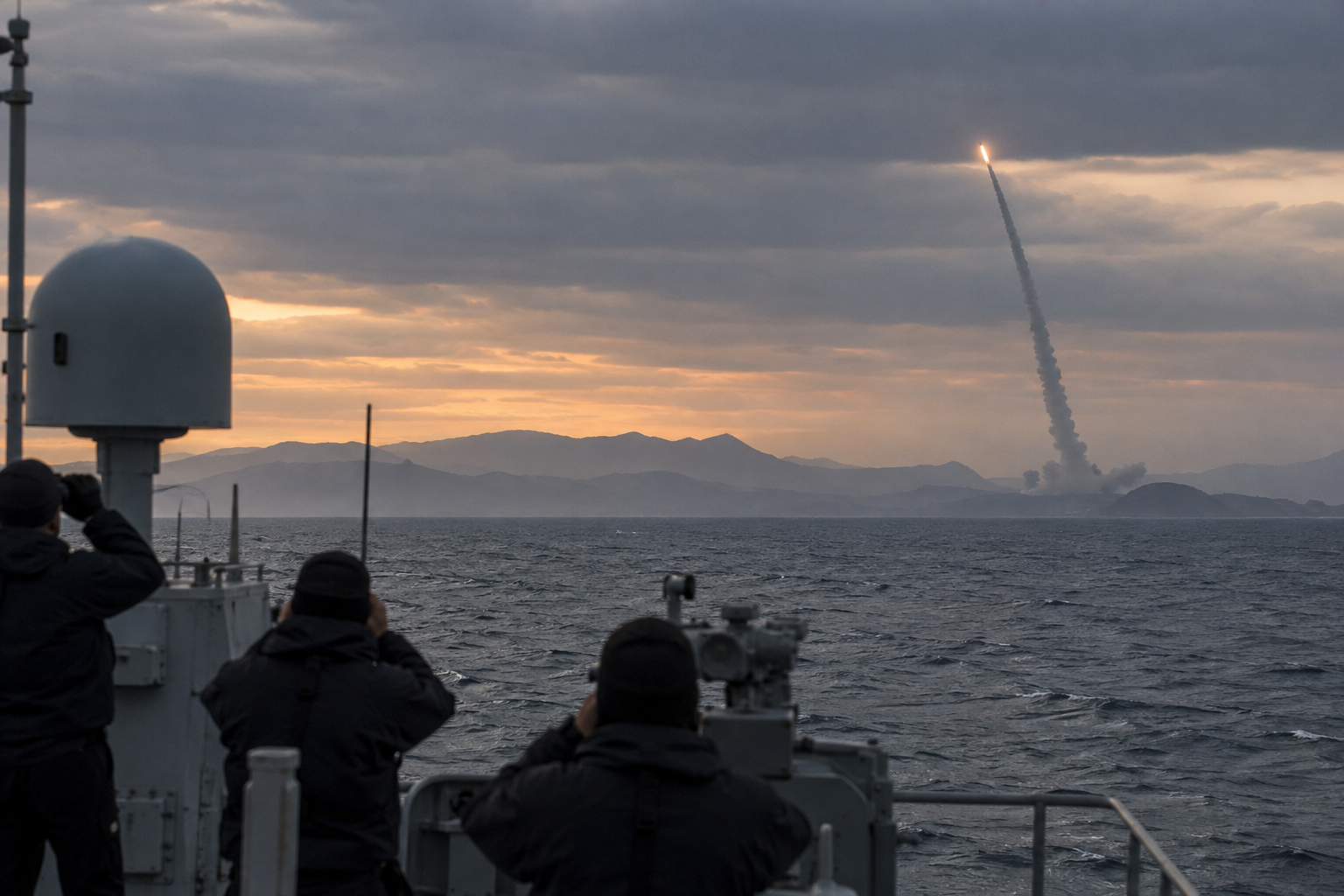
North Korea fired multiple ballistic missiles toward the sea off its east coast on Monday, according to South Korea’s Joint Chiefs of Staff (JCS). The JCS said one missile traveled more than 900km from the Pyongyang area but did not state how many launches were detected. Japan’s coastguard separately reported two unidentified projectiles believed to be ballistic missiles, which appeared to have already fallen. South Korea’s presidential office said the launches violate United Nations Security Council resolutions and called on Pyongyang to stop immediately.
The launches come amid rising tensions on the Korean Peninsula, where both North and South Korea have recently tested weapons. JCS spokesperson Jang Do-young described North Korea’s latest launch as an apparent show of force following South Korea’s hypersonic missile test. President Lee Jae Myung oversaw South Korea’s first test-firing of such a missile on Thursday. His office said the weapon, once fully developed, could help the country strike key targets by surprise in the peninsula’s theatre of operations. North Korea also tested a hypersonic intermediate-range missile on October 3, which it said was designed to evade missile defences in South Korea and Japan.
The article also describes a dispute over a landmine blast in the Demilitarized Zone that wounded three South Korean soldiers. A joint South Korean-UN investigation concluded that North Korean forces had planted two mines about a year earlier. Pyongyang rejected the accusation and accused Seoul of provocation. The incident followed South Korea’s preliminary efforts to encourage dialogue between North Korea and the United States.
Lee has pledged to reopen dialogue, but Kim Jong Un continues to promote North Korea’s nuclear weapons programme and reject offers to resume stalled diplomacy. Talks between Kim and US President Donald Trump ended abruptly in 2019. North Korea continues to demand that Washington abandon what it calls a hostile policy and drop denuclearisation as a precondition for talks.
Entities: North Korea, South Korea, Pyongyang, Korean Peninsula, Kim Jong Un • Tone: analytical • Sentiment: neutral • Intent: inform
12-10-2026
North Korea fired multiple ballistic missiles toward waters off its eastern coast on Monday, continuing a series of weapons demonstrations amid a prolonged freeze in diplomacy. South Korea’s Joint Chiefs of Staff said the missiles were launched from near Pyongyang but did not immediately provide their number or flight distances. Japan detected at least two and said they landed outside its exclusive economic zone.
The launch followed South Korea’s flight test of its first domestically developed hypersonic weapon. President Lee Jae Myung called that test an important step in strengthening the country’s conventional defenses. North Korea has also been expanding its nuclear-capable arsenal, including with an October 3 test of a missile it described as a hypersonic intermediate-range weapon designed to evade defenses in South Korea and Japan. Other recent military activities include missile tests, live-fire drills, and the commissioning of a new warship.
Relations have worsened amid disputes over land mine explosions near the inter-Korean border that injured three South Korean soldiers. South Korea’s military and the U.S.-led United Nations Command attributed the blasts to North Korean devices; Pyongyang denied responsibility and mocked calls for an apology.
North Korean leader Kim Jong Un has halted diplomacy and cooperation with South Korea, calling it a permanent enemy, and has rejected efforts by President Donald Trump to restart talks that broke down in 2019. North Korea says Washington must end its “hostile” policy and abandon denuclearization demands as a precondition for negotiations. The tensions complicate Lee’s efforts to pursue engagement while strengthening South Korea’s defenses and reducing reliance on the United States. The article also notes Washington’s unilateral decision to scale back a major joint military exercise in August, with Trump citing his good relationship with Kim.
Entities: North Korea, South Korea, Pyongyang, Kim Jong Un, Lee Jae Myung • Tone: analytical • Sentiment: negative • Intent: inform
12-10-2026
North Korea fired multiple ballistic missiles into the sea on Monday morning, according to South Korea’s military. South Korea’s Joint Chiefs of Staff said the launches involved various types of missiles fired from the Pyongyang area. One missile traveled more than 900 kilometers (559 miles) before landing in the sea. Japan’s coast guard also detected two objects launched from North Korea.
The launches followed South Korean President Lee Jae Myung’s announcement of a rare test firing of a new hypersonic missile. South Korea’s Joint Chiefs of Staff described North Korea’s activity as “a show of force” in response to the South’s successful test and as an intentional demonstration of North Korean missile capabilities.
The incident took place amid broader regional tensions. North Korea has carried out missile tests on more than 10 occasions this year, including four in October alone. Tensions have also risen following a landmine explosion near the demilitarized zone (DMZ) last month, which injured three South Korean soldiers. The article reports the launches and their immediate context, relying on statements and detections attributed to South Korean and Japanese authorities.
Entities: North Korea, South Korea, Pyongyang, Japan's coast guard, South Korea's Joint Chiefs of Staff • Tone: analytical • Sentiment: neutral • Intent: inform
12-10-2026
North Korea fired several ballistic missiles from the Pyongyang area toward the East Sea on Monday, according to South Korea’s Joint Chiefs of Staff. Seoul said it detected the launches at about 09:20 local time, increased surveillance and remained alert for further launches. Japan’s defence ministry separately confirmed at least one suspected ballistic missile. The launches came amid escalating tensions following a September landmine incident in the Demilitarised Zone (DMZ), where two explosions injured three South Korean soldiers in territory controlled by Seoul. A joint South Korean-UN investigation concluded that North Korea had planted the mines more than a year earlier, a claim Pyongyang has rejected. The North has also recently announced a ballistic missile test that Kim Yo Jong, sister of leader Kim Jong Un, said involved artificial intelligence and a missile able to alter its flight path at low altitude. South Korea, meanwhile, announced it had successfully tested a domestically developed hypersonic glide vehicle, describing it as a new means of deterring threats and striking important targets on the Korean Peninsula. Seoul has demanded an apology for the mine incident. Kim Yo Jong condemned that demand and rejected a planned transfer of medical equipment from the South, saying that improved relations would require respect and sincerity. The report places the latest missile launches in the context of a long-running military standoff: the DMZ is among the world’s most heavily fortified borders, and the two Koreas remain technically at war because the 1953 conflict ended with an armistice rather than a peace treaty.
Entities: North Korea, South Korea, Japan, Pyongyang, East Sea (Sea of Japan) • Tone: analytical • Sentiment: negative • Intent: inform
12-10-2026
North Korea fired multiple ballistic missiles toward its eastern waters on Monday, continuing a series of weapons demonstrations amid a prolonged freeze in diplomacy. South Korea’s Joint Chiefs of Staff said the missiles were launched from near Pyongyang. One traveled more than 559 miles before landing in the sea; officials did not provide a total missile count or details about the other weapons. Japan detected at least two missiles, which landed outside its exclusive economic zone, and reported no damage.
The launches follow North Korea’s Oct. 3 test of what it called a hypersonic intermediate-range missile, as well as other missile tests and live-fire drills. Leader Kim Jong Un has continued expanding the country’s nuclear-capable arsenal, rejecting offers from the United States and South Korea to restart stalled diplomacy. South Korean officials said the latest launches could advance North Korean missile technology and might be a response to South Korea’s own flight test of a domestically developed hypersonic weapon on Friday. That weapon is intended to fly at least five times the speed of sound and evade missile defenses. South Korea’s President Lee Jae Myung described it as important to strengthening conventional defenses and potential strike capabilities.
South Korea’s presidential national security office called on the North to stop its repeated ballistic launches, saying they violate UN Security Council resolutions and do not help manage tensions. Strains have also risen after land-mine explosions near the inter-Korean border injured three South Korean soldiers last month. South Korean and United Nations Command investigators blamed devices planted by North Korea, which denied responsibility. Kim has characterized South Korea as a permanent enemy and rebuffed US President Donald Trump’s calls to resume talks, which broke down in 2019. Pyongyang has demanded that Washington end its “hostile” policy and drop denuclearization as a precondition for negotiations.
Entities: North Korea, South Korea, Pyongyang, Jang Do-young, Kim Jong Un • Tone: analytical • Sentiment: negative • Intent: inform