12-10-2026
Stellantis CEO Antonio Filosa has urged European regulators to create stronger incentives for automakers that design, engineer and manufacture vehicles in Europe. Speaking to CNBC ahead of the Paris Motor Show, Filosa said a “level playing field” should include effective “Made in Europe” rules that reward and protect companies able to demonstrate local production and development. The proposed EU legislation would require automakers to meet minimum local-content requirements to sell in the regional market.
Filosa’s comments come as Chinese carmakers rapidly expand in Europe and Stellantis faces declining sales. The company, whose brands include Jeep and Ram, is pursuing a $70 billion turnaround strategy, and its shares have fallen almost 60% since the beginning of the year. GlobalData says Chinese brands’ share of worldwide auto sales rose nearly 70% between 2020 and 2025. In Europe, Chinese brands’ share of car sales rose from close to zero in 2020 to 12% in August, according to Dataforce. Filosa acknowledged that Chinese automakers offer consumers good technology and competitive prices.
The article also reports that European Trade Commissioner Maroš Sefčovič said China had agreed to halve its exports of hybrid cars to the EU. The announcement lifted shares of European automakers and parts suppliers in early trading: Stellantis rose 2.7%, Renault gained about 3%, and Valeo and Forvia also moved higher.
China’s Ministry of Commerce said the EU and China had reached several consensuses aimed at maintaining a stable and balanced trade relationship. It emphasized a principle of non-discrimination, stating that measures should not specifically target Chinese companies and that China’s quota would not be lower than that of any other import source for the EU.
Entities: Antonio Filosa, Stellantis, European Union, China, Maroš Sefčovič • Tone: analytical • Sentiment: neutral • Intent: inform
12-10-2026
The supplied material contains only a headline-like URL slug and a link to a South China Morning Post article. No article text is included, so its central claims, context, evidence, and conclusions cannot be verified or summarized reliably. The slug suggests the article concerns a China–European Union car-related deal and whether it eases trade tensions, at least for now. Beyond that topic, there is no basis in the provided content to describe the deal, identify the parties or officials involved, or assess its likely effects. A substantive summary, cleaned article text, and evidence-based judgments about tone, sentiment, and intent would require the article itself.
Entities: China, European Union (EU), China–EU car deal, Trade tensions, Automotive trade • Tone: analytical • Sentiment: neutral • Intent: inform
12-10-2026
After weeks of negotiations, China and the European Union reached a surprise trade agreement intended to ease escalating bilateral tensions and temporarily head off a trade war. The reported terms include strict quotas on Chinese hybrid-car exports to the EU and reductions in Chinese tariffs on a range of European goods. The article describes the agreement as being praised by both sides, while emphasizing that it is a temporary cooling of tensions rather than a resolution of the broader trade dispute.
China’s Ministry of Commerce characterized the arrangement as an “upward arrangement” based on Chinese hybrid-car shipments in 2025. It said the deal would leave room for the stable growth of Chinese companies’ exports. The article also notes a subsequent Chinese move to reduce value-added tax export rebates on certain goods, which could further restrain outbound shipments.
French President Emmanuel Macron welcomed the agreement during a visit to the Paris Motor Show. He said it would help Europe protect its market against what he called “disloyal competition.” Overall, the article presents the deal as a negotiated pause: it offers both parties immediate relief and introduces controls and tariff changes, but the underlying trade tensions remain. The text provides only a brief account of the agreement and does not specify the quotas, the goods affected by tariff reductions, or the duration of the measures.
Entities: China, European Union (EU), Finbarr Bermingham, Xiaofei Xu, Emmanuel Macron • Tone: analytical • Sentiment: neutral • Intent: inform
12-10-2026
The article describes a surprise trade deal reached after weeks of intensive negotiations between China and the European Union, presenting it as a temporary de-escalation of escalating bilateral trade tensions. Announced on Friday, the agreement includes measures affecting trade in both directions: the EU will restrict Chinese hybrid-car imports through an annual quota, while China will reduce tariffs on a range of European goods.
Under the arrangement, China agreed not to retaliate against the EU’s import curb. Shipments of Chinese hybrid cars to the bloc will be capped at 350,000 vehicles annually, with the quota increasing by 6 per cent each year. The article compares that limit with the EU’s projection that 800,000 Chinese vehicles would be shipped in 2026, meaning the cap would leave exports at less than half that projected volume.
The account emphasizes that Beijing’s acceptance was unexpected. Chinese officials had spent weeks rejecting the idea of voluntarily limiting vehicle shipments, and the article says EU officials were asked how they had secured the concessions. Brussels’ response was the business maxim, “The customer is always right.” EU officials also described the agreement as a “paradigm shift,” saying that “the nature of the rebalancing exercise has changed.”
The deal temporarily averts the prospect of a damaging trade war and takes some pressure out of the dispute, but the supplied article excerpt does not provide further detail about the negotiations, the tariff reductions, or how the agreement will be implemented. Its central focus is the unexpected compromise and the significant change in China’s position on car-export limits.
Entities: China, European Union (EU), Brussels, Beijing, Finbarr Bermingham • Tone: analytical • Sentiment: neutral • Intent: inform
12-10-2026
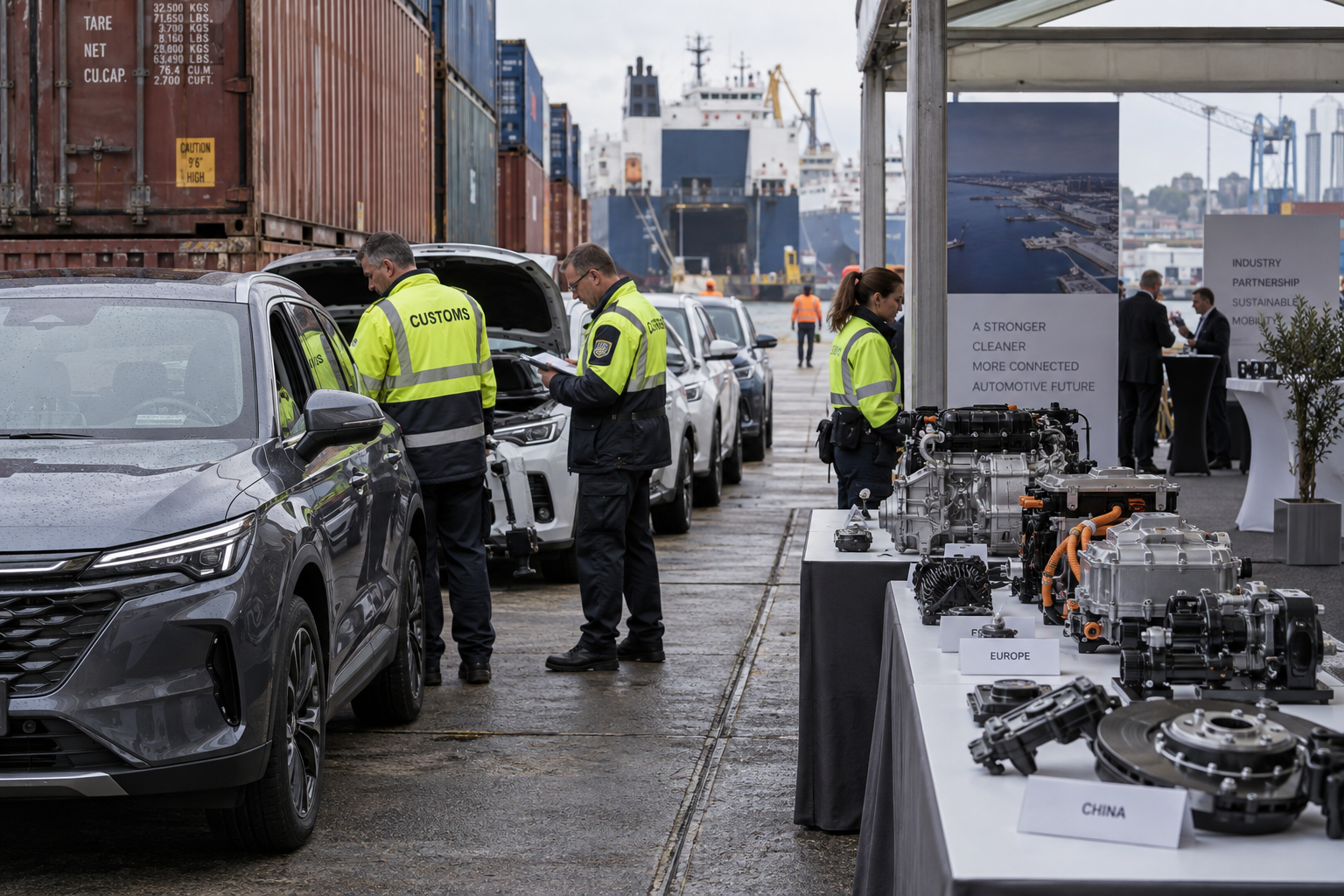
The European Commission has confirmed that the European Union will cap imports of hybrid electric vehicles from China at 350,000 cars annually, with the restriction due to take effect in December. The measure will use World Trade Organization safeguard rules, enabling the EU to introduce it more quickly than anti-dumping measures, which require investigations. The EU expects the quota to cut China’s current 6% share of the market by about half. Cars shipped above the quota will not incur tariffs, but will be held at European ports and blocked from customs clearance.
The restriction applies to Chinese-made vehicles, including those produced by EU companies in China. Chinese vehicles assembled within the EU, including in Hungary and potentially Spain, are exempt. The policy comes amid rapidly rising imports: approximately 800,000 battery and plug-in hybrid vehicles are expected to be sold this year, and Chinese hybrid exports to the EU tripled in value in the first half of the year, reaching €6.7bn.
The limit is part of a broader agreement reached in Beijing, under which China also agreed to reduce some tariffs on EU auto parts and halve duties on EU footwear, olive oil and ice-cream. EU officials say China supports the quota and that discussions will continue on other products, including chemicals, renewable energy and furniture.
The deal reflects a shift in EU trade policy as officials respond to a trade deficit with China of about £1bn a day and concerns about deindustrialisation and job losses. The EU had previously focused on increasing exports to China, but is now placing greater emphasis on managing imports. EU leaders are also due to discuss a proposed mechanism that could restrict access to the single market in response to harmful developments, such as restrictions on rare earths. An analyst said China may seek prolonged negotiations in other sectors, but that political conditions in Europe have changed.
Entities: European Union, China, European Commission, World Trade Organization safeguard measures, Chinese plug-in hybrid electric vehicles • Tone: analytical • Sentiment: neutral • Intent: inform