10-09-2026
Oil prices surged above $100 a barrel as the U.S.-Iran conflict intensified and attacks targeted oil facilities, tankers, and shipping routes in the Middle East. Brent crude settled at $101.21 per barrel, while U.S. benchmark crude closed at $96.05. The escalation has renewed concerns about disruptions to global energy supplies, particularly because fighting has severely restricted traffic through the Strait of Hormuz, a waterway that previously carried roughly one-fifth of the world’s oil.
The article explains that the conflict has caused major volatility in oil markets for more than six months. Prices initially approached $120, later fell toward $70 when peace talks appeared promising, and then rose again after negotiations collapsed and attacks increased. Recent strikes by U.S. forces, Iran-backed Houthi rebels, and others have placed additional pressure on shipping routes and regional infrastructure.
Higher oil prices are already affecting consumers and businesses. Gasoline and diesel costs have risen sharply in countries including Nigeria, Indonesia, Lebanon, and the United States. More expensive diesel increases the cost of trucking and farming, while higher jet fuel prices have led airlines to reduce flights and increase fares. The effects also extend to food, medicines, household goods, synthetic fabrics, rubber products, and package deliveries. Constrained natural-gas supplies could raise fertilizer costs, reduce agricultural yields, and worsen hunger.
Analysts warn that the full effects of the energy shock may take time to spread through global supply chains. Bank of America said prices could reach $95 to $120 a barrel if disruption around Hormuz continues, or as high as $150 if major energy infrastructure is damaged. The prolonged crisis could also fuel inflation and create political difficulties for President Donald Trump and his Republican Party ahead of the U.S. midterm elections.
Entities: Oil prices, Brent crude, U.S.-Iran conflict, Donald Trump, Lukman Otunuga • Tone: analytical • Sentiment: negative • Intent: inform
10-09-2026
The article reports a sharp escalation in the U.S.-Iran conflict, with fighting spreading across the region and creating new pressure on global energy markets. Brent crude rose above $100 per barrel, its highest level since late May, after renewed attacks connected to the Strait of Hormuz. Goldman Sachs warned that prices could exceed $120 per barrel, while the U.S. Energy Information Administration projected that traffic through the waterway would remain constrained through the end of 2026. The agency estimated that an average of 5.7 million barrels of oil per day could remain shut in, with prewar export levels not returning until the second quarter of 2027.
Iranian strikes on Jordan reportedly damaged several U.S. aircraft at Muwaffaq Salti Air Base. Sources said approximately eight F-15s sustained light damage and were returned to service, while an A-10 Thunderbolt lost a wing. Jordan said it intercepted 18 Iranian missiles, and no U.S. deaths were reported. U.S. forces used more than 30 Patriot missiles to defend against the attack, raising concerns about declining missile stockpiles.
The conflict also expanded through Iran-backed regional groups. Yemen’s Houthi movement launched missiles and drones at three cities in southwestern Saudi Arabia for a second consecutive day. Saudi Arabia reported dozens of injuries and temporary shutdowns at oil facilities after earlier attacks, while the Houthis claimed that Saudi forces responded with more than 30 strikes in Yemen. Secretary of State Marco Rubio described the Houthis as Iranian proxies, a characterization rejected by Iran.
President Trump predicted that the war would end immediately after the U.S. midterm elections, alleging that Iran was trying to influence the vote. He said the United States was not currently seeking negotiations and intended to continue economic pressure. Iran also rejected a U.N. nuclear watchdog resolution referring it to the Security Council, calling the measure politically motivated and ineffective.
Entities: Iran-U.S. war, Donald Trump, Iranian Revolutionary Guard Corps, Marco Rubio, Jordan • Tone: urgent • Sentiment: negative • Intent: inform
10-09-2026
The live report covers several developments connected to the escalating Iran war and its broader regional and economic consequences. Sources told CBS News that Iranian strikes damaged several U.S. fighter jets at a Jordanian military base. Iran’s state media said the attacks targeted American assets across the region in retaliation for U.S. strikes on Iranian oil tankers.
President Donald Trump said Iran was attempting to influence the U.S. midterm elections and predicted that the war would end immediately after the election because Iran could not continue fighting. Meanwhile, Iranian-backed Houthi rebels reportedly seized or entered the strategic Yemeni Red Sea port city of Mokha. Multiple military sources and local residents described a Houthi takeover, although The Associated Press said it could not independently verify the reports. Control of Mokha would bring the Houthis closer to the Bab el-Mandeb Strait, a vital shipping route connecting the Red Sea, Gulf of Aden and Indian Ocean, and an important pathway for Saudi oil exports.
The report also details the withdrawal of U.S.-led coalition forces from Iraq’s Kurdistan region. The withdrawal is occurring ahead of a September 30 deadline established under a 2024 agreement between Baghdad and Washington, following the coalition’s defeat of the Islamic State’s territorial control in Iraq and Syria. Kurdish and Iraqi officials said the withdrawal had begun, while noting that Islamic State remnants remain active in remote areas.
The conflict is also affecting global energy markets. The European Central Bank raised its benchmark interest rate by a quarter point to 2.50% in response to inflation driven partly by oil prices above $100 per barrel. Reduced tanker traffic through the Strait of Hormuz, amid threats of Iranian attacks, has contributed to the increase. Defense Secretary Pete Hegseth separately described the damage to Iranian military capabilities as historically significant and said the United States was in a strong position to shape the conflict’s outcome.
Entities: Iran war, President Donald Trump, Iran, U.S. fighter jets, Jordanian military base • Tone: urgent • Sentiment: negative • Intent: inform
10-09-2026
Multiple U.S. military aircraft were damaged during Iranian strikes on Muwaffaq Salti Air Base in Jordan overnight Tuesday into Wednesday, according to people with direct knowledge who spoke anonymously because they were not authorized to comment publicly. One A-10 Thunderbolt attack aircraft was hit and lost a wing, while approximately eight F-15 fighter jets sustained light damage and were subsequently returned to service. No U.S. deaths have been reported.
The strikes followed a U.S. attack on five Iranian tankers, which Washington described as retaliation for Iran targeting a U.S. Navy warship. Iran’s Islamic Revolutionary Guard Corps said it responded by attacking eight tankers and two warships, including the military base in Jordan. U.S. forces reportedly fired more than 30 Patriot missiles to defend against the attacks. The incident comes amid concerns among U.S. officials about declining stocks of Patriot missiles and other precision munitions.
President Trump said Iran is attempting to influence the U.S. midterm elections and predicted that the war would end immediately afterward because Iran could not continue fighting. He accused Tehran of seeking to install a weak U.S. government that would allow it to obtain a nuclear weapon, warning that such an outcome would endanger the world.
Although Trump said he originally wanted to negotiate with Iran, he indicated that the administration was not currently seeking talks before the midterm elections. He said negotiations remained possible but were not an immediate priority. The report was written with contributions from Mark Osborne.
Entities: Muwaffaq Salti Air Base, Jordan, Iran, United States, Islamic Revolutionary Guard Corps • Tone: neutral • Sentiment: negative • Intent: inform
10-09-2026
Oil prices rose Thursday as the seven-month U.S.-Iran conflict intensified and concerns grew that attacks on shipping could cause more severe supply disruptions. Brent crude for November delivery increased 0.62% to $101.84 per barrel, while U.S. West Texas Intermediate for October gained 1.01% to $96.06. The market move followed a U.S. military operation on Tuesday in which five Iranian crude oil tankers were destroyed after Iran allegedly attempted to attack an American warship. U.S. Central Command said the warship evaded the attack and that no U.S. personnel were injured.
Goldman Sachs warned that continued attacks on shipping could push oil prices above $120 per barrel. Daan Struyven, the firm’s co-head of global commodities research, said the escalation is increasing the risk of a major price surge. The Strait of Hormuz, a critical route for global energy shipments, is central to the supply concerns, with numerous merchant vessels reportedly remaining at anchor near Bandar Abbas, Iran.
The article also reports that senior advisers to President Donald Trump have privately discussed the possibility that the conflict could continue through the remainder of his term, according to The Wall Street Journal. Analysts said a further reduction in oil transit volumes, a broader regional escalation, or attacks on energy infrastructure could tighten the physical market and extend oil’s upward price movement. Market analyst David Morrison noted that WTI has recovered its earlier decline from June and July, while Brent is trading well above its early-June levels. Overall, the article presents the conflict as both a geopolitical crisis and a growing threat to global oil supplies and prices.
Entities: U.S.-Iran conflict, Oil supply disruptions, Strait of Hormuz, Bandar Abbas, Iran, Brent crude • Tone: urgent • Sentiment: negative • Intent: inform
10-09-2026
U.S. crude oil prices climbed above $100 per barrel on Thursday as fighting between the United States and Iran intensified and markets prepared for a potentially prolonged conflict. West Texas Intermediate futures rose 6.7% to settle at $102.48 per barrel, their highest closing price since May 19, while Brent crude gained 6.3% to $107.63. Oil prices have risen more than 18% in September, reflecting growing concerns about disruptions to supply, shipping and energy infrastructure across the Middle East.
The market reaction followed reports from U.S. officials cited by The Wall Street Journal that senior White House advisers have discussed the possibility that the war could continue beyond January 2029, when the next president would be inaugurated. That account conflicts with President Donald Trump’s repeated claims that the conflict could end soon, including his assertion that it would conclude immediately after the midterm elections. Trump has also said oil and gasoline prices would decline after the elections, even as gasoline reached a record Labor Day price and diesel was expected to surpass $6 per gallon.
The fighting escalated after a relatively calm August. Iran has reportedly targeted American warships, while the U.S. military has destroyed at least eight Iranian tankers since Saturday. Houthi forces aligned with Iran also attacked energy facilities and other targets in Saudi Arabia, injuring more than 70 civilians and raising concerns that the conflict is spreading.
Analysts warned that oil could rise above $120 per barrel if attacks on shipping continue or energy infrastructure comes under further threat. Goldman Sachs’ Daan Struyven said declining transit volumes, broader escalation and infrastructure risks could tighten the physical oil market further. Other analysts noted that WTI has recovered its earlier selloff and Brent is already trading well above early-June levels.
Entities: U.S.-Iran conflict, West Texas Intermediate (WTI), Brent crude, Donald Trump, The White House • Tone: urgent • Sentiment: negative • Intent: inform
10-09-2026
Iran reportedly used newly developed electro-optical missile technology for the first time in an attempted overnight attack on US warships near the Strait of Hormuz. According to officials cited in the article, the Islamic Revolutionary Guard Corps launched a wave of strikes against US forces in Jordan and approximately 10 American vessels in the strategic waterway. The missiles targeting the ships allegedly used electro-optical seekers—cameras and light sensors designed to identify and strike targets precisely without relying on GPS. US Central Command confirmed the attacks but said they failed, as did the separate Iranian missile attack on Jordan, where air defenses reportedly intercepted the projectiles.
The strikes were described as retaliation for US attacks that destroyed five Iranian oil tankers near Kharg Island, a major Iranian oil hub. Iran’s government characterized its actions as legitimate self-defense. The article links the reported naval attack to the Qassem Bassir, a medium-range ballistic missile unveiled by Iran late the previous year and promoted as capable of accurate GPS-free targeting, which could make it more resistant to electronic jamming. However, it remained unclear whether that missile was used in the attack. Mohsen Rezaei, Iran’s newly appointed secretary of the Supreme National Security Council, suggested that a new “special anti-destroyer” missile may have been deployed.
The Islamic Revolutionary Guard Corps also threatened further attacks on US warships, oil tankers, and bases in Bahrain and Kuwait, urging crews to evacuate vessels. The escalating exchanges have raised concerns about maritime security in the Strait of Hormuz, through which roughly 20% of global oil shipments pass. The article says the conflict, combined with attacks by Iran-backed Houthi rebels on Saudi oil facilities, pushed crude prices above $100 per barrel for the first time since July.
Entities: Iran, Islamic Revolutionary Guard Corps (IRGC), United States warships, Strait of Hormuz, Electro-optical missile seekers • Tone: urgent • Sentiment: negative • Intent: inform
10-09-2026
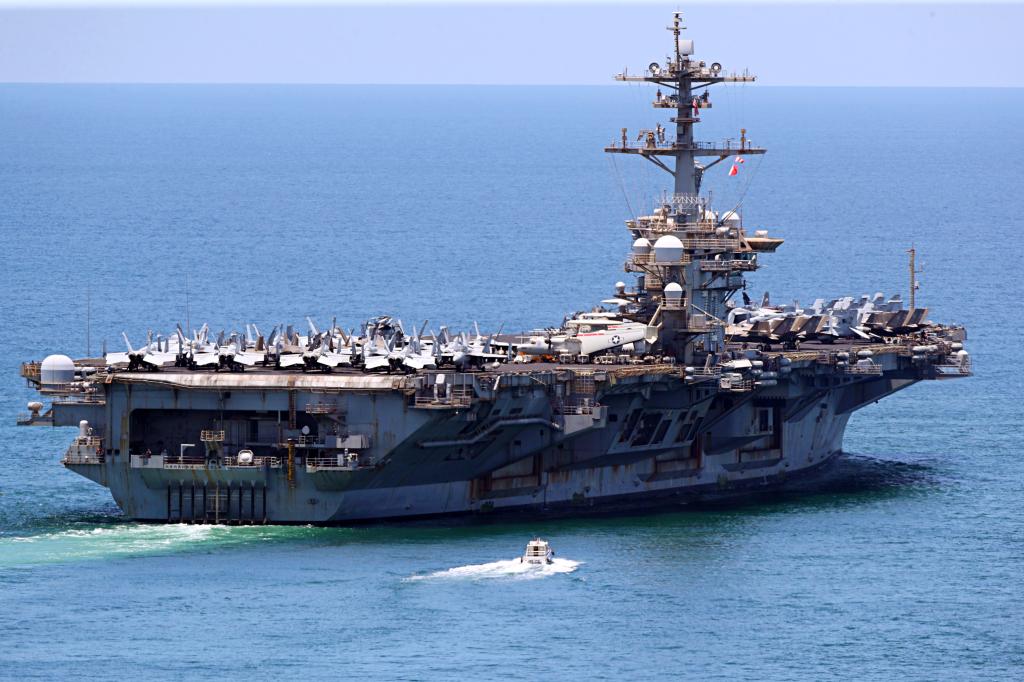
Iran has intensified attacks on US military assets over the past week, targeting American warships near the Strait of Hormuz three times, including an aircraft carrier, according to the article. The escalation marks a shift from Iran’s earlier focus on US and allied bases across the Middle East toward the Navy vessels enforcing a blockade on Iranian ports. One attack on Wednesday reportedly involved medium-range ballistic missiles launched toward 10 US ships. The missiles were said to possess advanced maneuvering capabilities, raising concerns among US officials that Iran’s targeting systems have improved substantially since the war began and that Russia or China may have assisted with their development.
Although US Central Command said the recent attacks were intercepted and caused no damage, the strikes have required the US and its allies to use expensive missile interceptors against less costly Iranian weapons. A separate mass barrage against a military base in Jordan has also led analysts to believe that Iran has restored some missile-launching infrastructure damaged or buried by initial US strikes.
The article presents the attacks as part of a broader Iranian strategy to increase the financial and political costs of the conflict, potentially ahead of US midterm elections. The escalation coincides with a new US sanctions regime, called Operation Economic Outcast, which is placing additional pressure on Iran’s economy and limiting its access to financial support. A former US ambassador described Iran as acting because it sees few alternatives under the blockade and sanctions.
The attacks, combined with a strike by Iran-backed Houthi rebels on Saudi oil facilities, pushed crude oil prices above $105 per barrel. President Donald Trump said Iran might not be able to sustain the conflict much longer but predicted that the confrontation would be settled after, or possibly before, the November elections. He also warned that Iran could be “totally wiped out as a country” if it continued retaliating against US forces.
Entities: Iran, United States Navy, Donald Trump, Strait of Hormuz, US Central Command • Tone: urgent • Sentiment: negative • Intent: inform
10-09-2026
The article examines Iran’s apparent strategy of using the ongoing conflict with the United States and Israel to increase political and economic pressure on President Donald Trump before the US midterm elections. Tehran has tightened restrictions on shipping through the Strait of Hormuz, a crucial energy corridor that carries roughly one-fifth of global oil and liquefied natural gas supplies. The Revolutionary Guards reportedly targeted vessels attempting to cross a newly expanded restricted zone, raising concerns that prolonged disruption could push energy prices higher.
According to analysts cited in the article, Iran does not expect to defeat the United States militarily. Instead, it may be seeking leverage by prolonging the war, increasing the costs of US involvement and reminding American voters of Trump’s previous promises to avoid “never-ending wars.” Higher gasoline prices and another Middle East crisis could damage Republicans’ electoral prospects and weaken Trump domestically.
The article says Iran has adopted a harder line despite Trump’s efforts to end the conflict. Tehran reportedly continued military strikes, including an attack on a US base in Jordan following the destruction of Iranian oil tankers. Iran’s leadership has also set conditions for negotiations, including an Israeli withdrawal from south Lebanon and the release of approximately $24 billion in frozen Iranian assets.
The report describes uncertainty surrounding Iran’s chain of command, noting that Supreme Leader Ali Khamenei and his successor, Mojtaba Khamenei, have remained largely out of public view. Iranian officials say they distrust Washington and want confidence-building measures before taking further steps. Analysts believe the conflict could remain unresolved well beyond Trump’s presidency, despite his claim that Iran is running out of options.
Entities: Iran, Donald Trump, United States midterm elections, Strait of Hormuz, Islamic Revolutionary Guards • Tone: analytical • Sentiment: negative • Intent: analyze
10-09-2026
The France 24 live report, issued on September 10, 2026, focuses on escalating tensions between the United States and Iran amid an ongoing Iran war. US President Donald Trump said on Wednesday that the United States could strike Iran’s Pickaxe Mountain, a warning accompanied by the instruction that Tehran should “not get cute” over activity at the site. The statement suggests Washington is closely monitoring developments at the mountain and is prepared to consider military action if it believes Iran is engaging in threatening or provocative activity.
Trump also addressed the economic consequences of the conflict, saying that oil prices, which have risen sharply because of the war, probably would not decline until after the US midterm elections. The report adds that Trump’s advisers had warned that the conflict could continue for the remainder of his presidency, indicating concern that the confrontation may become prolonged rather than resolve quickly.
The item is presented as the opening entry in a France 24 liveblog and promises continuing updates. However, the supplied page contains no further liveblog developments or detailed explanation of the activity at Pickaxe Mountain. It also does not provide additional information about possible US military plans, Iran’s response, the precise location or strategic significance of the site, or the effect of the conflict on shipping and energy markets. The report credits France 24, Reuters, the Associated Press, and Agence France-Presse. Overall, the article conveys a tense and potentially escalating geopolitical situation in which military threats, presidential rhetoric, prolonged conflict, and elevated energy prices are closely connected.
Entities: Iran, Donald Trump, United States, Pickaxe Mountain, Iran war • Tone: urgent • Sentiment: negative • Intent: inform