10-09-2026
This France 24 video report examines how the United States is working to preserve public memory of the September 11, 2001 terrorist attacks 25 years after they occurred. The report describes the attacks as an era-defining national trauma and emphasizes that their memory is becoming more difficult to sustain as the number of Americans who experienced the events firsthand declines over time.
The item highlights the generational dimension of remembrance. While the attacks remain a defining event for older Americans, younger people increasingly encounter them through education, public memorials, historical accounts, and the recollections of others rather than personal experience. The report therefore presents commemoration as an ongoing national responsibility.
It also focuses on President Donald Trump’s planned observance. Trump is expected to pay his respects at the Pentagon rather than in New York City. The report notes that New York was the site of the World Trade Center attacks and that the towers’ destruction accounted for the largest share of the 2,977 victims recorded on September 11. The choice of location provides a specific illustration of how national leaders continue to mark the tragedy across the sites associated with it.
The available material is a brief 1-minute-34-second video description rather than a full transcript. It does not provide detailed interviews, historical background, or information about particular memorial events, but it establishes the central issue: how the United States can keep the memory and significance of 9/11 alive as direct personal memory gradually fades.
Entities: September 11 attacks, United States, 2001 terrorist attacks, President Donald Trump, Pentagon • Tone: neutral • Sentiment: negative • Intent: inform
10-09-2026
In this personal commentary, James Zogby recalls experiencing the September 11, 2001 terrorist attacks while working in Washington, DC. He describes hearing from a woman trapped in traffic that a plane had struck the World Trade Center, then watching the second plane hit and the towers collapse. The attacks killed nearly 3,000 people and left lasting trauma for those who witnessed them.
Zogby’s grief was compounded by concern for his family and community. His daughter lived near the Pentagon, which was also attacked, while his office near the White House was evacuated as a precaution. Because he led the Arab American Institute, however, Zogby and his colleagues asked to remain so they could respond to frightened Arab Americans across the country. Police allowed them to stay and provided protection.
In the days after the attacks, the organization documented hundreds of anti-Arab and anti-Muslim hate crimes, including death threats directed at its staff and at people perceived to be Arab or Muslim. Zogby explains that Arab Americans were forced to mourn the national tragedy while also fearing attacks and questioning whether they were regarded as part of the American community.
He then describes a gradual shift in public response, supported by years of advocacy. He appeared on television networks, the Ad Council produced an anti-hate campaign, the Senate condemned anti-Arab and anti-Muslim hatred, and civil rights and religious organizations rallied in support. Although these developments were encouraging, they were also exhausting amid the broader shock and grief.
Writing 25 years later, Zogby argues that remembering the attacks must include the experiences of Arab and Muslim Americans. He believes these stories remain essential both for survivors and for younger Americans who were not alive, were too young to remember, or had not yet immigrated to the United States in 2001.
Entities: James Zogby, Arab American Institute, The National, September 11, 2001 terrorist attacks, World Trade Center • Tone: emotional • Sentiment: negative • Intent: inform
10-09-2026
The article examines President Donald Trump’s account of his actions after the September 11, 2001, attacks and the controversy surrounding his decision not to attend the 25th-anniversary ceremony at Ground Zero. At a White House event honoring emergency personnel killed on 9/11, Trump said that two firefighters physically carried him away from a site near an unstable building. He described himself as having been in danger and said he would never forget the incident.
The report notes that Trump’s account is part of a changing narrative he has repeated for years, often portraying himself as a central figure in the recovery effort. Trump has previously claimed that he visited Ground Zero shortly after the attacks and sent 100 workers to help. CNN, The New York Times and rescue officials who were present have disputed parts of those claims.
Trump’s remarks came as attention focused on his absence from New York for the 25th anniversary. Instead, he is scheduled to attend a ceremony at the Pentagon, another target of the attacks. Trump and the White House have denied reports that he chose the Pentagon because he was barred from speaking at the 9/11 memorial. Trump called those reports “Corrupt News” on Truth Social and argued that the Ground Zero ceremony is solemn and does not feature speeches.
Vice President JD Vance and former presidents Joe Biden, Barack Obama, Bill Clinton and George W. Bush are expected at Ground Zero. Trump is also scheduled to travel to Ireland after the Pentagon ceremony to attend a golf tournament at his family’s course. In a later Truth Social post, he clarified that he had not been at Ground Zero on the day of the attacks but said he arrived soon afterward with construction workers and “as soon as the Law allowed.”
Entities: Donald Trump, September 11 attacks, 25th anniversary of 9/11, Ground Zero, Pentagon • Tone: analytical • Sentiment: negative • Intent: inform
10-09-2026
The article examines how New York City has changed in the 25 years since the September 11, 2001 attacks, contrasting the physical redevelopment of Lower Manhattan with the lasting psychological, political and social effects of the tragedy. Nearly 3,000 people died when hijacked planes struck the World Trade Centre and the Pentagon, while another aircraft crashed in Pennsylvania. In the years that followed, Lower Manhattan received billions of dollars in public and private investment. New office towers, apartments, transport links, shops, cultural institutions and the 9/11 Memorial and Museum transformed the area, which is now crowded with workers and tourists again.
For younger New Yorkers, however, the security measures introduced after the attacks—including cameras, checkpoints, surveillance, bollards and concrete barriers—are an ordinary part of urban life. Older residents describe a more profound transformation, marked by fear, anxiety and heightened awareness of personal safety. The article also recalls the immediate solidarity among New Yorkers, while noting that the aftermath produced greater distrust, division and suspicion across the United States.
The attacks reshaped American foreign policy, contributing to wars in Afghanistan and Iraq and changes to immigration, counter-terrorism and airport-security policies. The article uses the experiences of several New Yorkers to explore memory and resilience. Sara Bitar, born shortly before the attacks, views 9/11 as inherited history and connects New York’s recovery to Beirut’s resilience. Dulcie Leimbach recalls recurring sadness and anxiety during commemorations but remains impressed by the city’s energy. Television producer Jonathan Wachtel describes surviving the collapse of a tower and the darkness and desperation of the debris cloud.
The article presents New York as both permanently wounded and remarkably resilient. It also highlights a major symbolic change: Zohran Mamdani’s reported election as the city’s first Muslim mayor, a development portrayed as difficult to imagine in the fearful and divided climate after 9/11.
Entities: September 11 attacks, New York City, Lower Manhattan, World Trade Centre, 9/11 Memorial and Museum • Tone: analytical • Sentiment: neutral • Intent: analyze
10-09-2026
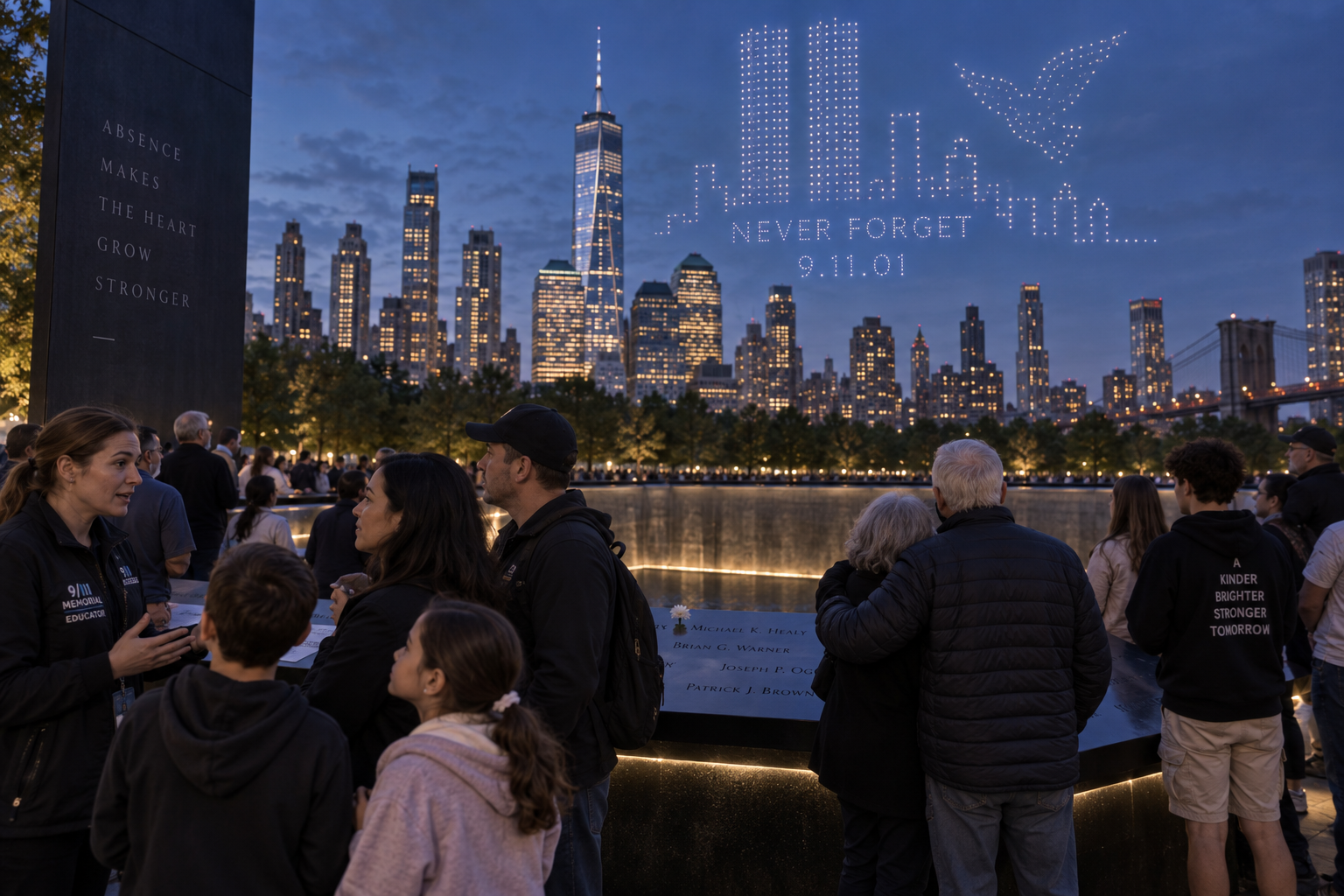
Almost 3,000 drones illuminated the New York City skyline during a test of the “Tribute in Light” memorial installation ahead of the 25th anniversary of the September 11, 2001 attacks. The tribute is scheduled for September 11, 2026, and will use 2,977 lights, matching the number of people killed in the attacks.
During the test, the drones formed changing patterns across the night sky above New York. The display is intended to provide a preview of the annual memorial and the expanded tribute planned for the milestone anniversary. By recreating the scale of the loss through thousands of individual lights, the installation will honour those who died and keep their memory visible across the city skyline.
The footage shows the drone formations as part of preparations for the anniversary event. The display connects a modern technology-based spectacle with the long-running “Tribute in Light” tradition, which commemorates the victims of the attacks. The article does not report on any disruptions, controversy or technical problems associated with the test. Instead, it focuses on the visual presentation and the symbolic significance of matching the number of lights to the death toll.
The report was updated on 10 September 2026 and presents the drone display as a commemorative event taking place in New York ahead of the anniversary. The tribute is expected to mark 25 years since the attacks while maintaining the memorial’s presence in the city’s night sky.
Entities: New York City, New York skyline, Tribute in Light, September 11 attacks, September 11, 2001 • Tone: neutral • Sentiment: neutral • Intent: inform
10-09-2026
France 24 reports on how New York’s Muslim community has changed in the 25 years since the September 11, 2001 terrorist attacks. The report presents the community as increasingly integrated into the city’s civic and social life, while also emphasizing that many Muslims continue to remember the discrimination and stigma that followed the attacks.
The article points to several developments as evidence of greater visibility and acceptance. One is the election of Zohran Mamdani as New York City’s mayor, described as a sign that Muslims have become more fully represented within the city’s political fabric. Another is the planned opening of what the report identifies as the state’s largest mosque, scheduled for the end of 2026. Together, these developments suggest a community that is more established and publicly recognized than it was in the immediate aftermath of 9/11.
At the same time, the report does not portray progress as erasing the past. It notes that many Muslims still recall the difficult months following the attacks, when suspicion, hostility, and stigmatization affected Muslim communities in New York and more broadly across the United States. The report’s framing therefore combines recognition of social and political progress with remembrance of the harm experienced after the attacks.
The supplied text provides an overview of the France 24 video report rather than a full transcript. It identifies Monte Francis as the reporter but does not include individual interviews, detailed accounts of discrimination, or comments from Mamdani or mosque representatives. Its central focus is the contrast between the Muslim community’s growing place in New York today and the painful legacy of the post-9/11 period.
Entities: New York City, Muslim community, Zohran Mamdani, September 11, 2001 attacks, 9/11 anniversary • Tone: analytical • Sentiment: neutral • Intent: inform