08-11-2026
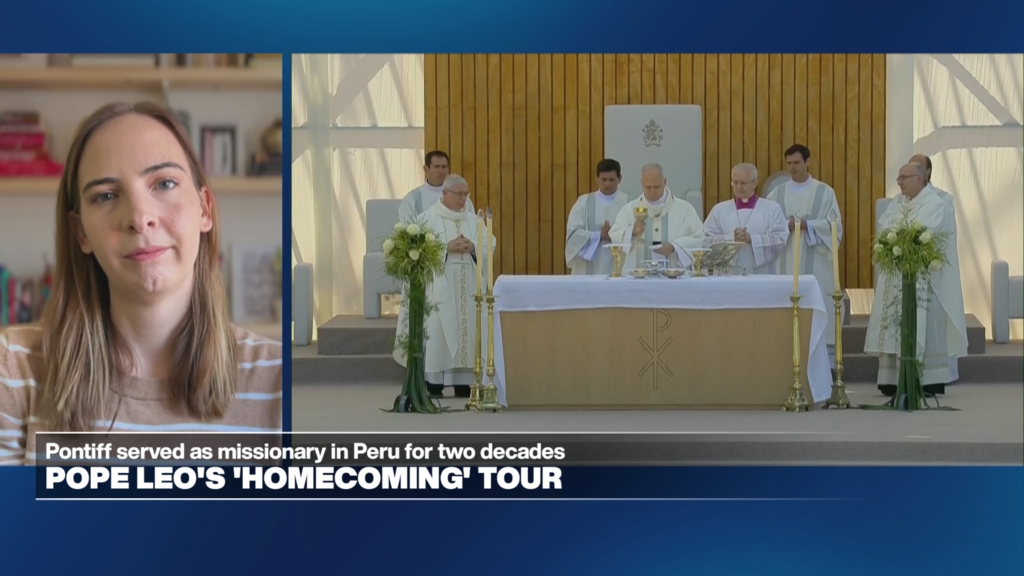
Pope Leo XIV concluded his visit to Uruguay on Sunday with a Mass in the city of Florida, where tens of thousands gathered to mark the feast of the Virgin of the Thirty-three. The Vatican estimated that 50,000 people attended, more than the city’s population of about 40,000. Leo praised mothers and grandmothers for passing the Catholic faith to younger generations, urging them not to lose heart even when their children no longer pray or attend Mass. He also called attention to gender-based violence and urged men to respect their wives. The article notes that Latin America recorded nearly 20,000 femicides over the previous five years, most committed by a current or former partner of the victim.
Leo’s visit was the first by a pope to Uruguay in nearly four decades. He encouraged worshippers to live their faith openly and said Uruguayans were capable of great things. In his homily, he also said he was deeply saddened by an attack in Krakow.
That evening, Leo arrived in Buenos Aires and was welcomed at the Casa Rosada by Argentine President Javier Milei. The visit takes place amid tensions between the Catholic Church and Milei’s government. The Church has criticized his cuts to social spending and his embrace of artificial intelligence. Milei has made spending cuts central to his effort to overhaul Argentina’s economy and achieve a budget surplus. He has also denounced social justice and dismissed complaints from families struggling to make ends meet under austerity.
For Argentine Catholics, the visit is significant spiritually because Leo is reconnecting with the country of his predecessor, Pope Francis, born Jorge Mario Bergoglio, who died on Easter Monday in 2025.
Entities: Pope Leo XIV, Uruguay, Florida, Uruguay, Montevideo, Virgin of the Thirty-three • Tone: analytical • Sentiment: neutral • Intent: inform
08-11-2026
Pope Leo XIV arrived in Buenos Aires on November 8, 2026, during his first Latin American tour as pope and the first papal visit to Argentina in nearly four decades. In a speech alongside President Javier Milei, Leo sharply criticized the social consequences of Milei’s austerity policies, arguing that economic growth must serve the public rather than the other way around. He highlighted people who struggle to meet household needs despite working hard, and called for particular care for people affected by illness, dependency and disability—a remark understood as referring to cuts to disability assistance. Leo also urged Milei to strengthen democracy by listening and choosing his words carefully.
Argentines hoped the pope could help ease the country’s divisions, which have deepened during three years of austerity. Supporters and opponents of Milei remain bitterly divided, while the pope’s visit drew crowds in Buenos Aires. Some attendees said they hoped he would bring peace and unity. Leo’s itinerary includes visits to a home for disabled people and a prison, as well as three outdoor Masses; the Church expects seven million people to attend events. The trip also comes as Catholic identification in Argentina has fallen substantially, from around 90 percent in the 1960s to 57.7 percent in a recent University of Buenos Aires poll.
Milei took office promising to revive the economy and curb inflation by reducing the welfare state, with cuts affecting public hospitals, universities and pensioners. Poverty reached 32.3 percent in September, although Milei retains strong support for reducing inflation. He previously insulted the late Pope Francis, an Argentine who championed social justice, but has so far maintained cordial relations with Leo. Argentina’s Catholic Church has criticized Milei’s treatment of social services as budget constraints and his restrictions on democratic freedoms, including the right to protest. Leo’s visit is therefore both an appeal for social concern and a test of the Church’s standing in a more secular country.
Entities: Pope Leo XIV, Javier Milei, Pope Francis, Argentina, Buenos Aires • Tone: analytical • Sentiment: neutral • Intent: inform
08-11-2026
The France 24 segment, titled “Pope Leo in Latin America: Papal Politics and Peru,” examines the significance of Pope Leo XIV’s South America tour. The article’s description says that Leo has completed his first visit to Uruguay and is heading to Argentina for the tour’s second leg. It anticipates that the Argentina visit will draw the largest turnout of his papacy so far. Vatican correspondent Colleen Dulle of America Magazine, who co-hosts the “Inside the Vatican” podcast, joins the program to analyze the political and religious significance of the trip in Latin America. The page identifies the video’s production team and lists Pope Leo XIV as its keyword. The supplied page text does not include a transcript or detailed account of the discussion, so it does not provide further specifics about the tour’s political implications, Peru, or the interview’s conclusions. Other headlines and video links shown on the page are unrelated items and are not part of the article itself. In short, the available article presents a news-analysis interview about the papacy’s engagement with Latin America, framed around the pope’s Uruguay visit and anticipated reception in Argentina.
Entities: Pope Leo XIV, Colleen Dulle, Argentina, Uruguay, South America • Tone: analytical • Sentiment: neutral • Intent: analyze
08-11-2026
The France 24 programme “Pope Leo in Latin America: Papal Politics and Peru” focuses on Pope Leo’s South American tour and the political and religious significance of his visits. The available article text says that the pontiff has completed his first visit to Uruguay and is heading to Argentina for the tour’s second leg. He is expected to attract the largest turnout of his papacy so far. The programme features Colleen Dulle, Vatican correspondent at America Magazine and co-host of the “Inside the Vatican” podcast, who joins France 24 to analyse the importance of the Latin American tour.
The page identifies the segment as part of the “Spotlight” show and gives its duration as 11 minutes and 49 seconds. It was issued on 8 November 2026. Alessandro Xenos, Gavin Lee, Théophile Vareille and Florent Marchais are credited in the production and reporting credits shown on the page.
Although the headline refers to Peru, the supplied description discusses Uruguay and Argentina. The page excerpt does not provide further details about the interview, the pope’s plans in Peru, or the specific political issues examined. It therefore supports a general account of the tour’s expected public reception and the programme’s analytical focus, but not conclusions about the interview’s more detailed arguments.
Entities: Pope Leo XIV, Colleen Dulle, Alessandro Xenos, Gavin Lee, Théophile Vareille • Tone: analytical • Sentiment: neutral • Intent: analyze
08-11-2026
Pope Leo XIV urged men to respect their wives and live with integrity during a homily in Uruguay, where he concluded the first leg of a 12-day Latin American tour. His appeal came amid severe gender-based violence across the region: more than 3,800 women were killed because of their gender in Latin America and the Caribbean in 2024, and nearly 20,000 femicides were recorded over the previous five years. Most victims were killed by current or former partners, according to figures cited from a United Nations regional body.
Leo held an open-air mass outside a basilica in Florida, Uruguay, a city associated with a shrine connected to the country’s independence from Spanish rule. Thousands attended. The pope also prayed for Uruguay’s leaders to govern in the interests of everyone. Worshippers described his visit as important for the Church’s presence in the largely secular country and praised his effort to undertake the demanding trip three weeks after surgery for lung cancer. The article notes that unusually cold weather had followed an exceptionally strong El Niño.
The pope is due to travel to Argentina and meet President Javier Milei, whose austerity policies have drawn criticism from the Catholic Church. Analysts quoted in the article suggest Leo’s visit may encourage people who feel excluded by Milei’s economic programme. His itinerary includes a disability care centre and a prison, reflecting his attention to marginalized communities; the care centre’s director says cuts have reduced disability benefits while poverty remains widespread.
The article places the trip in the context of Leo’s broader public positions, including calls for humane treatment of immigrants and action on climate change, as well as warnings about artificial intelligence. It also recalls Milei’s past insults toward Pope Francis and his later attempt to repair relations. One sociologist argues Milei has little to gain from conflict with Leo and could benefit from presenting Argentina as orderly.
Entities: Pope Leo XIV, Javier Milei, Pope Francis, Uruguay, Argentina • Tone: analytical • Sentiment: neutral • Intent: inform
08-11-2026
Pope Leo XIV concluded his visit to Uruguay on Sunday with a Mass in Florida, where tens of thousands gathered for the feast of the Virgin of the Thirty-three. In his homily, he connected the Catholic faith with Uruguay’s history and thanked mothers and grandmothers for passing it to younger generations. He acknowledged their disappointment when children stop praying or attending Mass, but urged them to continue sharing their faith. The visit was the first by a pope to Uruguay in nearly four decades, and the article describes it as an effort to reaffirm the church’s place in a country that later became notably secular and at times anticlerical.
Leo’s next stop is Argentina, where he is expected to meet President Javier Milei. The visit could be politically delicate because the Catholic Church has criticized Milei’s austerity measures, which include substantial reductions in social spending. The article notes that his government cut the healthcare budget by 48% in real terms, while poverty reached 32.3% in the first half of 2026. Planned cuts to public universities have also prompted student protests. Milei defends the measures as necessary economic reforms, and his government says the papal visit is religious rather than political.
The article places the visit in the context of Pope Francis’s legacy. Francis, an Argentine who never returned to his homeland during his papacy, had championed poor and marginalized communities. Leo, who spent two decades ministering to poor people in Peru, is described as carrying forward aspects of Francis’s pastoral focus. His trip to Argentina also precedes a return to Peru, where he served as a missionary. Meanwhile, Argentine authorities said a person was arrested over death threats against Leo ahead of his arrival.
Entities: Pope Leo XIV, Javier Milei, Pope Francis (Jorge Mario Bergoglio), Uruguay, Argentina • Tone: analytical • Sentiment: neutral • Intent: inform
08-11-2026
Pope Leo XIV’s first visit to Argentina is expected to highlight sharp differences between the church’s social teaching and President Javier Milei’s libertarian, spending-cutting agenda. The pope’s first full day includes a visit to Cottolengo Don Orione, a Catholic home for about 400 disabled people whose coordinator says government cuts have halted deliveries of medicines, special foods and diapers. Disability funding has become a point of conflict between the government and church leaders, with bishops raising concerns and a related funding law stalled.
Milei has cut public spending in an effort to curb inflation, but retirees and other groups have faced a loss of purchasing power. He previously insulted Pope Francis, Leo’s predecessor, although Milei says he apologised when they met in 2024. Leo’s visit also puts into focus disagreements over artificial intelligence: the pope has called for AI to be “disarmed,” while Milei opposes regulation and supports datacentre construction and legal status for “no-human corporations.” Critics see this as part of a broader clash over whether technology and markets should take precedence over human dignity.
The pope’s itinerary—visiting the disability home, meeting business and union leaders, and celebrating Mass at a state-owned aircraft factory where workers have protested cuts—may itself signal the themes of his message. Observers expect Leo to defend labour, domestic production, social justice and the inherent dignity of people, while avoiding direct confrontation with Milei. The article also describes closer ties between Latin American social movements and the Catholic church, while noting that LGBTQIA+ activists remain critical of church doctrine. Meanwhile, Catholic identification in Argentina has declined as evangelical affiliation has risen. The article ends mid-sentence after noting that Catholicism remains the country’s majority religion.
Entities: Pope Leo XIV, Javier Milei, Pope Francis, Argentina, Cottolengo Don Orione • Tone: analytical • Sentiment: negative • Intent: analyze
08-11-2026
Pope Leo XIV urged young people in Uruguay to marry and start families, telling them not to fear lifelong commitment during a youth prayer service in Montevideo. His appeal came amid a sharp decline in the country's birth rate and during the first stop of a three-country South American tour. Uruguay is often regarded as Latin America's most secular country, and the Pope also called on its people to strengthen faith and fraternity.
On Saturday, Leo celebrated his first Mass in South America in Paysandú, near the Argentine border. The Vatican estimated that about 40,000 people attended despite rainy and windy weather. Speaking in Spanish, he described Catholicism as part of Uruguay's history and urged the faithful to pass it on to future generations with creative courage. He also invoked mate, the widely shared herbal tea, as a symbol of welcome, unity and common identity.
In Montevideo's Casavalle neighbourhood, which is affected by drug trafficking and gang violence, the Pope visited homes built by Our Lady of Guadalupe Parish in Borro and praised church groups supporting people recovering from addiction. He called on Christians to show compassion, invoking the Good Samaritan, and highlighted the danger faced by children who fear they may not return home from school.
Leo later led a prayer vigil at Centenario Stadium, the venue of Pope John Paul II's 1988 visit. The Vatican estimated that 70,000 people were inside, with another 30,000 watching on screens outside. Leo said Uruguay's relatively small Catholic population did not make the Church insignificant, drawing on Bethlehem as an example. He was scheduled to depart for Argentina before continuing to Peru, described as his second homeland, where the tour would conclude.
Entities: Pope Leo XIV, Uruguay, Montevideo, Paysandú, Argentina • Tone: neutral • Sentiment: neutral • Intent: inform