08-11-2026
The Jillaroos reached their fifth consecutive Rugby League World Cup final after recovering from a major early challenge to beat tournament debutants Fiji in the semifinal at Sydney Football Stadium. Fiji took an unexpected 8-0 lead within the opening 16 minutes, with Luisa Yaranamua scoring a penalty goal and then crossing after a dummy. Australia had dominated the group stage, compiling an aggregate score of 242-6, but struggled early against Fiji’s disciplined and aggressive play.
Abbi Church and Tamika Upton scored tries to bring Australia level by half-time. The Jillaroos had not played to their usual standard and completed only 12 of 19 sets in the first half. After the break, they improved, moved ahead and built a cushion. Church scored four tries in total, including three in the second half and a notable aerial finish. Fiji added a late try through Maria Paseka, but Church’s fourth try quickly restored Australia’s margin. The article’s opening summary gives the result as 34-14, while its main report says 30-14.
Church praised Fiji for giving Australia a demanding contest and said the test would be valuable before the final. Fiji captain Sereana Naitokatoka expressed pride in her team’s effort and its performance throughout the tournament. Australia will play New Zealand in the final at Lang Park in Brisbane next Sunday. The Kiwi Ferns qualified for their seventh straight final by defeating Samoa. Australia’s Jaime Chapman was also a concern after reportedly experiencing cramp and spending much of the second half off the field.
Entities: Jillaroos, Fiji Bulikula, New Zealand Kiwi Ferns, Abbi Church, Sereana Naitokatoka • Tone: analytical • Sentiment: neutral • Intent: inform
08-11-2026
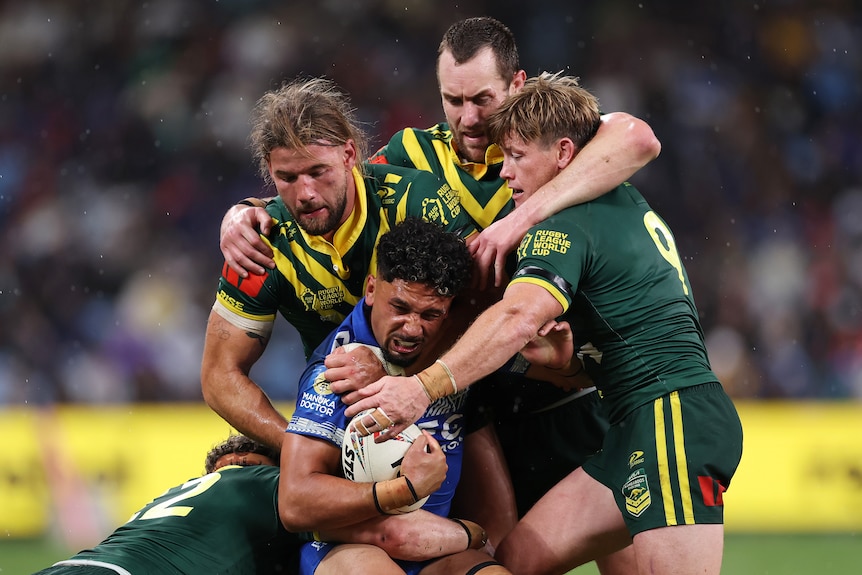
Australia’s Kangaroos and Jillaroos have both advanced to the Rugby League World Cup finals after semifinal victories over Samoa and Fiji. The Kangaroos defeated Samoa 44–12 at Sydney Football Stadium, with fullback Reece Walsh scoring a hat-trick and Cameron Munster setting up three tries. Australia’s attack, which had looked disjointed earlier in the tournament, was far more effective, while Samoa’s errors and ill-discipline helped the Kangaroos build a 26–2 halftime lead. Samoa scored twice after the break, but Australia remained in control. The win sets up a final against New Zealand, a rematch of the tournament opener, which Australia won 24–22.
In the women’s semifinal, the Jillaroos recovered from an early 8–0 deficit to beat Fiji’s Bulikula 30–14. Fiji gave Australia a stern challenge, but the Jillaroos held on to reach their fifth consecutive World Cup final against New Zealand. Both finals are scheduled for Lang Park in Brisbane the following Sunday.
The live coverage also reflected on the contrasting semifinal performances, praised Walsh, Munster and halfback Tom Dearden, and noted the impact of Australia’s forward selections. Samoa captain Junior Paulo said the team remained proud of its culture and its place in international rugby league despite missing the final. A reader raised concerns about refereeing decisions; the reporter acknowledged Australia benefited from some close calls but said the Kangaroos were clearly the better team.
Entities: Kangaroos, Jillaroos, Toa Samoa, Bulikula, Reece Walsh • Tone: analytical • Sentiment: positive • Intent: inform
08-11-2026
Australia defeated Samoa 44–12 in Sydney to reach the Rugby League World Cup final, turning a highly emotional semi-final into a one-sided contest through discipline, precision and control. The article describes the contrast between the atmosphere around the teams—the anthems, the Siva Tau and the passionate Pacific support—and Australia’s execution once play began. Australia repeatedly punished Samoa for defensive lapses and penalties, scoring three times in quick succession during a damaging first-half spell and taking a 26–2 lead into the break.
Samoa struggled to maintain possession and field position, conceding a combined 12 penalties and set restarts. Spencer Leniu’s errors and sin-binning captured the team’s mounting frustration, while two Samoa tries were ruled out by narrow margins. Australia, by contrast, consistently exploited the opportunities Samoa gave them. Reece Walsh scored a hat-trick, strengthening his case for the Golden Boot, while Cameron Munster and Harry Grant directed the game. Pat Carrigan and Tino Fa'asuamaleaui were also influential in the middle.
The writer presents the result as both a decisive win and a reminder of the gulf that remains between Australia and the Pacific challengers. Samoa and Tonga have made substantial progress, and the article recognizes their importance to the future of international rugby league, but Australia’s record and depth continue to make it the benchmark. New Zealand is identified as a credible opponent and perhaps the favourite for the final, though the article stresses that beating Australia requires near-perfect execution. Samoa’s next challenge, the writer concludes, is taking the final step from growth and promise to consistently competing with the Kangaroos on the biggest stage.
Entities: Australia Kangaroos, Samoa national rugby league team, New Zealand national rugby league team, Rugby League World Cup, Sydney Football Stadium • Tone: analytical • Sentiment: negative • Intent: analyze
08-11-2026
The Jillaroos have reached the 2026 Women’s Rugby League World Cup final after beating Fiji’s Bulikula in a semi-final that proved far more challenging than most observers expected. Australia, the three-time defending champions, had dominated their pool matches by a combined 242–6 and entered the game as overwhelming favourites. Fiji, making its first appearance at the women’s World Cup, instead applied intense, technically strong defence and an effective kicking game that unsettled the Australians and helped establish an 8–0 lead. Australia’s completion rate fell to about 40 per cent, while errors from players including Tamika Upton and Jocelyn Kelleher illustrated how unusual the pressure was for the usually dominant side.
The article argues that Fiji’s performance should not be viewed merely as a scare for Australia. It is evidence that the international women’s game may be becoming more competitive, and that Fiji could eventually challenge the Australia–New Zealand dominance that the writer says has held the sport back. Fiji’s five-eighth Luisa Yaranamua is singled out for an outstanding performance, while the team’s defence and kicking are praised. Australia gradually reduced its errors and took advantage of its opportunities, with Abbi Church scoring four tries, including a notable try from a kick. The win came at a physical cost: Jamie Chapman left early with cramp, and the Jillaroos finished bruised.
Fiji tired in the second half but continued competing and scored late. The team also made an impression before kick-off by performing the hymn “Noqu Masu,” representing the cultural and spiritual presence of Pasifika nations in the tournament. Australia’s victory keeps its campaign on course: the Jillaroos will face New Zealand’s Kiwi Ferns in the final in Brisbane, with a fourth consecutive World Cup title at stake.
Entities: Amanda Shalala, Jillaroos, Fiji Bulikula, Kiwi Ferns, Fetu Samoa • Tone: analytical • Sentiment: positive • Intent: analyze