08-11-2026
The US military’s Central Command (CENTCOM) says it has created Task Force Iron Gate to disrupt Iran’s land-based supply routes, expanding a months-long naval blockade of Iranian ports in the Strait of Hormuz. CENTCOM says the force, based in Tampa, Florida, will work with other US government agencies to prevent the movement across Iran’s land borders and the Caspian Sea of advanced weapons, dual-use technologies, sanctioned materials, and illicit revenue. CENTCOM Commander Admiral Brad Cooper described the task force as reinforcing the blockade’s success at sea.
Michael Mulroy, a former US deputy assistant secretary of defence for the Middle East, said the task force would assess how weapons and energy are transported and how those routes might be cut off. He suggested that if President Donald Trump orders an escalation, targets could include economic and infrastructure sites, rather than focusing mainly on military targets as Operation Epic Fury does. Such attacks, he said, could be part of a broader effort to limit Iran’s ability to fight and fund itself.
Separately, CENTCOM said a US military aircraft disabled the St. Kitts-flagged cargo ship M/V Huda in the Gulf of Oman after its crew was directed to leave targeted areas. CENTCOM reported that enforcement actions since July had redirected 147 commercial vessels and disabled five that did not comply.
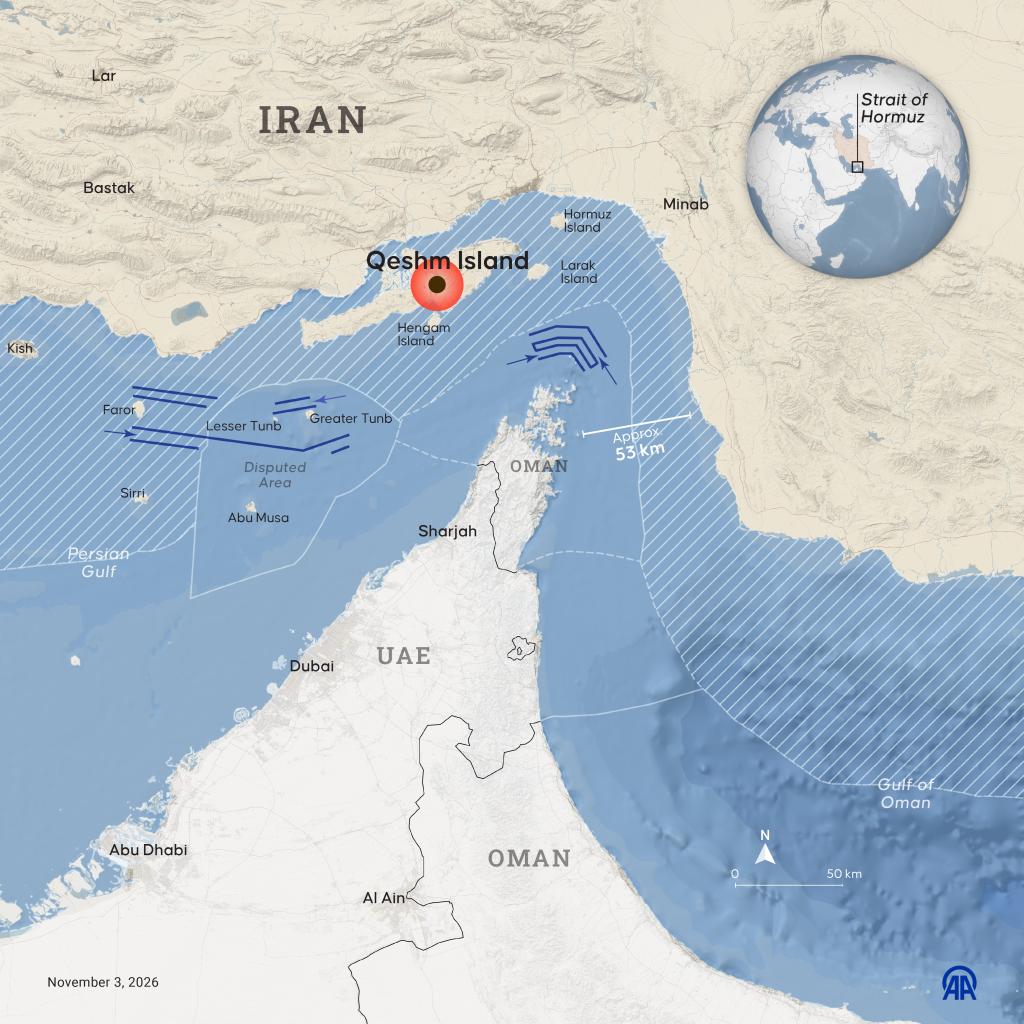
The article also reports explosions on Qeshm Island and in the Iranian cities of Jask, Sirik, and Bandar Abbas. President Trump confirmed strikes on Qeshm the previous day but called them minor and said Tehran still wanted a deal as Qatari-mediated talks continued. Iran’s Islamic Revolutionary Guard Corps Navy, meanwhile, said two oil tankers struck sea mines near the Strait of Hormuz after passing through an unsafe area with their navigation systems off. Iranian state television reported that both vessels were severely damaged and stopped.
Entities: United States Central Command (CENTCOM), Task Force Iron Gate, Iran, Strait of Hormuz, Admiral Brad Cooper • Tone: analytical • Sentiment: negative • Intent: inform
08-11-2026
The article examines Task Force Iron Gate, a new US military unit intended to disrupt Iran’s movement of advanced weapons, dual-use technology, sanctioned materials and revenue across its land borders and the Caspian Sea. Announced by US Central Command (CENTCOM), the Tampa-based task force is expected to coordinate about 20 civilian and military personnel and extend pressure beyond the US blockade of Iranian ports. Former US official Michael Mulroy describes it as a coordination body to identify supply routes and expand economic pressure; he suggests that any escalation could target economic and infrastructure sites as well as military ones.
Iran’s Islamic Revolutionary Guard Corps (IRGC) dismissed the initiative as wordplay and argued that earlier US predictions of economic collapse had not come true. The announcement also comes amid reports of Russia supplying Iran with drone components and explosives through the Caspian Sea, as well as possible Russian assistance with missile technology. Analysts say the task force could disrupt these connections and risk confrontation with Russia, although CENTCOM did not explicitly identify Russia as its target.
Experts disagree about the unit’s likely effectiveness. Rami Khouri argues that Iran’s long-established regional trading networks and indirect procurement routes make it nearly impossible for the US to seal off all supplies, especially when other countries and commercial intermediaries are involved. Mahjoob Zweiri questions whether the task force can act meaningfully in the Caspian, where the US has no military presence and would need cooperation from neighboring states that may avoid antagonizing Russia. He also says the Caspian accounts for a limited share of Iran’s economic activity.
Former Trump aide Joe Kent portrays the initiative as potentially undermining diplomacy and encouraging escalation while negotiations are underway. The article presents Iron Gate as part of a broader US effort to constrain Iran’s ability to wage and finance war, while emphasizing uncertainty over its practical impact and the risk that it could intensify the conflict.
Entities: Task Force Iron Gate, Iran, United States Central Command (CENTCOM), Islamic Revolutionary Guard Corps (IRGC), Caspian Sea • Tone: analytical • Sentiment: neutral • Intent: analyze
08-11-2026
The live updates describe expanding military and economic pressure related to the Iran war, alongside renewed violence across the region. U.S. Central Command announced Task Force Iron Gate, a roughly 20-person group based in Florida intended to disrupt prohibited shipments and revenue flows moving across Iran’s land borders and the Caspian Sea. The task force is presented as an extension of the U.S. naval blockade, but the announcement did not explain how it would operate or whether it would involve military action. Iran’s military dismissed the initiative as “word play,” arguing that it would not cause economic collapse. The article also notes that the United States had offered up to $20 million and possible relocation for information about Iran’s nuclear program, and that President Trump confirmed U.S. “minor strikes” on Iran after reports of missile strikes on Qeshm island.
Other updates describe threats and attacks around the region. Israel’s defense minister, Israel Katz, said Israel’s mission against Iran was not complete and warned that Hezbollah would face severe consequences if it joined an attack on Israel. He also said Israel would not withdraw from security zones in Gaza, Lebanon, and Syria. In Saudi Arabia, authorities reported that air defenses intercepted missiles targeting Riyadh and other areas; falling shrapnel caused minor damage to an Aramco building, with no casualties reported. Saudi authorities attributed the attempted attack to the Houthis.
In Yemen, Houthi officials said Saudi-led coalition strikes in Sanaa province killed 33 people and wounded 39, including women and children. The Saudi side had not commented on that specific report. The United States also said it disabled a commercial vessel, the St. Kitts-flagged M/V Huda, in the Gulf of Oman after its crew allegedly ignored warnings and tried to breach the blockade. The updates portray a widening regional conflict involving maritime restrictions, land-route enforcement, attacks, and competing claims from governments and armed groups.
Entities: Task Force Iron Gate, U.S. Central Command (CENTCOM), Iran, Strait of Hormuz, Caspian Sea • Tone: analytical • Sentiment: negative • Intent: inform
08-11-2026
The United States said it struck the commercial vessel M/V Huda after the ship attempted to leave regional waters following a visit to an Iranian port, in what Washington described as a breach of its naval blockade on Iran. US Central Command said a US military aircraft fired precision munitions that hit the vessel’s stern after its civilian crew ignored repeated warnings. A CENTCOM video showed an explosion on the ship. Separately, UAE authorities reported rescuing 22 people after a fire aboard a vessel in the Gulf of Oman; the article does not explicitly confirm whether that vessel was the M/V Huda.
The US blockade has been in force for months and is intended to pressure Iran to end its own blockade of the Strait of Hormuz. Before the war began in late February, roughly one-fifth of the world’s oil and gas supplies passed through the strait. The conflict and restrictions on shipping have driven energy prices higher. Iran’s Revolutionary Guards said three oil tankers they described as “non-compliant” caught fire while transiting the strait, where Tehran has repeatedly attacked vessels it had not approved.
The article also reports a separate escalation involving Saudi Arabia and Yemen’s Iran-backed Houthis. Saudi Arabia said it intercepted missiles headed toward Riyadh, and debris from the interception damaged a building belonging to state-owned oil company Aramco. No casualties were reported, though witnesses said some floors were heavily damaged. Saudi Arabia blamed the Houthis for firing two ballistic and two cruise missiles, but the group had not claimed responsibility. The Houthis, meanwhile, said Saudi-led attacks on Sanaa had killed 33 people on Saturday.
Entities: United States, Iran, M/V Huda, US Central Command (CENTCOM), Strait of Hormuz • Tone: analytical • Sentiment: negative • Intent: inform
08-11-2026
US Central Command said its forces disabled the St. Kitts-flagged commercial vessel M/V Huda in the Gulf of Oman after its crew allegedly ignored repeated warnings and attempted to breach the US naval blockade of Iran. According to CENTCOM, a US military aircraft fired precision munitions at the ship’s stern after directing the crew to leave targeted areas. The vessel had reportedly visited an Iranian port before attempting to leave regional waters. CENTCOM said it has redirected 147 commercial vessels that complied with the blockade since July and disabled five merchant ships that refused. It also said it had destroyed 10 Iranian commercial oil tankers linked to what it described as an Islamic Revolutionary Guards Corps shadow network. The UK Maritime Trade Operations agency reported an incident involving a bulk carrier and military forces about 18 nautical miles east of Khor Fakkan, in the UAE. The UAE National Guard said 22 people were rescued from a cargo ship in the gulf. Separately, Iran’s Revolutionary Guards navy claimed that two oil tankers caught fire after hitting mines near or in the Strait of Hormuz. It accused the vessels of switching off navigation systems and taking an unauthorised route, and warned that ships cooperating with the US or violating Iranian regulations could hit mines. The claims come amid renewed tensions between Tehran and Washington over the strategic waterway. The article also reports recent explosions on Qeshm Island and at several other locations in Iran. US President Donald Trump confirmed that American forces had targeted an Iranian air-defence system, while Iranian news agencies reported further explosions in Qeshm, Sirik, Jask and Bandar Abbas.
Entities: M/V Huda, Gulf of Oman, Strait of Hormuz, Iran, United States • Tone: neutral • Sentiment: negative • Intent: inform
08-11-2026
The United States carried out fresh strikes on Iranian air defenses on Qeshm Island on Friday, after attacks on vessels in and around the Strait of Hormuz. President Donald Trump described the operation as minor, saying the targeted anti-aircraft system was knocked out within minutes. The strikes were the first since Tuesday’s midterm elections, in which Democrats made major gains amid voter concerns about the war and rising prices. The United Kingdom Maritime Trade Operations reported that at least 11 ships had been attacked in the area over the past week, with three sinking.
Despite the military action, diplomatic discussions between Washington and Tehran remain active. Bloomberg reported that Iran may be willing to discuss parts of its nuclear program that were previously excluded from negotiations. Qatar’s Prime Minister Mohammed bin Abdulrahman Al Thani said mediation was continuing and urged the parties not to let the pursuit of a perfect agreement prevent a workable deal. Iran’s Foreign Minister Abbas Araghchi said he had spoken with 12 foreign ministers in 48 hours to avert further escalation. A Qatari proposal reportedly includes the US lifting its Strait of Hormuz blockade and releasing some frozen Iranian assets in exchange for Iran allowing International Atomic Energy Agency inspectors to visit bombed nuclear sites.
Meanwhile, the US is maintaining economic pressure. US Central Command announced a 20-member task force, Iron Gate, to restrict Iran’s use of land routes and the Caspian Sea to move advanced weapons and materials, as well as to target sanctioned goods and illicit revenue. Centcom said the blockade had trapped $25 billion in Iranian crude oil.
Trump defended the war, arguing that Iran would otherwise have developed and used nuclear weapons against Israel, the Middle East, Europe, and US cities. He also claimed Iran now wants a deal. The article presents the strikes, diplomatic efforts, maritime attacks, and economic pressure as developments unfolding simultaneously.
Entities: Donald Trump, Iran, United States, Qeshm Island, Strait of Hormuz • Tone: analytical • Sentiment: neutral • Intent: inform
08-11-2026
US Central Command said it disabled a St. Kitts-flagged commercial vessel in the Gulf of Oman after the ship ignored repeated warnings and attempted to leave the region following a visit to an Iranian port. The incident occurred amid a US naval blockade on Iran that has been enforced for months in and around the Strait of Hormuz, a vital route for global shipping and oil transport. The article says the last confirmed US strike on a cargo vessel had taken place nearly a month earlier.
The announcement came as questions persisted about US military activity in the region. CENTCOM had not publicly announced at least two other reported strikes, and officials declined to confirm military action when asked about local reports of explosions. Iranian state media reported explosions on Qeshm Island and in the port of Jask, but their cause was unclear. The US military did not immediately respond to an Associated Press request for comment. Iran’s military separately said two unidentified tankers had struck mines in the Strait of Hormuz area and caught fire.
The report also describes recent US strikes on an Iranian air defense system, which President Donald Trump confirmed on Friday and characterized as “minor.” CENTCOM did not comment on that action. Trump had said for weeks that he was considering another wave of strikes after the November 3 US midterm elections, fueling concern that the United States could resume full-scale operations against Iran after a pause of almost two months.
The conflict, now more than eight months old, has unsettled global markets, while diplomatic efforts to end it have stalled. Commercial shipping has also faced growing risks: October saw the most attacks on ships in the Strait of Hormuz since March, as Iran sought to increase economic pressure on the United States and push it to lift the blockade.
Entities: US Central Command (CENTCOM), St. Kitts-flagged commercial vessel, Gulf of Oman, Iran, Strait of Hormuz • Tone: neutral • Sentiment: negative • Intent: inform
08-11-2026
Iranian media suggested that explosions heard in southern Iran, including on Qeshm Island, may have been connected to Iranian military activity rather than a new US attack. Iranian state television said officials had not confirmed missile strikes on Iranian territory, while the semi-official Tasnim news agency reported that two missiles hit Qeshm. Neither Iran nor the United States commented on that report. Washington had said it struck the island on November 2 in what it described as a limited defensive measure. The reports came amid continuing attacks on shipping in and around the Strait of Hormuz. The US military said its air force disabled a commercial vessel in the Gulf of Oman as it tried to pass through a US blockade. Iran’s Revolutionary Guards Navy said two oil tankers hit mines on an unauthorized route through the strait; another tanker reportedly exploded and caught fire. Reuters could not independently confirm the reported strikes. UK Maritime Trade Operations also reported an incident involving a bulk carrier and military forces near Khor Fakkan, with the extent of damage unknown and any connection to the reported US attack unclear.
The article places the maritime incidents within a wider regional conflict that has disrupted energy exports and other trade. It reports that a Saudi Aramco administrative building in Riyadh was damaged by falling debris after an attempted attack, with no casualties. It also describes ongoing diplomatic efforts: Qatar denied reports that US-Iran talks had failed, while an Iranian official said Tehran had sent Washington a nuclear proposal through Qatar. Iran’s conditions include sanctions relief, access to frozen assets and war reparations; Washington says nuclear issues must be part of initial talks. Separately, the US announced a task force to restrict the movement of advanced weapons and other sanctioned goods to Iran through land borders and the Caspian Sea. Iran’s Revolutionary Guards dismissed the initiative as ineffective, saying Tehran had prepared and coordinated with neighbouring countries.
Entities: Iran, United States, Donald Trump, Strait of Hormuz, Qeshm Island • Tone: analytical • Sentiment: negative • Intent: inform
08-11-2026
Iran has escalated threats to shipping in and around the Strait of Hormuz, claiming that three ships caught fire after explosions and that at least 12 ships have hit naval mines since the start of November. The UK Maritime Trade Operations (UKMTO) reported multiple vessel incidents, including two tankers affected late Saturday, while the UAE National Guard rescued 22 people from a burning cargo ship in the Gulf of Oman. UKMTO said it had confirmed eight attacks in the strait and three in the Arabian Gulf over the past week; some other reported incidents could not be independently verified. Analysts at the Institute for the Study of War said Iran’s claims may be intended to heighten shipping companies’ perceptions of risk. Traffic through the strait is now about 20 per cent of its prewar level, according to Lloyd’s List Intelligence.
The IRGC says the three vessels that burned on Sunday used unauthorised routes and had disabled navigation software. Iran asserts a right to direct traffic through its preferred lane and says the strait will remain closed until the US makes concessions. The United States is tightening its blockade of Iran, including through Task Force Iron Gate, which is intended to restrict goods, weapons, materials and revenue from entering by land or via the Caspian Sea. Centcom says the task force will reinforce the naval blockade; an IRGC spokesman dismissed the plan as “merely a play on words.”
The confrontation is unfolding as the US considers further military action. The USS Theodore Roosevelt, the third US aircraft carrier expected in the region, is due to arrive this week, while Qatar, Pakistan and others are working to prevent the war from reigniting. Diplomatic contacts include discussions between Egyptian and Turkish foreign ministers and talks by Iran’s foreign minister with 12 counterparts in 48 hours. Iran has offered to reopen the strait sooner if the US meets extensive demands, including ending its blockade. Meanwhile, the Houthis claimed an attack on Saudi Aramco that damaged a building with falling shrapnel, and Iran has suggested they could disrupt the Bab Al Mandeb strait if the war resumes. The article also notes that the unresolved war and high prices associated with the blockade were widely blamed for Republicans’ poor midterm election results.
Entities: Strait of Hormuz, Iran, Islamic Revolutionary Guard Corps (IRGC), United States, UK Maritime Trade Operations (UKMTO) • Tone: analytical • Sentiment: negative • Intent: inform
08-11-2026
Iran’s Northern Fleet Commander, Rear Admiral Mohsen Razzaqi, warned US forces against aggression, saying Iran’s armed forces are highly coordinated and its naval units are ready around the clock to defend the country’s maritime borders. Speaking at a ceremony in Astara, he highlighted the role of personnel and described missile, drone and commando units as maintaining a continuous presence in Iranian waters. Razzaqi said Iran seeks not only to end hostilities but also to make the cost of aggression so high that an adversary would not attack again. He pointed to Iran’s military capabilities, geography and public resolve as parts of its deterrence strategy.
The remarks follow other signals of Iranian readiness. Mohsen Rezaei, secretary of the Supreme National Security Council, recently warned on X that a war would bring a “devastating response.” In late October, Iran’s Supreme Leader, Ayatollah Sayyid Mojtaba Khamenei, reportedly ordered “maximum deterrence,” instructing commanders to prepare for immediate and effective retaliation without geographical limits, maintain combat readiness and update target banks.
The article places these warnings against a new US effort to restrict Iranian military supply networks. US Central Command announced Task Force Iron Gate, a unit of about 20 civilian and military personnel based in Tampa, Florida, under Admiral Brad Cooper. The task force will work with other US government agencies to disrupt the alleged movement of advanced weapons, dual-use technologies, sanctioned materials and illicit revenue across Iran’s land borders and the Caspian Sea. Overall, the report describes an escalating exchange of deterrent warnings alongside US measures targeting Iran’s alleged procurement and transit routes.
Entities: Mohsen Razzaqi, Mohsen Rezaei, Ayatollah Sayyid Mojtaba Khamenei, Admiral Brad Cooper, Iran • Tone: analytical • Sentiment: negative • Intent: inform
08-11-2026
The supplied page text does not include the liveblog’s updates or any article body. It contains a headline and a short block of website clutter, so the events cannot be independently contextualized or summarized in detail. The headline presents three claims: the United States is moving to block land supply routes; the United Arab Emirates has rescued 22 sailors; and explosions have hit Qeshm. It frames these developments as part of the US-Israel war on Iran and identifies the page as a live news report from Al Jazeera. No details are provided about when or where the explosions occurred, which routes are being targeted, the sailors’ identities or circumstances, or the sources for these claims. The text also offers readers alerts and updates based on their interests, which is promotional website material rather than reporting. Accordingly, this summary is limited to what the headline states and does not infer further details about the conflict or the reported events.
Entities: Iran war, United States (US), United Arab Emirates (UAE), Qeshm, Al Jazeera • Tone: urgent • Sentiment: neutral • Intent: inform