08-11-2026
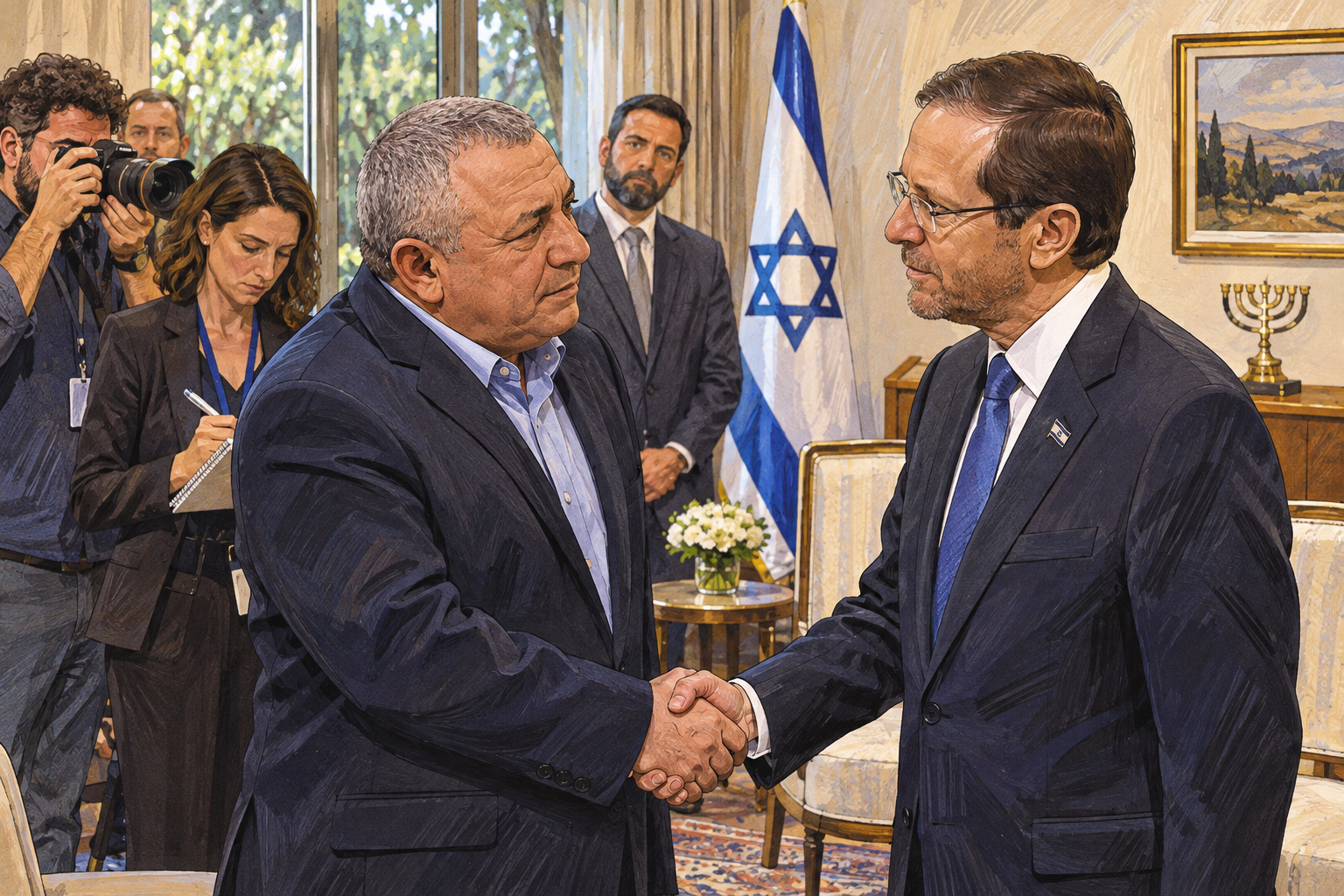
The article reports on reactions in Israel to President Isaac Herzog’s decision to select Gadi Eisenkot to lead efforts to form the country’s next government. The move dealt a blow to Prime Minister Benjamin Netanyahu, who lost his parliamentary majority in the previous month’s election. Although Israelis disagree about the political decision, the article says they share a sense that forming a government will be difficult.
Jerusalem resident Nachman Horowitz expresses hope that the political transition might encourage a broader change in public attitudes. He says Israelis should be able to respect and understand one another regardless of which government takes office, and argues that a new mentality matters as much as the government itself.
Eisenkot also lacks a parliamentary majority, while Arab-led parties made historic gains in the election. Their support could make them kingmakers, but cooperation with them is politically complicated. Another Jerusalem resident, Anny Soronow, lists major challenges for the next government: addressing security, protecting democracy, reversing what she calls Netanyahu’s judicial revolution, and potentially working with an Arab party. She says she has no objection to Arabs being included in government.
Eisenkot has six weeks to assemble a coalition. The task comes amid deep political divisions and the continuing effects of the 2023 Hamas attacks and three years of war in Gaza and beyond. The article presents the coalition negotiations as uncertain and difficult, while highlighting residents’ hopes for greater respect and understanding across Israeli society.
Entities: Gadi Eisenkot, Isaac Herzog, Benjamin Netanyahu, Nachman Horowitz, Anny Soronow • Tone: analytical • Sentiment: neutral • Intent: inform
08-11-2026
The article reports that Israel’s president asked opposition leader Gadi Eisenkot, rather than Prime Minister Benjamin Netanyahu, to form the country’s next government. It presents this as a development in Israel’s 2026 election and focuses on how opposition to Netanyahu brought different political parties together. Al Jazeera correspondent Nour Odeh explains the political alignment behind Eisenkot’s selection. The supplied text does not provide further details about the parties involved, the president’s reasoning, the negotiations, or whether Eisenkot is expected to secure enough support to form a government. It therefore establishes the central political event and points to opposition unity as its key explanation, but leaves the outcome and broader implications unspecified.
Entities: Gadi Eisenkot, Benjamin Netanyahu, Nour Odeh, Israel, Israeli president • Tone: analytical • Sentiment: neutral • Intent: analyze
08-11-2026
Israel’s President Isaac Herzog has asked opposition leader Gadi Eisenkot to try to form a government after Prime Minister Benjamin Netanyahu’s coalition lost its parliamentary majority in October’s election. Eisenkot, leader of the Yashar party, has 28 days to assemble a coalition and may request a 14-day extension. The central obstacle is a divided opposition: Eisenkot’s potential partners—Yashar, Yair Golan’s Democrats, Naftali Bennett’s Together party and Avigdor Lieberman’s Yisrael Beiteinu—hold 48 seats, below the 61 needed for a majority in the 120-seat Knesset.
Arab-led parties Ra’am and the Joint List, with 19 seats combined, have backed Eisenkot’s effort. Their support could bring the broader anti-Netanyahu camp to 67 seats, but Eisenkot has ruled out including them in his government, and Lieberman opposes relying on them to sustain a minority administration. Golan has been more open to cooperation. A minority government could nevertheless seek their external parliamentary support without giving them cabinet positions.
Netanyahu’s coalition has 53 seats, down from 64 in 2022. His position is further complicated by United Torah Judaism’s decision not to endorse him during consultations, although it could still support him in negotiations. Eisenkot could also seek a majority by recruiting the ultra-Orthodox parties Shas and United Torah Judaism, whose 13 seats would bring his bloc to 61. That route would require agreement on exemptions from military service for ultra-Orthodox religious students. Another possibility is a unity government including Netanyahu’s Likud, but that would undermine Eisenkot’s pledge to remove him from power.
If Eisenkot fails, Herzog could invite Netanyahu to try; parliament could then nominate another candidate. If no government is formed within 100 days, another election may follow. The outcome will shape control of ministries and policy on the economy, conscription and the occupied Palestinian territory. The article also notes that potential coalition partners have differing records and views on Palestinian statehood and the West Bank.
Entities: Gadi Eisenkot, Benjamin Netanyahu, Isaac Herzog, Israel, Knesset • Tone: analytical • Sentiment: neutral • Intent: analyze
08-11-2026
Following legislative elections that produced no clear winner, Israeli President Isaac Herzog has chosen Gadi Eisenkot, leader of the centrist Yashar party, to try to form a new government. Herzog made the decision after consulting political figures, including Eisenkot and Prime Minister Benjamin Netanyahu. Factions representing 67 members of the Knesset backed Eisenkot in the consultations, compared with 46 who supported Netanyahu. Eisenkot is expected to receive the mandate at a ceremony at the president’s residence.
The mandate gives Eisenkot 28 days to form a government, with a possible extension of up to 14 days. If he does not succeed, Herzog can give another leader up to 28 days to try. If that attempt also fails, the Knesset may request a third candidate, who would have 14 days. Failure of all attempts would lead to another election.
Neither major bloc has a majority in the 120-seat Knesset. Netanyahu’s camp won 53 seats, while the opposition led by Yashar secured 48. Likud, Netanyahu’s right-wing party, remained the largest single party with 27 seats. Arab parties collectively won a record 19 seats. Eisenkot, a former military chief, has pledged to do everything he can to form a government. Netanyahu called on Saturday for a national unity government. The article describes the steps ahead in the government-formation process and the parliamentary arithmetic, but does not report that a coalition has yet been formed.
Entities: Gadi Eisenkot, Isaac Herzog, Benjamin Netanyahu, Yashar party, Likud • Tone: analytical • Sentiment: neutral • Intent: inform
08-11-2026
France 24 reports that Arab-led political parties in Israel have endorsed Gadi Eisenkot, even though Eisenkot has ruled out bringing them into a governing coalition. The parties’ support is presented as being motivated by a shared political objective: removing Benjamin Netanyahu from power. Their endorsement therefore raises a question about the role they may play beyond simply backing a candidate: could they become pivotal in determining which bloc can form Israel’s next government?
The report frames the parties’ influence in the context of a developing contest over government formation. If neither political camp can secure sufficient support on its own, the Arab-led parties could potentially affect the balance of power, though the article does not establish that this outcome is certain. Their support for Eisenkot alongside his rejection of a coalition with them highlights a tension between electoral cooperation against Netanyahu and the limits of coalition-making.
Antonia Kerrigan reports on this political development for France 24. The supplied page contains only a short description of the video report, not a full transcript or detailed account of the parties’ positions, negotiations, or seat totals. Accordingly, the central focus is the possible leverage of Arab-led parties in the effort to form Israel’s next government, rather than a definitive prediction about the result.
Entities: Israel, Arab-led parties, Gadi Eisenkot, Benjamin Netanyahu, Antonia Kerrigan • Tone: analytical • Sentiment: neutral • Intent: analyze
08-11-2026
The article reports that Israeli President Isaac Herzog has officially asked Gadi Eisenkot, a former military chief and leader of the Yashar party, to try to form Israel’s next government. The decision followed the October 28, 2026 parliamentary election, in which neither Eisenkot’s bloc nor the bloc of incumbent Prime Minister Benjamin Netanyahu secured a clear majority in the Knesset. The article does not give seat totals, describe coalition negotiations in detail, or indicate whether Eisenkot is likely to succeed. It presents the assignment as an attempt to resolve the inconclusive election and establish a governing coalition.
The page is formatted as a live Middle East news update, but the supplied content contains only a short opening report and a recap of developments from the previous day. That recap says Yemen’s health ministry reported at least 33 people killed in Saudi air strikes near Sanaa, Yemen’s capital. It also restates Herzog’s decision to task Eisenkot with forming a government. The report attributes its coverage to FRANCE 24, with contributions from the Associated Press, Agence France-Presse and Reuters.
The headline and page metadata refer broadly to Middle East developments, while the visible article text focuses chiefly on Israeli coalition formation and the reported deaths in Yemen. The source text ends with a notice that the requested content is unavailable, so further live updates or supporting details cannot be recovered from the supplied material. Overall, the piece is a concise, factual news update about political uncertainty in Israel alongside a deadly reported air strike in Yemen; it does not offer an explicit editorial position or analysis of the wider regional situation.
Entities: Gadi Eisenkot, Isaac Herzog, Benjamin Netanyahu, Louise Nordstrom, Israel • Tone: neutral • Sentiment: negative • Intent: inform
08-11-2026
After Israel’s October 27, 2026, election produced no clear parliamentary majority, President Isaac Herzog selected Gadi Eisenkot to try to form a new government. Eisenkot, a former military chief and leader of the Yashar party, received the most endorsements, including nominations from Arab leaders, although he has said he will not join forces with Arab parties. Prime Minister Benjamin Netanyahu’s Likud won the most seats for a single party, but his religious-nationalist coalition fell short of a majority. Eisenkot’s coalition also lacks enough seats to govern on its own.
Eisenkot has 28 days to assemble a government, with a possible 14-day extension. Options include relying on Arab parties for support on key votes, forming a coalition with ultra-Orthodox parties, or reaching a unity agreement with Netanyahu. Each path is considered unlikely, and Eisenkot has previously vowed not to serve in a government with Netanyahu. If his attempt fails, other candidates may be given a chance; if no one can form a government within roughly 100 days, Israel would hold another election.
The article describes Eisenkot’s background and political positions. The 66-year-old, whose family traces its roots to Morocco, would be Israel’s first prime minister from the Mizrahi community if successful. He entered politics in 2022, briefly served in Netanyahu’s wartime cabinet after Hamas’s October 7, 2023, attack, and later returned to the opposition. He has criticized Netanyahu’s leadership and handling of the Gaza campaign. The deaths of his son and two nephews while fighting in Gaza have also shaped his public profile.
Eisenkot campaigned on his military credentials, including the “Dahiyeh doctrine,” and has criticized settler violence against Palestinians. He opposes far-right coalition figures Itamar Ben-Gvir and Bezalel Smotrich, who have faced sanctions by some Western countries over alleged incitement to violence against Palestinians.
Entities: Gadi Eisenkot, Benjamin Netanyahu, Isaac Herzog, Israel, Knesset • Tone: analytical • Sentiment: neutral • Intent: inform
08-11-2026
Israeli Prime Minister Benjamin Netanyahu warned on Nov. 7 that a prospective government involving opposition parties and Arab political groups would “dismantle the State of Israel from within.” His remarks came after the Oct. 27 election produced no parliamentary majority, leaving the country’s next government uncertain. Israel is deeply polarised after Netanyahu’s hard-right rule and three years of war.
The opposition, led by Gadi Eisenkot—a former military chief and political newcomer—has explored an alliance that could unite it with ultra-Orthodox Jewish parties. Such a coalition could also include the moderate Islamist Raam party, whose leader has recognised Israel as a Jewish state, and receive external support from the Arab-majority Joint List. Netanyahu’s warning invoked claims made by far-right politicians in Europe that parts of the continent have come under Islamic law.
President Isaac Herzog is expected to select a candidate to form the next government. Following consultations with the parties, Herzog said it would be logical to give Eisenkot the mandate: factions representing 67 lawmakers recommended him, compared with 46 for Netanyahu’s bloc. Herzog has also signalled interest in a national unity government joining Jewish Israelis from both political camps.
Netanyahu endorsed the idea of a unity government, calling for one that includes parties in the national camp and Zionist parties committed to safeguarding Israel as the state of the Jewish people. Unlike in a previous speech, he did not say that he should lead it. Eisenkot’s Yashar party responded by inviting Likud and its allies to publicly break with their extremist partners and join a broad government led by Eisenkot.
Entities: Benjamin Netanyahu, Gadi Eisenkot, Isaac Herzog, Israel, Jerusalem • Tone: analytical • Sentiment: neutral • Intent: inform