07-11-2026
New Zealand’s 2026 election remains too close to call after more than 98 per cent of voting places were counted. National, led by incumbent Prime Minister Christopher Luxon, and Labour, led by Chris Hipkins, are separated by only about 300 party votes: National is on 29.3 per cent and Labour on 29.27 per cent. The outcome may change when an estimated 700,000 special votes are counted, a process expected to take several weeks. Neither major party has claimed victory, and both say they have a path to forming a government.
On current seat projections, National, ACT and New Zealand First together hold a majority of two seats and could form a government. However, National has suffered significant losses among its senior MPs, including deputy leader Nicola Willis, Justice Minister Paul Goldsmith, Speaker Gerry Brownlee and Transport Minister Chris Bishop. ACT and New Zealand First have increased their support. The Greens have recorded their strongest parliamentary showing, reaching 13.3 per cent, while Opportunity has polled around six per cent.
The live coverage considers whether Labour could assemble an alternative arrangement involving the Greens, Te Pāti Māori and Opportunity, though analysts say a formal four-party coalition would be difficult. Negotiations are expected while the special votes are counted, and caretaker conventions will apply in the meantime, according to Luxon.
The article also explains “overhang” seats, which are added to Parliament when a party wins more electorate seats than its party vote would otherwise entitle it to. Parties’ efforts to encourage supporters to split their electorate and party votes drew criticism from both major leaders. The live blog concludes with Luxon’s speech, in which he described the “promise of New Zealand” as a country where people can prosper through hard work, young people can build their futures at home, and communities feel safe.
Entities: New Zealand 2026 general election, Christopher Luxon, Chris Hipkins, National Party, New Zealand Labour Party • Tone: analytical • Sentiment: neutral • Intent: inform
07-11-2026
New Zealand’s election remains too close to call, with the National and Labour parties separated by less than one percentage point in the preliminary results. National has a narrow lead, and a National–ACT–NZ First bloc is projected to hold 67 of 131 seats—one more than the number required for a majority—but the count of about 700,000 special votes, including overseas ballots, could alter the outcome. Those votes are expected to take weeks to process, so the final balance of power and the formation of a government may not be clear until close to Christmas.
Both major-party leaders have acknowledged that negotiations and compromise are likely. Labour leader Chris Hipkins said every vote must be counted and pledged to act quickly if his party forms government. National leader and Prime Minister Christopher Luxon said it was too close to call, while maintaining that his party had a pathway back to government. National may also lose several senior ministers.
The article explains how New Zealand’s Mixed Member Proportional system combines votes for local representatives with party votes that determine parliamentary seat allocations. Electorate victories can create “overhang” seats, potentially affecting which bloc can govern. Smaller parties may therefore be decisive. The newly led Opportunity party could become a kingmaker if the traditional right-wing bloc cannot secure a majority.
The Treaty of Waitangi has also been a major election issue, following the defeat of a bill seeking to define its principles in law. Māori enrolment reached a record level, and Te Pāti Māori co-leader Debbie Ngarewa-Packer said her party could work with Labour, the Greens and Opportunity. Whatever the final result, the next government will face the unresolved Treaty debate.
Entities: New Zealand election, Chris Hipkins, Christopher Luxon, Labour Party, New Zealand National Party • Tone: analytical • Sentiment: neutral • Intent: inform
07-11-2026
New Zealand Prime Minister Christopher Luxon says the election remains “too close to call,” while also claiming he has a pathway to form the next government. Early results show his National Party narrowly ahead of Labour in the popular vote. The brief report does not provide vote totals, seat counts, details of the parties’ positions, or further information about how Luxon’s proposed pathway to government might work. It therefore presents the outcome as uncertain, with the early popular-vote lead offering only a limited snapshot of the contest. The article was published on November 7, 2026.
Entities: New Zealand, Christopher Luxon, National Party, Labour, New Zealand election • Tone: neutral • Sentiment: neutral • Intent: inform
07-11-2026
New Zealand’s general election produced no clear winner, leaving the country’s two largest parties preparing for negotiations over a coalition government. Preliminary results show Prime Minister Christopher Luxon’s centre-right National Party winning 42 seats, while Chris Hipkins’s Labour Party won 36. National is the largest party but remains well short of the 61 seats needed for a majority. With ACT and New Zealand First, it could form a narrow centre-right bloc, although an agreement has not yet been reached. Hipkins did not concede, saying the shape of the next government would remain uncertain and that the next parliament would need to find compromise.
More than 99% of votes had been counted, but the results were still preliminary. The electoral commission was expected to publish the official result on 27 November, after processing special votes cast outside voters’ electorates, including overseas ballots. The election’s close outcome also reflected historically low combined support for National and Labour, at about 60% of the vote. The Greens won 16 seats, ACT 13, New Zealand First 12, the Opportunity Party seven, and Te Pāti Māori five.
The Opportunity Party’s entry into parliament after crossing the 5% threshold could make it pivotal. Its leader, Qiulae Wong, said the party was open to working with either bloc, while an election-law expert said it could determine which side governs. The Greens also increased their vote share and campaigned on requiring the country’s two main supermarket chains to divest stores for publicly owned shops.
The campaign focused heavily on cost-of-living pressures and unemployment. A pollster told the BBC that economic concerns were central to voters, while a social cohesion survey found that more than half of New Zealanders no longer viewed the country as a land of opportunity. Record numbers of New Zealanders have been leaving, many for Australia. Under the country’s mixed-member proportional system, governments are usually formed by coalitions.
Entities: New Zealand general election, Christopher Luxon, Chris Hipkins, National Party, New Zealand Labour Party • Tone: analytical • Sentiment: neutral • Intent: inform
07-11-2026
New Zealand’s general election remained too close to call after 95% of votes had been counted, with the governing center-right National Party narrowly ahead of the opposition Labour Party by about 3,500 votes. Both parties had received just under 30% of the vote, amid voter concerns over the cost of living and broader economic difficulties, including high prices and rising unemployment.
Prime Minister Christopher Luxon said National remained the largest party and had a pathway to form the next government. Preliminary results suggested National could continue its current coalition with the pro-business ACT and right-wing populist New Zealand First, which together were projected to hold 67 seats—a very narrow majority. Labour leader Chris Hipkins said the next parliament would require compromise and cooperation, as neither major party appeared likely to govern alone.
The count is not final. Special votes, including ballots cast overseas, were due to be counted over the following three weeks. These votes have typically favored left-leaning parties and changed preliminary outcomes in recent elections. Final results were expected on November 27. If the right-leaning bloc loses its projected majority, the centrist Opportunity Party, forecast to win seven seats and enter parliament for the first time since its 2017 founding, could become pivotal. Luxon had ruled out working with it.
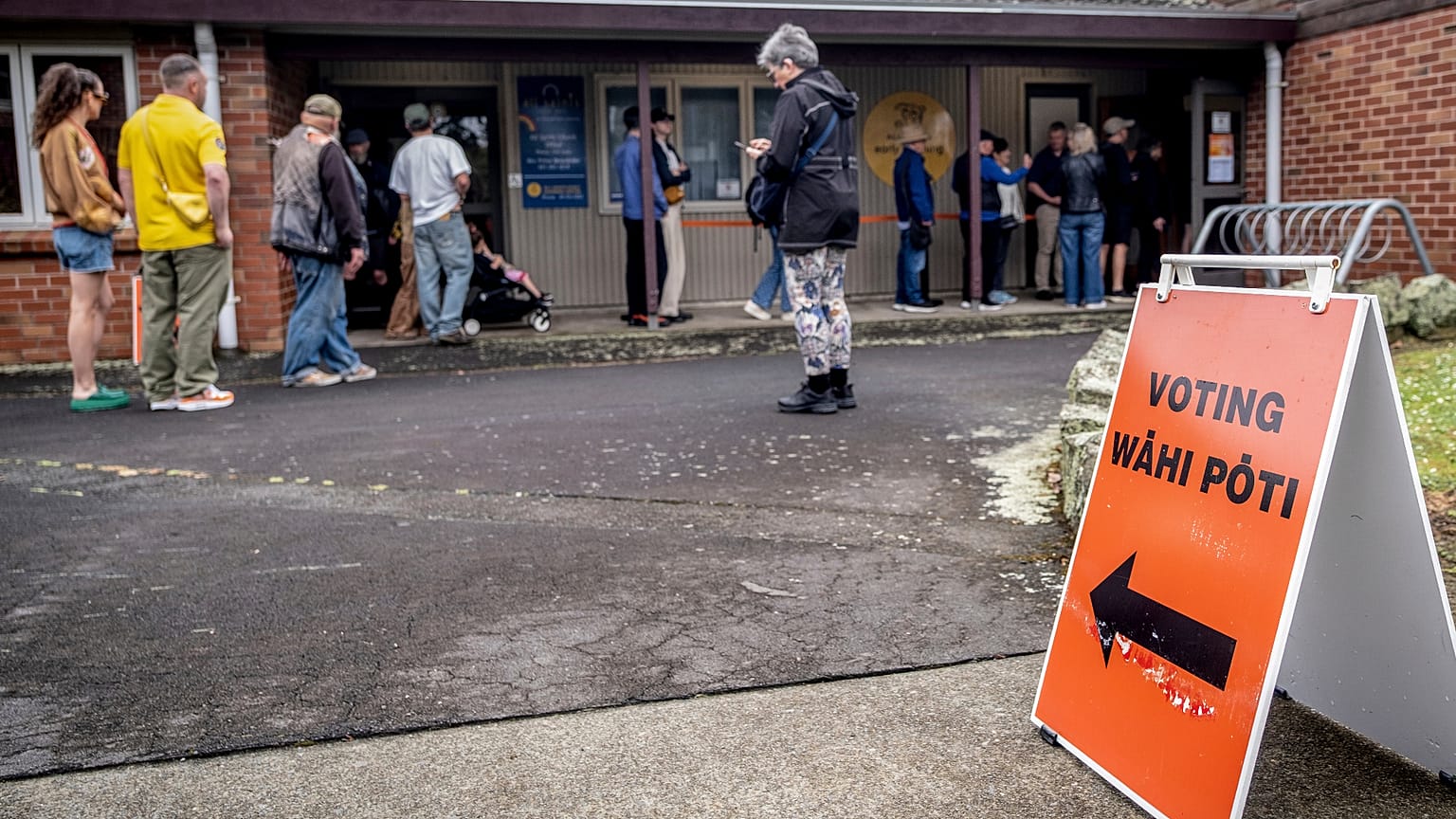
New Zealand uses a mixed-member proportional system, combining votes for a party and a local candidate. Preliminary results indicated an overhang would expand the usually 120-seat parliament to 130 members, its largest size in the country’s history. Voting took place under restrictions on election-day media reporting and campaigning. Advance voting had begun on October 26, and nearly 1.7 million of 3.8 million eligible voters had cast ballots by Thursday.
Entities: New Zealand, National Party, Labour Party, Christopher Luxon, Chris Hipkins • Tone: analytical • Sentiment: neutral • Intent: inform
07-11-2026
New Zealand’s general election remained too close to call as early results showed a near tie between the two main parties. With just over 42% of votes counted, the Labour Party, led by Chris Hipkins, had 29.71% of the party vote, narrowly ahead of Prime Minister Christopher Luxon’s National Party at 29.41%. The Green Party was in third place with 13.96%, followed by ACT New Zealand, a National coalition partner, on 10.63%, and the New Zealand First Party on 9.41%. The campaign had focused on the cost of living and the economy. Luxon and the National-led right-wing coalition were seeking a second term, but no party was expected to win an outright parliamentary majority, making coalition arrangements likely to matter.
The article explains New Zealand’s voting system, in which voters cast both a party vote and an electorate vote. The party vote indicates which party they want in government, while the electorate vote selects a local representative for Parliament. Voters of Māori descent may choose either the general roll or the Māori roll, which determines which electorate’s candidates they vote among. The article illustrates this distinction with Rotorua: a voter there on the Māori roll votes in the Waiariki electorate, while a voter on the general roll votes in the Rotorua electorate. The candidate receiving the most votes in the selected electorate becomes its local MP. The reported figures are preliminary, and the narrow gap between Labour and National means the result could change as counting continues.
Entities: New Zealand, 2026 general election, Christopher Luxon, Chris Hipkins, National Party • Tone: analytical • Sentiment: neutral • Intent: inform
07-11-2026
New Zealand’s 2026 general election ended without a clear winner, with the preliminary count putting Prime Minister Christopher Luxon’s National Party and its right-leaning partners narrowly ahead of Labour and the left bloc. With 97% of votes counted, National, Act and NZ First were projected to hold 67 of 130 seats—just above the 66 needed for a majority—while Labour, the Greens and Te Pāti Māori were projected to have 56. The figures could change when hundreds of thousands of special votes are counted; final results are expected on 27 November, and those votes have historically tended to shift the balance to the left. Neither Luxon nor Labour leader Chris Hipkins claimed victory or conceded defeat, and both anticipated a wait for coalition negotiations. The newly established Opportunity Party, led by Qiulae Wong, was projected to win seven seats after crossing the 5% threshold. Wong said she was open to negotiating with either side, although Luxon had ruled out governing with her party. The Greens appeared headed for a record 16 seats. Te Pāti Māori won several electorate contests despite a very low party-vote share, which could create overhang seats; the party had urged voters to support its candidates in electorates rather than give it their party vote. Labour improved its support among Māori voters and gained a new MP, while the Greens’ party vote rose substantially across Māori electorates. The live coverage presents the result as exceptionally close and stresses that the final parliamentary balance—and the eventual government—will remain uncertain until the special votes and coalition talks are complete.
Entities: Christopher Luxon, Chris Hipkins, Qiulae Wong, New Zealand, National Party • Tone: analytical • Sentiment: neutral • Intent: inform
07-11-2026
New Zealand’s election has produced no decisive winner, leaving the country facing a wait of at least several weeks before the next government is clear. Preliminary results show Prime Minister Christopher Luxon’s centre-right National party with 42 seats, alongside its traditional partners Act with 13 and New Zealand First with 12. Their combined 67 seats appear to provide a narrow majority, but the result is precarious because some electorate contests were close and special votes have not yet been counted. The official results are due on 27 November. Special votes include overseas ballots and votes cast outside a person’s electorate; they have tended to benefit left-wing parties in past elections. Labour, led by Chris Hipkins, won 35 seats, while the Greens secured 16 and Te Pāti Māori five. Together with the seven seats won by the new centrist Opportunity party, the left bloc remains three seats short of a majority on the preliminary count. Opportunity’s 5.9% party vote marks the first time since the introduction of proportional representation in 1996 that a new party has crossed the threshold for parliamentary representation without emerging from a split in another party. Although National currently appears able to govern without Opportunity, a changed final count could make the party a potential kingmaker. The electoral system’s overhang rules could expand parliament to a record 130 seats, with 65 required for a majority. The result also means several senior National ministers will not return to parliament. Luxon said caretaker conventions would keep government business running while votes are counted and negotiations take place. The article attributes the major parties’ weaker results and smaller parties’ gains partly to a sluggish economy and persistent inflation.
Entities: New Zealand, Christopher Luxon, Chris Hipkins, Qiulae Wong, National party • Tone: analytical • Sentiment: neutral • Intent: inform
07-11-2026
New Zealand’s general election remains unresolved, with the two major parties nearly tied in the reported results: the center-right National Party has 29.21% of the vote, while the center-left Labour Party has 29.36%. The contest has been described as the “battle of the Chrises,” referring to incumbent Prime Minister Christopher Luxon, who leads National, and opposition leader Chris Hipkins, who leads Labour. The close figures mean the result is too close to call and leave the country’s next prime minister undecided. The provided article excerpt does not include further details about vote counting, coalition negotiations, or the eventual outcome.
Entities: New Zealand, Joshua Yang, Helier Cheung, Christopher Luxon, Chris Hipkins • Tone: analytical • Sentiment: neutral • Intent: inform