05-11-2026
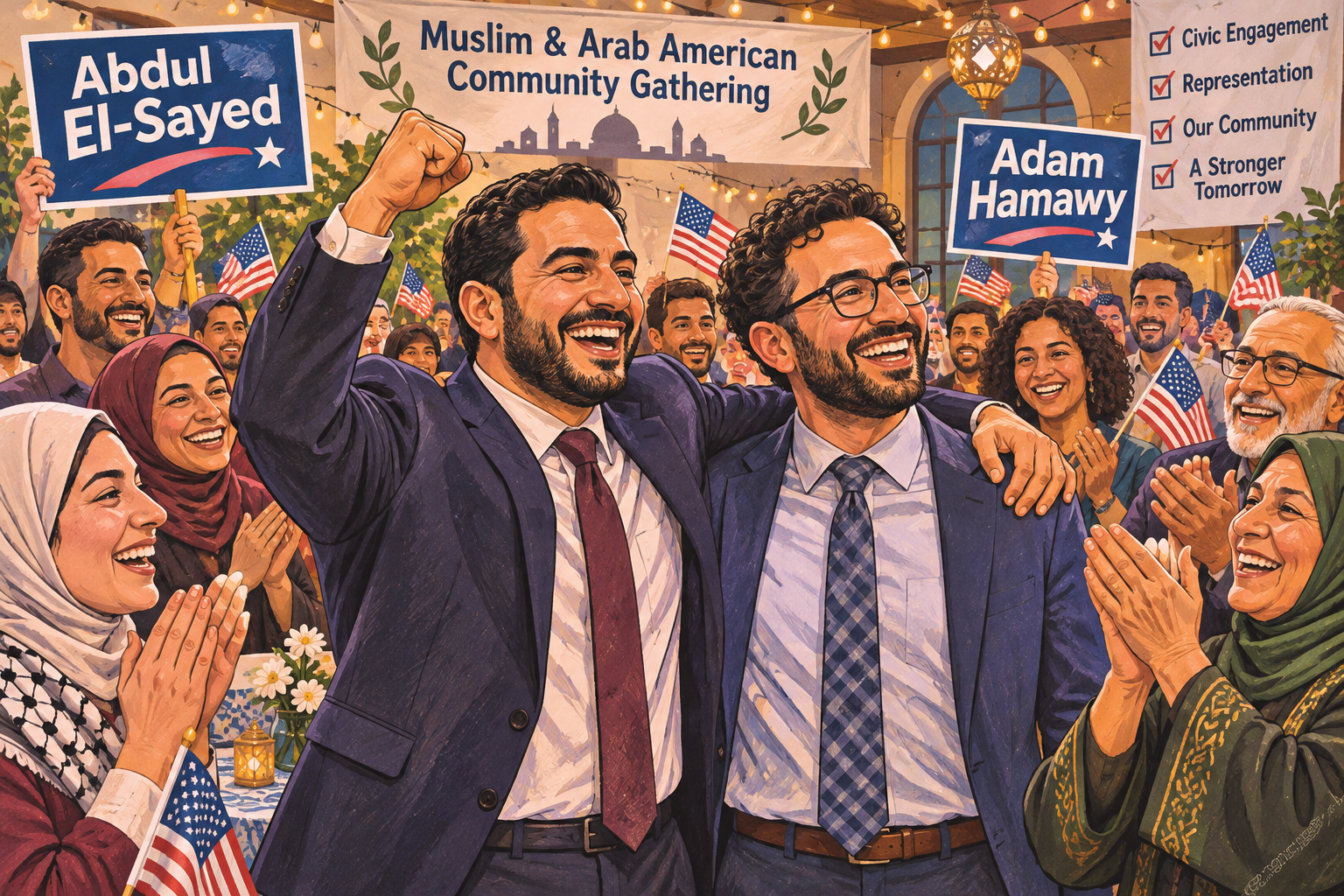
Abdul El-Sayed’s victory in Michigan’s U.S. Senate race is being celebrated by Arab Americans and Muslims as a historic breakthrough. A former public health official and Democrat, El-Sayed will become the nation’s first Muslim senator. The article describes the emotional significance of his victory speech for Zaynah Jadallah, a 26-year-old Palestinian American from Dearborn, who had hoped to hear him say “Alhamdulillah” (“praise be to God”) after repeatedly saying “Inshaallah” (“God willing”) during the campaign. She heard the phrase in the early hours after his win.
The result has particular resonance after a bitter, divisive primary marked by a surge of Islamophobic rhetoric. Dearborn Heights business owner Chadi Abdulrazek called the victory a barrier-breaking message affirming that people from minority backgrounds—including Black, Hispanic, Arab, Muslim and Jewish communities—have a place in the country.
Voting data cited from the AP Voter Poll, a survey of more than 4,500 Michigan voters, shows strong support for El-Sayed among Muslim voters. Although Muslims make up about 2% of Michigan voters, around nine in ten Muslim Senate voters backed him. He also received the votes of about seven in ten Michigan voters of Arab or Middle Eastern descent. The article situates those results in Michigan, home to the nation’s largest concentration of Arab Americans, with Dearborn at the heart of the community.
Dearborn Mayor Abdullah Hammoud said voters chose El-Sayed for his leadership, regardless of his faith, describing the outcome as “beautifully American.” Overall, the article presents the win both as a milestone in political representation and as a moment of affirmation for communities that faced hostile rhetoric during the campaign.
Entities: Abdul El-Sayed, Zaynah Jadallah, Chadi Abdulrazek, Abdullah Hammoud, Michigan • Tone: positive • Sentiment: positive • Intent: inform
05-11-2026
Abdul El-Sayed’s election to the United States Senate has prompted contrasting reactions in Egypt. The Michigan Democrat, who is of Egyptian descent, made history as the first Muslim elected to the Senate. His campaign drew racist and Islamophobic attacks, while his positions on Gaza and Israel led to accusations of antisemitism. Those positions also energized supporters both in the United States and across the Middle East.
For many Egyptians, El-Sayed’s victory is encouraging because they see it as evidence that American voters can look beyond a candidate’s religion and ethnicity. However, his outspoken criticism of Egypt’s government has tempered official enthusiasm. After securing his party’s nomination, he described his family’s country of origin as “a country without democracy” and called Egypt “a military dictatorship funded by our tax dollars.”
The article reports that Egyptian state media has largely ignored the election result, while pro-government commentators have played down El-Sayed’s Egyptian background. Despite that muted official response, many ordinary Egyptians celebrated his win. One especially popular moment came when he used the Arabic term “habibi” in his victory speech. The result, therefore, is presented as both a source of pride for some Egyptians and a politically sensitive development because of El-Sayed’s criticism of Cairo.
Entities: Abdul El-Sayed, United States Senate, Michigan, Egypt, Cairo • Tone: analytical • Sentiment: neutral • Intent: inform
05-11-2026
Adam Hamawy, an Egyptian-American reconstructive surgeon, US Army veteran and humanitarian doctor, won election to represent New Jersey’s 12th Congressional District. He is set to become New Jersey’s first Muslim member of Congress and was one of eight Muslim Americans elected on a night when Democrats gained control of both chambers of Congress. The article traces Hamawy’s path from medicine and military service into politics, focusing on his medical missions to Gaza in 2024 and 2025. He said witnessing the destruction and treating its victims made it impossible to return to ordinary life. His campaign’s “healthcare not bombs” message connected domestic concerns, including medical debt and universal healthcare, with opposition to US military aid to Israel and support for Palestinian rights.
Hamawy served as a combat trauma surgeon in Iraq, where he treated Tammy Duckworth after her helicopter was shot down in 2004. Duckworth later credited him with saving her life and preventing her from becoming a triple amputee. After retiring from the Army as a lieutenant colonel in 2011, he took part in humanitarian missions in several countries, including Gaza. During one Gaza mission, he described the destruction as unprecedented and refused evacuation until he knew non-American colleagues could also leave.
His candidacy also drew attacks over his past association with Omar Abdel Rahman, the “Blind Sheikh,” whom Hamawy encountered at a conference in his early twenties and later testified for at trial. Hamawy has condemned Rahman’s rhetoric and actions, saying he testified from civic duty. He and supporters characterized the campaign scrutiny and other attacks as anti-Muslim and bigoted. His policy priorities include universal healthcare, ending medical and student debt, abolishing ICE, opposing war with Iran, ending US military aid to Israel, and advocating justice and equal rights for Palestinians. Hamawy presents these domestic and foreign-policy goals as responses to a political and economic system he considers broken and rigged.
Entities: Adam Hamawy, Gaza, New Jersey’s 12th Congressional District, United States Congress, Tammy Duckworth • Tone: analytical • Sentiment: neutral • Intent: inform