05-11-2026
Bomb threats disrupted at least 25 flights across Europe on Thursday, marking the third day this week that similar threats have affected air travel. The disruption particularly involved low-cost airlines flying over Italy, Bulgaria and the Czech Republic, as well as France, Brussels and Austria. Several aircraft were diverted, while others landed at their intended destinations. Authorities and airlines reported finding no explosives or suspicious devices on any of the planes searched, and the source of the threats remained unknown.
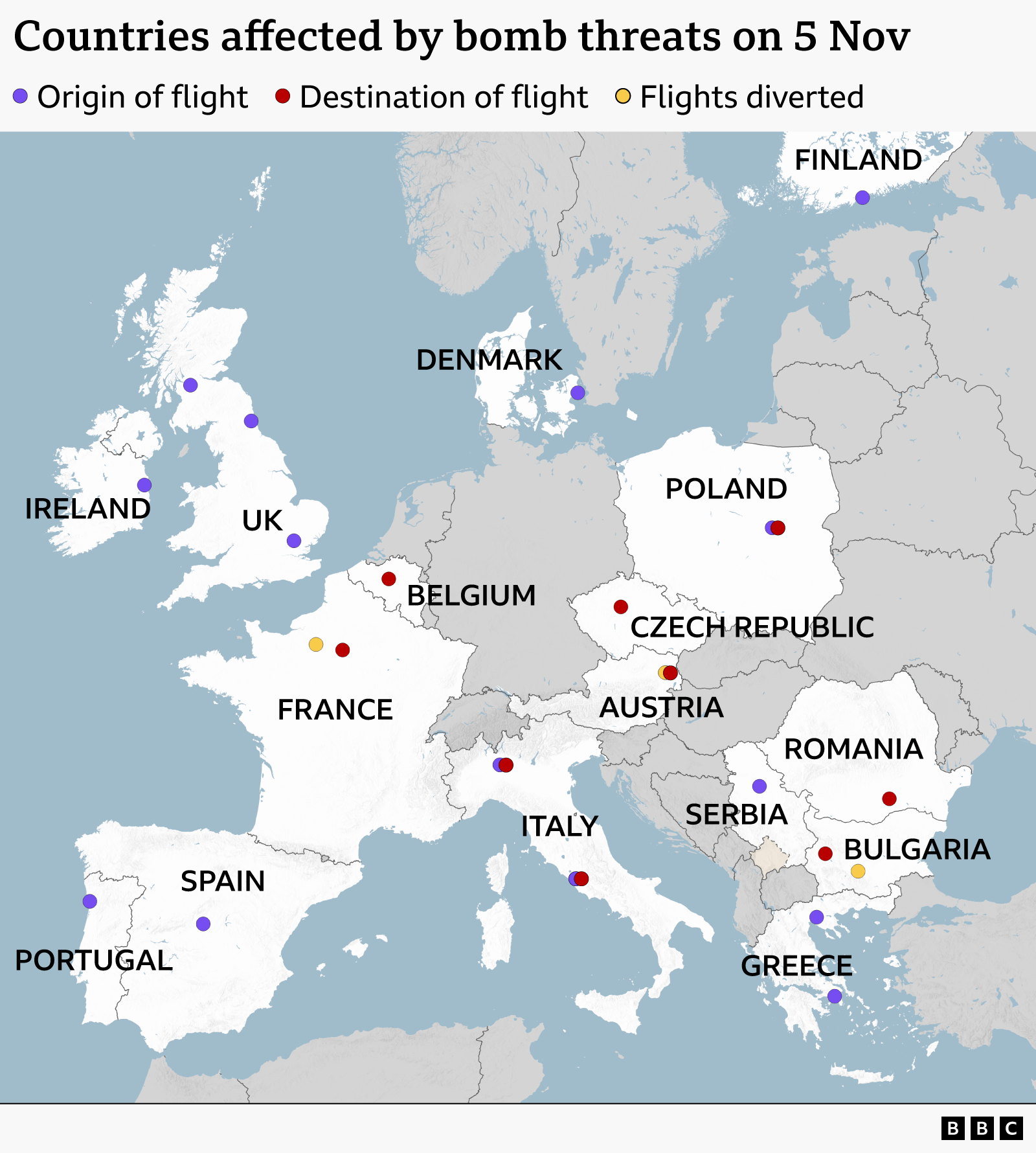
Among the diversions, Aer Lingus flight EI402 from Dublin to Rome landed at an air base near Évreux, France, where military bomb-disposal teams examined the aircraft. Ryanair flight FR1730, travelling from London Stansted to Sofia, landed in Plovdiv, Bulgaria, while a Wizz Air flight from Milan to Warsaw diverted to Vienna and later continued to Warsaw. Other flights affected by threats included services by Finnair, Aegean Airlines, Ryanair, LOT and Wizz Air. Some planes were inspected after landing; others were escorted by fighter jets or had passengers disembark while checks took place.
Officials in Spain, Denmark, Italy, Austria, Romania and the Czech Republic also reported threats or precautionary inspections. Several flights continued normally after authorities found no danger. On Tuesday, threats targeted about 10 flights, led to the closure of a Warsaw airport and prompted Italian air-force escorts. Monday’s incident involved a Wizz Air flight diverted to Budapest.
Britain’s transport secretary, Heidi Alexander, described Thursday’s incidents as “malicious hoax threats.” The European Union said it was too early to determine whether the week’s incidents were connected and that it was coordinating with national authorities. Although some European officials have accused Russia of orchestrating sabotage and hybrid attacks, no country has blamed anyone for these threats. The article reports that investigations and aircraft inspections were ongoing; it ends mid-sentence while describing the situation at Prague Airport.
Entities: Aer Lingus, Ryanair, Wizz Air, Finnair, Aegean Airlines • Tone: analytical • Sentiment: neutral • Intent: inform
05-11-2026
The BBC report examines how bomb threats were relayed through air traffic control after more than 20 aircraft across Europe were targeted. The UK described the incidents as a “malicious hoax,” and the report says this was the second such occurrence that week. BBC Verify analysed messages sent by an aircraft to trace what happens when a flight receives a bomb hoax and how the threat is passed on. The supplied article excerpt does not give the messages’ contents, identify the aircraft or the routes involved, or explain the response taken by crews or authorities. It instead introduces an accompanying video in which Thomas Copeland explains the analysis. Emma Pengelly is credited with additional reporting; Aisha Sembhi produced the piece, with graphics by Mesut Ersoz and Sally Nicholls. Overall, the report is a short, investigative news item focused on the communication chain around aircraft bomb threats, rather than a detailed account of the threats’ origins or operational consequences. Its framing distinguishes the threats from confirmed bombs by calling them hoaxes, while emphasizing their scale and recurrence. The excerpt provides no evidence about who sent the messages or whether the incidents were connected, so those details cannot be established from the text provided.
Entities: Europe, United Kingdom, BBC Verify, Thomas Copeland, Emma Pengelly • Tone: analytical • Sentiment: neutral • Intent: inform
05-11-2026
At least 21 aircraft and several European airports were targeted by bomb threats on Thursday, the second wave of such incidents in a week. Flights involving Austria, Belgium, Bulgaria, the Czech Republic, France, Italy, Poland and Romania were affected. The UK described the threats as malicious hoaxes. Several flights were diverted or escorted by fighter jets, while other aircraft were searched on arrival or before departure. Authorities and airlines reported that searches found no explosives, and some threats were assessed as unfounded or not credible. The incidents’ connection to one another remains unclear.
An email threat against two Rome-bound flights was signed in the name of “Fighters of the Male State,” which may refer to the Russian ultra-right group Muzhskoi Legion, banned in Moscow in 2021. The article cautions that the email may not help investigators identify who is behind the threats. UK Transport Secretary Heidi Alexander said the government was taking the incidents seriously, while Heathrow and Birmingham confirmed receiving threats that were dealt with through established security procedures.
Passengers on a diverted Aer Lingus flight from Dublin to Rome were taken to an air base in Normandy. Passenger Emily Noble described being told first of a technical problem and then a security issue, hearing fighter jets during the landing, and waiting aboard while police and military personnel searched the plane.
Aviation experts said threats are common, but warned that repeated hoaxes can create complacency or serve as a diversion. They considered the latest incidents likely hoaxes, while noting the possibility of coordinated, low-cost disruption or copycat behavior. The incidents followed other recent threats: seven European flights were searched two days earlier, and a Wizz Air flight was escorted to Budapest after a mid-air threat on Monday.
Entities: Heidi Alexander, Emily Noble, Philip Baum, Marco Chan, Aer Lingus • Tone: analytical • Sentiment: negative • Intent: inform
05-11-2026
At least 21 flights and several European airports were affected by coordinated bomb threats on Thursday. Most threats were considered credible enough to divert aircraft, and Italian authorities even scrambled fighter jets to escort a plane. All the threats proved false, though the article cautions that this does not guarantee future threats will be. The coordinated incidents have prompted speculation that Russia could be responsible, amid a broader pattern of cyber-attacks, suspicious drone activity and other disruptive incidents in Europe. These have included the remote hacking of supermarket freezers and a blood bank, an incident on Poland’s border with Russia, and a drone attack at Germany’s Leipzig Halle airport that Germany’s interior minister blamed publicly on Moscow. Some observers characterize such actions as “hybrid” or “grey zone” warfare: damaging activity that is anonymous or deniable and stays below the threshold for triggering Nato’s collective-defence response. Russia has a motive, the article notes: it is angry at Nato’s support for Ukraine, and Russian bloggers have argued that Western countries should experience disruption similar to that affecting Russia. But, as of Thursday evening, there was no hard evidence connecting the threats to Russia, Iran or their proxy groups. An email sent to Rome airport authorities in the name of “Fighters of the Male State” may refer to a banned Russian ultra-right group, the Male Legion, which retained a large online following and supported the invasion of Ukraine. However, the sender’s identity is uncertain, and the name could have been used by another group. The article concludes that investigators should follow verifiable leads rather than assume who is responsible, while working out how to limit the impact of future hoaxes.
Entities: Frank Gardner, BBC, European airline and airport bomb threats, London Heathrow Airport, Russia • Tone: analytical • Sentiment: neutral • Intent: analyze
05-11-2026
At least 27 flights across Europe received bomb threats on Thursday morning, the second such wave of threats this week. Some flights made unplanned landings or were escorted by fighter jets, while others were searched, delayed, or allowed to continue after authorities assessed the threats as low credibility. No incendiary devices or suspicious items were found in the inspections described in the report, and airport operations in Bulgaria returned to normal.
The affected flights involved airlines and airports in countries including Ireland, Bulgaria, France, Spain, Czechia, Italy, Poland, Denmark, and Romania. In France, fighter jets intercepted an Aer Lingus flight from Dublin to Rome and escorted it to an air force base after the pilot did not cooperate with authorities as expected; officials gave no explanation for the pilot’s behaviour. In Spain, three emailed threats in less than 20 minutes prompted aircraft to be halted or returned to stands and passengers to disembark for inspections. Bulgarian authorities reported emergency landings by three Ryanair flights, while LOT said a Warsaw-to-Brussels flight landed safely after a warning that was not confirmed.
No country has officially blamed anyone for the threats. The incidents occurred amid European officials’ accusations that Russia has conducted sabotage and other so-called hybrid attacks, although Russia and Iran deny involvement in such activity. The article also notes earlier accusations involving Russia and Iran, including alleged attacks or plots in Europe.
A British pilots’ association safety director said airlines generally do not act on threats unless assessors consider them credible. Aviation cybersecurity executive Eliran Almog suggested repeated threats could disrupt operations while revealing how airlines, airports, and governments respond. The article places the incidents alongside other recent disruptions, including bomb threats earlier in the week and cyberattacks on supermarket refrigeration systems, which have imposed economic costs and may undermine public confidence.
Entities: Sébastien Lecornu, Joji Waites, Eliran Almog, European flight bomb threats, Aer Lingus • Tone: analytical • Sentiment: negative • Intent: inform
05-11-2026
At least 20 commercial flights across Europe faced bomb threats on Thursday, adding to at least seven earlier incidents this week. The threats prompted diversions, fighter-jet escorts, emergency landings, airport disruption and searches of aircraft, but authorities reported finding no explosives or suspicious items. All affected planes landed safely, and passengers and crew were unharmed. Incidents involved flights operated by Aer Lingus, Finnair, Wizz Air, LOT, Ryanair, EasyJet, Aegean Airlines, Iberia, Air Europa and Air Serbia, among others, and affected airports and destinations in France, Italy, Austria, Poland, Bulgaria, the Czech Republic, Spain and Romania. The scale of the incidents disrupted travel for thousands of passengers and raised concern that the threats might be coordinated, although no authority has confirmed a connection or identified a perpetrator. Air transport security expert Paul Mason said the broad range of airlines and credible nature of the threats suggested a deliberate act, while FlightGlobal editor David Kaminski-Morrow cautioned that the cluster was difficult to assess and that publicity could prompt unrelated copycat threats. The report places the incidents amid wider European concern about state-sponsored sabotage and hybrid warfare, including activity potentially linked to Russia or Iran, but notes that officials have not attributed these threats to any actor. It also explains that aviation safety procedures require airlines and pilots to treat threats seriously, even when they prove to be hoaxes.
Entities: David Kaminski-Morrow, Paul Mason, Tasos Chatzivasileiou, Ken McCallum, FlightGlobal • Tone: analytical • Sentiment: neutral • Intent: inform
05-11-2026
Bomb threats disrupted at least 27 flights across Europe on Thursday, marking the second wave of such incidents this week. Flights involving London, Dublin, Helsinki and other locations were affected; some aircraft made unexpected landings or were escorted by fighter jets. Aer Lingus, Finnair, Wizz Air and LOT Polish Airlines confirmed that flights had received threats, and the airlines said the affected aircraft were cleared after security inspections. Finnair reported threats against flights from Helsinki to Rome and Vienna, both of which landed safely. Inspections in Rome and Vienna found nothing unusual. Wizz Air said flights from Milan to Bucharest and Warsaw were targeted; the Bucharest flight landed safely and was cleared, while the Warsaw flight was diverted. Aer Lingus diverted a Dublin-to-Rome flight to Normandy, and LOT said two flights from Warsaw were checked and cleared. The incidents followed threats against seven passenger planes on Tuesday, including two departing from the U.K. The U.K. government characterized those as malicious hoaxes. U.S. Transportation Secretary Sean Duffy described the latest events as apparent “false attacks” and said U.S. and European partners were monitoring the situation and cooperating to protect travelers and airspace. Air France CEO Ben Smith said his airline was not affected, though he called the coordinated threats unprecedented and hoped they would not discourage travel. European Union transport commissioner Apostolos Tzitzikostas cautioned that it was too early to determine whether the incidents were connected. He said the EU’s aviation-security information-sharing mechanism had been activated. While officials and airlines have described the threats as unfounded or hoaxes, investigations and security checks were undertaken in response to each report.
Entities: Aer Lingus, Finnair, Wizz Air, LOT Polish Airlines, Air France • Tone: analytical • Sentiment: neutral • Intent: inform
05-11-2026
At least a dozen commercial flights across Europe faced bomb threats on Thursday, leading to unscheduled landings, military escorts, or heightened security at airports in Austria, France, Italy, Belgium, Czechia, Spain, Serbia and Bulgaria. Some aircraft diverted, while others landed at their planned destinations under alert. The incidents followed similar threats earlier in the week, which authorities later determined were hoaxes. As of the article’s reporting, preliminary information had revealed no dangerous materials connected to Thursday’s threats, but investigations were ongoing. EU Transport and Tourism Commissioner Apostolos Tzitzikostas said it was too early to determine whether the incidents were linked.
Reported cases included an Aer Lingus Airbus A320 traveling from Dublin to Rome that diverted to France’s Evreux airbase and landed safely after French military aircraft were dispatched to escort it. Finnair said two flights landed at their scheduled destinations amid security concerns, including one from Helsinki to Rome that received a military escort. A Wizz Air flight from Milan to Warsaw diverted to Vienna. Bulgaria reported three Ryanair flights bound for Sofia affected by threats: two landed in Sofia and one diverted to Plovdiv. Other alerts involved flights landing at Milan’s Malpensa airport, three flights at Madrid airport, four anticipated landings at Prague airport, and an Air Serbia flight from Belgrade to Bucharest.
Authorities described some threats as having low credibility or as hoaxes, while emphasizing that security procedures were activated and investigations continued. The article also notes that earlier aviation disruptions coincided with apparent cyberattacks affecting supermarket freezer units and French blood banks. Although no connection had been established, the incidents were said to have possible features of “hybrid attacks,” which seek to create significant disruption with limited resources.
Entities: Apostolos Tzitzikostas, Sébastien Lecornu, European Union, Aer Lingus, Ryanair • Tone: analytical • Sentiment: neutral • Intent: inform
05-11-2026
At least 11 commercial flights across Europe were diverted or made emergency landings Thursday after receiving bomb threats. The affected flights originated in cities including Copenhagen, Dublin, Helsinki, Madrid, Milan and Warsaw. Authorities had not identified the source of the threats, and inspections reported no explosives or other suspicious items.
The incidents followed similar warnings received by European flights on Tuesday. The U.K. government described those earlier threats as “malicious hoax threats.” Czech police said they were preparing for the arrival of four aircraft threatened with improvised explosive devices, but assessed the threat as low; inspections later produced negative results.
Several Thursday incidents were detailed. A flight from Dublin to Rome diverted to a military air base in Évreux, Normandy, and landed safely. All 151 passengers and six crew members disembarked. A LOT Polish Airlines flight from Warsaw to Brussels reached its destination, where inspections found nothing hazardous or suspicious. A Wizz Air flight from Milan to Bucharest also landed safely after a threat, and Finnair reported that nothing was found aboard Flight 1761 from Helsinki to Rome.
Three Ryanair flights bound for Sofia, Bulgaria, made emergency landings. Two, from Copenhagen and Madrid, landed safely at Sofia’s Vasil Levski Airport. The third, from London Stansted, was diverted to Plovdiv and landed safely there.
The article places the threats amid European officials’ concerns about “hybrid attacks” and sabotage, which they have attributed to Russia and Iran; both countries deny responsibility. It does not establish a connection between those concerns and the aviation threats. Overall, the reported incidents caused widespread disruption but, according to the accounts cited, no injuries or confirmed explosive findings.
Entities: European flight bomb threats, Czech Police, United Kingdom, Prague, Russia • Tone: neutral • Sentiment: neutral • Intent: inform
05-11-2026
Bomb threats prompted airliners to make unplanned landings across Europe on Thursday morning, causing major flight disruptions. The France 24 report describes the incidents as the latest in a series of threats directed at flights in Europe. The article does not identify the affected airlines, routes, airports, countries, number of aircraft involved, or whether any explosives were found, so the scale and operational details of the disruption are not specified in the text provided.
The report notes that no country has attributed responsibility for the threats. It places the incidents in the context of European officials’ broader warnings about alleged “hybrid attacks” and acts of sabotage, for which officials have blamed Russia and Iran. Both Moscow and Tehran deny conducting such a campaign. The article therefore distinguishes between the existence of the flight threats and the wider allegations about state-linked activity: it reports the allegations and denials without asserting who was behind the latest incidents.
France 24’s International Affairs Editor Philip Turle provides further explanation in the accompanying video. Overall, the piece is a brief news report about aviation disruption and unresolved security concerns, rather than a detailed account of an investigation. It emphasizes the repeated nature of threats to flights, the immediate consequence of unplanned landings, and the absence of an official attribution of blame.
Entities: Bomb threats, Unplanned landings, Flight disruptions, Europe, European officials • Tone: analytical • Sentiment: negative • Intent: inform
05-11-2026
France 24 reports that multiple flights in Europe made emergency landings on Thursday, November 5, 2026, after being diverted because of bomb threats. The incidents came after hoax bomb threats earlier in the same week had already led to searches and flight diversions; one of those earlier incidents also involved a military escort. The article’s brief description does not identify the affected flights, airlines, airports, the number of threats, or whether any threat was found to be credible. It also provides no further details about the emergency landings or the authorities’ response. France 24 lists Europe, France, Ireland, and Italy as keywords, but does not specify which locations were involved in the incidents. The report is presented as a short video item, issued at 13:52 on November 5, 2026, with video by Solange Mougin. Its central focus is the disruption caused by the latest bomb-threat reports and their connection to earlier hoaxes. The available article text describes the events without assigning responsibility or drawing conclusions about the threats. Because the supplied page text is brief, it supports only a limited account of what happened; additional details may have appeared in the video, which the page says may not load.
Entities: Europe, France, Ireland, Italy, Solange Mougin • Tone: neutral • Sentiment: neutral • Intent: inform
05-11-2026
Multiple flights across Europe were affected by bomb threats on Thursday, prompting emergency diversions, inspections and, in some cases, military fighter escorts. More than a dozen flights from cities including Copenhagen, Dublin, Helsinki, Madrid, Milan and Warsaw were reported as targets. Some aircraft landed at alternate airports, while others continued to their planned destinations. Inspections reported so far found no hazardous or suspicious materials. The incidents followed hoax threats earlier in the week and occurred amid broader European concerns about geopolitical tensions and so-called hybrid threats, including cyberattacks on supermarket refrigeration systems and drone incursions.
A flight from Dublin to Rome was diverted to the French military air base at Evreux in Normandy after Italian authorities alerted France to a threat. A French warplane escorted the aircraft. Its 151 passengers and six crew members were safe, and military bomb disposal teams examined the plane. Passengers were questioned and checked in groups, and French aviation security authorities opened an investigation.
Italian fighter jets also escorted a Finnair flight from Helsinki to Rome, which landed safely at Rome’s Leonardo da Vinci airport. Police bomb disposal experts found no explosives. Finnair said two of its flights faced unfounded hoax threats: the Rome flight and a Jettime-operated flight from Helsinki to Vienna. The latter landed safely and was expected to return to service after inspection.
Other reported incidents included searches of four planes that landed in Prague, a LOT Polish Airlines flight from Warsaw to Brussels, a Wizz Air flight from Milan to Bucharest, and a flight diverted to Vienna after an abstract threat was emailed to Polish authorities. No suspicious items were found in the reported inspections. The article ends mid-sentence while beginning to describe further checks by Polish authorities.
Entities: Colleen Barry, Angela Charlton, David Biller, The Associated Press, Evreux, Normandy • Tone: neutral • Sentiment: neutral • Intent: inform
05-11-2026
At least 25 European flights were affected Thursday by bomb threats, including emails that claimed to come from an anti-feminist group calling itself the “Fighters of the Male State.” The messages threatened to “turn the skies red” and target a “feminist regime,” with Italy—and Rome-bound flights—among their targets. One email warned that explosives had been placed on an Aer Lingus flight from Dublin carrying 151 passengers and on a Finnair flight from Helsinki to Rome, and said an explosion would occur within 60 minutes.
The Aer Lingus aircraft was intercepted and diverted to the French military base at Évreux, where it landed safely. The airline said it was working to get passengers to their final destination as soon as possible. The Finnair plane also landed safely in Rome. Other flights were affected across a broader area, with some escorted by military fighter jets as a precaution.
The group name used in the emails matches that of the far-right, misogynistic Russian movement Male State, which Moscow formally designated an extremist organization in October 2021. The threats singled out Italy, where Prime Minister Giorgia Meloni is a prominent female political leader.
No country has claimed responsibility for the threats. However, European officials have repeatedly accused Russia of conducting sabotage and “hybrid attacks” against countries supporting Ukraine. Denmark, Poland and Romania, which were affected by Thursday’s incidents, have previously accused Moscow directly; Germany also blamed Russia for an attack in August. Russia has denied responsibility.
Entities: Giorgia Meloni, Fighters of the Male State, Male State, Aer Lingus, Finnair • Tone: neutral • Sentiment: negative • Intent: inform
05-11-2026
More than a dozen flights across Europe were affected by bomb threats on Thursday, Nov. 5, forcing diversions, emergency landings, aircraft inspections and, in several cases, military escorts. Flights connected with Copenhagen, Dublin, Helsinki, Madrid, Milan, Warsaw and other cities were involved. Authorities and airlines reported that searches had found no explosives or suspicious materials, and no one was injured. The incidents followed similar hoax threats earlier in the week, adding to concerns about broader hybrid threats amid geopolitical tensions and other disruptions in Europe.
A Dublin-to-Rome Aer Lingus flight landed safely at the Evreux military base in western France after a French warplane escorted it there. All 151 passengers and six crew members were safe. Passengers were questioned and checked in groups, while military bomb-disposal teams examined the aircraft. French aviation security authorities opened an investigation after Italian authorities alerted France to the threat.
Italian fighter jets escorted a Helsinki-to-Rome Finnair flight after an email threat; it landed safely at Rome’s Leonardo da Vinci airport, where police found no explosives. Finnair said two flights faced hoax threats, including a Jettime-operated Helsinki-to-Vienna flight that landed safely and was inspected. Other reported incidents included four planes searched in Prague, flights between Warsaw and Brussels, Milan and Bucharest, and Warsaw and Vienna, and a threat that prompted checks at Warsaw’s Chopin Airport and the temporary closure of one runway.
Three Ryanair flights bound for Sofia made emergency landings after threats. Two landed safely in Sofia, while a flight from London Stansted diverted to Plovdiv. Fighter jets escorted all three, according to Bulgaria’s Ministry of Defense. Earlier in the week, threats had also prompted searches and diversions, including a flight headed for Bulgaria that was redirected to Hungary. Across the incidents described, inspections found no danger.
Entities: Bomb threats and hoax threats, Hybrid threats, Evreux military air base, France, Aer Lingus • Tone: neutral • Sentiment: neutral • Intent: inform
05-11-2026
A new wave of bomb threats affected airlines across Europe on Nov. 5, the second such wave that week. Flights were diverted or landed early, and some were escorted by fighter jets. Although none of the threats had proved genuine and no explosive devices were found on affected aircraft, authorities treated each report as real while investigating. No group or individual had claimed responsibility, and officials had not publicly attributed the incidents to a particular source.
The article explains that threats are commonly delivered through anonymous emails or phone calls to airlines, airports or authorities. A Prague airport representative said an anonymous email had been sent to the airport, while Czech police reported similar messages to other European airports. Aviation security staff assess reports using established procedures and alert authorities, who may divert aircraft or arrange fighter-jet escorts and detailed searches.
Experts say most bomb threats turn out to be false alarms, but airlines must assess each one and respond cautiously. A British government spokesperson described the current incidents as malicious hoaxes and said the country has robust aviation security. The possible motives behind such threats vary, including political grievances, activism, criminal activity, online groups or state-linked hybrid operations; however, the article notes there is no public evidence tying this week’s events to any specific state or organisation.
Even false alarms can have substantial operational consequences. Aircraft searches require passengers and baggage to be unloaded and then reloaded, while diversions add fuel and rebooking costs. Delays can disrupt crews’ schedules, cause missed connections and lead to cancellations if crew duty limits are exceeded. Air France-KLM chief executive Ben Smith said the coordinated reporting was unlike anything he had previously seen, while expressing confidence that the airline could limit the impact and saying it was not asking governments to change their response procedures.
Entities: Europe, Vaclav Havel Airport, Prague, Czech police, Eric Schouten • Tone: analytical • Sentiment: neutral • Intent: inform
05-11-2026
At least 12 passenger aircraft across Europe were diverted or made precautionary landings on Thursday after bomb threats prompted airport security checks in several countries. The incidents mark the second wave of such alerts in a week. An Aer Lingus flight from Dublin to Rome landed safely at Evreux airport in France. A Finnair flight on the same route was escorted by Italian Air Force fighter jets to Rome Fiumicino Airport, where police searched the aircraft and found no explosives. A LOT flight landed at Brussels Zaventem airport; the airline reported that no dangerous or suspicious items were found.
Bulgaria reported three emergency landings: two flights arrived in Sofia from Copenhagen and Madrid, while another landed in Plovdiv from London. Czech police said four aircraft bound for Prague had received threats about possible improvised explosive devices. Authorities considered the threats low risk but activated security measures and planned inspections after landing. In Romania, nearly 200 passengers were evacuated from a Wizz Air flight from Milan after a threat. The plane landed safely at Henri Coanda International Airport, where an explosives disposal team inspected it.
The alerts followed threats received two days earlier by at least seven flights and a cruise ship. No explosives were found after Tuesday’s incidents. No country has identified who is responsible for the latest threats. The article places them amid European officials’ concerns about hybrid attacks and sabotage operations they associate with Russia and Iran. It also notes that unidentified hackers this week disrupted refrigeration systems at supermarkets in several European countries and at French blood banks, causing temperatures to rise. Some experts suggest the hoax threats may be part of broader, low-cost disruption operations that are difficult to trace.
Entities: Prisha Patnaik, The Times of India, Aer Lingus, Finnair, LOT Polish Airlines • Tone: neutral • Sentiment: neutral • Intent: inform