05-11-2026
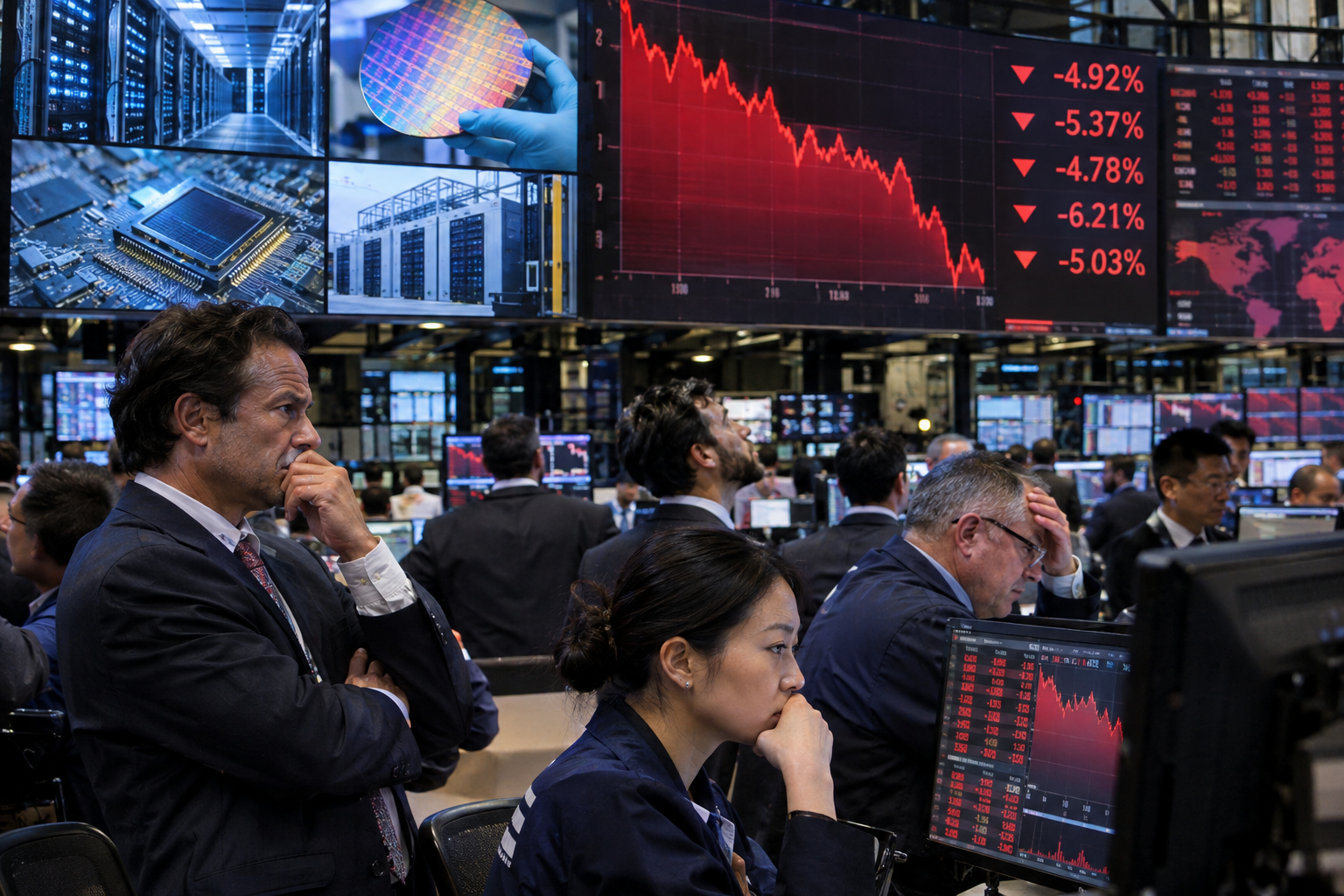
A sharp global sell-off in AI-related stocks drove a steep decline across major markets on Thursday. The S&P 500 fell 4.4 per cent, its worst session since the market turmoil caused by President Donald Trump’s “Liberation Day” tariffs in April 2025. The Dow dropped 3.4 per cent and the Nasdaq fell 5.5 per cent, leaving it 11.9 per cent below its record high from the previous month—a decline commonly described as a correction. Canada’s main stock index also fell, while South Korea’s Kospi lost 5.3 per cent.
Investors have been concerned for months that high borrowing costs and the expense of building AI data centres could slow construction. Critics also argue that AI-related share prices have risen to unsustainable levels. The U.S. midterm election results added uncertainty: Democratic victories raised the possibility that governments could pause data-centre construction, amid public concerns about AI and the higher electricity bills associated with data centres. Less construction could reduce demand for chips, electricity and other products tied to the AI boom.
Major AI-linked companies fell sharply, including Nvidia, Advanced Micro Devices, CoreWeave and GE Vernova. Nvidia’s size means its share-price moves have an outsized influence on the S&P 500. Losses spread broadly after most Wall Street stocks initially rose. AppLovin and Tapestry were notable exceptions, gaining after reporting better-than-expected results and, in AppLovin’s case, approving a large share-buyback program.
Elsewhere, Brent crude rose as it recovered some of the previous day’s steep decline, while uncertainty remained over the Iran war and the energy industry. U.S. Treasury yields fell, a move that may indicate investors were seeking the relative safety of government bonds as stocks dropped.
Entities: S&P 500, Dow Jones Industrial Average, Nasdaq Composite, Nvidia, Advanced Micro Devices • Tone: analytical • Sentiment: negative • Intent: inform
05-11-2026
After Democrats won sweeping victories in the 2026 midterm elections, billionaires and investors reacted to both the scale of political spending and the possible consequences for artificial intelligence infrastructure. Richard Branson criticized the billions spent by technology entrepreneurs and hedge fund managers to influence elections and called for campaign finance reform. Reid Hoffman also argued that money should be removed from politics, while criticizing Elon Musk’s spending. Musk, the election’s largest individual donor, spent $224 million in Texas, but the Republicans he backed lost the Senate and governor races there. Alex Soros, whose family contributed about $103 million to Democratic efforts, celebrated the outcome.
Several investors warned that Democratic opposition to new data centers could slow AI development and weaken U.S. technological leadership. Bill Ackman said the country could not afford to slow down. Chamath Palihapitiya argued that restrictions on data centers could damage the AI trade, while Brad Gerstner and analyst Dan Ives estimated that substantial planned data-center capacity might not be built. In Texas, Democratic governor-elect Gina Hinojosa, who has proposed a temporary halt to new data-center construction pending stronger safeguards, defeated incumbent Greg Abbott. AMD CEO Lisa Su urged technology companies to show communities how they would benefit from AI infrastructure.
Markets reacted positively despite the warnings. The Dow rose 3%, the S&P 500 gained 1.6%, and the Nasdaq advanced 1.4%, with investors welcoming reduced uncertainty, political gridlock, and Trump’s acceptance of the election results. Big Tech companies briefly added more than $750 billion in market value. The article notes that a slowdown in construction could benefit existing data centers and reduce technology companies’ spending burdens, even as smaller, debt-dependent operators fell.
Entities: Richard Branson, Reid Hoffman, Elon Musk, Alex Soros, Bill Ackman • Tone: analytical • Sentiment: neutral • Intent: analyze
05-11-2026
After Democrats’ strong performance in the 2026 midterm elections, prominent party figures are calling for limits on data center construction and, in some cases, a pause in AI development. Sen. Bernie Sanders called for a national data center moratorium, arguing that large technology companies threaten the environment, jobs and humanity’s future. Rep. Yassamin Ansari said pausing AI development should be a priority for the incoming Democratic House majority, with Rep. Greg Casar endorsing her position.
The article reports that data centers and AI were important to many voters: 56% of respondents to the CNBC Voter Poll said the issues were a crucial or major factor in their vote, and 65% of those voters said they voted for a Democratic congressional candidate. Several Democrats who won competitive races also emphasized opposition to data center projects, including South Carolina’s Annie Andrews and Ohio’s Sherrod Brown. Pennsylvania Gov. Josh Shapiro, who had already signed an executive order to slow development, said local communities should have the final say.
Texas is identified as especially consequential because it accounts for 27% of planned U.S. data center capacity, according to Wells Fargo. Gina Hinojosa, who defeated incumbent Gov. Greg Abbott, had pledged to halt data center approvals until state lawmakers pass protective legislation. Meanwhile, shares of companies tied to AI infrastructure fell after the election as investors weighed the prospect of government restrictions. Semiconductor stocks were particularly affected: the iShares Semiconductor ETF fell nearly 9%, Nvidia declined 8%, and AMD dropped more than 14%.
Entities: Bernie Sanders, Yassamin Ansari, Greg Casar, Annie Andrews, Sherrod Brown • Tone: analytical • Sentiment: neutral • Intent: inform
05-11-2026
Asian markets were mixed on Thursday after US stocks rallied following the midterm elections, in which President Donald Trump’s party lost its sole control of Washington. The Dow Jones Industrial Average rose more than 3% on Wednesday. Hong Kong, Shanghai and Australian shares gained, while markets with greater exposure to artificial-intelligence and semiconductor stocks fell. South Korea’s Kospi dropped 3.5% by late morning after briefly losing more than 4%, with Samsung Electronics and SK Hynix among the decliners. Tokyo’s Nikkei and Taiwan’s Taiex also fell. Brent crude traded near $94 a barrel, close to its lowest level in two months.
The article says the election may have limited long-term consequences for the broad market, where company profits and interest rates tend to matter more than political control. Still, investors often favor divided government because it can reduce the likelihood of major economic changes. The results also raised concerns about companies associated with Trump, Elon Musk and the AI industry. Trump Media & Technology Group fell 24.5%; Tesla and SpaceX also declined. Investors were concerned that a Democratic-controlled Congress could investigate Musk and challenge policies supporting AI.
Expectations that Democrats might pressure Trump to reduce the US war with Iran weighed on defense contractors and major oil companies. Lockheed Martin, Northrop Grumman and General Dynamics all fell, as did ExxonMobil and ConocoPhillips. The article also reports early Thursday currency movements: the dollar weakened against the yen, while the euro rose against the dollar. Overall, the market reaction reflected differing sector-specific expectations rather than a uniform response to the election.
Entities: Donald Trump, Elon Musk, United States midterm elections, Wall Street, Asian stock markets • Tone: analytical • Sentiment: neutral • Intent: analyze