05-11-2026
The article reports that Ueno Bank in Paraguay was shut down in the middle of the night amid a solvency crisis. The closure left customers unable to access their money and was followed by protests across the country. The report says an estimated 60% of Paraguay’s adult population banks with Ueno, indicating that the shutdown affects a large share of residents who use banking services. The headline characterizes the collapse as involving “half of the population’s savings,” while the accompanying description specifically states the 60% figure refers to adults who bank with Ueno; it does not provide a separate estimate of the amount of savings held there.
The available article text offers only a brief account. It does not explain the causes or financial details of the solvency crisis, identify who made the closure decision, or describe what arrangements may be made for customers to recover or access their funds. It also gives no details about the protests, such as their locations, size, or response from authorities. Accordingly, the report establishes the central event and its immediate effects—Ueno Bank’s shutdown, customers’ loss of access to money, and public demonstrations—but leaves the broader financial and political consequences unclear. Its primary function is to inform readers of a rapidly developing banking crisis and its potential reach, rather than provide an in-depth account of the resolution or the bank’s financial condition.
Entities: Paraguay, Ueno Bank, banking crisis, bank collapse, solvency crisis • Tone: urgent • Sentiment: negative • Intent: inform
05-11-2026
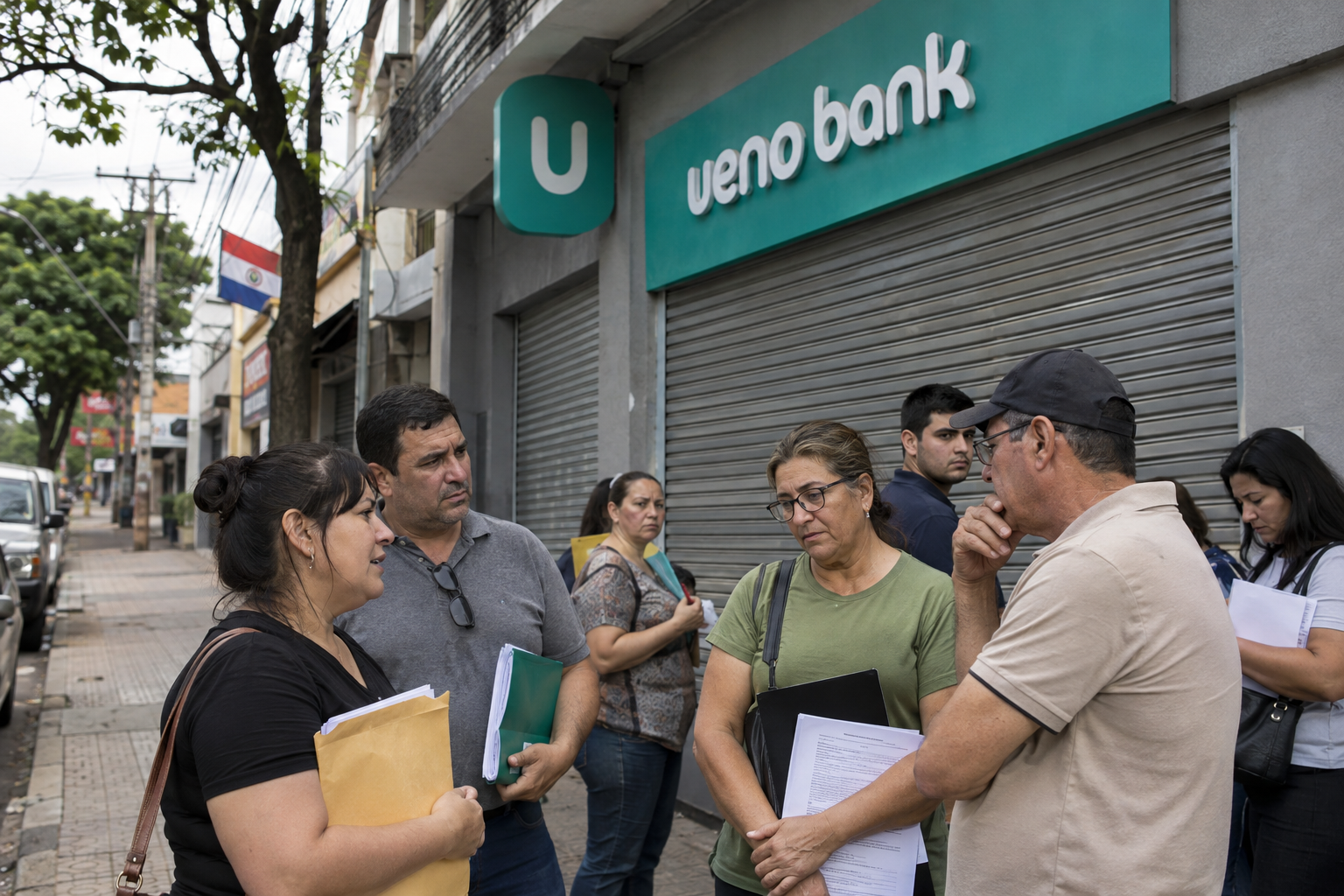
The liquidation of Ueno Bank has plunged Paraguay into a financial and political crisis. On 3 November, the bank’s app stopped showing customer balances, and the Banco Central del Paraguay announced that it had intervened in the institution and begun winding it up after its solvency ratio fell below 50%. The shutdown left millions of customers unable to access accounts or use cards and services. Crowds gathered at branches across the country, with some customers urgently needing money for food, medicine, and other essentials.
Ueno held about $850 million in public resources, including funds associated with Paraguay’s social security institute that support pensions and healthcare. Authorities said a guarantee fund would reimburse customers up to a specified limit, but the announcement did little to ease public distrust. The crisis has also prompted fears of a “corralito,” a restriction on access to deposits reminiscent of Argentina’s financial crisis.
Opposition legislators have targeted President Santiago Peña, accusing his administration of failing to oversee the bank and alleging conflicts of interest, misuse of pension funds, and protection of the central bank. At the request of 35 legislators, the Chamber of Deputies is due to consider whether to open impeachment proceedings; the measure requires 53 votes in the lower house and subsequent approval by two-thirds of the Senate. Peña cancelled his official schedule, later announced the central bank chief’s departure, and called for judicial accountability. Eight senior Ueno executives, including CEO Miguel Vázquez, were arrested.
The shutdown is already affecting the wider economy: importers and retailers reported a 35% drop in sales as customers’ money became inaccessible. The article describes Ueno’s rapid expansion, prominent advertising and football sponsorship, and an ambitious $100 million capitalisation plan, set against regulators’ finding that it could not meet a required $70 million reserve. The crisis threatens Peña’s political standing despite Paraguay’s strong recent economic growth.
Entities: Ueno Bank, Santiago Peña, Banco Central del Paraguay (BCP), Liana Caballero, Miguel Vázquez • Tone: urgent • Sentiment: negative • Intent: inform
05-11-2026
Paraguay’s Congress began a session on Thursday, November 5, to consider whether to initiate impeachment proceedings against President Santiago Peña. The political effort follows the collapse of digital lender ueno, which has left millions of Paraguayans unable to access their accounts and prompted protests and demands that Peña resign. To begin impeachment proceedings, at least two-thirds of lawmakers participating in the session must support the move.
The drive gained momentum as Congress President Basilio Nuñez and Colorado Party leader Horacio Cartes withdrew their backing for Peña on Thursday, weakening the president’s position ahead of the vote. Congress had convened an extraordinary session late Wednesday after 35 lawmakers submitted articles of impeachment in the 80-seat lower house.
The lawmakers accuse Peña of conflicts of interest, misuse of pension funds and institutional cover-ups connected to ueno’s collapse. The article notes that Peña held a share in the group controlling the lender until last year. It does not report the outcome of the session or establish that the allegations have been proven. The central development is therefore a move to debate the president’s possible removal, amid public anger over the lender’s failure and a loss of support from prominent political allies.
Entities: Santiago Peña, Paraguay, Paraguay Congress, Basilio Nuñez, Horacio Cartes • Tone: analytical • Sentiment: negative • Intent: inform