05-11-2026
France experienced a nationwide day of strikes and demonstrations on Thursday, 5 November, as unions brought together workers, students and other protesters calling for higher wages, tax justice and improved public services. By 1 p.m., the Interior Ministry had recorded 270,000 demonstrators across 180 marches outside Paris. The CGT reported more than 250,000 participants in 73 cities. Authorities deployed approximately 70,000 police officers and gendarmes nationwide. The strike also affected schools: 81 secondary schools were blockaded, and 15.81% of teachers took part.
Protests unfolded in several cities. In Marseille, thousands marched from Les Réformés towards Place Castellane with union flags and flares, while police monitored the procession; 17 metro stations were closed. In Nantes, organisers estimated that about 30,000 people attended, while police put the number at 24,000. The march proceeded through the city centre after unions obtained permission.
In Paris, police used tear gas outside Lycée Honoré-de-Balzac in the 17th arrondissement to disperse students protesting what they said was a lack of educational resources. Footage showed a firework exploding above the crowd and cardboard burning in a bin near the school gates as officers moved in. Police also dismantled a separate student blockade on Rue de Rivoli. The capital’s main union march began at Place de la République at 2 p.m. and followed a route set by authorities towards Place de la Nation. The nationwide mobilisation was described as another major test for the autumn protest movement, bringing together workers, students and public-sector employees amid calls for better pay and working conditions.
Entities: France, 5 November nationwide strike and demonstrations, CGT, French Interior Ministry, Marseille • Tone: neutral • Sentiment: neutral • Intent: inform
05-11-2026
Tens of thousands of people marched through eastern central Lyon on Thursday during the fourth nationwide French union strike day of the autumn. The unions were protesting over pay and public services. The estimated size of the crowd differed: authorities counted 30,500 participants, while the CGT union put the number at 55,000. Demonstrators carried union banners and Palestinian flags as they followed a route set by local authorities. Officials had prohibited demonstrations in much of central Lyon, citing concerns about renewed vandalism and looting. Unions contested the restrictions in court but failed to overturn them, so the march proceeded along the imposed route.
Tensions rose near Pont Gallieni, where police said about 500 black-clad demonstrators threw projectiles and set off fireworks. Riot police responded by deploying tear gas, and six arrests were reported. The article does not specify the extent of any injuries or property damage. Disruption also affected public transport: all metro and funicular services in Lyon were suspended. The report presents the march as a large labor protest shaped by a dispute over the demonstration route and by clashes between some demonstrators and police. It provides competing crowd estimates and attributes the account of projectiles and fireworks to police, while noting the unions’ unsuccessful court challenge to the restrictions.
Entities: Lyon, France, French unions, CGT, Pont Gallieni • Tone: neutral • Sentiment: neutral • Intent: inform
05-11-2026
Workers across France went on strike on Thursday after trade unions called for a nationwide day of action, with hundreds of thousands expected to join demonstrations. Protests took place in Paris, Marseille, Lyon, Nantes and Lille, and organisers said rallies were planned in 260 cities and towns. The Education Ministry estimated that 16 percent of teachers nationwide would strike.
Demonstrators are calling for a higher minimum wage, increased salaries for all workers, tax reforms and improved conditions in schools. The unrest follows protests that began in September, when students demonstrated against conditions in public high schools, and has since grown to include broader concerns about the cost of living and public services. President Emmanuel Macron convened a defence and security meeting ahead of the demonstrations to address public order. In Lyon, Reuters reported, riot police fired tear gas at a demonstration.
A history student protesting in Lille described shared anger over low wages, rising living costs and shortages in schools and universities. Al Jazeera correspondent Rebecca Collard reported that the protests, which began with a student movement in Paris, had spread across the country, with Marseille among the cities seeing some of the largest demonstrations.
The strikes come as France prepares for a presidential election next April. Macron cannot seek another term under the two-term limit, and polls indicate that far-right candidate Marine Le Pen is the favourite. France has also faced allegations of police violence in its handling of demonstrations. Separately, Reuters reported that the G7 foreign ministers’ meeting was moved from Marseille to Paris at short notice after six weeks of protests. Diplomats described the decision as chaotic and said it could damage France’s image. The article places France’s unrest amid recent demonstrations in other European countries, including Germany and Portugal, over falling living standards and a shortage of affordable housing.
Entities: France, Paris, Marseille, Lyon, Nantes • Tone: analytical • Sentiment: neutral • Intent: inform
05-11-2026
France is seeing a new wave of strikes and protests as five unions join forces with high school students and other demonstrators to demand higher wages and action on the rising cost of living. By 13:00 local time on Thursday, more than 250,000 people had demonstrated in almost 70 towns and cities, according to the report. CGT leader Sophie Binet said the mobilisation had reached a new level and warned that the demonstrations were only beginning.
The campaign began in September with protests over conditions and resources in high schools, then broadened to include workers and the yellow-vest movement. The unions have organised more than 250 actions across public and private sectors. They seek an increase to the €12.31 hourly minimum wage and, as CFDT leader Marylise Léon put it, a net monthly pay rise of €100. Disruption affected schools, hospitals and public transport; the Eiffel Tower and some Louvre exhibition rooms closed. Strikes at nuclear plants were expected to leave France importing more electricity than it produced, while refinery workers were also urged to stop production.
The government has responded to public anger by releasing diesel from strategic reserves to reduce fuel costs and promising reforms to the Parcoursup university admissions platform. The education ministry reported that 16% of teachers were on strike, while unions said more than a quarter of high schools and most universities were affected.
Authorities deployed 70,000 police and promised a firm response to violence. Unrest was reported in Lyon, where a car was set alight and black-bloc demonstrators clashed with police, and in Rennes, where masked individuals gathered near a union march. Although Thursday’s march was permitted in central Paris, authorities approved a route different from the one unions requested. Union leaders cited earlier violence and looting as a reason marches had been kept away from central areas. The revived yellow-vest movement has also called for more blockades and protests on Friday and Saturday.
Entities: France, Sophie Binet, Laurent Nuñez, Marylise Léon, CGT union • Tone: neutral • Sentiment: neutral • Intent: inform
05-11-2026
French riot police fired tear gas and charged protesters in Lyon on Thursday as strikes and demonstrations spread across France. The nationwide action, called by trade unions and backed by student groups, protested wages, the cost of living, public services and education. It follows weeks of unrest that have included riots and looting, and comes five months before a presidential election.
The Interior Ministry said several hundred hardline protesters confronted police in Lyon and that violence had been contained, though tensions remained high. Demonstrations also took place in Marseille, Nantes and Paris. In Paris, students had earlier faced off with police while blocking a street with rubbish bins; the main march was scheduled for the afternoon. The Eiffel Tower closed because of the strike. CGT union leader Sophie Binet estimated that about 250,000 people were demonstrating nationwide and said the protests were larger than ever. A firefighter at the Paris protest said wages had not kept pace with inflation and argued that the country needed more resources to respond to crises such as wildfires.
The unrest also disrupted a high school near Toulouse after people throwing fireworks caused a fire, prompting pupils and staff to evacuate. Education Minister Edouard Geffray condemned the incident. Authorities deployed about 70,000 police nationwide. The Education Ministry said just over 15 per cent of teaching staff joined the strike. The government has defended police tactics while saying alleged abuses would be investigated.
The movement began in September with a school protest over staff shortages southeast of Paris, then expanded as students demanded more education funding and workers called for better pensions and relief from rising fuel and other costs. The demonstrations have become entangled with campaigning to succeed President Emmanuel Macron, who is serving his second term and cannot seek another consecutive term. The article says the election could feature far-right candidate Marine Le Pen and hard-left rival Jean-Luc Melenchon in a runoff, and later describes Le Pen as the favourite. Macron has faced criticism over his handling of the crisis, including after riots and looting on Oct. 17 damaged shops and public buildings.
Entities: Emmanuel Macron, Marine Le Pen, Jean-Luc Melenchon, Sophie Binet, Edouard Geffray • Tone: analytical • Sentiment: negative • Intent: inform
05-11-2026
France's National Assembly unanimously rejected the government's proposed 2027 budget, deepening uncertainty over efforts to reduce the country's deficit just as nationwide strikes and protests were expected. Prime Minister Sébastien Lecornu had proposed €54 billion in spending cuts to reassure bondholders and address concerns about France's public finances. But the parliament has been fragmented since a 2024 snap election, making agreement on fiscal policy difficult. Previous governments have used Article 49.3 to pass budgets without a vote, while another constitutional option—passing a budget by ordinance—has never been used in the Fifth Republic.
The rejection was widely expected. Analysts said it could give the government time to prepare to use special powers, since passage through a normal parliamentary vote appeared unlikely. They also warned that the measures would probably not meet the government's deficit goals: weaker-than-expected economic growth means the deficit is likely to remain above 5% of GDP next year. France's deficit was 5.1% of GDP in 2025, while its public debt reached 115.6% of GDP. Rising borrowing costs have added pressure to French government bonds, known as OATs.
The budget dispute coincides with unrest over living costs and public spending. Protests that began with students opposing education funding cuts have included riots and looting, with estimated damage exceeding €1 billion. Hundreds of thousands of people were expected at nationwide strikes, and authorities planned to deploy 70,000 police and gendarmes. Reports described fires at demonstrations and tear gas used in Lyon.
Economists characterized France's outlook as difficult, citing weak growth, declining confidence, and softening domestic demand and investment. They said the government has limited scope to restore social calm by increasing spending, as it has done in the past. However, one analyst cautioned that the country was not on the verge of collapse and was not in a situation comparable to Greece before the euro-zone crisis.
Entities: France, National Assembly, Sébastien Lecornu, François Bayrou, Laurent Nuñez • Tone: analytical • Sentiment: negative • Intent: analyze
05-11-2026
Hundreds of thousands of people took part in demonstrations across France on Thursday, as public-sector workers went on strike alongside students protesting education conditions and the rising cost of living. Trade unions called the mobilization to demand higher minimum and general wages, tax reforms, and improved learning conditions. The demonstrations followed weeks of youth-led protests that had grown to encompass concerns about living costs and inequality; some earlier actions culminated in serious rioting on October 17.
Authorities prepared a large security response, with Interior Minister Laurent Nunez announcing that about 70,000 police officers and security personnel would be deployed. Unions planned around 260 rallies. Officials anticipated 500,000 to 700,000 participants nationwide, including approximately 80,000 in Paris. An official cited by the Associated Press said roughly 270,000 people had joined 180 rallies by early afternoon. Most marches were peaceful, though violence and disruption were reported in several cities, including Lyon, Nantes, Pau, Orleans, Rennes, and Toulouse. Reports included attempts to block roads in Rennes and a fire at a high school near Toulouse.
Education, rail, hospital, postal, power, and air-traffic workers were among those called to strike. The Education Ministry said just over 15% of teaching staff had walked out, while about one-third of high schools were closed because of student blockades or teacher strikes. The Eiffel Tower also closed. SNCF expected only minor disruption to long-distance trains, while the impact of the air-traffic-control strike was unclear. The article describes a largely peaceful but tense nationwide mobilization, with some clashes and property damage, amid wider public anger over wages, education, living costs, and inequality.
Entities: France, Laurent Nunez, Marseille, Paris, Lyon • Tone: neutral • Sentiment: neutral • Intent: inform
05-11-2026
France saw its fourth nationwide day of strikes and demonstrations on Thursday, 5 November 2026, as trade unions brought together workers, students and other protesters. Demonstrators called for higher wages, tax justice, better public services, and improved pay and working conditions. Participation figures varied by source: by 1 pm, the Interior Ministry counted 270,000 people across 180 marches outside Paris, while the CGT reported more than 250,000 participants in 73 cities. Authorities deployed about 70,000 police officers and gendarmes nationwide. The strike also affected schools: 81 secondary schools were blockaded, and 15.81% of teachers joined the walkout.
Large demonstrations took place in Marseille and Nantes. In Marseille, thousands marched between Les Réformés and Place Castellane, while 17 metro stations were closed. In Nantes, organisers estimated that about 30,000 people marched, compared with a police estimate of 24,000; unions had secured permission to use a route through the city centre.
Tensions arose in Paris outside Lycée Honoré-de-Balzac, where police used tear gas to disperse students protesting a lack of educational resources. Video showed a firework exploding over the crowd and cardboard burning in a bin as officers moved in. Police also dismantled a separate student blockade on Rue de Rivoli. The capital’s main union march began at Place de la République at 2 pm, following a route set by authorities towards Place de la Nation. The protests were described as a major test of the autumn mobilisation, which united workers, students and public-sector employees.
Entities: France, CGT, French Interior Ministry, Paris, Marseille • Tone: neutral • Sentiment: neutral • Intent: inform
05-11-2026
Tens of thousands of people marched through Lyon on Thursday, 5 November 2026, during France’s fourth nationwide strike day of the autumn. The strike was called by unions over wages, purchasing power and public services. Estimates of the Lyon crowd differed: authorities counted 30,500 participants, while the CGT union put the number at 55,000.
Demonstrators carried union banners and Palestinian flags along a route set by local authorities. Officials had banned demonstrations across much of central Lyon, citing concerns about renewed vandalism and looting. Unions challenged the restrictions in court but failed to overturn them.
Clashes broke out near Pont Gallieni. Police said that around 500 black-clad demonstrators threw projectiles and set off fireworks. Riot police responded with tear gas, and six arrests were reported. The protest also caused major disruption to local transport: all metro and funicular services were suspended.
The report describes a large, contentious demonstration and the response by police and local authorities. It gives competing estimates of attendance and outlines the reasons for the strike, restrictions on the march, reported clashes, arrests and transport shutdown. It does not provide further details about injuries, the duration of the service suspension or the demonstrators’ specific demands beyond the broader issues of pay, purchasing power and public services.
Entities: Lyon, France, CGT union, French unions, Pont Gallieni • Tone: neutral • Sentiment: negative • Intent: inform
05-11-2026
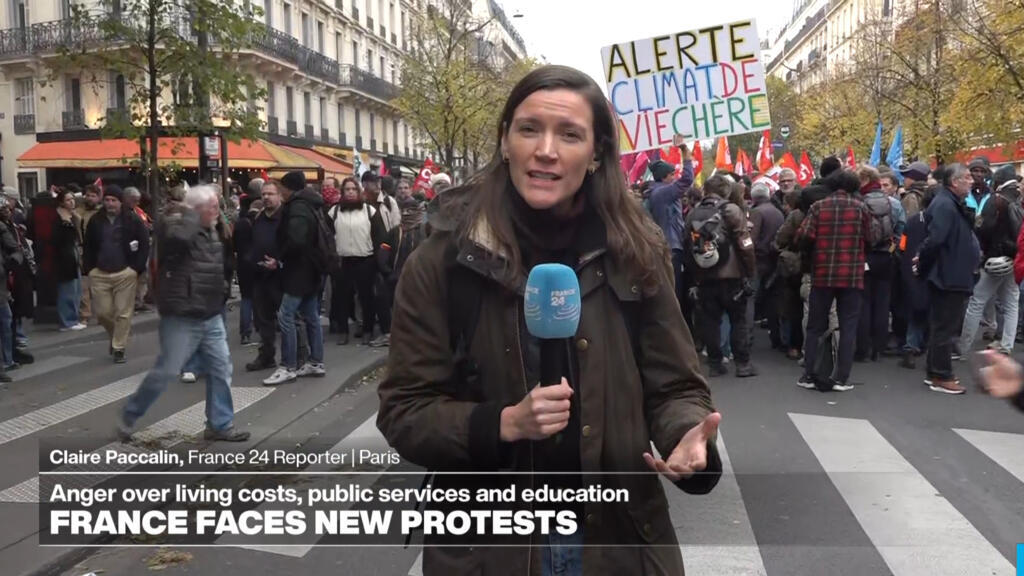
The France 24 report says France is facing new protests as the government seeks to prevent a repeat of unrest that occurred in October. Protesters are calling for better public services, with education specifically mentioned, and are also criticizing the cost of living. The report is attributed to France 24 journalist Claire Paccalin, who reports from the scene. The supplied page contains only a short description of the video report; it does not include a transcript, details about the planned demonstrations, the government’s specific preventive measures, or further accounts from protesters. The summary is therefore limited to the information available in the article text provided.
Entities: France, France 24, Claire Paccalin, October unrest, Protests • Tone: neutral • Sentiment: neutral • Intent: inform
05-11-2026
France is preparing for large demonstrations and strikes on Nov 5, as unions, student groups and public-sector workers challenge President Emmanuel Macron over living costs, public services and education. The protests come after weeks of unrest, including riots and looting on Oct 17 that damaged shops and public buildings and exposed security forces to criticism for being caught off guard. The government is trying to prevent a repeat of that violence as the presidential election approaches in five months.
Authorities plan to deploy around 70,000 police nationwide. France’s domestic intelligence service estimates that 500,000 to 700,000 people could demonstrate outside Paris. The Education Ministry expects 17.5 per cent of public primary-school teachers to strike, while unions anticipate disruption to rail and other public transport. Power-sector unions are also expected to participate.
Students say worsening school conditions and uncertainty about their futures remain central concerns. One Paris student, Irma de Banville, said some people were reluctant to mobilise because they feared police violence. The government has defended police tactics but says alleged abuses will be investigated.
Macron convened a defence and security meeting ahead of the protests. An official close to him described the government’s objective as restoring calm and ensuring the presidential campaign begins in stable conditions. Although protests on Oct 31 were generally peaceful, with some clashes at their edges, the political climate remains tense as candidates and opposition parties respond to public dissatisfaction with living standards and government policy. A previous power-sector strike in September reduced electricity supply and limited delivery capacity at the Dunkirk LNG terminal, raising the prospect of further disruption.
Entities: Emmanuel Macron, Maud Bregeon, Irma de Banville, France, Paris • Tone: analytical • Sentiment: negative • Intent: inform
05-11-2026
France faced another nationwide round of protests on November 5, after weeks of unrest that began with student demonstrations over underfunded schools and expanded into broader anger about the cost of living and public services. Trade unions and student groups mobilised demonstrators, while the government deployed 70,000 police and security officers to oversee 220 planned demonstrations and prevent a repeat of the October 17 clashes and looting.
The government is considering raising the minimum wage, currently €1,478 net per month, but has resisted wider cost-of-living measures while trying to control the budget deficit. The CFDT union wants an increase of at least €100. For schools, the government has promised 3,000 qualified teachers, smaller classes, more staff next year and €4 billion in renovation loans.
Protests are expected to continue: grassroots groups plan another demonstration on Saturday, and some unions and housing associations have called for pan-European protests from November 20 to 22. The unrest has weakened household and business confidence and worsened pressure on France’s fiscal outlook. Higher energy prices linked to the Iran war and a divided parliament’s struggle over the 2027 budget add to the strain. Investor concerns have weighed on stocks and French government debt; the 10-year bond yield reached 5.14% last month, its highest level since 2002.
The article places France’s unrest within a wider wave of Gen Z-led protests across Europe, with demonstrations over education, living costs, public services and housing reported in Germany, Italy, Spain and Portugal. Politically, polls suggest the crisis is benefiting far-right candidate Marine Le Pen and hard-left candidate Jean-Luc Melenchon. Centre-right candidate Edouard Philippe is trailing them ahead of the 2027 presidential election, in which Emmanuel Macron will step down after a decade in office.
Entities: France, Paris, Emmanuel Macron, Marine Le Pen, Jean-Luc Melenchon • Tone: analytical • Sentiment: negative • Intent: inform
05-11-2026
France 24 reports that students across France again blocked access to their high schools and universities on Thursday, November 5, 2026. The students considered the government’s response to their concerns insufficient, describing it in the headline as “meaningless.” The article’s brief accompanying description says the renewed blockades took place despite that government response and identifies the protest movement as the central development. The item is presented as a short video, with a listed duration of 1 minute and 11 seconds, and is credited to video journalist Mandi Heshmati. It was issued on November 5, 2026, at 13:51.
The supplied page text does not explain what specific demands the students are making, what measures the government has proposed, how many schools or universities were affected, or whether there were disruptions or responses from officials. It also provides no interviews or further reporting beyond the headline and brief description. Accordingly, the report establishes that school and university blockades were occurring again and conveys students’ dissatisfaction with the government’s response, but does not provide enough information to assess the protests’ scale, causes, or likely outcome. The unrelated headlines and page-navigation material in the supplied text are not part of this report.
Entities: France, France 24, Mandi Heshmati, French students, High schools • Tone: neutral • Sentiment: negative • Intent: inform