05-10-2026
Spanish Prime Minister Pedro Sánchez has called a snap election for November 29 as his minority government struggles to advance housing reforms amid a worsening housing crisis. In a televised address, Sánchez said he wanted voters to renew his government’s mandate and elect a larger progressive majority. He also acknowledged mistakes and unmet campaign promises. The announcement follows parliament’s rejection of housing relief measures and large protests demanding affordable homes. Demonstrations were triggered by the eviction of 87-year-old Maricarmen Abascal from the Madrid apartment where she had lived for more than 70 years. Tent encampments have since appeared in Madrid, Barcelona, Seville and Palma de Mallorca.
Housing pressures are substantial: Spain’s average rent has nearly doubled over the past decade, reaching 15.10 euros per square metre in August. The Bank of Spain estimates the country is short 700,000 homes, while social housing accounts for less than 2 per cent of housing stock. The government’s defeated proposals included automatic tenancy renewals, limits on evicting vulnerable tenants, restrictions on bulk property purchases by investment funds and a tax on seasonal rentals.
Some protesters welcomed the election as a result of street pressure, while others expressed concern about what might follow and whether a future government would protect housing rights. Opinion polls point to a possible coalition led by the conservative People’s Party, supported by Vox, which could bring a far-right party into central government for the first time since Spain’s return to democracy after Franco’s death. Sánchez, however, has repeatedly assembled unlikely coalitions and remained in office for three successive terms despite never winning a parliamentary majority outright. His current term has seen little legislation pass, and Spain has not passed a budget since 2023. The People’s Party leader, Alberto Núñez Feijóo, welcomed the election and said voters would finally have their say.
Entities: Pedro Sánchez, Maricarmen Abascal, Alberto Núñez Feijóo, Spain, Madrid • Tone: analytical • Sentiment: neutral • Intent: inform
05-10-2026
Spanish Prime Minister Pedro Sánchez has called a snap election for 29 November after his government’s housing proposals were narrowly defeated in parliament, confirming that his left-wing coalition no longer has a majority. The proposals aimed to improve tenants’ conditions, curb soaring rents, prevent evictions, improve rental contracts and restrict investors’ purchases of residential property. Parties on the right, including the conservative People’s Party (PP) and far-right Vox, opposed the measures.
The article presents the election call as a calculated move rather than an impulsive response. Sánchez’s government has faced mounting pressure from corruption allegations involving former senior Socialist Party figures Santos Cerdán and José Luis Ábalos, as well as claims that former prime minister José Luis Rodríguez Zapatero benefited financially from an airline bailout. Zapatero denies wrongdoing. Sánchez’s wife, Begoña Gómez, is also due to stand trial over allegations of misusing funds and influence peddling, which both she and Sánchez deny. Separately, the sudden arrival of more than 70,000 migrants in the Spanish exclave of Ceuta in July has created a political and logistical challenge; most have since returned to Morocco.
The housing protests have given Sánchez an opportunity to shift the campaign’s focus from those controversies and Ceuta. He is urging progressive voters to secure a larger majority, while arguing that the right-wing parties’ opposition to his housing plan demonstrates their position on tenant protections. The PP and Vox generally oppose direct state intervention in housing, arguing it may have counterproductive effects.
Although housing is Spaniards’ leading concern in polls and could help mobilise left-wing voters, the Socialists remain behind the PP in polling. The article concludes that Sánchez’s chances of remaining in power after the election are uncertain and that doing so may be the greatest challenge of his political career.
Entities: Pedro Sánchez, Begoña Gómez, Santos Cerdán, José Luis Ábalos, José Luis Rodríguez Zapatero • Tone: analytical • Sentiment: neutral • Intent: analyze
05-10-2026
Spanish Prime Minister Pedro Sánchez has called a general election for 29 November, moving the vote forward from the summer of 2027 at the latest. The decision follows parliamentary defeats for his minority coalition government, which failed to pass two housing-related decree laws. Sánchez said a broader progressive majority was needed to advance reforms, while acknowledging shortcomings in his government’s record on inequality, public services and access to housing.
Housing has become a major source of public anger. The eviction of 87-year-old Maricarmen Abascal from her Madrid home after a sharp rent increase helped trigger protests in Madrid, Valencia and Barcelona. A legal glitch allowed her rent to rise from €500 to €2,650 a month; it was later reduced to €1,650, still above her monthly pension. Her lawyer says she will be able to return home. The government’s proposed measures included suspending some evictions, extending rental leases, raising taxes on tourist apartments and limiting purchases by investment funds. A second decree proposed automatic renewal of rental contracts. The political right argued that intervention would reduce rental supply and push prices higher.
Sánchez also faces challenges beyond housing, including cost-of-living concerns, immigration and a series of corruption investigations and scandals involving people connected to his party and government. His wife, Begoña Gómez, has been charged in a case she denies; the Socialist party has denied allegations connected to a police investigation; and former transport minister José Luis Ábalos was jailed after being found guilty in a kickback case involving pandemic-era face-mask sales.
The conservative People’s Party leads many opinion polls but is expected to need support from the far-right Vox party to form a government. Its leader, Alberto Núñez Feijóo, welcomed the election as an opportunity for voters to choose change. Sánchez has been prime minister since 2018 and retained office after the 2023 election through agreements with left-wing, Catalan and Basque parties.
Entities: Pedro Sánchez, Maricarmen Abascal, Begoña Gómez, Alberto Núñez Feijóo, José Luis Ábalos • Tone: analytical • Sentiment: neutral • Intent: inform
05-10-2026
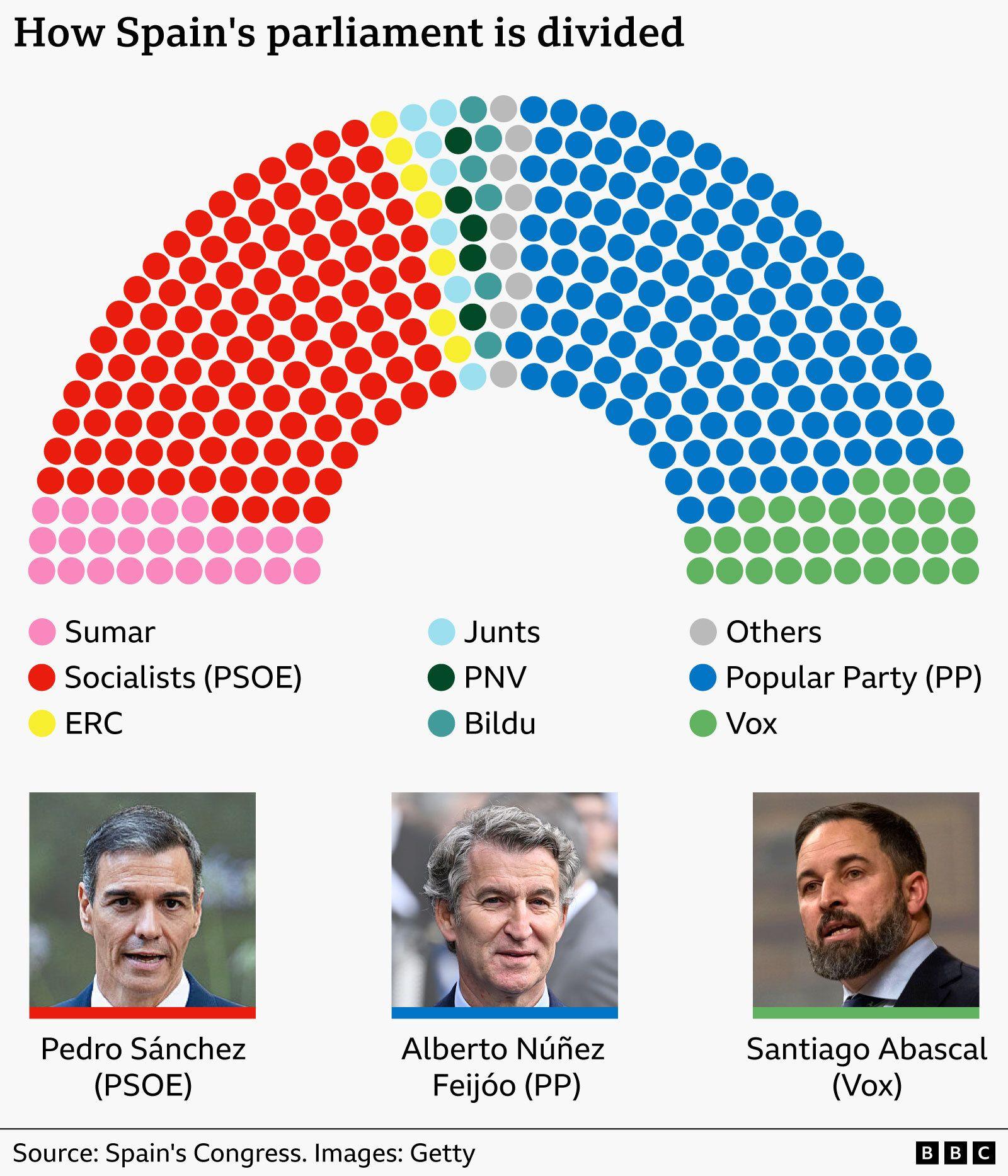
Spanish Prime Minister Pedro Sánchez has called a snap election for Nov. 29, seeking a stronger parliamentary mandate after lawmakers rejected his government’s housing proposals. The vote is a major risk: Sánchez’s Socialist Party is behind in most polls, and a defeat could bring Spain’s first far-right party into central government since the country’s return to democracy in 1975. The opposition People’s Party (PP), potentially governing with the anti-immigration Vox party, is projected to win a comfortable majority, while the Socialists and their junior partner Sumar are forecast to fall well short.
Sánchez argues that a larger progressive majority would let his government tackle vested interests and advance social reforms. The housing crisis, which has prompted nationwide demonstrations over unaffordable homes and evictions, may offer him an opportunity to rally left-wing voters. Spain’s two largest unions also plan a 24-hour national strike this autumn to demand higher wages that would help people afford housing. PP leader Alberto Núñez Feijóo has countered with a pledge to nearly double annual homebuilding to 200,000 units and cut taxes.
The election comes amid political instability. Sánchez has relied on fragile alliances across parties ranging from the far left to Catalan separatists, but growing divisions have prevented the government from passing a budget and limited its legislative output since 2023. He may attempt to enact the rejected housing measures through an unusual legislative procedure before the election.
Sánchez has gained international attention for progressive positions on Palestinian statehood, multilateral institutions and technology companies, and has defended immigration as important to economic growth. His domestic standing, however, has been weakened by corruption scandals and other controversies, including the Catalan amnesty deal that helped secure his second term. Analysts say the housing issue gives him a chance to shift attention from those vulnerabilities, though the result remains uncertain.
Entities: Pedro Sánchez, Alberto Núñez Feijóo, Santiago Abascal, Miriam Nogueras, Lorenzo Bernaldo de Quiros • Tone: analytical • Sentiment: neutral • Intent: inform
05-10-2026
Spain’s Prime Minister Pedro Sánchez has called a snap election for November 29, following parliament’s rejection of housing measures introduced amid mounting public anger and protests over affordability and evictions. Analysts say Sánchez may use the issue to rally left-leaning voters, although he risks being blamed for failing to resolve the crisis after more than eight years in office. Polls currently favor the center-right People’s Party, and analysts see a possible majority for a coalition involving the PP and far-right Vox. One analyst put the likelihood of a center-right majority at 70%, while noting Sánchez’s history of outperforming expectations and his ability to mobilize voters around a central issue.
The election comes as Spain faces multiple domestic pressures. Despite strong economic growth, a robust labor market and booming tourism, housing costs and shortages have fueled demonstrations across the political spectrum. Public anger intensified after an 87-year-old disabled woman was evicted from her longtime home. Immigration, particularly the arrival of tens of thousands of migrants in the North African enclave of Ceuta, has also become a political flashpoint. Sánchez’s fragile coalition, parliamentary deadlock, the absence of a budget for more than three years, and investigations involving the Socialist Party and an ally have further complicated his position.
Sánchez’s international profile has also been shaped by clashes with U.S. President Donald Trump. Sánchez criticized U.S. policy toward Iran and Israel’s war in Gaza; Trump criticized Spain over NATO spending and threatened to sever trade and diplomatic ties. Analysts say a change of government could affect Spain’s defense commitments and trade relations with the United States. It could also alter Spain’s position within the European Union on China: Sánchez’s government has favored a less confrontational approach, while France and Germany have become more concerned about Chinese competition in sectors such as autos. The election therefore carries implications for Spain’s domestic policy, European politics and markets.
Entities: Pedro Sánchez, Donald Trump, Spain, Madrid, Ceuta • Tone: analytical • Sentiment: neutral • Intent: analyze
05-10-2026
Spanish Prime Minister Pedro Sanchez has called an early general election for November 29, bringing forward a vote that had been scheduled for 2027. He announced the decision at Madrid’s Moncloa Palace after consulting close advisers over the weekend. Sanchez said voters should decide the country’s future direction and presented the contest as a choice between what he described as a “far-right wave” and a path of openness, social justice and environmental responsibility. He said he hoped to win a broader progressive parliamentary majority, despite having repeatedly said in recent months that his government would serve its full four-year term.
The election call follows a parliamentary defeat on Friday, when lawmakers rejected government proposals intended to address Spain’s housing crisis. The measures included automatically extending tenancy contracts and limiting evictions of vulnerable tenants. The defeat underscored the difficulties faced by Sanchez’s minority coalition in passing legislation. Spain has also been operating under its 2023 budget, the last national spending plan approved under his government.
Housing has become a growing source of public pressure. Tens of thousands of people marched in Madrid and other cities on Saturday to demand more affordable housing, following broader protests over high rents and evictions. Demonstrations intensified after 87-year-old Maricarmen Abascal was evicted from the Madrid apartment where she had lived for decades. Since then, hundreds of protesters have established a tent camp in central Madrid.
Recent opinion polls have generally placed the conservative opposition Popular Party ahead of Sanchez’s Socialist Workers’ Party. The article does not report the parties’ reactions to the election announcement or provide further details about the campaign.
Entities: Pedro Sanchez, Spain, Madrid, Moncloa Palace, November 29 snap election • Tone: neutral • Sentiment: neutral • Intent: inform
05-10-2026
Maria Tadeo argues that Spanish Prime Minister Pedro Sánchez is calling a snap election because he has lost control of the political narrative that has helped him survive repeated crises. The article describes his carefully managed public image, or “el relato,” as a story built around perception and political positioning rather than simply reality. For years, Sánchez presented himself as a progressive bulwark against a rightward shift in Europe and repeatedly outmanoeuvred his opponents. The Ceuta migration crisis, however, has made that strategy harder to sustain: more than 70,000 migrants crossed into the enclave, the situation remains unresolved, and public opinion increasingly frames it as a national security issue rather than a test of humanitarian policy.
At home, Sánchez faces a paralysed government that cannot pass a budget, a fractious coalition, dependence on Catalan separatists, and the loss of regional governments by the Socialists. His strong role in European politics contrasts with his weaker domestic position. Meanwhile, his left-wing partners Sumar and Podemos have faded, while the conservative People’s Party and far-right Vox may be willing to govern together. That possibility reflects a wider European trend toward tougher migration policies and resistance to progressive social attitudes.
The November 29 election is a high-stakes attempt to shift attention from Ceuta and mobilise Sánchez’s supporters around social justice, especially anger over the housing crisis. The article points to the eviction of 87-year-old Maricarmen as a possible catalyst for wider protest. Tadeo recalls Sánchez’s dramatic political comeback after being forced out as Socialist Party leader in 2016, noting his history of defying expectations. But the central difference now is that events may be shaping the story instead of Sánchez. His gamble may restore his momentum, but the article concludes that he is entering unfamiliar territory: a crisis in which he is no longer writing the narrative himself.
Entities: Pedro Sánchez, Maria Tadeo, Spain, Ceuta migration crisis, Snap election of November 29 • Tone: analytical • Sentiment: negative • Intent: analyze
05-10-2026
Spain’s snap general election, called by Prime Minister Pedro Sánchez for 29 November after parliament rejected two housing decrees, could have consequences beyond Spain. The article presents the vote as a potential turning point for European politics: a Sánchez defeat could end the last centre-left government in a major EU member state, reduce the influence of socialists in EU institutions and further weaken the centrist coalition that has traditionally supported European integration. Sánchez’s government is already facing corruption scandals, migration pressures in Ceuta and protests over housing. Polls indicate that the centre-right Popular Party and far-right Vox could win a majority, although Sánchez’s supporters point to his unexpected survival after the 2023 election.
Officials quoted by Euronews expect limited immediate effects during the campaign, apart from possible symbolic votes. The more important consequences would follow if Sánchez left office. Without his influence, the Socialists and Democrats (S&D) might be less inclined to compromise with the European People’s Party (EPP) and more willing to criticize European Commission President Ursula von der Leyen’s agenda. The change could also affect contests over leadership positions in the European Parliament and European Council, including the future roles of Roberta Metsola and António Costa.
A centre-right government in Spain would diminish the socialists’ presence in the European Council, leaving few centre-left-led governments among EU member states. Denmark’s Mette Frederiksen could become the most prominent progressive leader, though her comparatively restrictive migration policy has caused tensions with Sánchez and within the S&D. The article also notes that the EPP has increasingly assembled alternative majorities with right-wing lawmakers, while some socialists worry that toppling von der Leyen could bring an even less favourable political outcome. Overall, the election is framed as a risk to the balance of power and cooperation between political groups in the EU, rather than as a guaranteed shift.
Entities: Pedro Sánchez, Spain, 29 November snap general election, Popular Party (PP), Vox • Tone: analytical • Sentiment: negative • Intent: analyze
05-10-2026
France 24 reports that Spanish Prime Minister Pedro Sanchez called a snap election for November 29, seeking to strengthen his parliamentary support. The announcement followed a setback in parliament, where lawmakers rejected proposals intended to address Spain’s housing crisis. The crisis has prompted protests across the country.
In an interview with France 24’s Mark Owen, Javier Carbonell, a policy analyst at the European Policy Centre, assessed the timing of Sanchez’s decision. Carbonell described it as the “best moment in a sea of troubles,” arguing that the prime minister may benefit electorally from the mobilisation of left-wing voters around the housing protests. The article therefore presents the election call not only as a response to legislative difficulties but also as a strategic opportunity to seek greater support.
The report is brief and centers on the analyst’s interpretation rather than providing extensive background on the election, the rejected proposals, or the housing crisis. It does not detail the parties’ positions, explain how the proposals would have addressed housing, or include reactions from opposition figures or protestors. Its central point is that Sanchez is aiming to improve his parliamentary position and may be able to capitalize on the political energy generated by the protests. The article frames that prospect as Carbonell’s assessment, not as a guaranteed outcome.
Entities: Pedro Sanchez, Javier Carbonell, Mark Owen, Spain, France 24 • Tone: analytical • Sentiment: neutral • Intent: analyze
05-10-2026
Spanish Prime Minister Pedro Sánchez has called a snap election for Nov. 29, following a parliamentary defeat over emergency measures intended to address the country’s housing crisis. The failed decrees included proposals to reduce evictions and real estate speculation, and were blocked after right-wing opposition parties united against them. The announcement follows public protests over housing affordability, fueled in part by the televised eviction of an 87-year-old woman in Madrid.
In a televised address, Sánchez said voters should decide the country’s future and argued that a broader progressive majority could address Spain’s most pressing problems. He has been prime minister since 2018 and has gained international prominence for his positions on migration, Palestinians and the Iran war. Spain has also experienced strong economic growth in recent years.
At home, however, Sánchez faces several challenges. Legal cases involving his Socialist party, wife and brother have raised political pressure; his wife and brother deny wrongdoing. He has also faced criticism over a large summer border crossing into Ceuta, Spain’s North African territory, where a humanitarian crisis has continued. Since 2023, Sánchez has governed with the left-wing Sumar party and depended on smaller parties for parliamentary support, limiting his ability to pass legislation.
The election is expected to focus on housing affordability, an issue that political scientist Oriol Bartomeus says may favor Sánchez and allow him to frame the campaign as a contest between left and right. The opposition Popular Party, which currently holds the most parliamentary seats, is likely to emphasize corruption. Its leader, Alberto Núñez Feijóo, said the election would be about Spain defeating Sánchez. The Cabinet must approve the formal dissolution of Parliament.
Entities: Pedro Sánchez, Spain, Madrid, Nov. 29 snap election, Housing affordability crisis • Tone: analytical • Sentiment: neutral • Intent: inform
05-10-2026
Spanish Prime Minister Pedro Sanchez has called a snap general election for November 29, seeking a stronger parliamentary mandate after the fragmented legislature rejected his government’s housing measures. In a televised address, Sanchez said he wanted renewed public support and a larger progressive majority, while acknowledging that he had made mistakes and failed to meet some campaign promises. The rejected housing proposals had been welcomed by many amid a mounting housing crisis and prompted plans for further protests, giving Sanchez an opportunity to campaign on an issue with public resonance.
The election is a gamble: Sanchez’s Socialist Party is trailing in opinion polls, and allegations of graft involving senior party members have further weakened its standing. Polls suggest a government led by the conservative People’s Party, potentially supported by the far-right Vox, is the likeliest outcome. Such a result would bring Vox into central government for the first time since Spain’s return to democracy after Francisco Franco’s dictatorship.
Sanchez has nevertheless survived political challenges before. Since taking office after the ouster of center-right Prime Minister Mariano Rajoy, he has assembled fragile coalitions spanning far-left and separatist parties. Those alliances helped him secure a second term in 2023, following an amnesty deal for Catalan pro-independence leaders that remains controversial. But divisions among coalition partners have impeded legislation, and Spain has not passed a budget since 2023, despite strong economic performance.
The article also reviews Sanchez’s record on labor reform, immigration, Palestinian statehood and multilateralism, as well as his opposition to US-led calls for higher defense spending. Economist Lorenzo Bernaldo de Quiros says the housing issue gives Sanchez a brief chance to rally the left and divert attention from corruption and the migrant situation in Ceuta, warning that those issues will return if he delays calling an election.
Entities: Pedro Sanchez, Spain, Spanish Socialist Party, People’s Party (PP), Vox • Tone: analytical • Sentiment: neutral • Intent: inform
05-10-2026
Spanish Prime Minister Pedro Sanchez has called an early general election for November 29, following a major defeat in parliament over emergency measures intended to address the country’s housing crisis. The measures, introduced by his government, included steps to reduce evictions and real estate speculation, but right-wing opposition parties joined forces to block two emergency decrees last week. The legislative setback intensified speculation that Sanchez would bring forward an election that had otherwise been expected next year. The article suggests the timing may also allow him to appeal to supporters angered by the rejection of the housing measures.
Housing affordability has become a national political flashpoint. In recent weeks, people across Spain have protested and demanded government action. Public outrage grew after the televised eviction of an 87-year-old woman in Madrid last month, a highly visible incident that brought attention to the housing crisis. Against this backdrop, Sanchez’s decision puts the issue at the center of the coming campaign and follows a period of growing public pressure and parliamentary conflict.
Entities: Pedro Sanchez, Spain, Madrid, Associated Press, November 29 election • Tone: analytical • Sentiment: neutral • Intent: inform
05-10-2026
The supplied text reports that Spanish Prime Minister Pedro Sánchez called for snap elections on Monday. It presents Sánchez as a prominent left-wing leader and perhaps Europe’s leading critic of U.S. President Donald Trump. The stated context for the election call is mounting protests in Spain over high housing costs and tenants’ rights. The excerpt therefore links a significant political decision to domestic concerns about housing and renters, while also noting Sánchez’s profile in European criticism of Trump. However, the provided material consists only of a headline and one sentence of article text; it does not explain the election timetable, Sánchez’s reasons in his own words, the parties’ responses, the scale of the protests, or the potential political consequences. The summary is limited to what the excerpt states and does not infer those missing details.
Entities: Pedro Sánchez, Donald Trump, Spain, Europe, Spanish prime minister • Tone: neutral • Sentiment: neutral • Intent: inform