05-10-2026
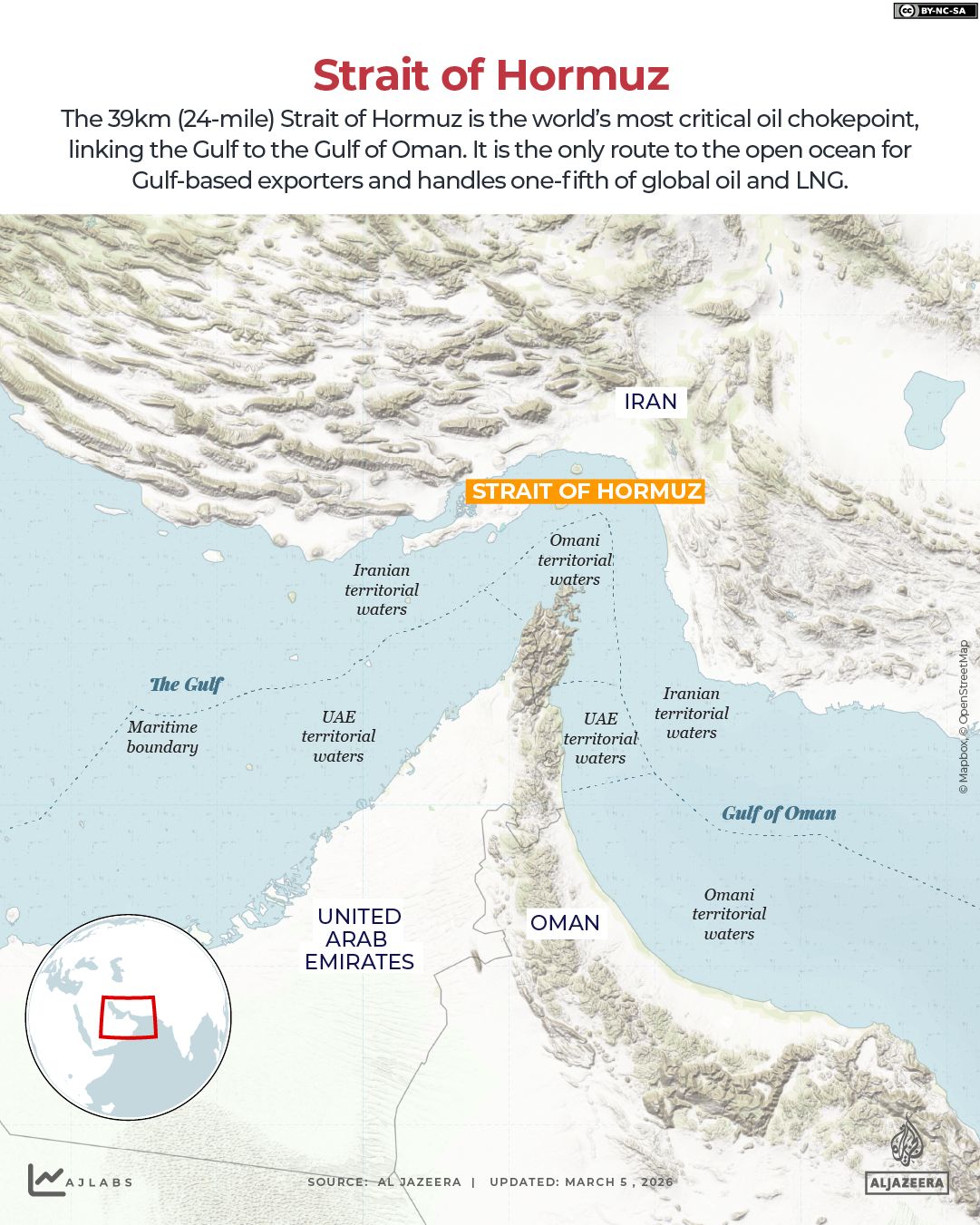
The article examines whether Iran is charging oil tankers for safe passage through the Strait of Hormuz as exports from the Middle East recover despite the US-Israel war on Iran. Provisional Kpler data show regional crude exports exceeded their pre-war average of about 18 million barrels per day on four days during the final week of September, reaching 19.5–22.5 million barrels per day. The article says the increase has been attributed largely to US naval escorts, ship-to-ship transfers, and alternative routes, while high oil prices reflect elevated insurance costs and fears of renewed conflict.
Kpler analyst Michelle Brohard speculated that Gulf countries may be paying Iran a share—perhaps 10 or 20 percent—of cargo value for safe passage. She described a rush to move oil before fighting resumes. The article emphasizes that this claim has not been independently verified. Earlier reporting by Lloyd’s List said Iran’s Islamic Revolutionary Guard Corps had established a system to control vessel traffic, and US officials have opposed any Iranian toll arrangement.
Exports have continued to rise into October. Iraq reported its first crude shipment through the strait in decades, while some oil bypasses Hormuz via pipelines and the Red Sea. Kpler’s figures may omit ships that disable tracking transponders. Iran disputes claims that it has lost control, and an IRGC commander said only a small volume of traffic was using a US-supervised route. Oil prices have eased somewhat but remain above pre-war levels, with continuing security threats—including an incident in which the IRGC told a tanker to turn back.
Experts characterize toll payments as plausible but unproven. One maritime academic considers an informal security arrangement more likely than a formal levy, noting legal concerns under the UN Convention on the Law of the Sea. Other analysts point to sanctions on a digital-assets firm allegedly used to transfer fees to Iran. The article concludes that shipping capacity, freight costs, and uncertain security remain major constraints on oil exports.
Entities: Strait of Hormuz, Iran, US-Israel war on Iran, Michelle Brohard, Kpler • Tone: analytical • Sentiment: neutral • Intent: analyze
05-10-2026
Saudi Aramco CEO Amin Nasser warned that restoring global oil inventories could take as long as two years, even after shipping through the Strait of Hormuz resumes and energy-market confidence improves. Speaking at the Energy Intelligence conference in London, he said the U.S.-Iran war has caused a severe supply disruption and that pressure on oil supply and demand could intensify while the strategically important waterway remains closed or constrained. The strait normally carries about 20% of global oil and liquefied natural gas supplies.
Nasser said nearly 3 billion barrels of oil supply had been lost since the conflict began, while about 1 billion barrels had been drawn from inventories. Most of that drawdown came from commercial stocks. He said roughly 6 billion barrels remaining in storage were “not practically available,” adding that the system was already straining. His warning followed a G7 decision to release 100 million barrels of diesel and crude from emergency reserves.
The article also reports signs of increased crude flows. Oil exports through the Strait of Hormuz and Saudi Arabia’s East-West pipeline were reportedly trending higher, and prices were mixed on Monday. December Brent futures rose 0.7% to $102.92 per barrel, while November U.S. West Texas Intermediate futures fell 0.4% to $90.76.
Separately, the United Kingdom Maritime Trade Operations Centre said a tanker north of Oman was instructed by Iran’s Islamic Revolutionary Guard Corps to turn back or risk being targeted. The tanker complied. Together, the inventory warning, continuing maritime tensions, and uneven recovery in exports point to persistent uncertainty in energy markets.
Entities: Amin Nasser, Saudi Aramco, Strait of Hormuz, U.S.-Iran war, Energy Intelligence conference • Tone: analytical • Sentiment: negative • Intent: inform
05-10-2026
Middle East crude oil exports excluding Iran recovered to, and on several days exceeded, their pre-war levels in the final week of September, despite continued attacks on ships near the Strait of Hormuz. Kpler data showed exports topped the pre-war average of about 18 million barrels per day on four days, reaching between 19.5 million and 22.5 million barrels per day. The recovery followed a sharp disruption after the strait closed at the start of the Iran war: Kpler reported that the seven-day average of non-Iranian crude exports from the region fell by 72% in just 10 days.
Exporters have adapted by routing oil around the strait and transferring cargo between vessels. In September, approximately 40% of crude left the Gulf without passing through Hormuz, up from 17% before the war. More than 70% of crude reportedly changed tankers offshore in the Gulf of Oman in August, a practice that had been almost absent before the conflict. Saudi Arabia also increased shipments through the Red Sea, while the United Arab Emirates used its pipeline to Fujairah. The region’s main crude exporters include Saudi Arabia, the UAE, Iraq and Iran, though Iran is a notable exception to the overall rebound: its exports remain far below their pre-war average, primarily because of US policies.
The article emphasizes that recovering export volumes have not eliminated security risks. At least seven incidents involving vessels around Hormuz were reported in recent weeks. On October 1, the tanker Kazimah III was reportedly hit by an unknown projectile, according to maritime intelligence firm Marisks; its crew was evacuated safely. Overall, the report describes a significant logistical adjustment that has restored much of the region’s oil-export flow while attacks and disruption continue.
Entities: Strait of Hormuz, Iran war, Kpler, Saudi Arabia, United Arab Emirates (UAE) • Tone: analytical • Sentiment: neutral • Intent: inform
05-10-2026
Iranian officials insist that the country retains full control of the Strait of Hormuz, while linking the restoration of shipping to the removal of hostile measures and acceptance of Tehran’s conditions. Foreign Minister Abbas Araghchi said the strait could be fully reopened and shipping restored within seven days if those conditions were met. Parliament Speaker Mohammad Bagher Ghalibaf said Iran would not open it until seven conditions based on the Islamabad memorandum were satisfied, rejecting what he described as one-sided demands from Washington. The statements come amid continuing attacks in and around the strait and the Gulf of Aden, with the UK Maritime Trade Operations agency reporting at least one attack per day since 2 October.
The article also describes mounting economic pressure on Iran. The rial reached record lows against the euro and US dollar, with the dollar exceeding 270,000 tomans on the informal market—more than twice its value at the beginning of the year. Oil Minister Mohsen Paknejad resigned, officially citing personal and family reasons, as speculation grew that falling exports could no longer meet the state’s financial needs. A new acting oil minister pledged to maximise production and continue exports through new strategies.
US Treasury Secretary Scott Bessent said Iran had not loaded any crude oil onto tankers in September, presenting the US administration’s pressure campaign as cutting off a vital source of revenue. Iranian President Masoud Pezeshkian had acknowledged that the blockade was disrupting exports. Meanwhile, Kpler data showed crude exports from the rest of the region remained above their pre-war average during the final week of September. Iranian military figures also issued warnings about the consequences of renewed conflict with Israel, while Araghchi argued that negotiations based on justice and fairness—not military confrontation—were the route to ending the conflict.
Entities: Iran, Strait of Hormuz, Abbas Araghchi, Mohsen Paknejad, Scott Bessent • Tone: analytical • Sentiment: negative • Intent: inform
05-10-2026
Persian Gulf oil exports rose back above pre-war levels on 14 days in September, according to shipping data, though continued tanker attacks and logistical limits make it uncertain whether the higher flows can be sustained. Kpler reported that the region’s seven-day average crude exports reached 18.3 million barrels per day on September 30. Before the U.S.-Israeli war with Iran began, exports averaged about 18 million barrels per day over 12 months. The September total included oil shipped through the Strait of Hormuz, via the Red Sea, and through Gulf of Oman terminals and ship-to-ship transfers.
Saudi Arabia drove much of the increase, loading crude from both the Red Sea and the Gulf after an attack on its East-West pipeline on September 10. The higher flows have required additional supertankers to pass through Hormuz, while ship-to-ship transfer capacity in the Gulf of Oman has reportedly reached its limits. Iraq has also arranged for tankers to load Basrah crude inside the strait after securing Iranian permission for Iraqi oil tankers to transit it.
Vortexa likewise reported a recovery in regional flows, with its 14-day average for Middle East crude and condensate exports reaching 18.6 million barrels per day—above the 10-year seasonal average and back to pre-conflict levels. Analyst Xavier Tang said Saudi Arabia was increasing exports to regain market share, and that additional supplies could ease tightness in the oil market, particularly for Asian refiners. Liquefied natural gas shipments through Hormuz also reached their highest level since February in September.
The recovery is unfolding amid serious security risks. Marisks reported at least seven tanker-related incidents in the prior week, including attacks that damaged the Kazimah III and Lipsi; crews were reported safe. The UK Maritime Trade Operations agency had reported at least one attack daily in the Strait of Hormuz or Gulf of Aden since October 2. Marisks cautioned that incidents may reflect missiles targeting a defined engagement area rather than deliberate attacks on individually selected vessels. The article ends mid-sentence while beginning to compare current traffic with conditions before the war.
Entities: Persian Gulf oil exports, Strait of Hormuz, Iran war, Saudi Arabia, Iraq • Tone: analytical • Sentiment: neutral • Intent: inform
05-10-2026
Persian Gulf oil exports briefly rose above pre-war levels in late September, averaging 18.3 million barrels per day, according to ship-tracking network Kpler. The increase followed Saudi Arabia’s use of loading facilities on both the Persian Gulf and Red Sea, as well as pipelines that helped reduce pressure on the Strait of Hormuz. The figure was slightly higher than the 18 million barrels per day exported in the year before the United States and Israel went to war with Iran. Exports have since slowed as threats to shipping have intensified.
Maritime intelligence company Marisks described a heightened and increasingly unpredictable threat to vessels. Seven attacks were reported in the past week, and the UK Maritime Trade Operations agency said at least one attack per day had occurred in the Strait of Hormuz or Gulf of Aden since Friday. Marisks said the incidents might not reflect deliberate attacks on individually selected merchant ships; it suggested Iranian forces could be firing into a predetermined area where missiles might lock onto available radar signatures. Before the war, about 20% of the world’s crude oil and liquefied natural gas passed through the Strait of Hormuz.
Separately, Yemen’s information minister said government forces backed by Saudi Arabia had taken key positions at the narrowest part of the Bab el-Mandeb Strait from the Iran-backed Houthis. The Houthis denied the claim as “completely untrue,” while fighting continued across Yemen’s front lines. The conflict’s spillover from Iran has heightened tensions, with the Houthis seeking control of the strategic strait and targeting Saudi infrastructure. The fighting has worsened Yemen’s humanitarian crisis, displacing about 184,000 people, according to a UN agency. President Rashad al-Alimi vowed to fight until the country was free of the Houthi militia. In the United States, the average gasoline price was $4.37 a gallon on Monday, up 33% from a year earlier, AAA said.
Entities: Persian Gulf oil exports, Strait of Hormuz, Bab el-Mandeb Strait, Iran, Saudi Arabia • Tone: analytical • Sentiment: negative • Intent: inform
05-10-2026
The article reports that oil producers are offering sailors as much as $25,000 for round trips through the Persian Gulf and Strait of Hormuz, where commercial vessels face strikes and drone attacks amid the Iran war. The payments can equal two or three months of a sailor’s usual pay and, for lower-level workers such as oilers and cadets, may exceed an annual salary. Producers are using very large crude carriers on “shuttle runs”: ships enter the Gulf, load oil, exit through the strait, and transfer their cargo to another vessel outside the waterway. Although the trips are dangerous and costly, producers appear willing to accept thinner profit margins rather than leave oil trapped in the Gulf.
Kpler data showed crude exports through the Strait of Hormuz reached 16.5 million barrels per day in September, up from a low of 5 million barrels per day in March, shortly after the war began. Meanwhile, nine commercial vessels were attacked near the strait over a two-week period, leaving two people injured and one seafarer dead, according to maritime authorities. Some crews reportedly travel at night with windows closed, lights off, and GPS signals disabled.
The risks and demand for transport have driven up shipping costs. In late September, hiring a supertanker to carry oil to China cost more than $1.2 million per day, compared with $231,400 the day before the war and under $40,000 per day in January. Producers reportedly pay $30 million to $40 million for a round trip, generating record profits for shipowners as well as unusually high earnings for sailors.
The article also connects the disruption to fuel prices and politics. Brent crude and West Texas Intermediate prices eased as Gulf exports accelerated, while US gasoline and diesel prices remained above $4 and $6 per gallon, respectively. The G7 agreed to release 100 million barrels of diesel and crude from stockpiles, though experts cautioned that the move might do little to lower US pump prices. President Trump was also expected to issue an order expanding access to tax-exempt diesel.
Entities: Persian Gulf, Strait of Hormuz, Iran war, Sailor risk payments, Very large crude carriers (VLCCs) • Tone: analytical • Sentiment: negative • Intent: inform
05-10-2026
Saudi Arabia’s East-West oil pipeline is reportedly operating normally, according to people familiar with the matter, despite an earlier report that it had been shut after a new attack. The AFP report, published on October 5 and citing an unnamed person in Saudi Arabia’s energy sector, said a pumping station along the route was struck over the weekend. Sources quoted in the article said oil continued to flow, while Saudi Aramco and the Energy Ministry had not immediately responded to requests for comment.
Oil prices rose by as much as 1.2% after the AFP report, then eased after reports that the pipeline remained operational. The seven-million-barrel-a-day conduit had been carrying more than 80% of capacity by late the previous week. Aramco had increased its use following drone attacks launched from Iraq in September, which had disrupted the pipeline.
The route has become strategically important during the Iran war because it allows oil to reach the Red Sea without depending on shipments through the Strait of Hormuz. After supplying refineries on Saudi Arabia’s west coast, about 4.5 million barrels a day were available for export as of the previous week, according to a source familiar with the matter.
However, the Red Sea shipping route and Saudi infrastructure on the west coast have faced growing risks from attacks by Yemen’s Houthi militants. The article also notes an escalation in Yemen’s conflict: the internationally recognised government launched a full-scale military campaign to retake territory held by the Houthis after weeks of increasing hostilities involving the militant group and Saudi Arabia.
Entities: Saudi Arabia, East-West oil pipeline, Saudi Aramco, Saudi Energy Ministry, AFP • Tone: analytical • Sentiment: neutral • Intent: inform