02-10-2026
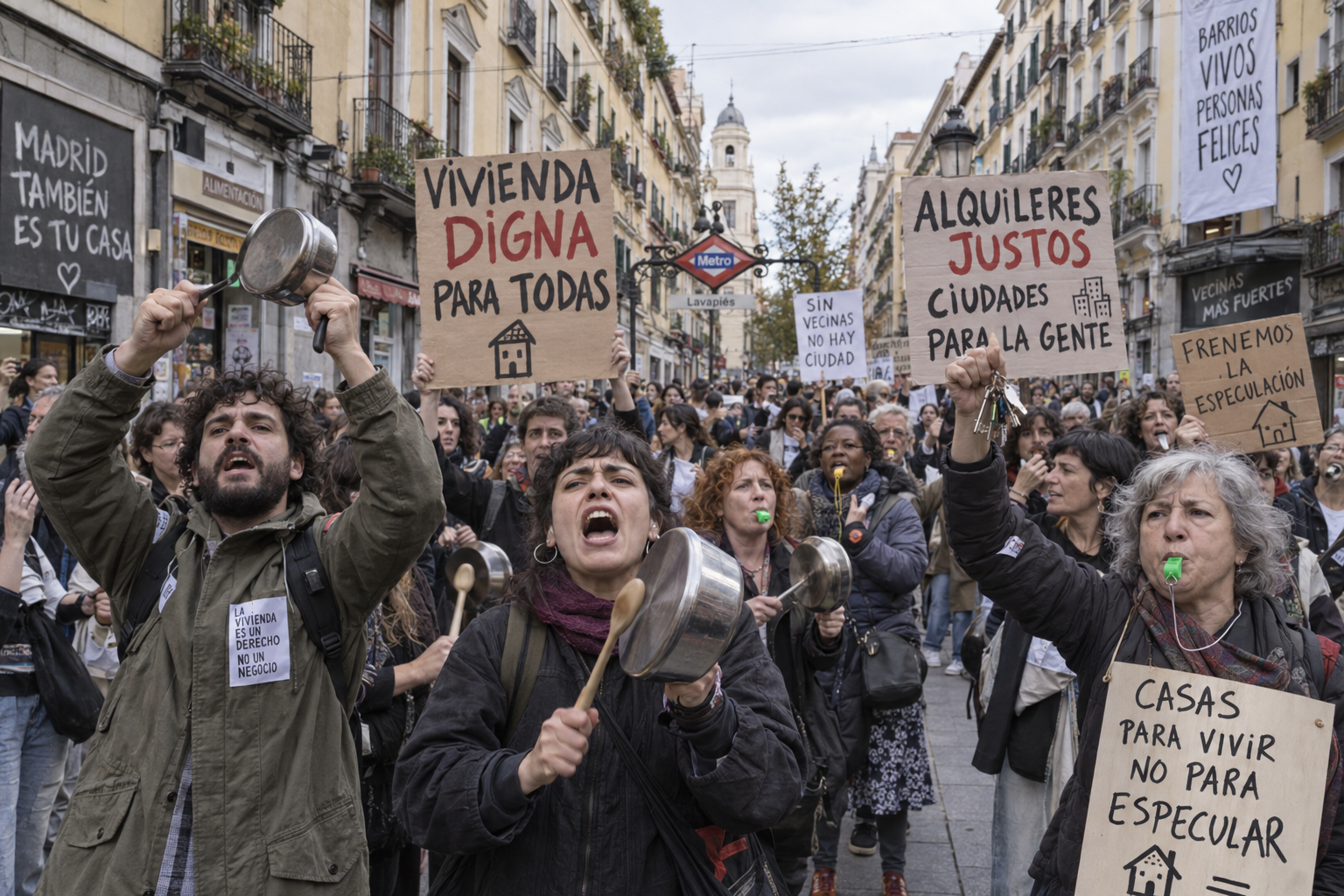
The article reports that hundreds of people across Spain staged pot-banging demonstrations to demand political action on the housing crisis. Protesters raised concerns about soaring rents, evictions and the shortage of affordable housing. The demonstrations took place ahead of a parliamentary vote scheduled for Friday on proposed measures intended to strengthen tenant protections. The report frames the protests as a public appeal for action while lawmakers were preparing to consider those measures. It does not specify which cities hosted demonstrations, describe the proposed protections in detail, identify individual protesters or political figures, or provide the outcome of the vote. Nor does it state whether the demonstrations changed the government’s position. The account is brief and focused on the protest’s demands and timing: people used the distinctive tactic of banging pots to draw attention to housing pressures, while an upcoming parliamentary decision offered a potential policy context for their demands. Overall, the article documents a protest mobilization around rents, evictions and affordable housing in Spain, and notes that the demonstrations occurred just before a vote on tenant protections. It provides no further background or reaction from officials, landlords or tenants, so the report supports a concise description of the event rather than a fuller assessment of the housing situation or the likely effects of the proposed measures.
Entities: Spain, Al Jazeera, Housing crisis, Pot-banging protests, Soaring rents • Tone: neutral • Sentiment: neutral • Intent: inform
02-10-2026
Several hundred people protested in Madrid and other Spanish cities ahead of a Friday vote on two government housing decrees. Spanish lawmakers were expected to decide whether to approve the measures, which had been drawn up after public outrage over the eviction of an 87-year-old woman. The article says the decrees’ passage was in doubt, but does not identify the specific provisions, explain which lawmakers or parties opposed them, or describe what would happen if they failed to pass.
The demonstrations were loud and conspicuous: protesters rattled keys, blew whistles and struck spoons against pots. The report presents these actions as signs of public protest over housing and the eviction that prompted the government response. It does not provide statements from demonstrators, officials or the woman, nor does it give details about the eviction or the scale of the demonstrations beyond “several hundred” participants.
The report’s focus is the timing of the protests—on the eve of a key parliamentary vote—and the uncertainty surrounding the decrees. It establishes that the eviction had triggered an outcry and that demonstrations took place in multiple cities, but offers little further context on Spain’s housing policy or the political debate. The available article text is a short video-news description rather than a full account, so the measures’ likely effects and the outcome of the vote are not included.
Entities: Spain, Madrid, Spanish lawmakers, France 24, government housing decrees • Tone: neutral • Sentiment: negative • Intent: inform
02-10-2026
Spain’s minority left-wing government faced a difficult parliamentary vote on housing measures after Junts, a Catalan separatist party whose seven lawmakers are important to the government’s legislative support, opposed the plans. The proposals include extending a ban on evicting vulnerable tenants until 2030, freezing rents on existing leases for two more years, and tightening rules for short-term rentals. Junts argues the measures could reduce housing supply and make it harder to find a home. A separate decree allowing automatic, indefinite renewal of rental contracts—one of protesters’ central demands—was already expected to fail for lack of support. The dispute has intensified amid widespread anger over housing costs and the eviction of 87-year-old Maricarmen Abascal. Her eviction prompted protests across Spain, including a week-long tent encampment in central Madrid. Rents have doubled over the past decade, reaching an average of €1,176 a month—nearly the average salary of a young person, according to Spain’s Youth Council. Protesters and tenant advocates say political leaders are not responding to the public’s concerns, while Abascal’s lawyer called for structural solutions. The government’s position is complicated by opposition from other parties and elections expected next year. Spanish media have reported that Prime Minister Pedro Sánchez could call a snap election in November if the main decree fails. Political scientist Alejandro Quiroga said an election could allow Sánchez to take the initiative and shift debate away from the government’s handling of the migrant crisis in Ceuta. The article portrays a widening conflict between efforts to address housing insecurity, concerns that regulation could worsen supply, and political calculations around a possible election.
Entities: Pedro Sánchez, Maricarmen Abascal, Miriam Nogueras, Beatriz Duro, Junts • Tone: analytical • Sentiment: negative • Intent: inform
02-10-2026
Spain’s Congress rejected two housing decree-laws put forward by Prime Minister Pedro Sánchez’s government, leaving it without two key measures intended to address the country’s housing crisis. The votes followed last-minute negotiations and exposed the government’s difficulty securing support from parliamentary partners. Sánchez urged MPs to back the measures, warning that history would judge them harshly, but the first decree was defeated 172–178 and the second was also rejected.
Housing Minister Isabel Rodríguez had appealed to Junts per Catalunya to support the bills or abstain, arguing that one decree incorporated many of Junts’ proposals and promising that the measures could later be processed as legislation with technical changes. Junts opposed both texts after the PSOE declined to withdraw them, as the party had demanded. Other parties took mixed positions: the PNV supported one decree with reservations, Coalición Canaria backed the first, Podemos supported both while criticizing the government’s approach, and EH Bildu voiced anger at the prospect of particular interests prevailing. The PP and Vox also opposed the measures.
The debate took place as hundreds of people gathered outside Congress to demand a response to the housing crisis, which had been brought into sharp focus by Maricarmen’s eviction. A separate protest, mobilized by the Tenants’ Union, included criticism of several parties, and police maintained a substantial security presence.
The failed votes also intensified discussion within the PSOE and government about whether Sánchez might call an early election. La Moncloa said no decision had been made, while some Socialist figures urged caution. The government had framed the vote as a test of Congress’s ability to reach agreement on a major social problem, but the outcome highlighted the coalition’s lack of an absolute majority and the narrow parliamentary arithmetic it faces.
Entities: Pedro Sánchez, Isabel Rodríguez, Maricarmen’s eviction, Congress of Deputies, Spain • Tone: analytical • Sentiment: negative • Intent: inform