03-09-2026
Tensions are mounting in Ceuta, Spain’s North African enclave, following a large migrant influx that has placed pressure on local resources and intensified public anger. More than 70,000 migrants crossed into the territory in late July, although most have since departed. At least 5,000 people remain, with many living in makeshift camps on the beach and facing homelessness while they await decisions about whether they can stay in Europe.
The article focuses particularly on Moroccan nationals, who say they are being denied the opportunity to apply for asylum. One migrant argues that people from several African and Arab countries—including Yemen, Sudan, Egypt, Algeria, and Tunisia—have been able to seek asylum, while Moroccans have not. The migrants are therefore calling for equal access to the asylum process and permission to remain in Europe.
The influx has also provoked a backlash among Ceuta residents, who say that the continuing presence of thousands of migrants is straining public services and resources. Anti-immigrant protests have reportedly spread across Spain. The situation has overshadowed Ceuta’s annual holiday on September 2, which would ordinarily be a day of celebration.
Prime Minister Pedro Sanchez has accused right-wing social media accounts of attempting to exploit the crisis. He said that many of those accounts are reportedly linked to Russia and Israel, adding a political and information-warfare dimension to the controversy. Overall, the article presents a deteriorating humanitarian and political situation involving homelessness, contested asylum rights, local resource pressures, and rising anti-immigrant sentiment.
Entities: Ceuta, Spain, Moroccan migrants, Africanews, Associated Press (AP) • Tone: analytical • Sentiment: negative • Intent: inform
03-09-2026
Ceuta, a small Spanish territory on Morocco’s northern coast, became the focus of Spain’s worst border crisis in decades after a mass arrival of migrants in late July. Instead of marking its annual Sept. 2 holiday with celebrations, the city saw protests, while tens of thousands of people demonstrated across Spain against the humanitarian situation and the government’s response.
Authorities estimated that about 50,000 people protested in Madrid, with large demonstrations also held in Barcelona, Valencia and Seville. Protesters waved Spanish flags, criticized Prime Minister Pedro Sánchez and demanded that migrants leave Ceuta. Police reportedly used rubber bullets and tear gas after the Madrid demonstration, and an Associated Press journalist heard shots and explosions.
The protests highlighted anger over the sudden influx of approximately 72,000 people who swam, climbed or charged across the border from Morocco in late July. At least 90 people died. Although most migrants were returned or sent back across the border, roughly 5,000 people, including 1,200 minors, remained in Ceuta weeks later. Local officials gave a higher estimate than the national government and accused Madrid of ignoring warnings before the border breach.
The crisis has also prompted questions about Morocco’s role and the causes of the mass crossing. Sánchez has defended Morocco, saying its authorities helped return migrants, and has blamed social-media disinformation and a misinterpretation of a Supreme Court ruling for encouraging the rush. He further accused accounts linked to Russia and Israel, along with right-wing groups, of amplifying the crisis, but offered no evidence and was contradicted by both countries. Spain’s territorial policy minister said the demonstrations were primarily an attack on the national government rather than a show of solidarity with Ceuta.
Entities: Ceuta, Spain, Morocco, Pedro Sánchez, Ángel Víctor Torres • Tone: analytical • Sentiment: negative • Intent: inform
03-09-2026
The article reports that tens of thousands of people took part in rallies across Spain in response to the migrant crisis involving Ceuta, the Spanish territory on Morocco’s northern border. According to the report, protesters expressed support for Ceuta and criticized the Spanish government’s handling of the situation. Demonstrators also accused Morocco of being involved in the surge of migrants at the border, though the supplied article text does not provide evidence, official responses, or further details about that allegation.
The report presents the demonstrations as a nationwide expression of concern over migration, border management, and the political status and security of Ceuta. It does not identify specific protest organizers, cities, government officials, or the number of participants at individual rallies. Nor does it explain the causes, timing, or scale of the migrant movement beyond describing it as a “border surge.”
The item is presented as a short Al Jazeera Newsfeed video report published on September 3, 2026. Its focus is on the public reaction in Spain rather than on the migrants’ circumstances, government policy details, or Morocco’s position. The wording attributes the criticism and accusations to protesters rather than presenting them as independently verified facts. Overall, the report is a concise account of mass demonstrations connected to the Ceuta migrant crisis and the resulting dispute over Spain’s and Morocco’s roles in managing the border. Because the provided content is brief, it offers limited context about what prompted the rallies, how authorities responded, and what consequences the protests may have had.
Entities: Spain, Ceuta, Morocco, Al Jazeera, migrant crisis • Tone: neutral • Sentiment: neutral • Intent: inform
03-09-2026
Thousands of people protested across Spain on September 2 against the continuing migrant and asylum-seeker crisis in Ceuta, a Spanish territory on the North African coast. About 50,000 people reportedly gathered in Madrid, while residents in Ceuta displayed Spanish and city flags and took part in demonstrations featuring nationalist chants. The protests coincided with Ceuta Day, a holiday commemorating the city’s 15th-century Portuguese takeover, and occurred just over a month after more than 70,000 migrants and asylum seekers crossed from Morocco into the territory on July 30 and 31. At least 80 people died during the mass crossing.
Although many arrivals have since returned to Africa, thousands remain in Ceuta. The Spanish government estimates that around 5,000 people are still there, including 1,200 minors, while local authorities report a higher figure. Some migrants are sleeping on beaches. The government has expanded emergency accommodation, increased social-service funding and pledged €309m in aid, but critics say the response is insufficient.
The prolonged crisis has contributed to violence, including fights, the stoning of a military patrol, alleged sexual assaults, clashes between residents and police, and the burning of migrants’ belongings. It has also deepened political divisions. Ceuta’s conservative regional leader, Juan Jesús Vivas, described the influx as a threat to Spain’s territorial integrity, while national government minister Ángel Víctor Torres accused conservative and far-right opponents of exploiting the situation. Prime Minister Pedro Sánchez blamed the surge on a misunderstood court ruling and online disinformation, including amplification by Russian- and Israeli-linked accounts, though he provided no public proof.
The article also highlights the migrants’ varied circumstances. Some, including Otman Ianaya and his family, are seeking economic opportunity, while others are fleeing persecution. Aid worker Halima Ahmed urged residents to show empathy while condemning violence against migrants.
Entities: Ceuta, Spain, Morocco, Spanish government, Pedro Sánchez • Tone: analytical • Sentiment: negative • Intent: inform
03-09-2026
Spanish Prime Minister Pedro Sánchez is facing mounting political pressure over the July influx of about 72,000 migrants into Ceuta, Spain’s North African exclave. Speaking in parliament after large demonstrations across Spain, Sánchez rejected claims that his government had been warned in advance and deliberately failed to act, calling that suggestion “absurd.” He also said there was no verified evidence that Morocco organized the crossing, while emphasizing that Spanish and Moroccan authorities had closely coordinated the return of more than 90% of the migrants within 72 hours.
The government’s position is challenged by a police report commissioned by a High Court judge. The report described “total permissiveness” by Moroccan security forces, saying they made no serious attempt to halt the influx and may even have guided some migrants. Opposition leader Alberto Núñez Feijóo accused Sánchez of lying and covering up what happened, arguing that Morocco had consented to or coordinated the operation and that Spain had received prior warnings.
Although most migrants were returned, around 5,000 remain in Ceuta, including up to 1,400 children. Reports of sexual assaults and violence have added to the humanitarian and logistical strain. The crisis has also caused friction with European partners, with Italy imposing restrictions on arrivals from Spain.
Sánchez is attempting to balance criticism of Morocco with the need to preserve bilateral relations. He condemned recent Moroccan claims to Ceuta and Melilla but said he would rely only on proven facts. He described Ceuta as Spanish territory and part of Europe, and announced that King Felipe VI would visit both enclaves. Sánchez also blamed trafficking networks, social-media misinformation and what he called an international far-right movement for aggravating the crisis, while denying evidence of state involvement. The episode has therefore developed from a migration emergency into a major political challenge for the Socialist prime minister.
Entities: Pedro Sánchez, Alberto Núñez Feijóo, King Felipe VI, Abdellatif Ouahbi, Ceuta • Tone: analytical • Sentiment: negative • Intent: inform
03-09-2026
Tens of thousands of people demonstrated across Spain over the continuing migration and border crisis in Ceuta, a Spanish enclave in North Africa. The protests took place on Ceuta’s annual official holiday, which was marked this year by social unrest rather than celebrations. Authorities estimated that approximately 50,000 people attended the rally in Madrid, while demonstrations were also held in Barcelona, Valencia, Seville, and more than 200 other cities and towns.
The rallies were organized by the nonpartisan Spanish Federation of Municipalities and Provinces, but Spain’s conservative and far-right opposition used them to criticize Prime Minister Pedro Sánchez’s left-wing government. Opponents accused the government of abandoning Ceuta and pursuing an overly conciliatory policy toward Morocco. Territorial Policy Minister Ángel Víctor Torres rejected those claims, arguing that the protests were primarily intended to attack the government. He pointed to the government’s allocation of €309 million for Ceuta’s social services, migrant housing, and security infrastructure.
Tensions escalated after the Madrid rally, with reports of shots and explosions. El País reported that police used rubber bullets and tear gas to disperse crowds. Counter-demonstrations opposing racism were also reportedly held in some cities.
A month after a large influx of migrants from Morocco, Ceuta remained far from normal. Many migrants, including unaccompanied minors, were still sleeping on streets and beaches while authorities attempted to provide shelter, register arrivals, and return eligible migrants to Morocco. Estimates indicated that between 5,000 and 8,000 migrants remained in the territory. Ceuta’s leader, Juan Jesús Vivas, called for stronger border controls rather than reliance on cooperation with Morocco. Sánchez said the government was using all available resources to restore calm. The crisis has revived broader debate over migration policy across the European Union.
Entities: Ceuta, Spain, Morocco, Madrid, Prime Minister Pedro Sanchez • Tone: analytical • Sentiment: negative • Intent: inform
03-09-2026
Tens of thousands of people protested across Spain on Wednesday, September 2, 2026, over the government’s handling of a mass migrant crossing into Ceuta, Spain’s North African enclave. Authorities estimated that approximately 50,000 demonstrators gathered in Madrid alone, while protests also took place elsewhere in the country. Demonstrators expressed anger at Prime Minister Pedro Sánchez and carried signs such as “Sánchez to prison” and “Invaders — go home!”
The protests followed the arrival of more than 70,000 foreign migrants from neighboring Morocco in late July. Thousands reportedly remain in Spanish territory. Ceuta’s regional leader, Juan Jesús Vivas, rejected the characterization of the event as an ordinary migration crisis, describing it instead as a violation of Spain’s territorial integrity.
Tensions escalated after Ceuta residents destroyed and burned makeshift migrant shelters near the city’s beaches. Police attempted to separate protesters from migrants as fires were set and shelters were dismantled. Violence reportedly continued for hours after the main demonstrations, with gunshots and explosions heard overnight.
Sánchez has blamed Russia and Israel, along with far-right networks, for amplifying the crisis through social media and spreading disinformation. He said research by the European External Action Service suggested that Russian and Israeli networks helped circulate misleading information connected to the border surge, which he attributed in part to a misinterpretation of a Spanish Supreme Court ruling.
Russia rejected the accusation, with Foreign Ministry spokesperson Maria Zakharova demanding evidence. Israeli Foreign Minister Gideon Sa’ar accused Sánchez of lying and attempting to divert attention from domestic policy problems. The dispute has therefore developed into both a border-security crisis and a political confrontation over migration, disinformation, and the government’s response.
Entities: Spain, Ceuta, Pedro Sánchez, Morocco, Juan Jesús Vivas • Tone: urgent • Sentiment: negative • Intent: inform
03-09-2026
The report concerns the political and security debate surrounding a mass influx of migrants into Ceuta, the Spanish enclave on Morocco’s northern border, in July. Spanish Prime Minister Pedro Sanchez told lawmakers on Thursday that there was no evidence Morocco had organized or directed the movement of migrants into the territory. His statement was made in response to a police report that became public earlier in the week.
According to the police report, the incident was not a spontaneous migration event. Instead, investigators characterized it as a planned and phased operation intended to overwhelm border controls. The report therefore raised questions about whether the influx was coordinated and whether Moroccan authorities or other actors may have played a role. Sanchez, however, said there was no proof establishing Morocco’s responsibility.
The article presents the contrast between the police assessment of the operation and the prime minister’s more cautious public position. While the police report reportedly described a deliberate strategy to breach or overload Ceuta’s defenses, Sanchez declined to endorse the conclusion that Morocco was behind it. His comments indicate that the Spanish government does not consider the available information sufficient to make such an attribution.
The short video report does not provide further details about the police investigation, the number of migrants involved, Morocco’s response, or any diplomatic consequences. It focuses instead on Sanchez’s denial that there is evidence linking Morocco to the border surge and on the report’s characterization of the event as coordinated rather than spontaneous.
Entities: Ceuta, Morocco, Spain, Pedro Sanchez, Spanish government • Tone: analytical • Sentiment: neutral • Intent: inform
03-09-2026
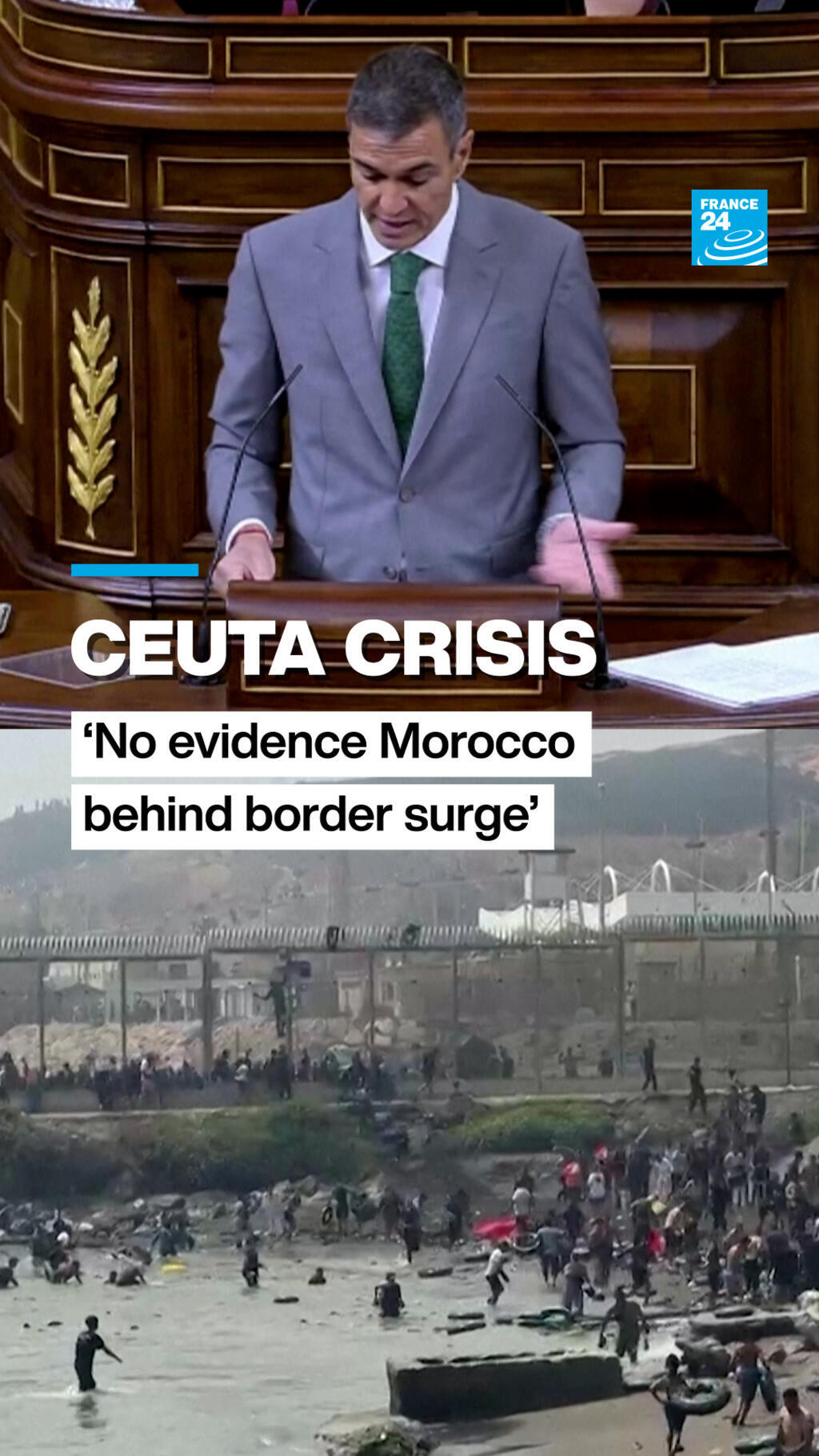
A France 24 video report examines Spanish Prime Minister Pedro Sánchez’s response to the migrant crisis in Ceuta, the Spanish enclave on Morocco’s northern coast. Sánchez told Spanish lawmakers that there was no “solid proof” that Morocco’s government had deliberately planned or orchestrated the large-scale influx of migrants into Ceuta. His comments followed protests across Spain, involving tens of thousands of people who criticized the government’s handling of the situation and questioned its response to the border crisis.
The report describes the influx as involving migrants crossing from Morocco into Spanish territory both on foot and by sea. Sánchez acknowledged that the events created two simultaneous challenges: a humanitarian crisis requiring an immediate response and an administrative challenge involving border management, public services, and relations with Morocco. However, he rejected the conclusions of a police report that appeared to attribute responsibility for the crisis to Morocco’s authorities.
The political dispute centers on whether the crossings were an unmanaged humanitarian emergency or a deliberate pressure tactic by the Moroccan government. Sánchez’s position was that the available information did not establish the latter claim. The report presents his remarks amid domestic criticism and public demonstrations, while France 24 correspondent Sarah Morris provides reporting from Madrid. The accompanying footage was recorded in Ceuta and shows Sánchez making statements during the crisis. Overall, the report focuses on the Spanish government’s interpretation of the events, the lack of conclusive evidence concerning Morocco’s role, and the political consequences of the migrant influx in Spain.
Entities: Pedro Sánchez, Spain, Ceuta, Morocco, France 24 • Tone: analytical • Sentiment: negative • Intent: inform
03-09-2026
Spanish prime minister Pedro Sánchez told parliament that Spain has no evidence that Morocco planned or facilitated the mass border breach into Ceuta in late July. His statement followed the publication of a police report, commissioned by a judge, which reportedly claimed that Moroccan border forces helped approximately 70,000 people cross into the Spanish territory. Sánchez said that neither Spanish diplomatic authorities, the European Commission nor any international body had supplied solid evidence implicating the Moroccan government. He also denied that Spain had received advance warnings about the scale or likelihood of the incident.
Sánchez has continued to defend cooperation with Rabat, noting that Morocco helped return most migrants after the crossing. However, he acknowledged that Moroccan forces allowed crossings during a crucial 10-hour period and said Spain had summoned Morocco’s ambassador over statements renewing Moroccan sovereignty claims over Ceuta and Melilla. Moroccan officials have denied enabling the breach.
The crisis has generated intense political criticism in Spain. Conservative leader Alberto Núñez Feijóo called for Sánchez’s resignation, while Vox leader Santiago Abascal accused him of acting as Morocco’s ambassador. The episode has also created a humanitarian emergency, with as many as 141 people reportedly dying while attempting to reach Ceuta and thousands still believed to be there, including at least 500 minors. Most arrivals returned to Morocco within 24 hours, but others remain in makeshift shelters or on the streets, amid hostility and deprivation.
Sánchez appealed for European solidarity and defended migrants’ rights under Spanish, European and international law, rejecting calls for indiscriminate returns. The government is expected to expand accommodation facilities in Ceuta rather than transfer the remaining migrants to mainland Spain. Sánchez argued that economic disparities between Ceuta and Morocco would continue to drive attempts to cross the border, even if stronger physical barriers were constructed.
Entities: Pedro Sánchez, Spain, Morocco, Ceuta, Melilla • Tone: analytical • Sentiment: negative • Intent: inform